Shepard Fairey — OBEY Collage: A Collector's Guide
A city wall, compressed into a single sheet.
Torn paper. Stenciled icons. Weathered texture. Posters pasted, ripped, and pasted again.
This is Shepard Fairey's OBEY Collage, a hand-signed and numbered screen print, 133/300. This guide covers what the image is built from, why the collage mode matters in Fairey's practice, how the numbered edition works, and what to check before you buy.
View this piece at Gauntlet Gallery →
What you are actually looking at
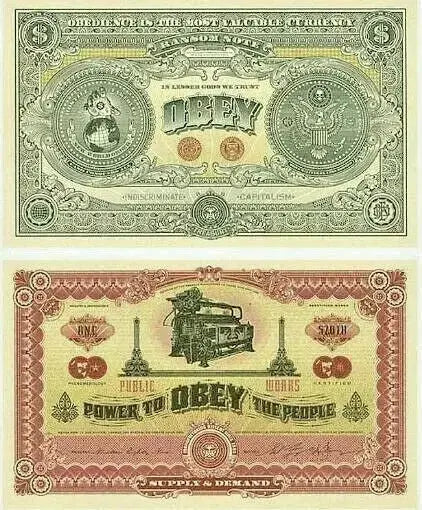
This is Fairey working in one of his most characteristic modes: layering torn paper, stenciled iconography, weathered textures, and the recurring OBEY GIANT motifs into a single dense composition.
The effect deliberately mimics the accreted surface of a city wall — the place where posters have been pasted, ripped, and pasted again until the wall becomes a palimpsest of competing messages. That is a direct nod to the street-poster origins of Fairey's practice, and to the way public space records the argument between everyone trying to claim it.
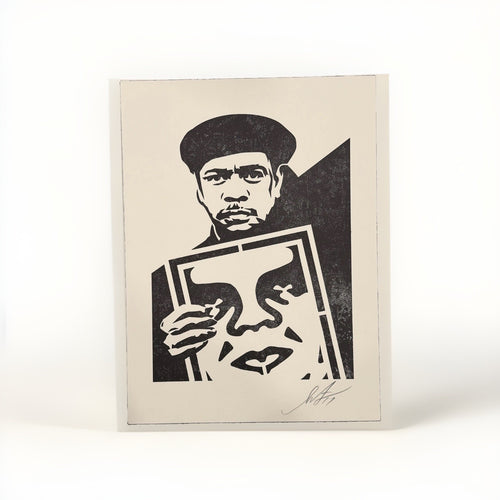
Within the collage the eye finds Fairey's core vocabulary: the Andre face, the star, the ornamental frames. They are arranged to feel simultaneously improvised and rigorously designed — the controlled accident that only looks casual. It rewards close looking; fragments keep emerging out of the visual density the longer you sit with it.
Accumulation as the subject
Most Fairey prints put a single figure at the center and build the ornament around it. OBEY Collage inverts that. Here the subject is the accumulation — the piece is about history, repetition, and how images gain power by being layered over one another.
That is a real statement about how Fairey's own iconography works. The Andre face did not become one of the most recognizable marks in street art through a single perfect image; it became powerful through relentless repetition across public space. A collage that stacks that face over itself, half-torn and re-pasted, is Fairey telling you exactly how the OBEY project achieved its saturation.
Shepard Fairey, in one paragraph
Shepard Fairey (b. 1970) is one of the most influential American artists of his generation. He emerged from the 1990s skateboarding and street-art scene with his OBEY Giant campaign — an experiment in propaganda and public space that grew into a global visual language. His 2008 Barack Obama “Hope” portrait became one of the most recognizable political images in modern history. His work is held by the Museum of Modern Art, the Victoria & Albert Museum, LACMA, and the Smithsonian. New editions release through his OBEY studio and routinely sell out and trade on the secondary market.
The edition and how it reached the market
This is a screen print on cream Speckletone paper, hand-signed and numbered 133/300 in pencil by Fairey.
A numbered edition of 300 is a defined, finite run. The fraction — 133 of 300 — tells you the sheet's position within that run, and it is one of the first things a collector checks. On a collage image this dense, the hand-pulled screen-print process is part of the appeal: the layering that reads as torn-and-pasted texture is built up in flat printed passes, not photographed. The pencil signature and numbering together are the primary marks of a genuine signed impression.
Authentication: what actually backs a Fairey
This is the part collectors most often get wrong, so read it carefully.
Shepard Fairey does not issue an artist certificate of authenticity, and there is no third-party authentication board for his work — no Fairey equivalent of Banksy's Pest Control. That is not a gap specific to this print. It is how the entire Fairey market operates.
Authenticity for a signed-and-numbered Fairey rests on three things: the pencil signature and numbering, the physical characteristics of the edition — paper stock, color, print process — and provenance. This release is documented in the Gauntlet Gallery Shepard Fairey reference archive. Be skeptical of anyone selling a Fairey with a claim of “third-party authentication” or a certificate implying an official board signed off. No such board exists for his prints.
Condition: what to check, and why photographs matter
Condition drives value on paper works more than most first-time buyers expect. On a print like this, watch the brightness of the cream stock, any handling creases or corner dings, the margins around the signature and number, and whether the sheet has ever been trimmed or light-exposed.
Because condition is specific to the individual sheet, treat the listing photographs as part of the condition description, not decoration. The images show the actual piece you will receive. Zoom into the corners and the pencil signature and numbering. We do not assign a numeric grade here; the photographs are the honest record.
Who this piece is for
Two kinds of collector tend to reach for OBEY Collage. The Fairey completist values it because it is a self-referential piece — the artist's own iconography stacked into a statement about how that iconography works. The design-first buyer wants it because it is a genuinely rich object to live with: a dense, texture-heavy composition that keeps revealing new fragments.
If you simply like the density and the street-wall feel, that is a valid reason to own it.
Frequently asked questions
Is it signed and numbered? Yes — hand-signed and numbered 133/300 in pencil by Shepard Fairey.
What is the edition size? This example is numbered within an edition of 300.
Does it come with a certificate? Fairey issues no artist COA and there is no third-party board for his prints. Authenticity rests on the signature and numbering, the documented edition characteristics, and provenance.
What is it printed on? A screen print on cream Speckletone paper.
What condition is it in? Refer to the current listing; condition is described per item and the photographs form part of that description.
How is it shipped? Ships flat-rolled in a heavy-duty tube, protected in an archival sleeve, and fully insured.
The bottom line
OBEY Collage is Fairey being honest about his own method. It takes the Andre face, the star, and the frames that made him famous and layers them the way they actually spread — across a city wall, over and over. Signed and numbered 133/300, it is a self-aware piece for a collector who wants the mechanics of the OBEY project in a single frame.
If it's the piece for you, the individual sheet — its number, its condition, its documentation — is where the decision actually lives.