Shepard Fairey — Jimi Hendrix Hear My Freedom: A Collector's Guide
A guitarist, turned into an icon of liberation.
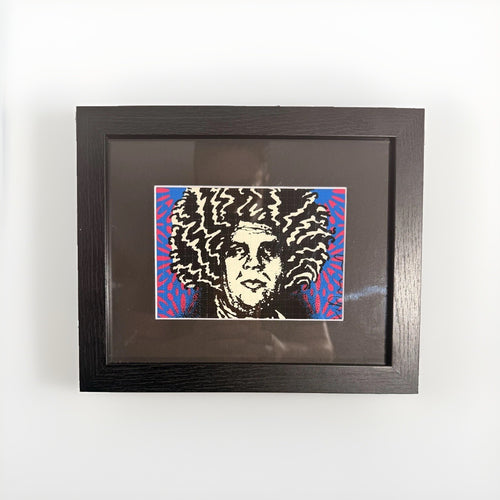
Central portrait. Decorative rays. Ornamental borders. The OBEY Records banner tying Fairey's two great obsessions — music and image-making — into one sheet.
This is Shepard Fairey's Jimi Hendrix — Hear My Freedom, a hand-signed screen print. This guide covers what the image is doing, where it sits in Fairey's music series, what backs its authenticity, and what to check before you buy.
View this piece at Gauntlet Gallery →
What you are actually looking at
This Hendrix portrait is part of Fairey's ongoing series celebrating revolutionary musicians, and it channels the guitarist as a symbol of creative and personal freedom.
It is issued under the OBEY Records banner — the imprint that unites Fairey's twin passions for music and image-making. The print renders Hendrix in the artist's signature layered graphic style: a commanding central portrait framed by decorative rays and ornamental borders that turn a rock legend into an icon of liberation.
The Hear My Freedom title underscores how Fairey reads Hendrix — not merely as a virtuoso but as a boundary-breaker whose sound dissolved the era's racial and cultural walls. As with the artist's tributes to musicians from Joe Strummer to Billie Holiday, the piece treats popular music as a form of resistance, honoring the artists who expanded what was possible.
OBEY Records and the music series
Fairey's relationship with music is not a side hobby; it runs through his whole practice. He came up in a scene where the poster, the record sleeve, and the flyer were the native art forms, and OBEY Records is the formalization of that — an imprint where his image-making and his love of music share the same object.
Within that project, the revolutionary-musicians series is a recognizable throughline. Fairey returns again and again to figures who used sound to break something open — political, cultural, racial. Hendrix belongs squarely in that lineage: an artist whose innovation was inseparable from the walls it knocked down. Reading the portrait as part of the series, rather than as a one-off, is the right frame for a collector.
Shepard Fairey, in one paragraph
Shepard Fairey (b. 1970) is one of the most influential American artists of his generation. He emerged from the 1990s skateboarding and street-art scene with his OBEY Giant campaign — an experiment in propaganda and public space that grew into a global visual language. His 2008 Barack Obama “Hope” portrait became one of the most recognizable political images in modern history. His work is held by the Museum of Modern Art, the Victoria & Albert Museum, LACMA, and the Smithsonian. New editions release through his OBEY studio and routinely sell out and trade on the secondary market.
The edition and how it reached the market
This is a screen print on cream Speckletone paper, hand-signed in pencil by Fairey, issued under the OBEY Records banner.
The primary mark of a genuine signed impression here is the pencil signature. We do not assert a specific edition total for this piece; where a numbered run is not stated on the sheet, the honest description is that it is a hand-signed limited edition rather than a claim of a particular number. If precise edition size is central to your decision, confirm it against the specific sheet.
Authentication: what actually backs a Fairey
This is the part collectors most often get wrong, so read it carefully.
Shepard Fairey does not issue an artist certificate of authenticity, and there is no third-party authentication board for his work — no Fairey equivalent of Banksy's Pest Control. That is not a gap specific to this print. It is how the entire Fairey market operates.
Authenticity for a signed Fairey rests on three things: the pencil signature (and, where present, numbering), the physical characteristics of the edition — paper stock, color, print process — and provenance. This release is documented in the Gauntlet Gallery Shepard Fairey reference archive. Be skeptical of anyone selling a Fairey with a claim of “third-party authentication” or a certificate implying an official board signed off. No such board exists for his prints.
Condition: what to check, and why photographs matter
Condition drives value on paper works more than most first-time buyers expect. On a print like this, watch the brightness of the cream stock, any handling creases or corner dings, the margins around the signature, and whether the sheet has ever been trimmed or light-exposed.
Because condition is specific to the individual sheet, treat the listing photographs as part of the condition description, not decoration. The images show the actual piece you will receive. Zoom into the corners and the pencil signature. We do not assign a numeric grade here; the photographs are the honest record.
Who this piece is for
Two kinds of collector tend to reach for this Hendrix. The music collector wants it because it sits at the crossing of two passions — an OBEY Records tribute to one of the most important guitarists who ever lived. The Fairey collector wants it because the revolutionary-musicians series is a distinct, recognizable lane within his catalog.
If you love Hendrix and respond to the image, that is a completely valid reason to own it.
Frequently asked questions
Is it signed? Yes — hand-signed in pencil by Shepard Fairey.
Is it part of a series? Yes — Fairey's ongoing series celebrating revolutionary musicians, issued under the OBEY Records banner.
Does it come with a certificate? Fairey issues no artist COA and there is no third-party board for his prints. Authenticity rests on the signature, the documented edition characteristics, and provenance.
What is it printed on? A screen print on cream Speckletone paper.
What condition is it in? Refer to the current listing; condition is described per item and the photographs form part of that description.
How is it shipped? Ships flat-rolled in a heavy-duty tube, protected in an archival sleeve, and fully insured.
The bottom line
Jimi Hendrix — Hear My Freedom is Fairey doing what OBEY Records was built for: honoring a musician who broke the walls of his era, in the visual language of the political poster. Hand-signed, it is a clean entry point into his music series for collectors who love both the artist and the subject.
If it's the piece for you, the individual sheet — its condition, its documentation — is where the decision actually lives.