Shepard Fairey — Lonesome: A Collector's Guide
Fairey is known for fire — fists, slogans, protest.
This print trades the fire for a ballad.
Lonesome taps the melancholy strain of American folk and roots music that has quietly shaped much of Fairey's imagery. It's the softer, more lyrical side of his practice, hand-signed and numbered 407/450. This is the full story of the work: what it depicts, where it sits in his catalogue, how the edition reached the market, and what to check before you buy.
View this piece at Gauntlet Gallery →
What you are actually looking at
The solitary traveler. The weathered iconography of Americana. Layered detail and muted framing that give the sheet a worn, nostalgic quality — as if it were pulled from an old songbook rather than printed last year.
Lonesome evokes the open road and the figure moving along it alone. It trades some of Fairey's political fire for a more reflective, atmospheric mood, and the result is a piece that feels like a ballad rendered in ink. It isn't a portrait of a single musician; it's a meditation on isolation and distance, the emotional register of the roots music it draws on.
Music in Fairey's catalogue
Fairey's affection for music runs throughout his catalogue — it's one of the persistent undercurrents beneath the political work everyone knows him for. He has designed for bands, drawn on album-cover aesthetics, and returned repeatedly to the imagery of American folk and roots traditions.
Lonesome is where that undercurrent surfaces directly. Rather than a specific artist or a specific song, it captures the mood of the genre — the solitude, the movement, the weathered romance of the road. For collectors, this places it in a distinct, quieter lane of Fairey's output: the music-adjacent, Americana-inflected work that sits apart from both the OBEY iconography and the protest posters. It shows a side of his practice that rewards collectors who want more than the greatest hits.
Shepard Fairey, in one paragraph
Shepard Fairey (b. 1970) is one of the most influential American artists of his generation. He emerged from the 1990s skateboarding and street-art scene with his OBEY Giant campaign — an experiment in propaganda and public space that grew into a global visual language — and in 2008 his Barack Obama "Hope" portrait became one of the most recognizable political images in modern history. His work is held by the Museum of Modern Art, the Victoria & Albert Museum, LACMA, and the Smithsonian. New editions release through his OBEY studio and routinely sell out and trade on the secondary market.
The edition and how it reached the market
This is a screen print on cream Speckletone paper, from an edition of 450. This impression is hand-signed and numbered 407/450 in pencil by Shepard Fairey.
An edition of 450 is a typical mid-size Fairey studio run. This specific sheet is number 407 — a detail worth noting simply because the number is part of what you're buying; on paper works, the individual number and its condition are the asset, not just the image. The cream Speckletone stock is a Fairey signature, a warm flecked paper he uses across much of his catalogue. This release is documented in the Gauntlet Gallery Shepard Fairey reference archive at fairey.gauntlet.gallery.
Authentication: what actually backs a Fairey
This is the part collectors most often get wrong, so read it carefully.
Shepard Fairey does not issue an artist certificate of authenticity, and there is no third-party authentication board for his work — no Fairey equivalent of Banksy's Pest Control. That is how the entire Fairey market operates.
Authenticity for a signed Fairey rests on three things: the signature and numbering, the physical characteristics of the edition (paper stock, color count, print process), and provenance. Be skeptical of any Fairey sold with a claim of "third-party authentication" or a certificate implying an official board signed off — no such board exists for his prints. A credible seller documents the signature, the numbering (here, 407/450), and the chain of ownership.
Condition: what to check, and why photographs matter
Condition drives value on paper works more than first-time buyers expect. For a print with muted, atmospheric framing like this one, watch for handling creases, corner dings, the brightness of the cream stock, and any sign of trimming, laydown, or light exposure — soft-toned imagery can hide a crease that a close look reveals.
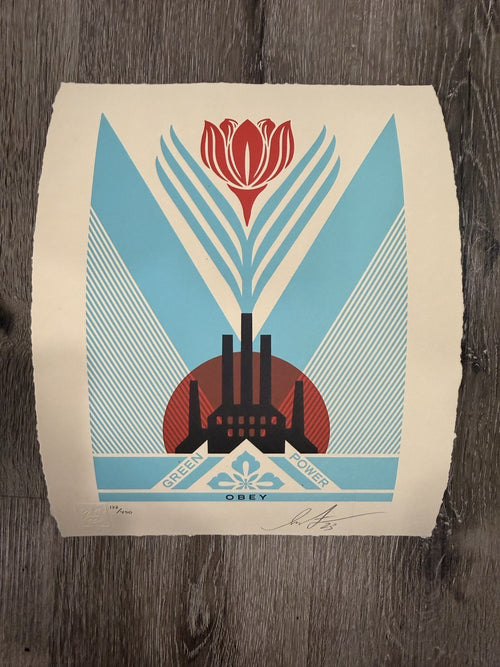
Because condition is specific to the individual sheet, treat the listing photographs as part of the condition description, not decoration. The images show the actual piece you will receive. Zoom into the corners and the margin around the pencil signature and number. We do not assign a formal grade here; the sheet in front of you is the description.
What the market says
This example does not carry a specific set of comparable figures in its product data, so we won't invent any.
Honestly and without numbers: Lonesome sits in the quieter, music-adjacent lane of Fairey's catalogue rather than among his headline political or OBEY images. That can cut two ways — it's a distinctive, less-common register that appeals to collectors looking beyond the greatest hits, while the broadest demand still concentrates on his best-known images. Where you land on price should follow the individual sheet — its condition, its number, and its documentation — plus any current comparable sales for this specific image. Any market discussion here is directional context, not an appraisal or a promise of future value.
Who this piece is for
The Americana- and music-minded collector wants it because it speaks their language: the open road, the roots-music mood, the weathered nostalgia. The Fairey collector after range wants it because it shows the quieter, more lyrical side of his practice — a counterpoint to the protest posters. And the image-first buyer wants it because it's simply a beautiful, atmospheric object that reads like a ballad on the wall.
If you just respond to the mood of it, that's a completely valid reason to buy it.
Frequently asked questions
Is it signed? Yes — hand-signed and numbered 407/450 in pencil by Shepard Fairey.
Is Lonesome about a specific musician? No. It captures the mood of American folk and roots music — solitude, the open road, weathered Americana — rather than portraying any single artist.
Does it come with a certificate? Fairey issues no artist COA and there is no third-party board for his prints. Authenticity rests on the signature and numbering, the documented edition characteristics, and provenance. This release is documented in the Gauntlet Gallery Shepard Fairey reference archive.
What is it printed on? A screen print on cream Speckletone paper — a warm, flecked stock Fairey uses across much of his catalogue.
What condition is it in? Condition is described per item, and the photographs form part of the condition description. Review every image closely; they show the actual piece you will receive.
The bottom line
Lonesome is Fairey in a minor key: a reflective, Americana-inflected print that trades protest for the mood of an old ballad, hand-signed and numbered 407/450. For collectors who want the range of his practice — not just the greatest hits — it's a distinctive piece.
If it's the piece for you, the individual example — its number, its condition, its documentation — is where the decision actually lives.