Shepard Fairey — Eyes on the King Verdict: A Collector's Guide
The title is a command.
Watch the verdict. Don't look away.
Eyes on the King Verdict draws on the imagery of civil unrest and the fraught history of policing and justice in America — a protest print that treats a moment of civic tension with the seriousness of a monument. This is the full story of the work: what it depicts, where it sits in Fairey's socially responsive output, how the edition reached the market, and what to check before you buy.
View this piece at Gauntlet Gallery →
What you are actually looking at
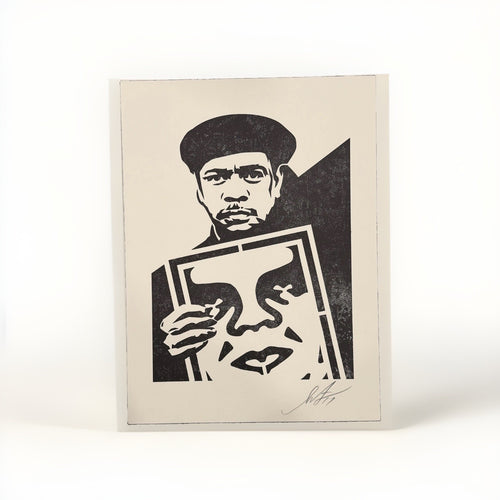
Stark graphic contrasts. Pointed symbolism. Fairey's familiar ornamental framing, deployed here not as decoration but as gravity — treating a moment of civic tension with the seriousness of a memorial.
Eyes on the King Verdict confronts a moment of reckoning head on. It draws on the imagery of civil unrest and the fraught history of policing and justice in America, keeping the viewer's attention fixed on questions of accountability. The title itself demands vigilance — it insists that verdicts be watched rather than passively accepted, that justice is something the public has to keep its eyes on rather than trust to run on its own.
Where this sits in Fairey's practice
This print belongs to the current in Fairey's practice that responds directly to social upheaval — the work where the print becomes a document of protest as much as an object of design.
That's a distinct strain in his catalogue. Some Fairey images are icons (the Andre face); some are meditative studio pieces; some are pointed political arguments made for a specific moment of tension. Eyes on the King Verdict is squarely in that last group: a direct entry in his socially responsive output, where the graphic exists to keep a civic question in front of the viewer rather than to soothe or decorate. His ornamental framing lends the subject gravity, treating civic tension with the weight of a monument — which is exactly what elevates it above a slogan.
Shepard Fairey, in one paragraph
Shepard Fairey (b. 1970) is one of the most influential American artists of his generation. He emerged from the 1990s skateboarding and street-art scene with his OBEY Giant campaign — an experiment in propaganda and public space that grew into a global visual language — and in 2008 his Barack Obama "Hope" portrait became one of the most recognizable political images in modern history. His work is held by the Museum of Modern Art, the Victoria & Albert Museum, LACMA, and the Smithsonian. New editions release through his OBEY studio and routinely sell out and trade on the secondary market.
The edition and how it reached the market
This is a screen print on cream Speckletone paper, measuring 18 by 24 inches, from an edition of 600. It is hand-signed and hand-numbered in pencil by Shepard Fairey.
The 18×24 format is a familiar Fairey print size, well suited to framing, and an edition of 600 is a standard studio run. The cream Speckletone stock is a Fairey signature — a warm, flecked paper he uses across much of his catalogue and part of what a genuine example should feel like. This release is documented in the Gauntlet Gallery Shepard Fairey reference archive at fairey.gauntlet.gallery.
Authentication: what actually backs a Fairey
This is the part collectors most often get wrong, so read it carefully.
Shepard Fairey does not issue an artist certificate of authenticity, and there is no third-party authentication board for his work — no Fairey equivalent of Banksy's Pest Control. That is how the entire Fairey market operates.
Authenticity for a signed Fairey rests on three things: the signature and numbering, the physical characteristics of the edition (paper stock, dimensions, color count, print process), and provenance. Be skeptical of any Fairey sold with a claim of "third-party authentication" or a certificate implying an official board signed off — no such board exists for his prints. A credible seller documents the signature, the numbering, the format, and the chain of ownership.
Condition: what to check, and why photographs matter
Condition drives value on paper works more than first-time buyers expect. On an 18×24 sheet, watch for handling creases, corner dings, the brightness of the cream stock, edge wear, and any sign of trimming, laydown, or light exposure.
Because condition is specific to the individual sheet, treat the listing photographs as part of the condition description, not decoration. The images show the actual piece you will receive. Zoom into the corners and the margin around the pencil signature and number. We do not assign a formal grade here; the sheet in front of you is the description.
What the market says
Now the numbers — restrained, because this is context, not a promise.
Across recent signed-and-numbered comparables for this edition of 600, observed asking and sale figures span roughly $74 to $630, with a median around $227; one tracked marketplace recorded a last sale near $118. That's a wide band, and the spread is a story about condition and venue as much as anything — a clean, well-documented example sits higher, while worn or thinly documented copies drag the low end down.
A few caveats to hold onto. These are directional secondary-market figures, not an appraisal. Value on any specific sale varies with condition, edition number, and the venue of the transaction. And market data ages — the figures above reflect data reviewed in 2026 (last updated 2026-07-31). No one, including us, can promise where the price goes next.
Who this piece is for
The political-Fairey collector wants it because it's a direct entry in his socially responsive output — protest treated with the weight of a monument. The message-first buyer wants it because it's a clear, serious statement on policing and accountability that reads as well in a thesis as on a wall. And the image-first buyer wants it because the stark graphic contrast and ornamental framing simply make a striking 18×24 object.
If you respond to what it's saying, that's a completely valid reason to buy it.
Frequently asked questions
Is it signed? Yes — hand-signed and hand-numbered in pencil by Shepard Fairey, from an edition of 600.
How big is it? The sheet measures 18 by 24 inches.
Does it come with a certificate? Fairey issues no artist COA and there is no third-party board for his prints. Authenticity rests on the signature and numbering, the documented edition characteristics, and provenance. This release is documented in the Gauntlet Gallery Shepard Fairey reference archive.
What is it printed on? A screen print on cream Speckletone paper — a warm, flecked stock Fairey uses across much of his catalogue.
What condition is it in? Condition is described per item, and the photographs form part of the condition description. Review every image closely; they show the actual piece you will receive.
The bottom line
Eyes on the King Verdict is Fairey doing what he does best on a serious subject: reducing a fraught civic question — policing, justice, accountability — into a single striking 18×24 graphic that treats protest with the weight of a monument. Hand-signed and numbered from an edition of 600, it's a direct piece of his socially responsive work.
If it's the piece for you, the individual example — its number, its condition, its documentation — is where the decision actually lives.