Shepard Fairey — Gigante (Andre the Giant): A Collector's Guide
Every OBEY sticker, every stencil, every wheatpaste on every wall traces back to one face.
This is that face — retitled.
Gigante is Fairey's Spanish-language riff on the image that launched his entire career: the stylized visage of Andre the Giant that began as a sticker campaign in Providence in the late 1980s. This is the full story of the work: what it depicts, why the image matters, how the edition reached the market, and what to check before you buy one.
View this piece at Gauntlet Gallery →
What you are actually looking at
Bold red and black. The wrestler's blunt visage staring out from beneath heavy brows. It's an image so reduced, so graphically direct, that it reads from across a room — which is exactly the point.
This is the foundational OBEY icon, the graphic that started as a scrappy skate-culture in-joke and became one of the most recognizable images in contemporary art. Here it's retitled Gigante — the Spanish for "giant" — a move that nods to the international reach of the OBEY phenomenon. What began on lampposts in one American city is now a global visual language, and the Spanish-language variant makes that reach part of the artwork itself.
The idea underneath the icon
It's tempting to treat the Andre face as a logo. Fairey never has.
The face has always been an experiment in phenomenology — a graphic so blunt it forces the viewer to question the ubiquitous imagery of advertising and authority alike. The original sticker campaign had no message. That was the message. By plastering a meaningless-seeming image everywhere, Fairey made people notice how much imagery they absorb without noticing, how much of public space is already claimed by someone selling or commanding something.
Gigante extends that idea across a language barrier. By retitling the giant, Fairey nods to his own fascination with how a single repeated image can seize public space and rewire how people see their surroundings — regardless of what language the people around it speak. The icon works the same way in Spanish as it does in English, which is precisely what makes it an icon.
Why this image matters to collectors
Fairey has made hundreds of prints. Only a handful sit at the origin of the whole project. The Andre the Giant face is the origin.
Owning a signed variant of the foundational OBEY image is different from owning any other Fairey print. This is the graphic that launched his career, in its most reduced and recognizable form. The Gigante retitling adds a specific wrinkle — it's the Spanish-language variant, which makes it a distinct, collectible take on the core image rather than a straight reprint of it. For a collector building around OBEY iconography specifically, the foundational image in a named variant is a natural anchor.
Shepard Fairey, in one paragraph
Shepard Fairey (b. 1970) is one of the most influential American artists of his generation. He emerged from the 1990s skateboarding and street-art scene with his OBEY Giant campaign — an experiment in propaganda and public space that grew into a global visual language — and in 2008 his Barack Obama "Hope" portrait became one of the most recognizable political images in modern history. His work is held by the Museum of Modern Art, the Victoria & Albert Museum, LACMA, and the Smithsonian. New editions release through his OBEY studio and routinely sell out and trade on the secondary market.
The edition and how it reached the market
This is a screen print on cream Speckletone paper, from an edition of 300, in Fairey's bold red-and-black colorway. It is hand-signed and hand-numbered in pencil by Shepard Fairey.
An edition of 300 is on the tighter side for a Fairey release — smaller than many of his studio editions, which run into the many hundreds. The cream Speckletone stock is a Fairey signature, a warm flecked paper he uses across much of his catalogue and part of what a genuine example should feel like. This release is documented in the Gauntlet Gallery Shepard Fairey reference archive at fairey.gauntlet.gallery.
Authentication: what actually backs a Fairey
This is the part collectors most often get wrong, so read it carefully.
Shepard Fairey does not issue an artist certificate of authenticity, and there is no third-party authentication board for his work — no Fairey equivalent of Banksy's Pest Control. That is how the entire Fairey market operates, not a gap specific to this print.
Authenticity for a signed Fairey rests on three things: the signature and numbering, the physical characteristics of the edition (paper stock, color count, the print process), and provenance. Be skeptical of any Fairey sold with a claim of "third-party authentication" or a certificate implying an official board signed off — no such board exists for his prints. A credible seller documents the signature, the numbering, and the chain of ownership, and does not pretend a paper certificate is something it isn't.
Condition: what to check, and why photographs matter
Condition drives value on paper works more than first-time buyers expect. For a bold two-color print like this, watch for handling creases, corner dings, the brightness and cleanliness of the cream margins, and any sign the sheet has been trimmed, laid down, or light-exposed.
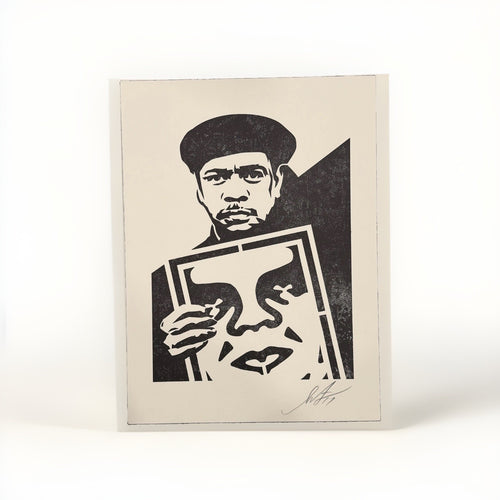
Because condition is specific to the individual sheet, treat the listing photographs as part of the condition description, not decoration. The images show the actual piece you will receive. Zoom into the corners and the margins around the pencil signature and number. We do not assign a formal grade here; the sheet in front of you is the description.
What the market says
This example does not carry a specific set of comparable figures in its product data, so we won't invent any.
What can be said honestly and without numbers: the Andre the Giant image is core OBEY iconography, and foundational Fairey images tend to hold steady collector interest precisely because they sit at the origin of the project. The smaller edition of 300 means fewer signed examples of this specific variant exist than of Fairey's larger studio runs. Where you land on price should follow the individual sheet — its condition, its edition number, and its documentation — and any current comparable sales you can find for this specific variant. Any market discussion here is directional context, not an appraisal or a promise of future value.
Who this piece is for
The OBEY-first collector wants it because it's the foundational image — the graphic the whole project is built on — in a named Spanish-language variant. The Fairey completist wants it because a tighter edition of 300 of the core icon is a distinct, scarcer lane within his catalogue. And the image-first buyer wants it because it's simply one of the most recognizable graphics in contemporary art, reduced to red, black, and that unmistakable stare.
If you just like the face — plenty of people do — that's a completely valid reason to own it.
Frequently asked questions
Is it signed? Yes — hand-signed and hand-numbered in pencil by Shepard Fairey, from an edition of 300.
What is Gigante? It's Fairey's Spanish-language variant of the Andre the Giant image that launched the OBEY campaign — the same foundational graphic, retitled to nod to the phenomenon's international reach.
Does it come with a certificate? Fairey issues no artist COA and there is no third-party board for his prints. Authenticity rests on the signature and numbering, the documented edition characteristics, and provenance. This release is documented in the Gauntlet Gallery Shepard Fairey reference archive.
What is it printed on? A screen print on cream Speckletone paper — a warm, flecked stock Fairey uses across much of his catalogue.
What condition is it in? Condition is described per item, and the photographs form part of the condition description. Review every image closely; they show the actual piece you will receive.
The bottom line
Gigante is the image that started everything, retitled for a global audience: the Andre the Giant face in bold red and black, hand-signed and numbered in a tighter edition of 300. For a collector building around OBEY iconography, it's about as close to the origin as a signed print gets.
If it's the piece for you, the individual example — its number, its condition, its documentation — is where the decision actually lives.