Shepard Fairey — Chinese Soldier
The heroic worker-soldier poster.
Borrowed from the machinery of the state, and turned against it.
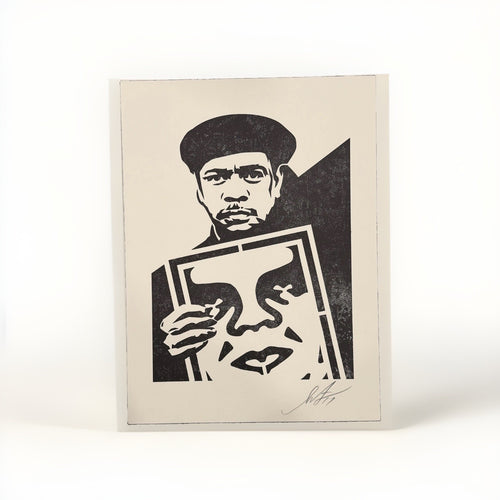
Chinese Soldier draws directly on the visual arsenal of twentieth-century propaganda and puts it to Fairey's own scrutinizing ends. This example is a hand-signed and numbered letterpress, 140/450, framed and ready to hang. This is the full story of the work: what it interrogates, why letterpress lends it authority, how the edition reached the market, and what to know before you buy.
View this piece at Gauntlet Gallery →
What you are actually looking at
Chinese Soldier draws directly on the heroic worker-soldier poster of twentieth-century state propaganda and turns it to Fairey's scrutinizing ends. Rendered as a letterpress edition, the figure is at once monumental and unsettling — a study of how nations manufacture idealized images of the fighter to serve the machinery of power.
The soldier here is not a celebration but an interrogation. It invites the viewer to notice how easily strength and duty can be stylized into obedience — how the visual language of heroism does quiet work in the service of control. Fairey doesn't mock the form; he reconstructs it faithfully enough that you feel its pull, then leaves you to sit with what that pull is for.
Fairey and the aesthetics of propaganda
This image sits at the absolute center of Fairey's project.
He has long mined the aesthetics of Soviet, Chinese, and American propaganda, absorbing their techniques in order to expose them. The whole OBEY enterprise began as an experiment in propaganda and public space — a study of how images command, persuade, and manufacture consent. Chinese Soldier is that study made explicit: it takes one of propaganda's signature forms, the idealized fighter, and holds it up for examination rather than belief.
The method is deliberate and it cuts both ways. To critique propaganda convincingly, Fairey has to reproduce its seductions convincingly. The image has to look like the thing it questions. That's why the soldier reads as genuinely monumental — the monumentality is the point, and the unease it produces is the argument.
Why letterpress matters here
The handmade letterpress impression lends the critique a tactile authority.
Letterpress presses the ink into the paper, leaving a physical impression you can feel — the raised, embossed quality of an official document or a struck seal. For an image about state authority and the manufacture of heroic figures, that quality does specific work: it makes the print feel official, which sharpens the irony. You're holding an object that carries the tactile authority of a state document, in service of an image that questions exactly that kind of authority.
It also sets the work apart from Fairey's more common screen-print output. Letterpress is his more deliberate, hand-pressed register, and it suits a piece meant to be read slowly rather than absorbed at poster speed.
Shepard Fairey, in one paragraph
Shepard Fairey (b. 1970) is one of the most influential American artists of his generation. He emerged from the 1990s skateboarding and street-art scene with his OBEY Giant campaign — an experiment in propaganda and public space that grew into a global visual language. In 2008 his Barack Obama "Hope" portrait became one of the most recognizable political images in modern history. His work is held by the Museum of Modern Art, the Victoria & Albert Museum, LACMA, and the Smithsonian. Editions release through his OBEY studio and routinely sell out and trade on the secondary market.
The edition and how it reached the market
This is a letterpress edition on cream paper, hand-signed and numbered 140/450 in pencil by Shepard Fairey. This example is framed and ready to hang. The specific number — 140 out of 450 — is present on the sheet, which is exactly the kind of detail that anchors a numbered edition.
For due diligence: the specific year and dimensions aren't stated in the product data for this example, so we won't assert them. What defines this sheet is documented and plain — a hand-signed letterpress numbered 140/450, framed. If exact year or size matters to your decision, confirm it against the specific example.
Authentication: what actually backs a Fairey
Read this carefully, because it's the point collectors most often get wrong.
Shepard Fairey does not issue an artist certificate of authenticity, and there is no third-party authentication board for his work — no Fairey equivalent of Banksy's Pest Control. That is how the entire Fairey market operates.
Authenticity for a signed Fairey rests on the pencil signature and numbering (here, 140/450), the physical characteristics of the edition (the cream stock, the embossed letterpress impression, the print process), and provenance. This release is documented in the Gauntlet Gallery Shepard Fairey reference archive, part of that provenance. Be skeptical of any "third-party authentication" claim or a certificate implying an official board signed off — no such board exists for his prints.
Condition: what to check, and why photographs matter
Condition drives value on paper works. This example is described as Very Good, and it is framed. For a framed letterpress print, the things worth examining are the brightness of the cream stock, the depth and crispness of the impression, any visible handling in the margins, and the state of the frame and glazing.
One practical note on framed pieces: because the work sits behind glazing, some areas may not be fully visible in standard photos. The listing photographs form part of the condition description, and if you're buying toward the higher end of this image's range, it's reasonable to ask for additional images of any area the framing obscures. We never assert a grade beyond what the photographs support.
What the market says
Specific comparable market data for this exact image wasn't compiled for this piece, so we won't put a number on it — that's the honest position rather than an invented figure.
What we can say directionally: Fairey's signed, numbered letterpress editions trade actively on the secondary market, and a numbered run of 450 is a defined, moderate edition for his output. Value on any specific example depends on condition, edition position, whether it's framed, documentation, and sales venue, and any secondary-market figure would be directional rather than an appraisal. If precise comparables matter to your decision, treat current listings and recent sales for this specific image as the reference point, and remember that market data ages.
Who this piece is for
A few kinds of collector tend to want this print. The Fairey collector who wants a piece at the conceptual center of his practice — the propaganda critique made explicit. The letterpress enthusiast drawn to the embossed, hand-pressed format over screen-print flatness. And the ready-to-hang buyer who values that this example arrives framed.
If you're none of those and simply respond to the image — a heroic soldier held up for questioning rather than belief — that's a valid reason too.
Frequently asked questions
Is it signed and numbered? Yes — hand-signed and numbered 140/450 in pencil by Shepard Fairey.
What is the medium? Letterpress on cream paper.
Is it framed? Yes — this example is framed and ready to hang.
What year and size is it? The specific year and dimensions aren't stated in the available data for this example; confirm them against the specific piece if those details drive your decision.
Does it come with a certificate? Fairey issues no artist COA and there is no third-party board for his prints. Authenticity rests on the signature, the numbering (140/450), the documented letterpress characteristics, and provenance.
What condition is it in? Graded Very Good. The photographs form part of the condition description and show the actual piece you will receive.
The bottom line
Chinese Soldier is Fairey's project distilled: take one of propaganda's signature forms, reproduce its seductions faithfully, and hold it up for interrogation rather than belief. As a signed letterpress numbered 140/450 — framed and ready to hang — it puts that argument on the wall with the tactile authority of a struck seal.
If it's the piece for you, the individual sheet — its number, its condition, its framing — is where the decision lives.