The 100% + 400% Set: Why Splitting It Is the Worst Mistake You Can Make
You bought the set. Both pieces. The 100% sitting next to the 400%, sealed in their original Medicom boxes, exactly as they shipped.
Then someone offers you good money for just the 400%.
Do you split it?
No. You do not split it. And if you walk away from this article understanding only one thing, let it be that.
The BE@RBRICK 100% + 400% set release is one of the most misunderstood value propositions in the contemporary collectibles market. Casual flippers see two pieces and assume two independent assets. Experienced collectors know better. The set is a single object. The moment you break it, you have created two orphans — and the market prices orphans accordingly.
This is the full breakdown: why sets are priced as units, what authentication looks like for a matched pair, which releases created the biggest spread between paired and split value, and what red flags to watch for when you are buying a "complete set" that might not actually be one.
First, the Basics: What a 100% + 400% Release Actually Is
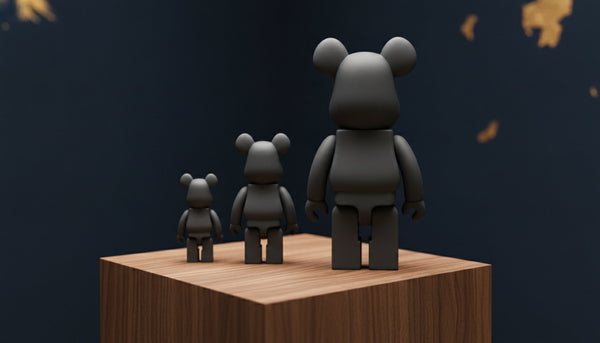
Medicom Toy introduced BE@RBRICK in 2001. The sizing system is percentage-based, with 100% representing roughly 7cm (the base unit) and 400% scaling to approximately 28cm. These are not proportional toys. They are proportion-matched collectibles released as intentional companion pieces.
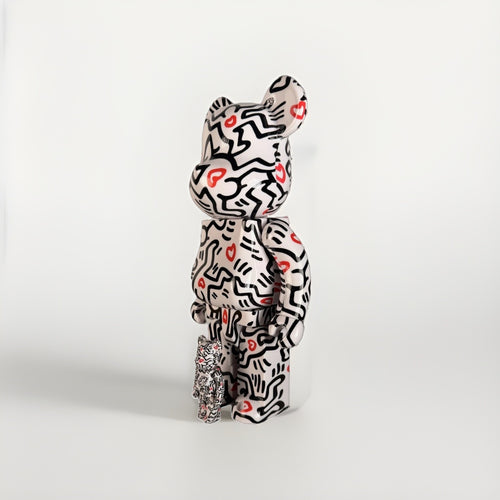
When Medicom drops a 100% + 400% set, both units share identical colorway, artwork application, surface finish, and often serial or edition numbering. They arrive together in coordinated packaging. The 100% is not a miniature accessory. It is the other half of a complete object.
Some releases add a 1000% (roughly 70cm) to the configuration, creating a three-piece set. That format follows the same logic at a higher price tier. But the 100% + 400% pairing is the standard, the most widely produced, and the format where the split-value conversation comes up most often.
Why Medicom Designed It This Way
This is not accidental product bundling. Medicom structures set releases to reinforce display value. A 400% on a shelf tells one story. A 400% flanked by its 100% tells the complete one. The scale contrast is part of the aesthetic intention. Serious collectors and interior designers who purchase these for display purposes — a significant and growing buyer segment — want the full composition.
Medicom also uses set releases to manage edition economics. Certain collaborator licenses are negotiated at the set level, not the individual piece level. The artist or brand partner approved a paired release. They did not approve two separate single-piece markets.
The Value Mathematics of Splitting a Set
Here is the uncomfortable reality that sellers learn too late.
The combined resale value of a matched 100% + 400% set, sold intact and authenticated as a unit, consistently exceeds the sum of what you would receive selling each piece separately. This is not a small gap. On strong releases — particularly artist collaborations, limited Medicom World Wide Tour drops, and licensed cultural properties with deep collector bases — the premium for the intact set over the split total can be meaningful.
Why does the market pay a premium for something you could theoretically reassemble?
Because you cannot fully reassemble it. Not with confidence.
The value of an intact set is partly about the objects and mostly about provenance certainty. A matched set that has never been separated carries a clean chain of custody. Both pieces share the same purchase origin, the same storage history, the same authentication moment. When you buy an intact set from a reputable source, you are buying a documented unit.
When you attempt to reunite a split 400% with a separately sourced 100%, you are building a provenance story out of two different threads. Sophisticated buyers recognize this immediately. They will discount accordingly, or they will pass.
The Orphan 100% Problem
The 400% almost always survives the split with its market value relatively intact, at least in the short term. It is the larger, more visually dominant piece. It is what most buyers picture when they think BE@RBRICK.
The 100% is where the value destruction happens.
A detached 100% from a set release trades at a significant discount to both its original set allocation and to a comparable standalone 100% release. Why? Because the collector community knows it came from a set. A standalone 100% has its own identity. A set 100% without its 400% is a provenance question waiting to happen.
Sellers who split sets typically underestimate what they will net on the 100% side. By the time they do the math, the damage is done.
Authentication for a Matched Set: What to Verify
Authentication for BE@RBRICK operates at several levels, and the set format adds complexity that single-piece buyers sometimes overlook.
Set-Level Documentation: The Paperwork Covers the Pair
For set releases, the documentation is tied to the set as a unit. A receipt, drop confirmation, or certificate for a 100% + 400% release covers both pieces together. Verifying one piece without the other produces an incomplete authentication read.
This is deliberate. Set releases are packaged and documented as a unit, and the paperwork enforces the set-integrity principle.
If a seller presents you with a single certificate or receipt for a 100% + 400% release and only one piece is physically present, that is not a half-authenticated item. That is a broken provenance chain wearing the visual appearance of documentation.
Does the certificate look legitimate if the set it covers no longer exists as a set?
Technically yes. Practically, no. A certificate that documents a set, where only half the set is present, raises more questions than it answers. Where is the other piece? Why was it separated? What happened between the original sale and this transaction?
Original Packaging and Hologram Verification
For the physical pieces themselves, authentication relies on:
-
Original Medicom packaging — both boxes
- Set releases ship in coordinated outer packaging that identifies the pair as a unit
- Individual inner boxes are numbered or marked to correspond with one another on authenticated set releases
- Verify that box condition, printing, and hologram placement match known documentation for that specific release
-
Medicom hologram verification
- Holograms should be present on both individual boxes
- Cross-reference hologram format against the release year — Medicom has updated hologram design across production eras
- A hologram that does not match the era of the purported release is a hard stop
-
Medicom release record cross-reference
- Every legitimate set release appears in Medicom's documented production history
- Edition numbers, colorways, and packaging formats are verifiable against third-party collector documentation and dealer records
- If a piece cannot be matched to a documented Medicom release, do not proceed on the seller's word alone
-
Packaging integrity for both units
- Sealed condition matters differently than it does for, say, trading cards, but factory seal integrity on one box and not the other suggests the set was opened and partially resealed
- Matched wear patterns across both boxes are a positive authenticity signal
Third-Party Grading for Set Pieces
PSA offers grading and encapsulation for BE@RBRICK. Their certification verification system will flag inconsistencies in submitted items, but grading a split set piece does not restore set provenance. A PSA-graded 400% from a set release is still an orphaned piece. The grade reflects condition. It does not reconstruct the original pairing.
If you are acquiring a set where one or both pieces have been individually graded by PSA or another service, ask explicitly about the other piece. A graded 400% with an ungraded, unboxed 100% being sold together as a "set" is a yellow flag. Grading decisions should be made at the set level, or not at all, if maintaining set provenance is the priority.
Which Releases Make Set Integrity Most Critical
Not every 100% + 400% release carries identical set-premium dynamics. The releases where keeping the set together matters most — both for authentication and for value retention — tend to cluster around several categories.
Major Artist Collaboration Releases
When Medicom partners with a significant visual artist for a set release, both the 100% and 400% carry the artist's aesthetic application as a unified composition. The artist approved the pairing. The iconography was designed to work at both scales simultaneously.
These releases attract two distinct collector segments: BE@RBRICK specialists who want the complete documented set, and art collectors who are entering the BE@RBRICK market specifically because of the artist association. Both segments will pay the set premium. Neither segment wants the orphaned piece.
Medicom World Wide Tour and Anniversary Drops
World Wide Tour releases and Medicom anniversary editions are produced in controlled quantities with documented production records. The set format is a central feature of the release identity. Splitting these is particularly destructive to value because the collector community for these releases is extremely well-informed. They know what a complete set looks like. They know what a split set looks like. You are not fooling anyone.
Licensed Cultural Property Releases
BE@RBRICK releases tied to significant licensed properties — entertainment franchises, fashion house collaborations, music artist partnerships — often carry fan-community demand that extends well beyond the core BE@RBRICK collector base. These crossover buyers frequently want the set as a display object. The visual completeness of the matched pair is a significant part of the purchase motivation.
When you sell a fan collector a 400% without the 100%, are you selling them the thing they actually wanted?
You are not. And the price they pay will reflect that, whether they articulate it explicitly or not.
Storage, Display, and Long-Term Preservation of a Matched Set
Keeping the set together is step one. Keeping it in condition is step two.
Sealed vs. Displayed
This is the perennial BE@RBRICK debate and it does not have a universal answer. What does have a universal answer is that the condition decision should be made for the set as a unit. Do not open the 400% for display while keeping the 100% sealed. Mismatched condition states between paired pieces create presentation inconsistency that buyers will notice and price into their offer.
If you display, display both. If you keep sealed, keep both sealed. The set tells a coherent story either way. A mixed-condition set tells an incoherent one.
Physical Storage Considerations
- Keep original boxes — Both boxes, together, in the same storage location. Do not separate the packaging from the pieces or from each other.
- UV protection — BE@RBRICK surface finishes, particularly on painted and printed pieces, are susceptible to UV degradation. Display cases with UV-filtering panels protect color fidelity on both pieces simultaneously.
- Temperature and humidity stability — Vinyl and ABS plastic respond to environmental fluctuation. Consistent, moderate conditions preserve both surface finish and box integrity.
- Document the pair — Photograph both pieces together with their boxes, alongside any accompanying documentation. Date-stamp the photographs. This is your provenance record for the set as a unit.
Insurance and Appraisal
If you are insuring a significant BE@RBRICK collection, insure matched sets as single items with a single appraised value. An insurance policy that treats the 100% and 400% as separate line items with separate individual valuations will likely undervalue the set and create ambiguity in a claims scenario. Work with an appraiser who understands set-release dynamics in the contemporary collectibles market.
Buying a "Complete Set" on the Secondary Market: Due Diligence Protocol
If you are acquiring a 100% + 400% set from a secondary market source rather than a primary Medicom channel or authorized retailer, you need to verify completeness before you verify anything else.
A set is not complete because the seller calls it a set. A set is complete when it demonstrably has always been a set.
Questions to Ask Every Secondary Market Seller
- Were both pieces purchased together at the same time from the same source?
- Have they ever been stored separately for any period?
- Are both original boxes present, and do they show consistent age and wear?
- If a certificate covers the set, does it reference both pieces, and can it be independently verified?
- Is there a purchase receipt, drop confirmation, or other documentation that references both pieces as a single transaction?
- Has either piece been individually graded or submitted for any third-party evaluation?
- Has the set ever been offered for sale previously? If so, why did it not sell?
These are not aggressive questions. They are standard due diligence for any significant collectibles purchase. A seller with a genuinely intact set should be able to answer most of them without hesitation.
What does it tell you when a seller gets uncomfortable with questions about provenance?
It tells you something.
Reconstructed Sets: The Gray Zone
A reconstructed set — two pieces from the same release, sourced separately and presented together — is not a fraudulent product. Both pieces are authentic. Both pieces are from the correct release. But it is not an intact set, and it should not be priced as one.
The gray zone is when a reconstructed set is presented without disclosure of its reconstruction. This happens more often than it should. Two pieces that are individually authenticated but were never originally paired together have a different provenance story than an original matched set. That difference has real market value. Sellers who obscure it are misrepresenting the product.
Ask directly: are these the original paired pieces from a single purchase, or have they been sourced separately? If the seller cannot or will not answer that question clearly, price your offer accordingly.
Red Flags
Before you buy, before you sell, before you split anything: run this list.
- One box present, one "lost" or "unavailable." Original packaging for both pieces is a baseline requirement for set integrity. A missing box is missing provenance.
- A certificate whose details do not match the pieces in front of you. This is an authentication failure. Do not rationalize it.
- Hologram format inconsistency between the two boxes. Both boxes from the same set release should carry matching hologram formats. Mismatched holograms suggest the boxes were separated and potentially swapped or replaced.
- Wear patterns that are dramatically inconsistent between pieces. Some variation is natural, but a 400% in near-mint condition paired with a 100% showing significant handling wear, or vice versa, suggests different storage histories.
- A seller who emphasizes the 400% and is vague about the 100%. The 100% is half the set. Any presentation that minimizes or glosses over it should make you ask harder questions.
- Pricing that suggests the 100% was added to justify calling it a set. If the asking price maps closely to the standalone 400% value with what amounts to a nominal add-on for the 100%, the seller may be attempting to monetize a reconstructed set at intact-set pricing.
- Individual third-party grading on only one piece. As noted above, grading decisions should be consistent across a set. One graded piece and one raw piece in the same "set" sale is a provenance question.
- No documentation beyond the figures themselves. A set at this level should travel with a receipt, drop confirmation, or verifiable certificate. A seller who cannot produce or direct you to any supporting documentation is presenting incomplete authentication.
- Release details that do not match documented Medicom production history. If the colorway, edition numbering, or packaging format does not align with known documentation for the purported release, you may be looking at a counterfeit, a prototype claim, or a misidentified piece. None of those outcomes is acceptable at set-release prices.
Bottom Line
The 100% + 400% set is not two collectibles. It is one.
Medicom designed it that way. The market prices it that way. Authentication treats it that way. The collector community understands it that way.
Every time a set gets split, value evaporates. Not just from the orphaned 100%. From the story the 400% can no longer tell. From the provenance chain that no longer runs clean from origin to present owner. From the display composition that no longer exists as the artist and licensor intended.
Keep the set together. Authenticate it as a unit. Store it as a unit. Sell it as a unit. Buy it as a unit.
If you are in a position where splitting feels financially tempting, the question to ask yourself is whether you are solving a short-term liquidity problem by destroying a long-term value asset. In most cases, that is exactly what you are doing.
The secondary market for intact, authenticated BE@RBRICK sets from significant releases is strong, documented, and growing. The market for the orphaned half of a split set is not.
The math is not complicated. The discipline required to act on it is.
Frequently Asked Questions
Does the 100% + 400% set always command a premium over individual piece values?
On meaningful releases — artist collaborations, limited drops, licensed cultural properties with strong collector bases — yes, consistently. On more common or open-edition adjacent releases, the premium may be modest. But even where the pure dollar premium is small, the intact set almost always sells faster and with less friction than split pieces. Liquidity is part of the value equation.
What if I purchased the pieces separately but they are from the same release? Can I sell them as a set?
You can sell two authenticated pieces from the same release together. What you cannot do is represent them as an original intact set if they were not purchased as one. Disclose the reconstruction. Price accordingly. Buyers who understand the market will appreciate the transparency. Buyers who do not understand the market enough to ask are not the buyers you want complications with later.
How does certificate verification work for a matched set in practice?
Where a matched set is covered by a verifiable certificate, the certificate covers the set as a registered unit and its record references both pieces. When purchasing, pull up the certificate and confirm that it references both pieces and that its status is clean. A certificate that does not check out, or that describes different pieces than the ones in front of you, is a problem that needs explanation before any transaction proceeds.
Are there releases where keeping the 100% and 400% together matters less?
Broadly produced, non-limited releases where both pieces remain widely available do not carry the same set-premium dynamics as scarce drops. If you can source a matched pair from primary retail today, the reconstructed-set problem largely disappears because provenance concerns are minimal. The set-integrity conversation becomes most critical on limited, documented, and demand-driven releases where the secondary market is the only available channel and provenance carries real weight.
What about 1000% pieces sold alongside a 100% + 400% set? Does the same logic apply?
Absolutely. Three-piece configurations follow exactly the same logic, with the stakes amplified. The 1000% is typically the highest individual value piece in the configuration, which creates even stronger temptation to split it off. Resist that temptation with equal or greater conviction. A documented three-piece intact set from a significant release is a genuinely rare object. Breaking it to capture the 1000% premium individually is almost always a value-destructive decision when you account for what happens to the remaining 100% + 400% pair.
Should I get my matched set graded by PSA?
This is a legitimate strategic question and the answer depends on your goals. PSA grading encapsulates pieces individually, which by definition removes them from their joint packaging context. If set display and intact provenance are priorities, grading may work against those goals. If maximum individual piece condition documentation is the priority — particularly for insurance or eventual single-piece sale — grading makes more sense. What you should not do is grade only one piece from a set while leaving the other raw. Make a consistent decision for the set as a unit, and document that decision in your provenance records.
How do I know if a BE@RBRICK release was officially designated as a set versus two separately available pieces?
Medicom's production documentation distinguishes set releases from separately available single-piece drops. Authorized dealers maintain release records. The established collector community has extensive documentation of which releases were set-designated. If you cannot confirm from dealer records or documented collector resources that a release was specifically packaged and sold as a 100% + 400% set, treat it as two separately provenance pieces until you can verify otherwise. The burden of proof for set designation sits with the claim, not with the skepticism.
What is the single most important thing to do when I acquire a new matched set?
Document it immediately and completely. Photograph both pieces together with both boxes and all accompanying paperwork, certificates, and authentication materials. If the set carries a verifiable certificate, capture the verification record digitally. Date everything. Store the documentation separately from the physical pieces. This record establishes your provenance chain from the moment of acquisition forward. It is what makes your intact set demonstrably intact to the next buyer, and the buyer after that. Every serious collector in this market knows that the documentation story is part of the object's value. Start telling it clearly from day one.