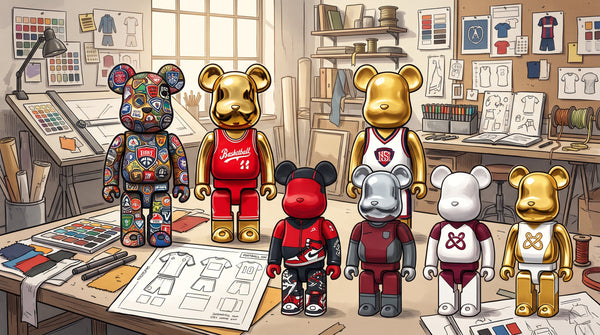
AI-generated conceptual editorial illustration created with Nano Banana. Imagined visual elements explain the essay; they do not document actual releases or gallery inventory.
In this essay
- A brand philosophy becomes a concrete design problem
- The 2017 release establishes a layered wearer
- The hem supplies another silhouette inside the silhouette
- 2018AW turns the centre line into a negotiation
- Asymmetry changes the lower body's rhythm
- The 2019 jacket has direct designer testimony
- The same outfit becomes another kind of image on the compact figure
- A seasonal archive can preserve relationships rather than fabric alone
- The familiar body makes garment differences visible
sacai's BE@RBRICK projects pose an unusually clear design question: how can a label associated with changing garment structure work on a body whose basic silhouette is already fixed? The answer in these releases is to make clothing relationships conspicuous. A padded-looking vest meets a blue lower layer and pale lace-like trim. An asymmetrical jacket combines contrasting panels and closures. A souvenir jacket places a bird motif and script across a compact torso. Each outfit changes how the same bear is read.
The figures preserve another constant as well. Their larger reference images show cream or off-white textured heads and paws with very simple dark eyes. This makes the clothing more than an all-over decorative field. The bear appears as a wearer, with a recognizable exposed body set against a sequence of different ensembles. The comparison concerns the organization of those ensembles, rather than an assumption that every tiny material is identical to the fabric used in human-sized clothing.
A brand philosophy becomes a concrete design problem
sacai's official account dates the label's founding by Chitose Abe in Tokyo to 1999. It describes hybridization through contrasting fabric textures and the reinterpretation of garment patterns, transforming familiar clothing into unexpected forms. This is the brand's own description of its approach. It gives the BE@RBRICK comparison a meaningful context without identifying every miniature panel as a copy of one particular runway garment. sacai's About page provides the primary statement.
The distinction between pattern as a clothing template and pattern as a repeated print is helpful here. A printed repeat can cover a fixed surface with motifs. A garment pattern establishes how pieces are shaped and joined to surround a body. The sacai figures introduce the appearance of shaped clothing around an already shaped toy. The outer garment lines can agree with the bear's joints, cross them or create another set of divisions that the viewer has to understand.
Hybridization becomes visible when neighboring areas suggest different clothing logics. A padded-looking upper layer and delicate hem can imply different weights and behaviors. A dark tailored-looking panel beside olive utility-like material creates another contrast. The viewer does not need to identify an exact fiber blend to notice these relationships. They are available in the release images as differences in color, texture, edge and arrangement, making the brand's general approach specific to the object.
The fixed bear also acts as a useful control in the comparison. The ears remain prominent; the head remains large relative to the torso; the arms and legs retain their simplified proportions. The garments must accommodate these features rather than relying on a human model's posture to establish their effect. A broad collar or lower hem therefore has a different relation to the body from the one it would have on an adult wearer. Adaptation is visible in those proportional negotiations.
The 2017 release establishes a layered wearer
MEDICOM TOY's 2017 sacai mixed-size announcement specifies approximately 70 and 280 millimetres and October plans. A separate 1000% announcement gives approximately 700 millimetres. Both distinguish the general planned month from a November 15 launch at the sacai Umeda Hankyu location. The larger format's page also names MEDICOM TOY PLUS among its sales locations. These details establish the project without requiring an assumed universal launch date.

In the larger reference, a cream textured head and paws sit above and beside a layered outfit. The upper garment resembles a padded vest, with beige or light grey and blue sections and small red zipper accents. Below it, a blue denim-like area meets a pale floral lace-like trim. Dark footwear provides a strong lower edge. The outfit combines several visual registers while keeping each distinguishable through its location and surface appearance.
The vest is important because it leaves the arms visually different from the torso. A full jacket could extend the same garment identity through both. Here the padded-looking central volume contrasts with the cream paws and exposed-looking upper body areas. The torso becomes a concentrated clothing structure, while the bear's own texture remains available around it. This establishes a clear relationship between wearer and garment even before the lower layer is examined.
The color blocking gives the vest an internal architecture. Blue supplies a strong cool area, while the paler sections separate it from the cream head. Red zipper tabs add small warm points that can attract attention without controlling the whole palette. Their limited scale matters. A small bright closure can make the garment seem specific, while broader color areas establish its shape. The design uses both large and small information to keep the miniature outfit readable.
The lower blue area changes the rhythm. It is less obviously padded and more garment-like in a different way, with the lace-like edge introducing an ornamental boundary. The eye moves from the vest's broad sections to a finer repeated pattern at the hem. The outfit does not rely on one dominant texture from top to bottom. Its identity emerges from the meeting of surfaces whose visual behaviors remain distinct.
The hem supplies another silhouette inside the silhouette
The pale trim does more than decorate a blue lower layer. Its irregular floral-looking edge establishes another outline within the standing bear's larger outline. The body may be mechanically regular, but the hem introduces small repetitions and openings that imply a more delicate structure. The contrast is particularly strong beside the broad padded-looking vest. One area reads through volume and blocks; the other through fine edge detail.
This relationship makes layering visible. An upper edge can appear to overlap a lower area, while the trim seems to finish another layer beneath it. The viewer builds a depth order from the meeting of these boundaries. That order does not require the bear to move. The release image already supplies enough cues to distinguish a garment above, a blue area below and a pale edge at the transition toward the legs.
The dark feet provide a final contrast rather than extending the pale trim downward. They anchor the ensemble visually, creating a decisive ending beneath a more intricate middle area. This helps balance the outfit's complexity. The head remains relatively simple, the torso introduces broad structure, the hem introduces fine detail and the feet restore a compact dark mass. The design gives the eye a sequence of different kinds of information along the body.
The cream bear texture also affects that sequence. It has a soft-looking, irregular surface that differs from both the smoother-looking vest panels and the fine hem motif. Three distinct surface languages therefore meet within a small area: the wearer's textured covering, the outer garment's broader structure and the lower layer's delicate edge. The comparison is more exact than saying that the bear simply wears a fashionable outfit. It identifies how the outfit establishes its character through contrasts.
2018AW turns the centre line into a negotiation
The sacai 2018AW mixed-size record gives approximately 70 and 280 millimetres with December 2018 plans and a MEDICOM TOY PLUS-exclusive context. The separate 1000% record gives approximately 700 millimetres. The seasonal wording belongs to the title. It should be preserved without automatically converting every visible element into a precisely identified runway look or garment model.

The larger image shows an asymmetrical arrangement of olive, dark tailored-looking panels, a blue collar, zippers and round button-like details. A pleated-looking olive section and a blue-and-white stripe accent add further distinctions below. The cream head and paws remain recognizable, providing continuity with the 2017 project. The clothing has changed more radically than the wearer, making its different internal organization especially easy to compare.
The central axis no longer behaves like one uncomplicated jacket opening. Different closure types and contrasting panels create several possible routes down the body. A zipper suggests one line of opening, while a row of buttons suggests another. The eye has to decide how these features relate within the ensemble. This is a specific form of hybridity: familiar garment cues remain individually legible while their coexistence complicates the expected structure.
The dark and olive areas contribute to that complexity through association as well as color. A dark smooth-looking panel can suggest tailoring, while olive and prominent zip details can suggest another clothing register. The image does not need a written explanation of every reference for the contrast to work. The viewer recognizes that the adjacent areas describe different kinds of garment behavior, then sees them assembled around one compact body.
The blue collar creates an additional interruption near the head. It introduces a cool accent at a boundary already occupied by cream texture and darker clothing. A collar ordinarily mediates between torso garment and exposed neck or head. Here that mediation is visually dense because the bear's proportions leave little neck space. The collar has to establish its presence in a compressed transition, adding another layer without obscuring the simple face above it.
Asymmetry changes the lower body's rhythm
The pleated-looking olive panel introduces repeated narrow divisions on one side of the lower body. Unlike the vest's broad color blocks, pleats imply a sequence of folds or fold-like lines. They create local directional activity that can run alongside the bear's standing legs without matching the body's mechanical division exactly. The garment thus supplies its own vertical rhythm within the platform's paired lower anatomy.
The stripe accent offers another repeated structure. A blue-and-white sequence reads differently from the olive pleats because its contrast comes strongly from color alternation. One passage can seem structured through folding, another through a graphic stripe. Their coexistence gives the ensemble several kinds of order, rather than one generalized patchwork effect. The viewer can distinguish a panel edge, a closure, a pleat and a stripe as separate contributions.
This makes 2018AW different from the 2017 outfit's more clearly stacked arrangement. In 2017, the eye moves through upper vest, blue lower layer and pale trim. In 2018AW, contrasting structures appear to interlock more laterally, with one side offering different information from the other. The bear's symmetry remains visible through its body, while the outfit introduces an asymmetrical reading across that symmetry. The tension between the two is central to the design.
The small dark eyes help maintain the wearer amid that complexity. A highly expressive painted face could compete with the panels and closures. The restrained facial treatment leaves the clothing as the principal field of detailed information. This does not make the bear anonymous; its textured cream head and rounded ears remain distinctive. It makes the relationship between a simple wearer and a complicated ensemble easier to perceive.
The 2019 jacket has direct designer testimony
The 2019 sacai mixed-size page specifies approximately 70 and 280 millimetres and July plans. A separate 1000% page gives approximately 700 millimetres. Both identify MEDICOM TOY PLUS as the sales context. The release references show the familiar cream textured head and paws with a two-tone jacket, dark trousers, a bird motif and sacai script on the chest, plus yellow footwear accents.

A direct interview with Chitose Abe gives this imagery a firmer identity than visual resemblance alone could supply. Discussing the July 2019 bear, she identifies a souvenir jacket combining its embroidery tradition with Dr. Woo's tattoo imagery. The interview describes the eagle motif and Abe's interest in faithfully reproducing the actual look. This is primary designer testimony about the project, rather than an inferred runway attribution. The 2019 OPENERS interview provides the account.
The jacket organizes contrast more economically than 2018AW. Tan and dark panels establish a clear relationship among sleeves, front and central opening. The bird supplies a concentrated pictorial event, while the script supplies an identifying word. The eye can read the garment as one coherent jacket before attending to those smaller details. The hybrid relationship now includes not only clothing structure, but a meeting between embroidery-associated imagery and tattoo-associated drawing.
The bird motif and script also occupy different descriptive roles. The bird is an image with internal directional movement; the word identifies the label through lettering. On a small chest, both have to coexist with the zipper and panel boundaries. Their placement shows how much information can be concentrated in a conventional garment area without turning the entire bear into an all-over print. The jacket remains a garment, and its applied imagery remains local.
Yellow at the feet provides a distant echo of the jacket's lighter warm area. It pulls attention downward and prevents the dark trousers from ending the figure in one undifferentiated mass. The head supplies another pale area above, so the dark clothing sits between several lighter accents. This distribution gives the ensemble a coherent whole-body balance while keeping its most specific descriptive content concentrated around the chest.
The same outfit becomes another kind of image on the compact figure
The mixed-size references introduce a particularly useful comparison within each project. The larger companion presents texture, layers and garment-like boundaries, while the compact 100% figure reproduces key clothing cues through graphics on its small body. The title groups the companions, but their images show that the route to recognition can differ. A garment detail that reads through an edge or surface on one can become a colored line or patch on the other.
The 2017 compact reference preserves the broad contrast among a pale head, blue clothing areas and lighter trim. The finer relationship of fluffy-looking texture, padded-looking volume and lace-like edge is condensed. The compact figure needs enough information to evoke the ensemble without reproducing every local surface relationship in the same way. This is a design selection problem: the overall outfit has to remain recognizable after some kinds of detail become less prominent.
The 2018AW compact figure faces a different selection problem because asymmetry and multiple closure cues are central. Its printed treatment has to preserve the impression that different garment structures meet across the body. Dark and olive areas, pale facial markings and small closure-like lines carry that identity. The reduction is not simply a uniform shrinking of information. Some features become especially important because they distinguish this ensemble from the more straightforward stacked layers of 2017.
In the 2019 compact reference, the two-tone jacket and chest imagery supply the clearest cues. A bird-like mark and script can remain local signs even when the garment's texture is less available. The relationship between graphic and clothing is therefore already present within one release pair. The larger figure shows an outfit with applied imagery; the smaller one uses imagery to show an outfit. That reversal is one of the collection's most revealing design operations.
A seasonal archive can preserve relationships rather than fabric alone
In the same interview, Abe describes representative seasonal looks becoming collectible as an archive, and says dressing the figure allows sacai to take on a different expression. These remarks give the project an explicit designer-led rationale. The bear is not merely an empty place for a logo. It preserves recognizable relationships within an outfit while changing the body that wears it. That is a more specific account than assuming the objects exist only to advertise the label.
The idea of an archive also clarifies what is preserved. A miniature may retain the contrast between a padded vest and fine trim, the meeting of asymmetric panels or a distinctive jacket image. Those relationships can matter even when the short release page does not give an exhaustive textile specification. The archive is visual and structural as well as material. It records how an outfit is organized, while the receiving bear introduces another set of proportions.
This makes the seasonal title important without making it sufficient. “2018AW” locates one project in a named season, but the title alone does not explain its asymmetry, collar, pleats or closures. The image supplies those details. Conversely, a visual resemblance to a runway garment does not by itself supply an exact look number. The strongest comparison uses the title to establish the project and the designer's testimony to explain the broader ambition, then looks closely at the outfit itself.
The archive also changes the relation between fashion and time. Human clothing is encountered through dressing, movement and changes of occasion. These figures hold a selected ensemble in a stable presentation. What remains available for comparison is the arrangement of parts: where a panel changes, how a hem ends, which motif occupies the chest. The standing bear makes those relationships persistent and comparable across the three documented projects, even though it cannot reproduce a human wearer's gait.
The title's fixed silhouette needs one qualification. Clothing can change the visible outer profile: a broad vest, a projecting hem or a collar adds its own edges around the body. What remains fixed for this comparison is the underlying platform's recognizable anatomy. The garments can modify its presentation without turning the ears, head and limbs into a human model. This gives the adaptation two related tasks. It has to make an outfit legible, and it has to negotiate the persistent form that the viewer still recognizes beneath it.
The cream head is a particularly effective point of negotiation. Its rounded ears make the wearer unmistakably bear-like, while its simple eyes avoid a competing narrative identity. The outfit does not need to persuade the viewer that this is a particular human celebrity or fictional person. Instead, the same uncomplicated wearer can host several complex clothing propositions. This keeps the comparison focused on the garments' relationships, while the textured surface gives the exposed body a distinct visual presence of its own.
Seen beside 2018AW, this also distinguishes two forms of complexity. One ensemble becomes intricate through the meeting of contrasting panels and closure systems. The other retains a more immediately coherent jacket structure and concentrates additional meaning in its chest imagery. Hybridization can therefore operate through construction-like relationships or through the meeting of garment tradition and another image-making vocabulary. The three projects provide concrete examples of these possibilities, rather than one generalized claim that combining more details automatically produces a stronger design.
The familiar body makes garment differences visible
The six release pages establish three related image families and their mixed-size and separate larger formats. The 2017 project's layered vest and trim, 2018AW's asymmetrical panels and the 2019 souvenir jacket are not interchangeable examples of “sacai style.” They stage distinct relationships among volume, edge, texture, closure and applied image. The recurring cream wearer helps hold the comparison together, allowing changes in the clothing to remain the main subject.
The BE@RBRICK Index makes that small archive available for close reading. The bear's fixed proportions do not prevent garment experimentation; they make the translation especially apparent. A fine hem meets a broad vest, a zipper meets a buttoned panel, and tattoo-associated bird imagery enters a souvenir jacket. Each project preserves a recognizable clothing relationship while allowing the familiar figure to give it another expression.
BE@RBRICK master index: This index is in beta and may contain errors, missing information, or display issues. We’re continuing to review and improve it.
Continue exploring
Browse the BEARBRICK essay library or continue with these related studies.
Shop BE@RBRICK
Explore current pieces available from the gallery.
-

BE@RBRICK Shepard Fairey Make Art Not War 400% + 100% Set
$225.00 USD
-

BE@RBRICK The Doors Strange Days 400% + 100% Set
$203.00 USD
-

BE@RBRICK Emotionally Unavailable Gradient Heart 400% + 100% Set
$299.00 USD
-

BE@RBRICK Oasis Noel Gallagher — Knebworth 1996 400% + 100% Set
$110.00 USD
-

BE@RBRICK PAC-MAN × GRAFFLEX × 9090 × S.H.I.P&crew 400% + 100% Set
$110.00 USD
-
BE@RBRICK Brandalism Highwayman 400% Medicom Toy Sync 2022
$228.85 USD


Browse the collection for current listings.