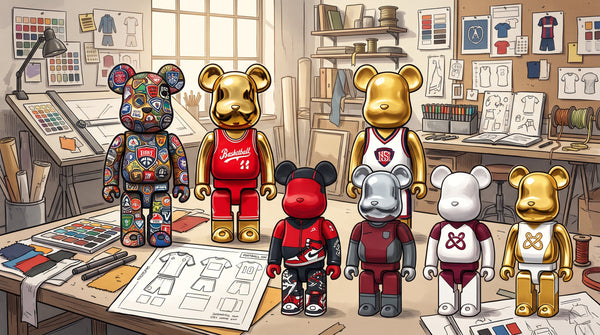
AI-generated conceptual editorial illustration created with Nano Banana. Imagined visual elements explain the essay; they do not document actual releases or gallery inventory.
In this essay
- Character recognition survives a change of body
- Elmo uses texture as a continuous field
- Cookie Monster changes the face within a related approach
- Pooh makes the material wording unusually precise
- Flocking offers a useful comparison without becoming Costume
- Paddington uses clothing to create an outer silhouette
- Stitch makes expression compete with the platform's face
- Painted Aardman figures clarify what texture adds
- Mastermind turns Costume toward a graphic mascot
- Sean Wotherspoon makes the bear a wearer of an outfit
- A garment can sit inside another character translation
- Texture changes the edge as well as the surface
- Keep the different kinds of covering visible
Costume BE@RBRICKs change the way a character occupies the bear platform. An outer covering can soften an edge, add a shaggy-looking surface or suggest an outfit with its own sleeves, cuffs and collar. The familiar head and limbs remain underneath the visual reading, but the viewer encounters another silhouette around them. Character identity now depends on the relationship between body, covering and face.
The word Costume does not establish one universal fabric. MEDICOM names pile fabric explicitly for a Winnie the Pooh version, while other announcements identify Costume editions without giving a complete fiber or construction specification. The release images still allow useful comparisons: Elmo's red texture, Cookie Monster's blue exterior, Paddington's coat and hat, Stitch's expressive face, Mastermind's black covering and Sean Wotherspoon's outfit all organize the platform differently.
The most revealing question is what the added surface does. Does it make the figure read as a furry character, a clothed bear, a graphic mascot or a miniature wearer of fashion? Comparing those roles explains more than treating every textured project as the same format.
Character recognition survives a change of body
Sesame Workshop introduces Elmo through his red color, curiosity and friendly character, while placing him within Sesame Street's wider educational world. Its anniversary account dates the show's debut to 1969. The producer's character context helps explain what can remain recognizable when the body changes: a color, a face and a small set of expressive cues can carry considerable identity.
The original character's proportions do not have to be reproduced exactly for those cues to work. A bear-shaped head can carry familiar eyes and a nose while remaining visibly different from the character's usual anatomy. Costume editions make that difference especially apparent because their coverings can suggest a physical character exterior rather than only a flat image.
Recognition therefore operates at several levels. The outline identifies a BE@RBRICK. The covering suggests fur, clothing or another outer surface. The face establishes a particular character or persona. A successful composition allows these levels to coexist, even where they pull the viewer toward different kinds of object.
This is a form of translation with deliberate constraints. The bear's round ears, broad muzzle area and compact limbs create recurring problems. The exact way a costume meets those regions determines whether the figure's anatomy becomes more prominent or recedes behind the character image.
Elmo uses texture as a continuous field
MEDICOM's Elmo Costume 1000% announcement specified January 2020 release and shipping plans, with an approximate height of 700 millimeters. It explicitly described an Elmo costume version and qualified the release photographs as samples that could differ from eventual products. The exact notice establishes the edition without supplying a detailed textile recipe.

In the release image, a shaggy-looking red exterior continues across the ears, head, torso, arms and legs. Large white eyes, an orange nose and a curved dark mouth provide distinct shapes within that field. The face is legible because its components contrast strongly with the surrounding texture.
The continuity of red is important. It links body regions that the underlying platform divides into separate components. An arm and torso remain different volumes, but the shared exterior lets the eye connect them as one character surface. Texture becomes a way to hold the figure together.
The facial elements operate differently from the red field. Their comparatively clear boundaries create a hierarchy: first the red body, then the prominent face, then smaller changes of contour. The bear remains recognizable, yet the costume gives its anatomy another reading as a familiar red monster.
The design does not need a detailed costume printed over the torso to establish identity. Its principal information is concentrated in color, texture and facial arrangement. That restraint makes Elmo a useful starting point for comparing editions in which clothing or a graphic emblem takes a larger role.
Cookie Monster changes the face within a related approach
The Cookie Monster Costume 1000% notice specified February 2021 and approximately 700 millimeters. It identified the character's Costume version and carried a sample-photograph qualification. The release announcement documents a separate project, even though its broad textured-body approach invites comparison with Elmo.

The reference shows a blue exterior with large white eyes, differently directed dark pupils and an open curved mouth. The face has fewer strongly differentiated color elements than Elmo's orange-nosed arrangement. Eye placement and the mouth's broad shape therefore carry more of the character-specific information.
Sesame Workshop's own Cookie Monster account emphasizes his appetite along with sharing, cooperation and healthy habits. That character description provides background for the familiar persona. It does not mean that the collectible's surface can communicate every part of that personality. The visible design relies on a much smaller vocabulary of color, eyes, mouth and texture.
Comparing Elmo and Cookie Monster shows how much can change within a shared body format. Both use a continuous textured-looking exterior and a strongly marked face, yet the face is organized differently. The distinction remains clear without requiring the bear to reproduce each character's usual body proportions.
The blue field also changes the effect of the white eyes. They become isolated bright circles above a dark mouth, establishing a quick route to recognition. Texture surrounds that arrangement and gives it a character-like setting, while the placement of the features supplies the more specific identity.
Pooh makes the material wording unusually precise
The Winnie the Pooh COSTUME Ver. (PILE FABRIC) 400% announcement specified September 2024 release and shipping plans and approximately 280 millimeters. The Japanese text also identifies pile fabric. The exact Pooh source therefore supports a more specific material description than the word Costume alone.

The release image shows yellow texture across the body, with small dark facial features and a cropped red shirt. Two different kinds of covering are visually apparent: the yellow character exterior and the distinct garment over the torso. The shirt creates its own edge within the larger bear silhouette.
This changes the hierarchy established by Elmo and Cookie Monster. Their textured bodies read largely as continuous fields, interrupted most strongly by the face. Pooh's red shirt introduces another major division. The eye moves from face to garment, then back to yellow arms and lower body.
The shirt also makes the bear platform participate in a familiar clothed-character arrangement. Short sleeves and a lower garment edge can be read as clothing boundaries, while the yellow surface continues beyond them. The figure becomes both a character-shaped exterior and a wearer of a separate outfit.
Pile fabric matters here because it is documented, but it should not erase the visual argument. The interest lies in how yellow texture and red clothing divide the form. A material label becomes more useful when connected to what that material allows the viewer to recognize on this particular body.
Flocking offers a useful comparison without becoming Costume
MEDICOM's Gizmo and Stripe 2PACK announcement specified February 2011, two 100% figures of approximately 70 millimeters each, and a flocked treatment for Gizmo. The two-pack source supplies that exact distinction. It should not be converted into a claim that every Gizmo release shares one surface construction.
The Gizmo reference shows brown-and-white character markings and prominent eyes. Texture is associated with the figure's exterior, but the record names flocking rather than a Costume version. The comparison makes an important design distinction: several treatments can suggest fur, while doing so through different documented formats.
The separate Gizmo 400% announcement specified November 27, 2010, and approximately 280 millimeters. That source identifies its size and release context without extending the two-pack's flocking statement to it. Its brown-and-white image gives the character another way to occupy the platform.
Gizmo's contrasting facial and body areas provide recognizable structure across the bear anatomy. Brown can frame the face while white defines another region of the chest or limbs. The arrangement can suggest a fur pattern through color boundaries, regardless of whether a particular source separately documents a textured treatment.
This is why visual softness and a material specification should remain connected but distinct. A character can look furry through printed markings, a flocked exterior or a named costume. Each can preserve related identity cues while changing the way the surface is encountered.
Paddington uses clothing to create an outer silhouette
The Paddington Costume 1000% notice specified November 2024, approximately 700 millimeters and a November 23 store release statement. The manufacturer announcement identifies the Costume project. Its reference shows a red hat and blue coat around a brown bear face and paws.
The clothing has a different role from a continuous fur-like covering. A hat changes the upper outline, while a coat establishes a broad colored field across the torso and arms. The costume does not simply replace the bear's surface; it adds recognizable garment shapes around it.
The face remains framed by those garments. Brown and cream facial areas are read beneath the red hat, giving the head an arrangement different from an undecorated BE@RBRICK face. The viewer encounters a clothed persona rather than only a bear covered with another character's markings.
Pocket outlines and toggle-like details in the reference reinforce the coat's identity. These marks work at a smaller scale than the large blue field, allowing the garment to remain recognizable both as a block of color and as a particular kind of outfit.
Paddington also demonstrates how clothing can preserve the underlying platform while changing its apparent proportions. The coat gives the upper body greater visual continuity, and the hat changes how the top of the head is read. The familiar paws and feet keep the overall figure connected to the bear form beneath the outfit.
Stitch makes expression compete with the platform's face
The Stitch Costume 1000% announcement specified November 2025 release and shipping plans and approximately 700 millimeters. It named the character from Lilo & Stitch: The Series and qualified the pictured sample. The exact source establishes the version context.
In the reference, a blue costume surrounds a face with one open eye, a wink, a prominent dark nose and a wide mouth with pointed white teeth. Pink inner-ear areas and a paler chest contribute additional contrast. The expression supplies far more internal activity than a simple neutral face.
This places several competing shapes on the bear's broad head. The open eye and wink create asymmetry. The nose forms a strong central area, while the mouth stretches beneath it. The face can suggest a lively character without altering the platform into a fully different head shape.
The chest patch provides a quieter counterpart to that busy face. It lets the torso participate in the character image without introducing another equally complex scene. Large color areas and smaller expressive details have different roles within the same costume.
The adaptation is therefore a useful contrast to Paddington. One depends heavily on recognizable clothing around a relatively calm face; the other concentrates energy within facial expression and body color. Both use the Costume designation, yet their visual strategies remain distinct.
Painted Aardman figures clarify what texture adds
The Gromit 100% and 400% set announcement specified June 2021 and approximate heights of 70 and 280 millimeters. The Shaun set specified September 2021 with the same size pair. Their sources name the characters and mixed-size configurations without labeling these particular releases Costume. The Gromit and Shaun records are useful visual comparisons for that reason.
Gromit's reference uses a cream field, a dark nose, wide eyes and contrasting ear-edge graphics. The official Wallace & Gromit site describes the character as intelligent and mute, emphasizing his nonverbal identity. The character owner's account gives context for a figure whose expression must be conveyed without speech.
The bear adaptation concentrates that expression in the face while retaining a relatively simple body field. It shows how a character can remain recognizable through graphic arrangement alone. A textured costume would introduce another layer of information, but it is not a prerequisite for identity.
Shaun's reference places curled linework over pale torso and upper-leg areas, alongside a dark head, arms and lower legs. The image suggests fleece through a graphic pattern. It provides a particularly useful distinction between a drawing of texture and an exterior that appears physically textured.
Placed beside the Costume examples, these figures make the translation problem clearer. Surface pattern can suggest a material, while an added covering can change the actual visible contour. The two approaches can produce related character cues through different visual means.
Mastermind turns Costume toward a graphic mascot
The mastermind JAPAN Costume 1000% notice specified September 2024 and approximately 700 millimeters. The exact project announcement establishes the edition without supplying a complete textile specification. Its reference uses a black textured-looking exterior, a small pale nose area, white forearm bands and a large skull-and-crossbones patch on the torso.
The face is comparatively restrained, allowing the emblem to become a principal point of recognition. This differs from the Sesame Street and Stitch examples, where facial features dominate. The body carries much of the visual identity through a conspicuous graphic sign.
Black texture helps connect the components into a continuous mascot-like form, while pale bands introduce controlled interruptions. The skull image occupies a bounded central region, making the torso a place to read a symbol rather than a garment's folds or a character's anatomy.
The comparison expands what Costume can mean within the platform. It can support a familiar animated character, a clothed literary bear or a brand-linked mascot. A shared commercial designation leaves room for substantially different hierarchies of face, emblem and surface.
Sean Wotherspoon makes the bear a wearer of an outfit
The Sean Wotherspoon Costume 400% announcement specified June 2026 and approximately 280 millimeters, with named MEDICOM and Sean Wotherspoon retail channels. That release notice identifies the exact project. The reference shows a teal head, hands and feet surrounding a sweatshirt-and-trouser composition.
The pictured sweatshirt combines a light gray field with a burgundy hood, cuffs, hem and front pocket. Small lettering appears on the pocket, while dark trousers establish another large division below. The outfit has a visual structure that can be read independently of the bear's face.
Teal exposed areas clarify the difference between wearer and garment. The head and extremities belong to a continuous underlying persona, while the outfit occupies the middle regions. This is another route to translation: the bear becomes a figure dressed in a recognizable fashion arrangement rather than a replacement anatomy for a named creature.
The garment details introduce their own scale. A pocket, cuff or hem can become a small bounded shape within the larger silhouette. Their placement matters because the bear's proportions differ from a human wearer's. The outfit has to remain legible while accommodating the short torso and compact limbs.
Compared with Mastermind, the emphasis shifts from a central emblem toward the organization of an ensemble. Both are Costume projects, but one concentrates identity in a large graphic sign while the other distributes it through several garment regions and their color relationships.
A garment can sit inside another character translation
Pooh and Paddington make a further distinction visible: a character can have an outer surface and also appear to wear clothing. The yellow pile-fabric Pooh body supplies one level of identity, while the red shirt supplies another. The shirt is understood as something worn by the character, even though both belong to the manufactured collectible.
This creates a nested reading. The viewer recognizes the bear platform, reads its yellow exterior as Pooh and then interprets the red region as Pooh's shirt. Each level depends on the previous one remaining sufficiently clear. If the shirt absorbed the whole silhouette, the yellow character exterior would become less apparent; if the yellow surface ignored the shirt, a familiar part of the image would disappear.
Paddington develops the relationship through larger garment shapes. Hat and coat frame the brown character areas, leaving the face and paws to establish the wearer. The outfit contributes substantially to the outer outline. The figure can remain recognizable as a clothed bear even where the original platform's body divisions become less prominent.
Sean Wotherspoon's project gives this arrangement a different emphasis because the outfit itself is the principal subject of close attention. The teal areas establish a wearer, while hood, pocket, cuffs and trousers organize the middle of the body. The viewer is invited to read an ensemble across unfamiliar proportions rather than identify a named furry creature through a continuous exterior.
These distinctions change what a costume needs to accomplish. A character-body covering connects separate limbs through one visual skin. A garment introduces new boundaries within that skin or around it. A complete outfit can distribute identity across several coordinated regions. The same commercial word can accommodate all three approaches, which is why the specific figure deserves a more precise description.
Looking for those levels also makes comparison less dependent on surface adjectives such as soft, furry or plush-looking. Those words describe an impression but leave the organization unexplained. The stronger question is where the covering belongs in the character image: as the character's exterior, as clothing worn by that character, or as an outfit that makes the bear into a new kind of wearer.
Texture changes the edge as well as the surface
A textured-looking covering can affect the figure at two scales. Close up, it creates many small variations of light and shadow. At the outer edge, it can soften the boundary that would otherwise read as a continuous smooth contour. Those effects give a familiar outline another kind of presence.
Elmo and Cookie Monster make the continuous covering especially important, while Paddington's hat and coat introduce more distinct outer boundaries. Pooh combines a documented pile-fabric character exterior with a separate-looking shirt. The costume's role can therefore be understood through both its local texture and its larger organization around the body.
The face has to remain readable within that organization. Large eyes, a nose or an open mouth can supply clear shapes against a busy exterior. A restrained face can instead allow clothing or a torso emblem to lead. The relationship between feature size and surrounding texture becomes part of the character translation.
Keep the different kinds of covering visible
The selected projects establish a useful set of distinctions: a continuous character exterior, an explicitly documented pile-fabric version, a clothed bear, a strongly expressive face, a brand-linked mascot and a fashion outfit. Painted and flocked comparisons show how related cues can be carried through other surfaces.
The BE@RBRICK master index keeps those exact titles and source configurations available. Costume, PILE FABRIC and a documented flocking statement each preserve information that a generic description such as “furry bear” would lose.
The design interest lies in what remains recognizable through the change. A red field and an orange nose, a blue exterior and broad mouth, a hat and coat, a skull emblem or a carefully divided outfit can each reorganize the same basic body. The covering gives character identity another set of tools while leaving the bear platform available to be recognized beneath it.
BE@RBRICK master index: This index is in beta and may contain errors, missing information, or display issues. We’re continuing to review and improve it.
Continue exploring
Browse the BEARBRICK essay library or continue with these related studies.
- READYMADE BE@RBRICK: Utility Clothing References and Collaborative Bodies
- Gremlins and Aardman BE@RBRICK: Texture, Ears, and Stop-Motion Character Design
- Winnie the Pooh, Stitch, and Disney BE@RBRICK: Three Ways to Suggest Softness
Primary release and background sources
- Sesame Street’s 50th Anniversary
- BE@RBRICK ELMO Costume Ver.1000%
- BE@RBRICK COOKIE MONSTER Costume Ver. 1000%
- Cookie Monster
- BE@RBRICK Winnie the Pooh COSTUME Ver.(PILE FABRIC) 400%
- BE@RBRICK GIZMO & STRIPE 2PACK
- BE@RBRICK GIZMO 400%
- BE@RBRICK Paddington(TM) COSTUME Ver. 1000%
- BE@RBRICK STITCH COSTUME Ver. 1000%
- BE@RBRICK GROMIT 100% & 400%
- BE@RBRICK Shaun 100% & 400%
- Gromit Releasing an Autobiography! — June 19, 2026
- BE@RBRICK mastermind JAPAN COSTUME Ver. 1000%
- BE@RBRICK Sean Wotherspoon COSTUME Ver. 400%
Shop BE@RBRICK
Explore current pieces available from the gallery.
-

BE@RBRICK Shepard Fairey Make Art Not War 400% + 100% Set
$225.00 USD
-

BE@RBRICK The Doors Strange Days 400% + 100% Set
$203.00 USD
-

BE@RBRICK Emotionally Unavailable Gradient Heart 400% + 100% Set
$299.00 USD
-

BE@RBRICK Oasis Noel Gallagher — Knebworth 1996 400% + 100% Set
$110.00 USD
-

BE@RBRICK PAC-MAN × GRAFFLEX × 9090 × S.H.I.P&crew 400% + 100% Set
$110.00 USD
-
BE@RBRICK Brandalism Highwayman 400% Medicom Toy Sync 2022
$228.85 USD


Browse the collection for current listings.