The Gap Is Real: Understanding Why a Fairey Hand-Signed Print Can Be Worth Ten Times an Open Edition
Two Shepard Fairey prints. Same image. Same size. Same paper stock. One sells for $80. One sells for $800. Sometimes more.
Collectors who are new to the OBEY Giant market see that gap and assume something is wrong. A mistake in the listing. A seller inflating value.
Nothing is wrong. The gap is real, and it is structural. Once you understand why, you will never look at a Fairey print the same way again.
This is a price education, not a marketing pitch. We are going to walk through exactly what separates an open edition commercial print from a hand-signed Fairey, how authentication works in a market where there is no artist-issued COA, and where the traps are for buyers who do not know the terrain.
First: What Fairey Does Not Have
Let's get the authentication framework out of the way immediately, because it shapes everything downstream.
Shepard Fairey does not issue a formal certificate of authenticity for his prints. There is no OBEY Giant authentication office. There is no third-party COA program endorsed by the artist the way Banksy uses Pest Control or the way Death NYC requires a studio-signed COA with a gold seal.
This surprises a lot of people. It should not stop you from collecting. It should make you smarter about what you are actually buying.
Authentication in the Fairey market rests on three interlocking pillars:
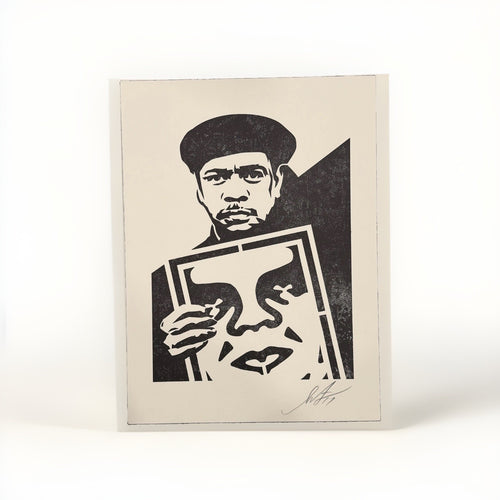
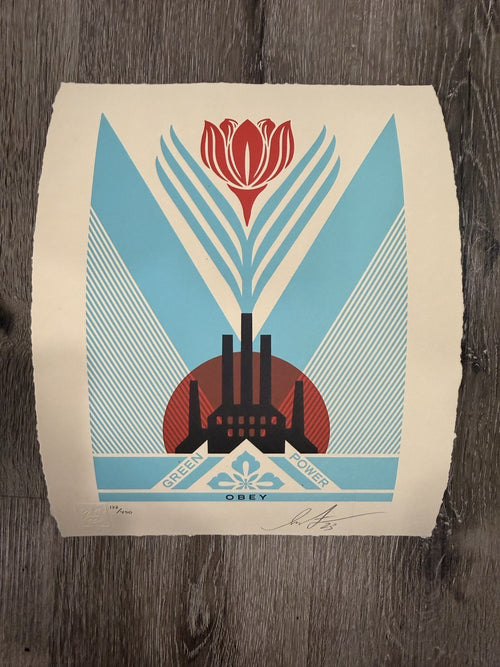
- The signature itself — hand-signed in pencil or pen, typically on the lower right margin, sometimes with numbering on limited editions
- Edition numbering — for numbered editions, the fraction (e.g., 45/450) must match documented release quantities
- Provenance chain and Obey Giant drop record — the release history maintained through obeygiant.com, documented drops, and verifiable purchase records back to the original release
When all three align, the piece is as authenticated as the market can make it. When one is missing or questionable, price should reflect that uncertainty.
If there is no drop record match and the signature cannot be cross-referenced against documented examples, why are you paying signed prices?
The Open Edition: What It Actually Is
Open editions are not lesser art. Let's be precise about what the term means.
An open edition print is produced without a predetermined quantity cap. Fairey — like many street artists who built their practice on the idea of wide distribution — has used open editions as a deliberate tool. Accessibility is part of the philosophy. The OBEY aesthetic was never meant to live only in the hands of wealthy collectors.
Open editions come in several forms in the Fairey catalog:
Commercially Released Prints
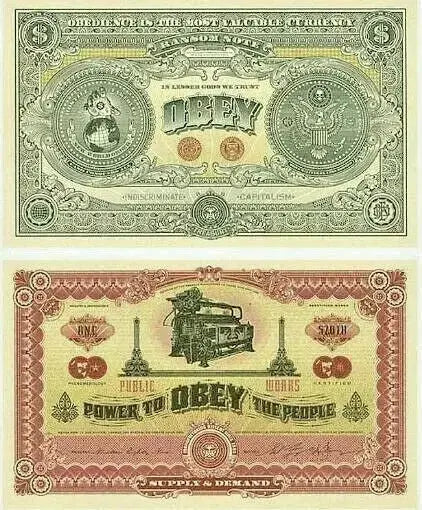
These are posters and prints released through obeygiant.com or through retail partners at accessible price points. They are often offset lithographs or digital prints on quality paper. They are not signed. They are not numbered. They are produced to meet demand.
The market for these reflects exactly what they are: entry-level, accessible, genuine Fairey imagery without the scarcity factor.
Promotional and Exhibition Prints
Fairey has produced enormous volumes of promotional material over decades of exhibitions, gallery shows, and street campaigns. Some of these were given away. Some were sold at low price points at events. Many are unsigned. Some show up years later in estate sales and online marketplaces with sellers unsure of exactly what they have.
Bootleg and Counterfeit Product
This is the category that trips up buyers. The Fairey market — precisely because his imagery is so widely reproduced in his own open edition work — has a counterfeit problem. The visual language of OBEY is so familiar that fake prints can circulate without immediate detection.
FBI Operation Bullpen, which in the early 2000s dismantled one of the largest sports memorabilia forgery networks in American history, taught the authentication world a lasting lesson: volume and familiarity create forgery opportunity. The same logic applies here. The more widely reproduced an artist's imagery, the more cover exists for fakes.
Open editions are not inherently fake. But fake prints almost always present as open editions because there is no numbered edition record to check against.
The Hand-Signed Print: Where the Value Lives
Now we get to the price engine.
A hand-signed Fairey print in a documented limited edition is a different object in every sense that matters to the secondary market.
Scarcity Is Real and Documentable
When Fairey releases a limited edition — say, a screen print in an edition of 450 — that number is the ceiling. The drop goes live on obeygiant.com, sells through (often within minutes), and the edition is done. The release record is public. The edition size is known. Collectors who got in at release have documentation.
Every subsequent resale of that print can be checked against the release record. Does the edition number fall within the documented run? Does the paper, ink, and production method match what was released? These are answerable questions.
Open editions cannot offer this. By definition, there is no ceiling to verify against.
The Signature Is the Scarcity Layer
This is the part that is hardest to communicate to buyers coming from other collecting categories.
In the Fairey market, the signature is not just a provenance marker. It is the primary scarcity mechanism. Fairey has produced an enormous body of work. Most of it is unsigned. The signed limited editions represent a fraction of the total output — and within that fraction, the screen prints on quality paper in small editions represent a fraction of a fraction.
That is where secondary market premiums live.
You are not paying ten times as much for the ink of a signature — you are paying for the documented, verifiable, limited supply that the signature represents.
Secondary Market Behavior
On the resale market — auction houses, reputable galleries, secondary dealers — the signed limited edition Faireys from significant release windows trade at multiples of their original retail. The most sought-after editions, particularly those tied to cultural moments or exhibitions with documented short print runs, can trade at significant premiums.
Open editions from the same period? They move, but at a fraction of those prices. Sometimes at prices below the original retail for prints that were mass-produced.
The gap is not arbitrary. It is a direct function of supply, documentation, and the authentication framework described above.
Screen Print vs. Offset vs. Digital: The Production Hierarchy
Within the signed edition market, production method creates another pricing tier that many buyers do not fully understand.
| Production Method | Typical Use | Edition Structure | Market Position |
|---|---|---|---|
| Hand-pulled screen print | Limited gallery editions | Numbered, signed | Highest tier |
| Offset lithograph | Larger editions, exhibitions | Sometimes numbered, sometimes signed | Mid tier |
| Digital / giclee | Open editions, commercial releases | Often unsigned, unnumbered | Entry tier |
A hand-pulled screen print — made with physical screens, squeegeed by hand or under direct artist supervision, often in multiple passes for layered color — carries intrinsic production value that an offset lithograph does not. The tactile quality is different. The ink sits on the paper differently. Experienced collectors can often feel the difference before they can articulate it.
When you see a Fairey listed as a "signed screen print," you are looking at the production method that commands the highest premiums. Signed offset lithographs are a step below. Signed giclees below that.
Has the seller actually confirmed what they are selling, or are they using "print" as a catch-all and hoping you do not notice?
How to Verify a Fairey Without a COA
Here is the practical workflow. This is what experienced collectors and reputable dealers do before buying a hand-signed Fairey in the secondary market.
-
Check the Obey Giant drop record
- obeygiant.com maintains release archives. The image, edition size, release date, and pricing are often preserved in the historical record.
- Match the edition number on the print to the documented run. If a print claims to be 45/200 but the documented edition was 450, something is wrong.
-
Examine the signature against documented examples
- Fairey's signature has evolved over time but maintains consistent characteristics. Cross-reference against auction house catalog images from verified sales.
- Christie's, Heritage Auctions, and Artsy all maintain image archives of sold Fairey lots with clear photography of signatures.
- Do not rely on a single reference. Compare against multiple documented examples from the same approximate period.
-
Evaluate the physical print
- Paper quality, ink density, registration (alignment of colors in screen prints) — all of these should match documented production standards for the edition.
- Counterfeit prints often fail on paper weight and ink saturation before they fail on anything else.
-
Build the provenance chain
- Original purchase receipt from obeygiant.com or a documented gallery drop is the gold standard.
- Subsequent ownership transfers should be documented as fully as possible.
- A print with a clear, unbroken chain back to the original release is worth more than an identical print with a murky "bought from a collector" history.
-
Use third-party authentication where stakes are high
- For high-value signed pieces, PSA (Professional Sports Authenticator) authenticates autographs including fine art signatures. PSA's certification covers the signature only — it does not authenticate the print's edition legitimacy or production provenance.
- JSA (James Spence Authentication) offers two distinct levels: JSA Basic (witnessed signature only) and a full Letter of Authenticity (JSA LOA), which involves more detailed analysis. Know which you are getting — the difference matters.
- Beckett Authentication Services (BAS) also authenticates signatures in the fine art category. For music or entertainment crossover pieces (a Fairey piece signed by both the artist and a musician, for example), the Roger Epperson REAL division within BAS is the specialist tier.
- PSA has itself warned collectors to verify that certification numbers on PSA labels are genuine — counterfeit PSA labels exist. Always verify a certification number directly on the PSA website before relying on it.
The Edition Size Spectrum: Why 50 and 450 Are Not the Same Market
Fairey has worked across a wide range of edition sizes throughout his career. Understanding where a specific print falls on that spectrum is essential to pricing it correctly.
Small Editions: Under 100
These are the rarest documented releases. Often tied to specific gallery exhibitions, artist proof variants, or special collaboration projects. The secondary market for these is tightest, prices are highest, and the demand from serious collectors is most concentrated.
Artist Proof (AP) designations within these runs — typically a small number reserved outside the main edition — can command premiums even above the standard edition numbers.
Mid-Range Editions: 100 to 300
The most common territory for Fairey's screen print limited releases. These drops sell through quickly at retail. On the secondary market, condition, provenance documentation, and cultural relevance of the specific image drive the price differential within this tier.
Larger Editions: 300 to 500+
Still signed and numbered, but with a larger supply ceiling. These are more accessible on the secondary market and trade at lower multiples over original retail. Not a lesser investment category necessarily, but a different one.
Open Editions vs. All of the Above
An open edition print, regardless of how culturally significant the image, cannot compete on the scarcity axis with any of the above. It is a categorically different product in market terms.
Sellers who present open editions without making this distinction clear are either uninformed or hoping you are.
Condition: The Variable That Overrides Everything
Two hand-signed Faireys in the same edition. Same image. Same number. One has a moisture stain in the lower margin. One is in near-mint condition with no handling marks.
These are not the same price. Not even close.
Condition grading in the street art print market borrows loosely from the print collecting world, but it is not as formally standardized as, say, the PSA grading scale for cards. What the market has settled on in practice:
- Near Mint / Mint: No visible flaws. No handling marks. Margins intact. No foxing, no fading, no scratches to the ink. Original tube or flat shipping packaging is a plus.
- Very Fine: Minor signs of handling. Possibly a small handling crease in a non-image area. Color and ink integrity fully intact.
- Fine: Noticeable but not severe condition issues. Priced accordingly.
- Good or Below: Meaningful damage. Significant price discount required for the piece to make sense as a purchase.
Fairey prints that were purchased at drops, kept rolled in archival tubes or flat in protective sleeves, and never framed in ways that exposed them to UV damage or moisture represent the condition ceiling. Those are the pieces that achieve top secondary market results.
If a seller cannot tell you how the print was stored for the last decade, what exactly are you being asked to trust?
The Cultural Relevance Premium
Not all Fairey images are created equal in the secondary market, even within identical edition parameters.
The Hope portrait, the Andre the Giant imagery, prints tied to specific political or cultural moments — these carry what the market recognizes as a cultural relevance premium. They are more broadly recognized. They are more frequently sought by collectors outside the street art specialist category. Museum attention, media coverage, and art historical positioning all feed into this premium.
A less-recognized image in an identical edition, from the same period, with the same production quality, will trade below the more culturally prominent piece. This is not irrational. It reflects genuine demand differential.
Understanding where a specific print sits in the Fairey cultural catalog — not just the edition record — is part of pricing it correctly.
Red Flags
Before you buy any Fairey print represented as a hand-signed limited edition, check this list.
- No verifiable drop record match. If the edition cannot be located in the Obey Giant release archive or through documented gallery records, the edition number is unverifiable. Walk away or pay open-edition prices.
- Signature that does not match period-appropriate documented examples. Fairey's signature is consistent enough within periods that significant deviation is a red flag, not a quirk.
- Paper that feels wrong. Counterfeit prints frequently fail on substrate. If the paper feels lighter or different in texture than documented production standards, take it seriously.
- Edition number outside the documented run. A print numbered 380/200 is impossible. More subtle errors — a print in a documented edition of 200 appearing with an unusually high number — warrant hard questions.
- A COA from an unknown or unverifiable source. Remember, there is no official Fairey COA system. A COA from an organization that cannot be independently verified adds nothing and may be an attempt to compensate for a weak provenance chain.
- PSA or JSA certification without verifiable certification numbers. Counterfeit authentication labels exist. Always verify directly through the authenticator's website.
- Provenance that starts with "bought from a collector" with no further documentation. This is not inherently fraudulent, but it is the weakest possible provenance chain. Price should reflect that gap.
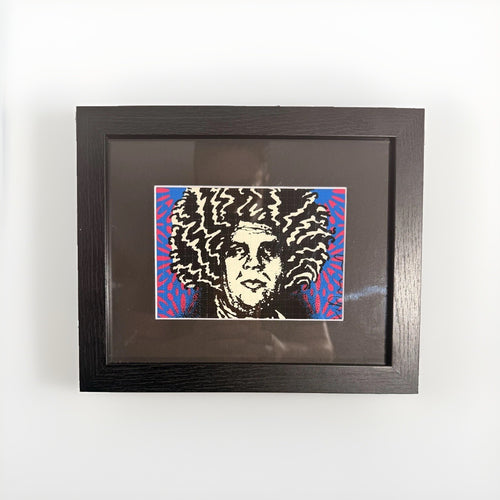
- Framed prints where the signature or number are not accessible for direct examination. Framing can conceal condition issues, altered numbers, or margin damage. Request unframed examination for high-value purchases.
- Prices that seem too close to open-edition levels for a supposedly hand-signed limited run. The market is efficient. If a "signed limited edition" is priced like an open edition, the seller knows something about its provenance that you may not.
Bottom Line
The gap between a Fairey open edition and a hand-signed limited print is not hype. It is not dealer markup. It is the direct product of documented scarcity, verifiable authentication, and a clear production hierarchy.
Open editions are a legitimate entry point into the Fairey market. Do not be embarrassed to own them. But do not pay hand-signed prices for them, and do not let a seller blur the line between the two categories.
The authentication framework in this market is real but different. No artist-issued COA. No centralized authentication board. What you have instead is a combination of the Obey Giant drop record, provenance documentation, signature verification, and third-party autograph authentication where the stakes warrant it.
Do the work. Cross-reference the drop record. Examine the signature against documented examples. Understand what production method you are actually buying. Know your edition size and where it sits in the scarcity spectrum.
The collectors who understand these distinctions are the ones who buy confidently and sell well. Everyone else is guessing.
If you have a Fairey print and you are not sure which category it falls into, bring it to someone who can tell you honestly. The price education is free. The mistake of paying wrong is not.
FAQ
Does Shepard Fairey issue certificates of authenticity for his prints?
No. Unlike Banksy, whose authentication runs through Pest Control, or Death NYC, whose signed COA with studio gold seal is a required component of authentication, Fairey does not operate a formal artist-issued COA program. Authentication in the Fairey market relies on the Obey Giant drop record, verifiable provenance, signature analysis against documented examples, and edition number verification. A COA claiming to be officially issued by the artist or studio should be treated with significant skepticism.
What does "open edition" actually mean in the Fairey context?
An open edition print has no predetermined quantity limit. It is produced to meet demand, not released in a capped run. Fairey has used open editions as a deliberate philosophical choice — accessible imagery at accessible prices. Open editions are typically unsigned, unnumbered, and produced via offset or digital methods. They are genuine Fairey-licensed work, but they do not carry the scarcity premium that documented hand-signed limited editions carry.
How can I verify that a limited edition number is legitimate?
Start with the Obey Giant release archive at obeygiant.com. Release records for documented drops typically include the image, the edition size, the release date, and the price point. Match the number on the print against the documented edition size. If the print claims a number within an edition, that edition should be locatable in the public record. Auction house catalog archives at Christie's, Heritage, and Artsy also document verified sold examples with clear edition information.
Is a JSA or PSA certification enough to buy a signed Fairey confidently?
Autograph authentication from JSA or PSA covers the signature — it does not authenticate the edition's legitimacy, provenance, or production method. A JSA LOA (Letter of Authenticity) is a stronger instrument than JSA Basic certification; know which level you are dealing with. PSA has specifically warned collectors to verify certification numbers directly on the PSA website, as counterfeit authentication labels exist in the market. Third-party signature authentication is a useful data point, not a complete authentication solution for limited edition prints.
What is the practical price difference between a signed screen print and a signed offset lithograph?
The market places hand-pulled screen prints at the top of the production hierarchy, above offset lithographs, above giclees. For comparable editions of similar cultural relevance and condition, a screen print typically commands a meaningful premium over an offset of the same image. Sellers do not always make this distinction explicit in their listings. Ask specifically what production method you are buying, and request documentation or physical examination that confirms it.
Are artist proofs (APs) worth more than standard edition numbers?
In most cases, yes. Artist proofs are held outside the main numbered edition — typically a small quantity (often around 10% of the main edition, though this varies) reserved for the artist, printer, or gallery. Because they are fewer in number and carry the distinction of being outside the primary edition run, APs generally trade at premiums on the secondary market. An AP designation should be verifiable against the documented release structure, not just claimed on the face of the work.
What happens to open edition prices if Fairey's market continues to grow?
Open editions can appreciate, particularly for culturally significant images released in the early periods of Fairey's career. But the appreciation trajectory for open editions is structurally capped relative to limited editions because there is no supply ceiling. An open edition print from twenty years ago has the same problem as a new one — an unknown number of copies exist. The scarcity premium that drives the strongest secondary market results simply is not available to open editions the way it is to documented limited runs.
How should I store a Fairey print to preserve its condition and value?
Flat storage in an archival sleeve or between acid-free boards is preferable to rolling for long-term preservation. If rolling is necessary for transport, roll loosely around a wide-diameter tube with the image facing outward, never inward. Keep prints away from direct light — UV damage fades screen print inks and paper alike. Controlled humidity is important; moisture causes foxing and paper degradation. If framing, use UV-filtering glazing and acid-free mat board. Condition is a primary price driver in this market. The cost of proper storage is trivial compared to the cost of a condition downgrade at resale.