Shepard Fairey — Deco Floral Pattern (Blue): A Collector’s Guide
No portrait. No slogan. Just pattern.
This is Fairey the designer, not Fairey the propagandist.
View this piece at Gauntlet Gallery →
What you are actually looking at
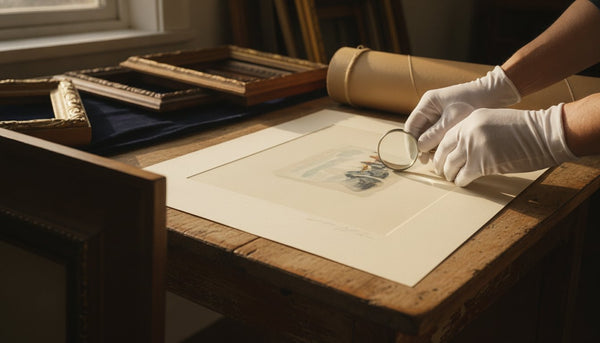
This is Shepard Fairey’s Deco Floral Pattern (Blue) — a hand-signed and numbered screen print from an edition of 275, on cream Speckletone paper. The design distills Fairey’s decorative vocabulary: repeating stylized blooms and geometric framing drawn from Art Deco and Arts-and-Crafts ornament, arranged into a clean, pattern-forward composition. The blue colorway is one half of a blue/red pairing Fairey released in the series.
The ornamental side of OBEY
Most people meet Fairey through his overtly political portraits. But the decorative framing in those works — the floral geometry, the Deco symmetry — is a language of its own, and the Deco Floral prints put that language front and center. Strip away the face and the slogan, and what remains is the design engine that makes a Fairey feel like a Fairey.
The OBEY branding remains, but the emphasis shifts from persuasion to pure pattern. For collectors, that makes these prints unusually versatile on a wall — they read as design objects first.
Shepard Fairey, in one paragraph you actually need
If you are new to the artist: Shepard Fairey (b. 1970) is one of the most influential American artists of his generation. He emerged from the 1990s skateboarding and street-art scene with his OBEY Giant campaign — an experiment in propaganda and public space that grew into a global visual language. In 2008 his Barack Obama "Hope" portrait became one of the most recognizable political images in modern history. His work is held by the Museum of Modern Art, the Victoria & Albert Museum, LACMA, and the Smithsonian. New editions release through his OBEY studio, where limited runs routinely sell out and trade actively on the secondary market.
The OBEY method: how Fairey builds an image
To understand why any Fairey print works, it helps to understand how he builds an image. His visual system is borrowed, deliberately, from twentieth-century propaganda — Soviet constructivism, WPA posters, the hard symmetry of political printing. He strips those forms of their original message and reloads them. A star, a sunburst, a bordered portrait, a slab of stylized type: individually they are the furniture of persuasion. Assembled, they make the viewer feel the weight of a message before reading a single word.
The Deco framing and floral geometry that recur across his work are not ornament — they are the poster’s way of saying “this is important, this is public.” Fairey has spent three decades training viewers to read that grammar instantly, which is exactly why his editions read as coherent whether the subject is a boxer, a factory, or a flower.
The edition and how it reached the market
The print was released as a screen print on thick cream Speckletone paper in an edition of 275, hand-signed and numbered. It was issued in blue and red colorways — this is the blue. Collectors often pursue the two as a pair, though each stands on its own.
Authentication: what actually backs a Fairey
This is the part collectors most often get wrong, so read it carefully.
Shepard Fairey does not issue an artist certificate of authenticity, and there is no third-party authentication board for his work — no Fairey equivalent of Banksy’s Pest Control. That is not a gap. It is how the entire Fairey market operates.
Authenticity for a signed Fairey rests on three things: the signature and numbering, the physical characteristics of the edition (paper stock, print process, edges, any embossed OBEY stamp), and provenance. Be skeptical of anyone selling a Fairey with a claim of "third-party authentication" or a certificate implying an official board signed off — no such board exists for his prints. A credible seller documents the signature, the numbering, the format, and the chain of ownership.
Condition: what to check, and why photographs matter
Condition drives value on paper works more than most first-time buyers expect. The things that move the needle are handling creases or corner dings, the brightness of the stock, whether the sheet has been trimmed or laid down, and any light-toning.
Because condition is specific to the individual sheet, treat the listing photographs as part of the condition report, not decoration. Zoom into the corners and the margins around the signature. If anything is unclear, ask for additional images — a reputable gallery will provide them. We do not assert a formal grade here; the photographs form part of the condition description.
What the market says
Now the numbers — restrained, because this is context, not a promise.
Secondary-market comparables for the Deco Floral Pattern prints most often appear as blue-and-red two-print sets, which trade roughly $150–$280; single blue examples sit toward the lower end near $150–$155. These are directional, secondary-market figures only and vary by whether the listing is a single print or a set, plus condition and venue. Data reviewed 2026.
A caveat to hold onto: these figures are directional rather than an appraisal. Value on any specific sale varies with edition, dimensions, condition, the strength of the documentation, and the venue of the transaction. No one — including us — can promise where the piece goes next.
Who this piece is for
This one suits the design-first collector who wants a Fairey that works as pure ornament, the completist chasing both halves of the blue/red pairing, and the first-time buyer looking for an accessible, signed, numbered entry into his work. It is one of the easier Fairey prints to live with, and one of the more affordable to acquire.
How to buy a Fairey print — a short discipline
If this would be an early Fairey purchase, a little discipline saves a lot of regret.
Buy the specific sheet, not the image. Two examples of the same print at the same edition size are not the same asset if one has bright margins and crisp corners and the other has a soft crease and light-toning. Read the condition notes and the photographs as the real description; the title is just the headline.
Confirm the physical markers. Check that the signature, any date, and the numbering are present and legible, and that the format matches what a genuine example should be — paper stock, print process, deckled edges, and any embossed OBEY stamp.
Weigh documentation, not certificates. Because Fairey prints have no official COA and no third-party board, what protects you is a clear account of where the piece came from and a seller who describes it honestly. Be more comfortable with a well-documented sheet and no fancy certificate than with a glossy certificate and a vague story.
Set your number before you look at the price. Decide what the piece is worth to you given the market context, then see whether the offer fits. That order of operations is the single most useful habit in print collecting.
Living with the work: display and care
Once it is yours, a signed print on quality paper is a durable object that rewards a little care. Frame it with UV-protective glazing and an acid-free mat, and keep it off walls that take direct afternoon sun; cream stock is beautiful precisely because it has not yellowed, and light is the thing that yellows it. If the sheet has deckled edges, consider a float mount so the hand-cut edge shows rather than hiding under a window mat — on these prints, the deckle is part of what you paid for. None of this is expensive relative to the work, and all of it protects both the experience of ownership and the eventual resale.
Frequently asked questions
Is it signed and numbered? Yes — hand-signed and numbered from the edition of 275.
Is this the blue or red version? This is the blue colorway; Fairey issued the design in both blue and red.
Does it come with a certificate? Fairey issues no artist COA and there is no third-party authentication board for his prints. Authenticity rests on the signature, numbering, format, and provenance.
What is it printed on? A screen print on cream Speckletone paper.
Is it framed? Refer to the current listing; framing and condition are described per item, and the photographs form part of that description.
The bottom line
Deco Floral Pattern (Blue) is Fairey’s design vocabulary standing on its own — a signed, numbered edition of 275 that reads as pure ornament rather than propaganda. Accessible, versatile, and one half of a collectable pair. As always, the individual sheet and its condition are where the decision lives.
See the current example and full details at Gauntlet Gallery →