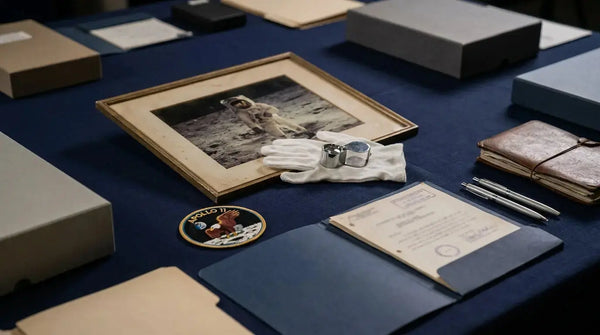
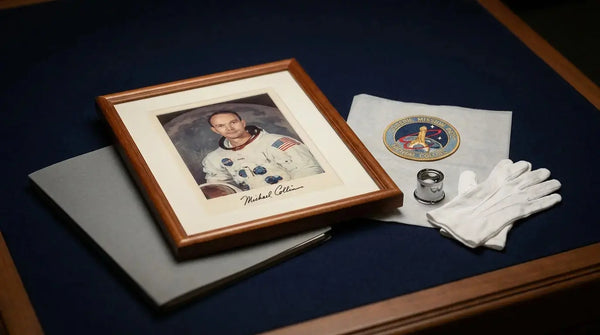
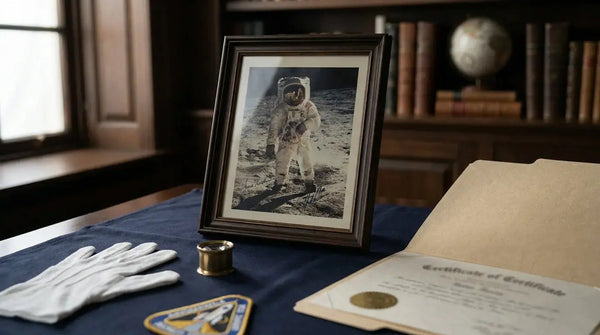
When Armstrong stepped onto the lunar surface on July 20, 1969, he changed what it means to be human. When he stopped signing autographs in approximately 1994, he permanently closed the supply of new authentic signatures, setting the stage for a decades-long appreciation in value that has accelerated since his death on August 25, 2012. Compare like-for-like signed objects or artifacts with matching mission association, signer, condition, authentication and provenance; a category-wide rate or median mixes different objects.
Early Life and the Making of a Test Pilot

Neil Alden Armstrong was born on August 5, 1930, in Wapakoneta, Ohio. From childhood he was captivated by aviation — he earned his student pilot certificate on his sixteenth birthday, before he held a driver's license. He studied aeronautical engineering at Purdue University under a U.S. Navy scholarship, interrupted his studies to serve as a naval aviator in the Korean War, and flew 78 combat missions before returning to complete his degree.
It was his post-Korea career as a test pilot that placed Armstrong on the path to the Moon. He joined the National Advisory Committee for Aeronautics (NACA) — the forerunner to NASA — at the Lewis Flight Propulsion Laboratory in 1955 and quickly transferred to the High-Speed Flight Station at Edwards Air Force Base in California. Over the following decade, Armstrong flew more than 200 different aircraft types. His most consequential assignment was the North American X-15 rocket plane, the hypersonic research vehicle that flew to the very edge of space. Armstrong made seven X-15 flights, reaching altitudes above 200,000 feet and speeds exceeding Mach 5. He flew to the threshold of space before NASA formally sent him there.
Gemini 8: Command Under Crisis
Armstrong was selected as a NASA astronaut in 1962, part of the second astronaut class — the group that would become the backbone of the Gemini and Apollo programs. His first spaceflight came on March 16, 1966, when he commanded Gemini 8 with pilot David Scott.
The mission demonstrated both Armstrong's skill and his composure under pressure. Gemini 8 achieved the first successful docking of two spacecraft in orbit, linking up with an Agena target vehicle — a critical milestone for the Apollo lunar-landing strategy. But within minutes of docking, a thruster on the Gemini capsule began firing uncontrollably, sending the joined spacecraft into a violent roll. Armstrong undocked from the Agena, which temporarily stabilized the situation, but the Gemini capsule itself continued to spin, reaching one revolution per second — fast enough to cause loss of consciousness. Armstrong used the capsule's re-entry control system to regain control, an improvised solution that forced an early mission termination. NASA's post-mission review credited Armstrong's instinct and technical mastery with saving both crew members' lives.
Apollo 11: First Steps on the Moon

NASA selected Armstrong to command Apollo 11 in January 1969. He trained for six months alongside Command Module Pilot Michael Collins and Lunar Module Pilot Buzz Aldrin. On July 16, 1969, Apollo 11 launched from Kennedy Space Center. Four days later, with the world watching, Armstrong and Aldrin descended to the Sea of Tranquility in the lunar module Eagle while Collins remained in lunar orbit aboard Columbia.
At 10:56 PM EDT on July 20, 1969, Armstrong placed his left foot on the lunar surface and spoke the words that defined a century: "That's one small step for [a] man, one giant leap for mankind." He and Aldrin spent two hours and 31 minutes on the surface, collecting 47.5 pounds of lunar samples, planting the American flag, and speaking briefly with President Richard Nixon in what Nixon called "the most historic phone call ever made." They rejoined Collins in lunar orbit and splashed down safely on July 24.
Armstrong was 38 years old. He had been in space for a total of 8 days, 14 hours, and 12 minutes across two missions — and he would never fly in space again.
Life After Apollo 11
Armstrong was profoundly uncomfortable with celebrity. He resigned from NASA in 1971 and took a faculty position at the University of Cincinnati, teaching aerospace engineering for eight years. He served on the boards of several aerospace companies and chaired the commission investigating the 1986 Challenger disaster. He gave occasional interviews but consistently deflected personal glorification, insisting that Apollo 11 had been a collective achievement of some 400,000 engineers, scientists, and support personnel — not a personal triumph.
Around 1994, Armstrong made a decision with significant consequences for the memorabilia market: he stopped signing autographs entirely. He had discovered that dealers were selling items he had signed as personal gifts, and that forgers were producing fraudulent signatures in volume. He was reportedly saddened that ordinary collectors were being defrauded. From approximately 1994 until his death on August 25, 2012 — from complications following heart surgery — Armstrong signed almost nothing for public consumption.
The Memorabilia Market: Why Armstrong Signatures Are Permanently Scarce

The arithmetic of the Armstrong autograph market is unambiguous. Armstrong signed an estimated 55,000 items during his lifetime — a figure that seems large until it is placed against global demand from collectors in over 100 countries, permanent absorption into museum and institutional collections, and attrition through fire, water damage, and undocumented loss. No new authentic signatures will ever enter the market. The supply curve is fixed forever.
Review the actual Armstrong signature and its provenance, checking the scope and identifier of any named specialist’s opinion. Signatures vary over time, so use documented exemplars appropriate to the claimed signing period rather than assuming one universal certificate chain or a market-wide forgery rate.
Armstrong died in 2012. That historical date does not establish a uniform price rise across authenticated categories; compare identified sales of the same object type and signing format over the relevant period.
Neil Armstrong Memorabilia: Current Market Price Ranges
| Item Type | Authentication |
|---|---|
| Signed 8x10 NASA photograph (inscribed) | PSA/JSA certified |
| Signed 8x10 NASA photograph (uninscribed, WSS) | PSA/JSA certified |
| PSA 9/10 graded Apollo 11 mission photograph | PSA graded slab |
| Signed crew portrait (Armstrong, Aldrin, Collins) | PSA/JSA certified |
| Signed index card or cut signature | PSA/JSA certified |
| Signed book (first edition, dust jacket) | PSA/JSA certified |
| Mission-flown artifact (documented provenance) | Zarelli + auction house LOA |
All figures assume PSA or JSA authentication at minimum.
Collecting Armstrong: What to Look For

Prioritize Mission-Specific Imagery
The highest appreciation within authenticated Armstrong material attaches to photographs that directly document the Apollo 11 mission: the EVA surface photographs, the Buzz Aldrin visor-reflection image, the Eagle lunar module descent, and the official NASA crew portraits. Generic aviation photographs or signed ephemera from the post-Apollo period trade at a meaningful discount to mission-specific material.
Uninscribed Examples Command a Significant Premium
Armstrong habitually inscribed pieces he signed, making uninscribed whole-signed-space (WSS) examples a genuinely scarcer sub-class.
Four-Era Signature Consistency Is Mandatory
Before any acquisition, Gauntlet Gallery applies a four-era authentication methodology that tracks the known evolution of Armstrong's hand across his naval, test pilot, astronaut, and post-NASA careers. Signatures that do not match the characteristics documented for the claimed period are rejected regardless of accompanying paperwork.
Avoid Unattributed Provenance Claims
A significant volume of circulating Armstrong forgeries are accompanied by plausible-sounding provenance narratives — claimed TTM responses, claimed event appearances, claimed gifts to third parties. Without a verifiable, documented chain of custody supported by PSA or JSA certification, provenance claims should be treated as unverified and priced accordingly.
Armstrong's Place in the Space Memorabilia Canon
The space memorabilia category encompasses signatures and artifacts from the Mercury, Gemini, Apollo, Space Shuttle, and International Space Station eras. Within that universe, Armstrong occupies a singular position. Buzz Aldrin — the second human to walk on the Moon — continues to sign and is accessible to collectors at a fraction of Armstrong's prices. Michael Collins signed regularly until his 2021 passing. Other Apollo astronauts, from Alan Bean's mission paintings to Edgar Mitchell's ESP research ephemera, occupy enthusiastic collector niches.
Armstrong was the first person to walk on the Moon, and he died in 2012. That historical significance helps explain collector interest, but it does not establish a market-wide forgery rate, authentication premium or future return for an individual signature.
Acquire Authenticated Armstrong Memorabilia
Gauntlet Gallery was founded in 2012 with a commitment to authenticated, documented collecting.
Every Armstrong item we offer carries PSA or JSA certification at minimum, with Zarelli LOAs on high-value pieces. Full provenance documentation accompanies every sale.
Shop Apollo 11
Explore current pieces available from the gallery.
-
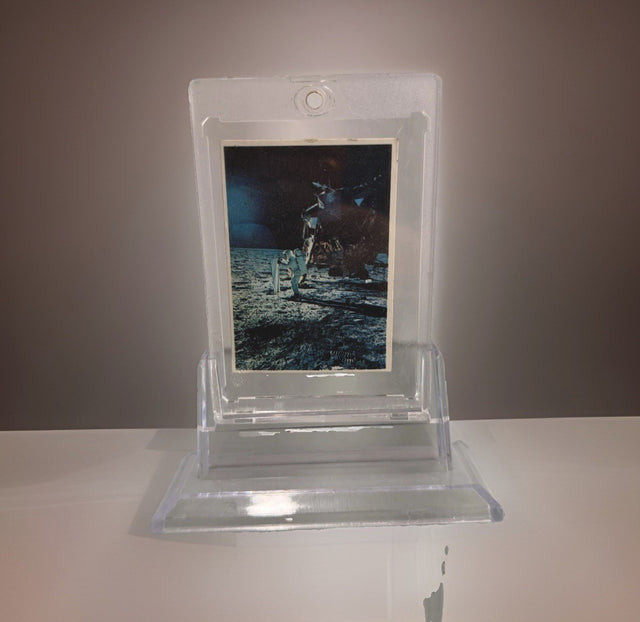
1969 Space Candy Buzz Aldrin Apollo 11 On The Moon Card #19 Taylor-Reed Display
$59.00 USD
-
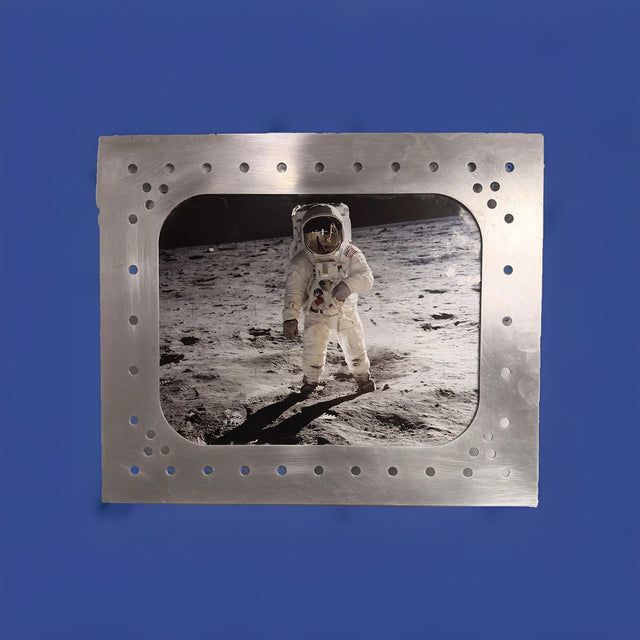
Apollo 11 Astronaut on the Moon NASA Photo Riveted Aluminum Spacecraft Frame
$89.00 USD
-
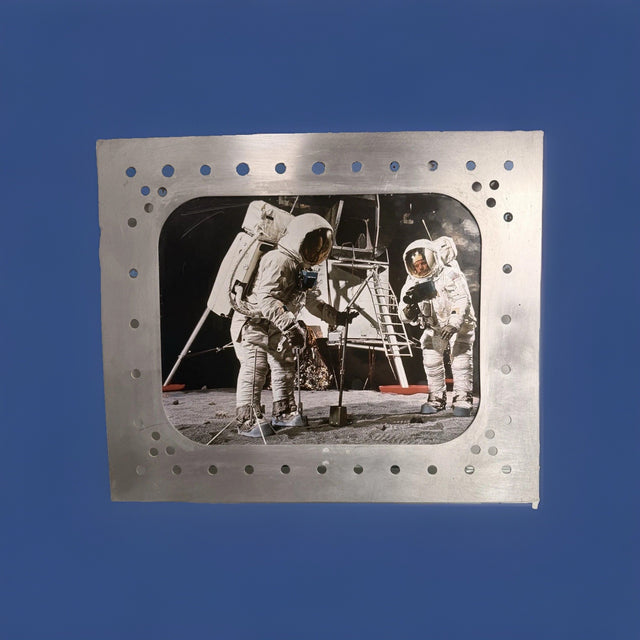
Apollo Astronauts on the Moon NASA Photo Riveted Aluminum Spacecraft Frame
$89.00 USD
-

Gene Kranz Signed Apollo 11 Moon Card PSA/DNA NASA Flight Director Autograph
$150.00 USD
-

Buzz Aldrin Apollo 11 Tranquility Framed Autograph - Zarelli Space COA
$350.00 USD
-
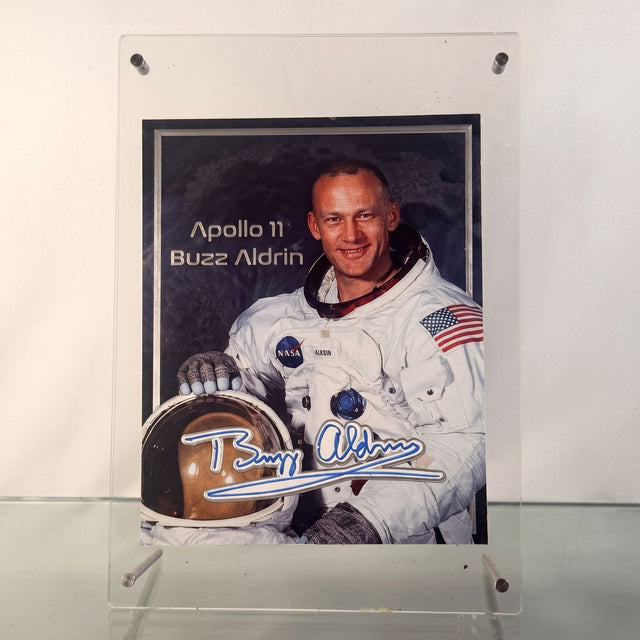
Buzz Aldrin Signed Apollo 11 NASA Double-Sided Photo JSA Authenticated Display
$450.00 USD


Browse the collection for current listings.