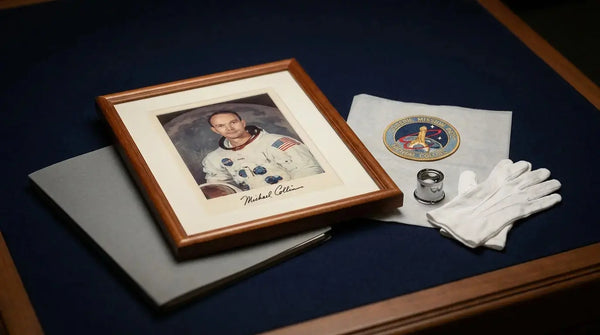
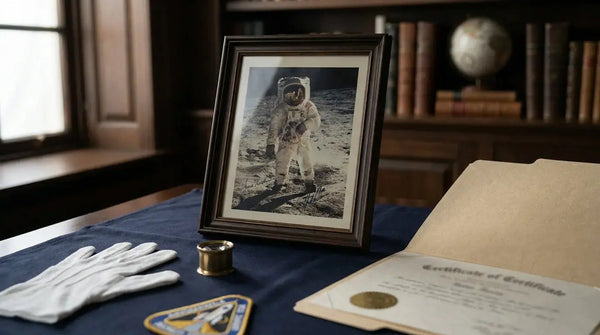
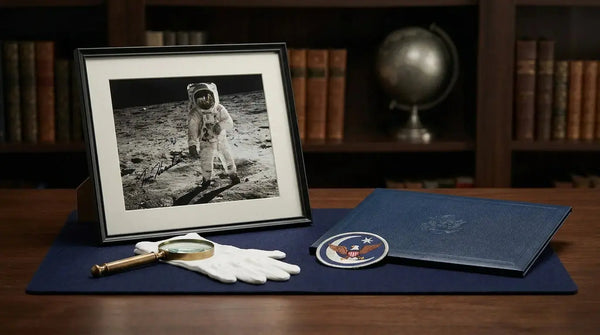
Apollo 11 memorabilia is among the most collectible and most valuable categories in the entire autograph and artifact market. Crew-signed photographs with all three astronauts — Neil Armstrong, Buzz Aldrin, and Michael Collins — trade between $8,000 and $50,000+ at major auction. Compare like-for-like signed objects or artifacts with matching mission association, signer, condition, authentication and provenance; a category-wide rate or median mixes different objects.
On July 16, 1969, a Saturn V rocket lifted three men off the planet. Eight days later, two of them had walked on the Moon and all three had returned safely. The Apollo 11 mission remains the defining achievement of the 20th century — and the material culture it produced is finite, authenticated, and actively traded at the highest levels of the collectibles market.
What follows is the authoritative collector's guide to what exists, how it is authenticated, and what the market currently pays.
The Six Categories of Apollo 11 Collectibles
1. Crew-Signed Photographs
The premier category. When all three crew members — Armstrong, Aldrin, and Collins — sign the same piece, value multiplies far beyond the sum of individual signatures. The triple-signed format is rare because the astronauts signed together only at formal NASA events and occasional private signings. Armstrong's 1994 decision to stop signing publicly, combined with his 2012 death, permanently closed the supply of new authentic Armstrong signatures and triggered structural appreciation across the category.
Authentication by PSA or JSA is the market standard. Zarelli Space Authentication adds the specialist layer that serious buyers require for high-value transactions. Gauntlet Gallery applies a four-era signature methodology to every acquisition — Armstrong's signature evolved distinctly across the early 1960s NASA period, the post-mission 1969–1975 era, the mid-career period, and his final signing years — allowing forgeries to be identified by period mismatch.
Forgery rates in unsigned market inventory are estimated at 30–40%. The authentication premium for documented pieces over undocumented comparables is significant and widening.
2. Individual Crew-Signed Items
Each astronaut carries distinct market dynamics.
Neil Armstrong commands the largest premium by a wide margin. As the first human to walk on the Moon, his signatures are culturally unique, and authenticated examples have appreciated consistently since his 2012 passing. Signed 8x10 photographs trade above $8,000; uninscribed whole-signed-space portraits benchmark above $25,000. Armstrong's 1994 decision to stop signing created an 18-year gap between his last public signings and his death — a supply constraint that has compounded steadily.
Buzz Aldrin continued signing publicly for decades, making his autographs more accessible — but items connecting him specifically to Apollo 11, such as mission photographs or EVA-era pieces, carry the mission premium. Authenticated signed photographs trade in the $800–$3,000 range.
Michael Collins is chronically underappreciated by casual collectors and quietly accumulated by serious ones. Collins piloted the Command Module Columbia alone in lunar orbit while Armstrong and Aldrin walked the surface. His signed material is rarer than Aldrin's and trades between $500 and $2,500 for photographs, with triple-signed pieces amplifying his contribution appropriately. Collectors who understand the mission understand Collins.
3. NASA-Issued Mission Documentation and Photographs
NASA produced an extensive record of Apollo 11 — technical manuals, flight plans, training documents, and official mission photographs distributed to press and government agencies. These items carry inherent provenance through their issuance channels. Signed NASA lithographs and official mission photographs with documented distribution chains trade between $1,500 and $12,000 depending on content, condition, and signatures present.
The AS11 Hasselblad photographs — taken during the lunar surface EVA — are among the most reproduced images in human history. Official NASA prints from the original negatives, particularly early-generation examples, are collected both as historical artifacts and as fine art photography. Period-correct prints with chain-of-custody documentation from the original NASA distribution command premiums over later reprints.
4. Mission-Flown Items: Flags, Patches, and Artifacts
The mission-flown premium is the most powerful value multiplier in space memorabilia. Items documented as traveling aboard Apollo 11 — either in the Command Module Columbia during the entire mission, or on the Lunar Module Eagle during the Moon landing — command prices that non-flown items cannot approach.
The authentication standard for mission-flown status requires NASA manifest documentation, unbroken chain of custody from original NASA distribution to the current holder, and in the highest-value transactions, corroborating provenance from the original crew or their estates.
Press photographs from the mission period — wire service prints, news agency originals from July 1969, contact sheets from accredited photographers — are actively collected as primary historical documents. Authenticated press originals with period stamps and agency markings trade between $500 and $5,000 based on image content and condition.
5. Books and Publications
First editions of significant Apollo 11 publications — particularly crew-signed copies — bridge the gap between autograph collecting and book collecting. Signed copies of Armstrong's limited publication record, or official NASA mission reports bearing crew signatures, occupy a collector niche with dedicated demand. Values range from $300 for mass-market crew-signed paperbacks to $5,000+ for limited-edition hardcovers with full triple-crew signatures. The intersection of astronaut autograph and book provenance creates a distinct collector segment with steady institutional demand.
6. The Intersection of Space History and Art History
Perhaps the most extraordinary category is where space memorabilia crosses into art history. Gauntlet Gallery holds a 1970-dated work bearing signatures of Neil Armstrong, Buzz Aldrin, and Michael Collins alongside the documented involvement of Andy Warhol — a piece that exists at the precise intersection of the two defining cultural phenomena of the era. Items of this caliber are not merely autographs; they are primary historical documents of a moment when the art world and the space program briefly occupied the same room, one year after the Moon landing. The convergence of three astronaut signatures with Warhol's creative legacy produces a category of one — an artifact without a direct comparable in the market.
Apollo 11 Collectibles: Current Market Value Reference
| Item Category | Signatures | Authentication |
|---|---|---|
| 8x10 Mission Photograph | Triple-signed (all 3 crew) | PSA / JSA |
| 8x10 Photograph | Armstrong only | PSA / JSA / Zarelli |
| WSS Portrait (uninscribed) | Armstrong only | PSA / Zarelli |
| Mission-Flown Flag | Crew-signed (documented) | NASA manifest + PSA |
| Mission Patch (signed) | 1–3 crew members | PSA / JSA |
| NASA Official Lithograph | Triple-signed | PSA / JSA |
| Buzz Aldrin Signed Photo | Aldrin only | PSA / JSA |
| Michael Collins Signed Photo | Collins only | PSA / JSA |
| Original Press Photograph | Unsigned (period stamp) | Provenance documentation |
Ranges reflect recent realized prices at Heritage Auctions and RR Auction (2023–2025). Exceptional provenance, mission-flown documentation, or art-historical crossover can produce results significantly above the upper range.
Authentication: The Non-Negotiable Standard
The Apollo 11 memorabilia market is an authentication market. The cultural magnitude of the mission created forgery pressure that has operated continuously since 1969 — more than five decades of skilled forgeries now circulate in general inventory. Gauntlet Gallery estimates that 30–40% of Armstrong-signed material on the open market is forged. For items acquired without documentation, that figure should be treated as the baseline risk.
The authentication hierarchy Gauntlet Gallery applies to every acquisition:
- PSA (Professional Sports Authenticator) — the broadest market recognition, required for liquidity at Heritage Auctions and RR Auction
- JSA (James Spence Authentication) — accepted at all major venues, with strong forensic methodology for space-era signatures
- Zarelli Space Authentication — the specialist standard for NASA-era material, applied by Gauntlet Gallery for mission documentation and high-value transactions
- Beckett Authentication Services (BAS) — increasingly accepted for astronaut material across mainstream auction channels
For mission-flown items, authentication extends beyond the autograph to the item itself. NASA manifest records, chain of custody documentation from original recipients, and crew or estate provenance letters are the verification standards that separate documented mission-flown artifacts from unverified representations.
No piece enters Gauntlet Gallery inventory without surviving this multi-layer authentication process.
The Mission-Flown Premium
The most important concept in valuing Apollo 11 items is the mission-flown premium — the extraordinary price differential between items that traveled aboard the spacecraft and items that did not.
The Command Module Columbia carried the crew from Earth to lunar orbit and back. The Lunar Module Eagle descended to the surface and returned Armstrong and Aldrin to rendezvous with Collins in orbit. Items documented as traveling in either spacecraft carry the mission-flown designation, with items that reached the lunar surface commanding the highest premiums.
What distinguishes legitimate mission-flown claims:
- NASA flight manifest documentation listing the item and its spacecraft assignment
- Chain of custody from original NASA distribution to the current holder
- Corroborating documentation from crew or NASA officials
- Physical characteristics consistent with spaceflight exposure where applicable
Unverified "mission-flown" claims are common and should be treated as marketing until documentation is produced. The premium is real and large — verified mission-flown flags trade at multiples of $15,000–$60,000 while unsigned commercial replicas sell for under $100. The documentation gap between a legitimate mission-flown item and a claimed-but-undocumented one represents the entire premium.
Why Apollo 11 Occupies a Category of Its Own
Among all the achievements of the space age, Apollo 11 stands alone. Twelve people walked on the Moon across six Apollo missions. Only three were aboard for the first landing. The cultural weight of July 20, 1969 — Armstrong's boot print in the lunar regolith, the television broadcast watched by 600 million people, the flag planted in the Sea of Tranquility — is permanent and universal in a way that no other event of the 20th century fully matches.
That permanence translates directly into collector demand that does not track economic cycles in the way that sports or entertainment memorabilia does. The market for Apollo 11 material is anchored by meaning, not trend. Institutional buyers — museums, foundations, and private collections with multi-generational investment horizons — compete at the top of the market, supporting price floors that speculative categories cannot sustain.
Gauntlet Gallery has operated in this market since 2012, building the authentication depth and comparable sales infrastructure that serious transactions require. Our space memorabilia collection represents the standard of documentation that the category demands — every piece sourced, authenticated, and positioned within the full context of the market.
Shop Apollo 11
Explore current pieces available from the gallery.
-
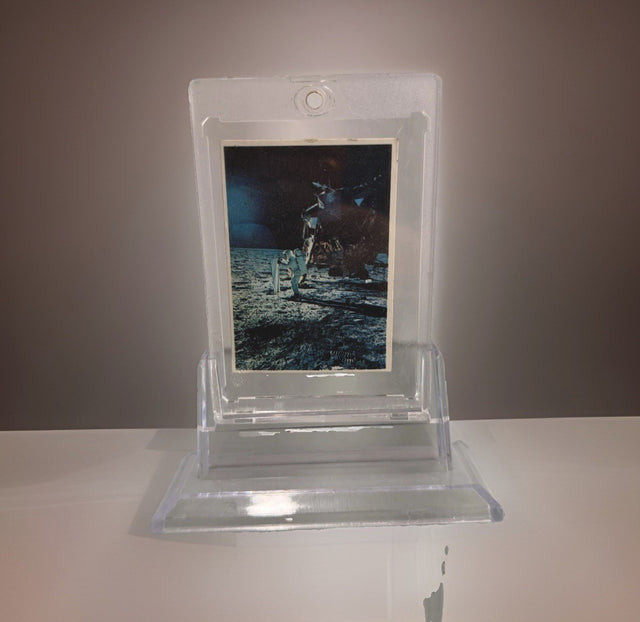
1969 Space Candy Buzz Aldrin Apollo 11 On The Moon Card #19 Taylor-Reed Display
$59.00 USD
-
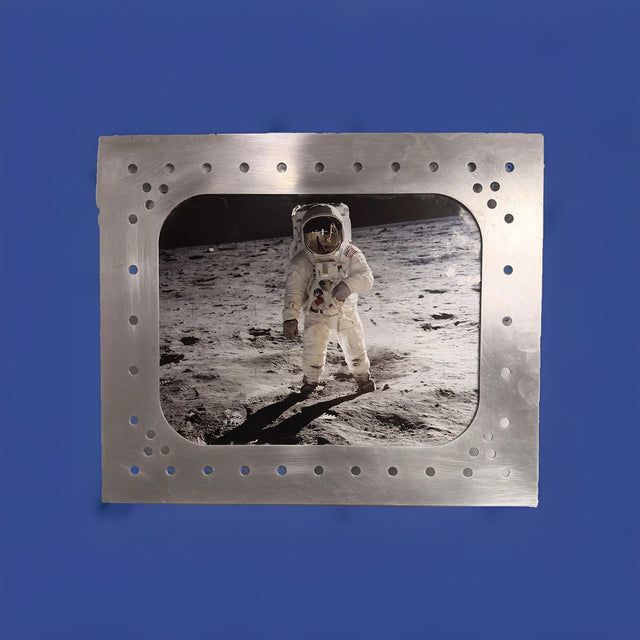
Apollo 11 Astronaut on the Moon NASA Photo Riveted Aluminum Spacecraft Frame
$89.00 USD
-
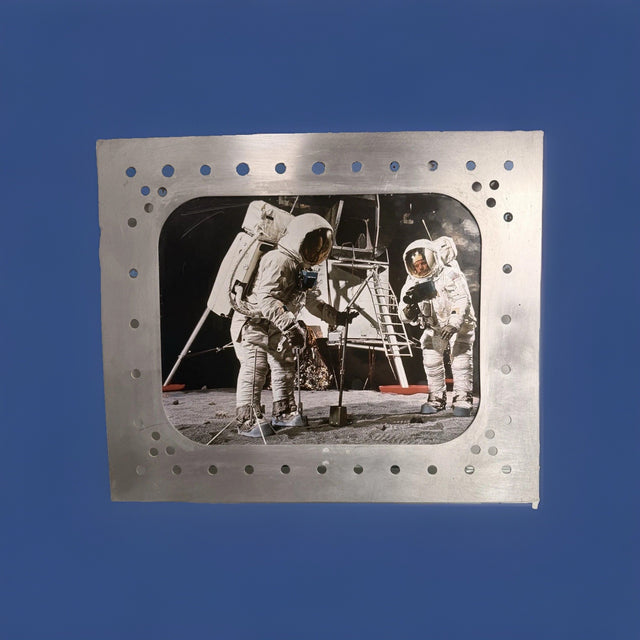
Apollo Astronauts on the Moon NASA Photo Riveted Aluminum Spacecraft Frame
$89.00 USD
-

Gene Kranz Signed Apollo 11 Moon Card PSA/DNA NASA Flight Director Autograph
$150.00 USD
-

Buzz Aldrin Apollo 11 Tranquility Framed Autograph - Zarelli Space COA
$350.00 USD
-
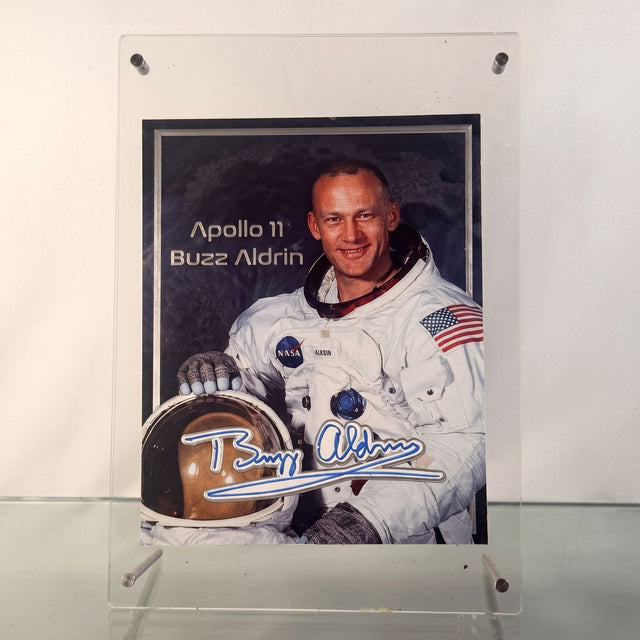
Buzz Aldrin Signed Apollo 11 NASA Double-Sided Photo JSA Authenticated Display
$450.00 USD


Browse the collection for current listings.