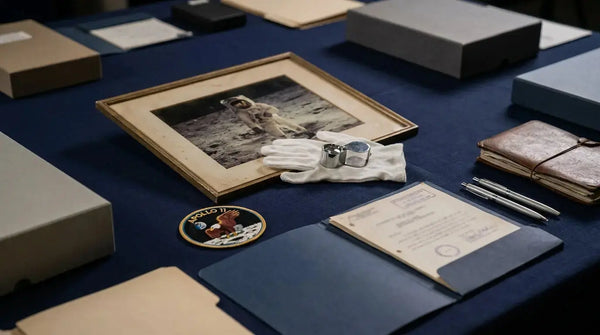
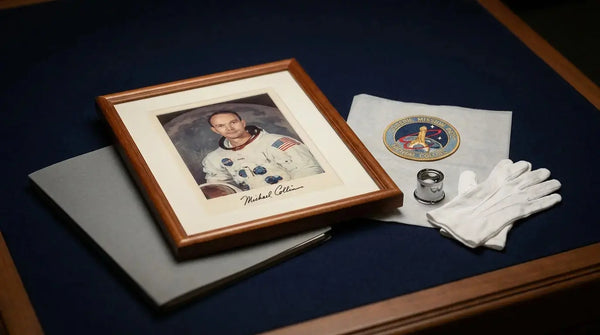
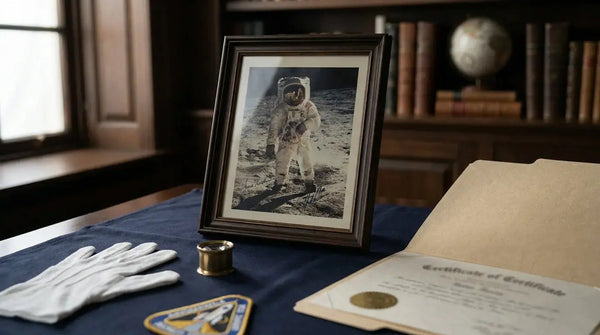
Buzz Aldrin is the living lunar astronaut whose name and signature connect collectors directly to July 20, 1969 — the greatest single day in human exploration. Born Edwin Eugene Aldrin Jr. on January 20, 1930, in Montclair, New Jersey, he is the last surviving member of the Apollo 11 crew, the second human being to walk on the Moon, and one of the most recognizable figures in the history of science and achievement. His authenticated signed memorabilia carries both profound historical resonance and a scarcity premium that grows with every passing year.
The Man Behind the Mission: Buzz Aldrin's Biography
Early Life and Military Career
Edwin Aldrin earned the nickname "Buzz" from his younger sister, who mispronounced the word "brother" as "buzzer" — a name that would eventually become his legal first name in 1988. He graduated from the United States Military Academy at West Point in 1951, commissioned into the Air Force at a moment when the Cold War was already reshaping the boundaries of what was possible in the sky.
In Korea, Aldrin flew 66 combat missions in the F-86 Sabre and shot down three MiG-15s — a record that marked him as one of the finest combat pilots of his generation. That fearlessness in the cockpit, combined with a relentless intellectual curiosity, set the trajectory for everything that followed.
After Korea, Aldrin pursued academic mastery with the same intensity he had brought to combat. He earned a Doctor of Science degree in Astronautics from the Massachusetts Institute of Technology in 1963, with his doctoral thesis focused on manned orbital rendezvous — the very technique that would become essential to the Apollo program. He was not merely a pilot who became an astronaut. He was an engineer who built the scientific foundation for how human beings reach the Moon.
NASA and the Road to Apollo 11
Aldrin joined NASA's astronaut corps in October 1963, part of the third group of astronauts selected. His Gemini 12 mission in November 1966 was a landmark: Aldrin performed three spacewalks totaling more than five hours, demonstrating definitively that extravehicular activity was practical and controllable in the vacuum of space. Those EVAs resolved a critical open question for NASA and cleared one of the final technical barriers to the Moon.
Selected as Lunar Module Pilot for Apollo 11, Aldrin flew with Mission Commander Neil Armstrong and Command Module Pilot Michael Collins. The mission launched July 16, 1969. Four days later, on July 20, 1969, Armstrong and Aldrin landed the Eagle on the lunar surface in the Sea of Tranquility. Armstrong descended the ladder first. Aldrin followed nineteen minutes later, stepping onto the Moon and famously describing the landscape as "magnificent desolation."
The two astronauts spent two hours and thirty-one minutes on the surface. The photograph Armstrong took of Aldrin in his spacesuit — visor down, the reflection of the lunar surface visible in his helmet — became one of the most reproduced and recognized images in the history of photography. That image is inseparable from the legacy of the mission, and it is Aldrin's image that most people picture when they think of a human being standing on the Moon.
Life After Apollo: Advocacy, Challenges, and Resilience
The years following Apollo 11 brought both public acclaim and personal difficulty. Aldrin was candid about his struggles with depression and alcoholism in the early 1970s — a candor that was rare for a public figure of his stature and that resonated deeply with many who admired his willingness to speak plainly about vulnerability alongside achievement.
He recovered, remarried, and became one of the most tireless advocates for continued human space exploration on the planet. He founded ShareSpace Foundation to promote science and space education, developed a cycling orbital trajectory concept for sustained Mars travel known as the Aldrin Cycler, and published numerous books and memoirs. In 2025, at 95, Buzz Aldrin continues to represent the living bridge between humanity's first steps beyond Earth and its aspirations for the future.
The Signed Memorabilia Market: What Collectors Need to Know
Why Aldrin Signatures Carry Genuine Market Weight
Among living space-program signers, Buzz Aldrin occupies an irreplaceable position. With Neil Armstrong's passing in August 2012, Aldrin became the sole surviving Moon-walking member of the Apollo 11 crew. Michael Collins, the Command Module Pilot who orbited above while Armstrong and Aldrin walked below, passed away in April 2021. Aldrin is the last direct link — the last human being alive who stood in the Sea of Tranquility on July 20, 1969.
That designation carries an enormous future-premium signal for collectors. The autograph market has documented precisely how this dynamic plays out: supply finalization at the time of a signer's passing typically triggers a sharp and sustained price appreciation for authenticated material. Armstrong signed pieces more than doubled in verified auction value in the two years following his death. Collectors who acquire authenticated Aldrin material now are positioned ahead of that curve.
Authentication: The Non-Negotiable Standard
The space memorabilia category carries meaningful forgery risk. The combination of high intrinsic value, broad cultural recognition, and decades of inconsistent record-keeping creates conditions that attract counterfeit material. Compare like-for-like signed objects or artifacts with matching mission association, signer, condition, authentication and provenance; a category-wide rate or median mixes different objects.
PSA (Professional Sports Authenticator) and JSA (James Spence Authentication) maintain robust Aldrin signature exemplar libraries that span his decades of public and private signings. Both firms can reliably distinguish authentic examples from forgeries, and their LOAs represent the market standard accepted by major auction houses including Heritage Auctions, RR Auction, and Bonhams.
Gauntlet Gallery applies these same authentication standards to every piece in our space memorabilia collection.
Current Market Price Ranges
| Item Type | Authentication |
|---|---|
| Signed 8x10 Photograph (standard) | PSA or JSA LOA |
| Signed Aldrin-on-Moon Photograph | PSA or JSA LOA |
| Signed NASA Mission Cover | PSA or JSA LOA |
| Signed Lithograph / Oversized Print | PSA or JSA LOA |
| Signed Book (memoir / inscribed) | PSA or JSA LOA |
| Signed Apollo 11 Flight Plan Reproduction | PSA or JSA LOA |
| Multi-signed Apollo 11 Crew Item (Aldrin + Collins) | PSA or JSA LOA |
The Armstrong Premium — and What It Signals for Aldrin
Uninscribed whole-signed-space portraits benchmark above $25,000. These figures represent a market that has fully priced in the permanent closure of supply following Armstrong's 2012 passing.
Aldrin equivalents currently trade at a fraction of those figures — but the structural conditions that drove Armstrong's appreciation are identical: an irreplaceable figure, finite and declining supply, forgery pressure maintaining premiums for authenticated material, and deep cultural permanence. Collectors who study the Armstrong trajectory view the current Aldrin market as a documented historical parallel in its earlier stage.
Gauntlet Gallery, founded in 2012 and active across space, music, entertainment, and fine art memorabilia for over a decade, has observed this pattern across multiple signer transitions. The window for acquiring authenticated Aldrin material at current market levels will not remain open indefinitely.
What to Look for When Buying
Provenance Chains Matter
The strongest Aldrin pieces carry documented provenance: a through-the-mail return envelope, a private signing event LOA, a NASA charity auction record, or a chain of custody from a reputable dealer. Provenance does not replace PSA or JSA authentication — it supplements it. Together, authentication and provenance provide the layered confidence that institutional buyers and serious collectors require.
Image Selection Drives Value
Not all Aldrin photographs are created equal. A signed image of Aldrin in full Apollo spacesuit standing on the lunar surface carries materially more significance — and commands a correspondingly higher price — than a signed portrait photograph taken at a public event. The closer the image is to the mission itself, the stronger the collector premium. The iconic Aldrin-on-the-Moon photograph, taken by Armstrong during the EVA, is the benchmark image in the category.
Inscriptions Affect Market Liquidity
Inscribed pieces — personalized "To John" — trade at a discount to uninscribed examples because they limit the universe of future buyers. If acquiring for investment appreciation, uninscribed examples with PSA or JSA documentation offer broader secondary market liquidity. If acquiring as a personal heirloom or display piece, an inscription from Aldrin carries its own meaning that transcends resale value.
Explore Authenticated Space Memorabilia at Gauntlet Gallery
Gauntlet Gallery has spent over a decade building one of the most rigorously authenticated collections in the space memorabilia category.
Buzz Aldrin's place in history is permanent and singular. The last living Apollo 11 crew member, the man photographed by Armstrong on the lunar surface in the image that defined an era, continues to represent everything this category stands for: human courage, scientific achievement, and the extraordinary reach of exploration.
Shop Apollo 11
Explore current pieces available from the gallery.
-
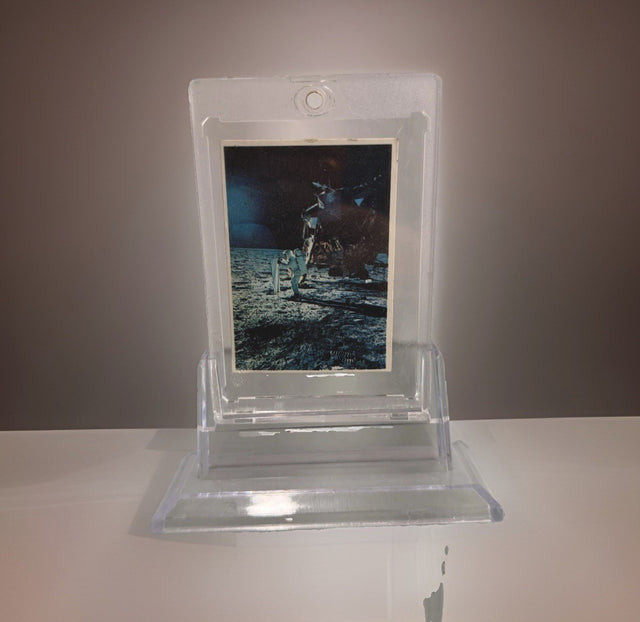
1969 Space Candy Buzz Aldrin Apollo 11 On The Moon Card #19 Taylor-Reed Display
$59.00 USD
-
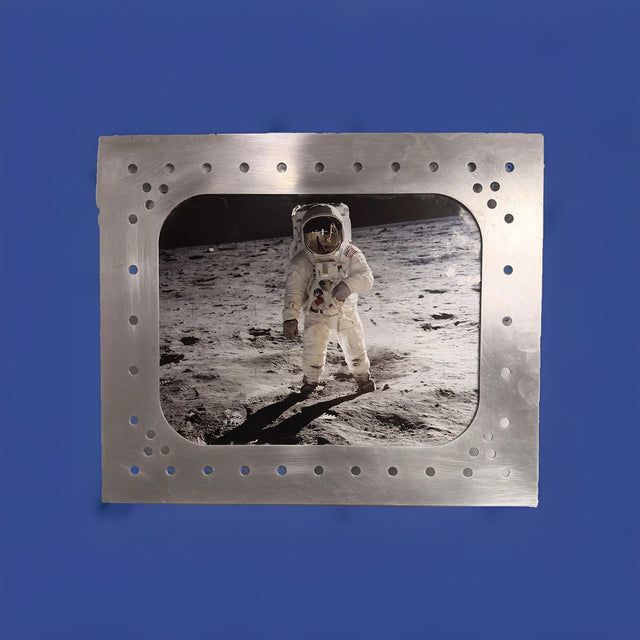
Apollo 11 Astronaut on the Moon NASA Photo Riveted Aluminum Spacecraft Frame
$89.00 USD
-
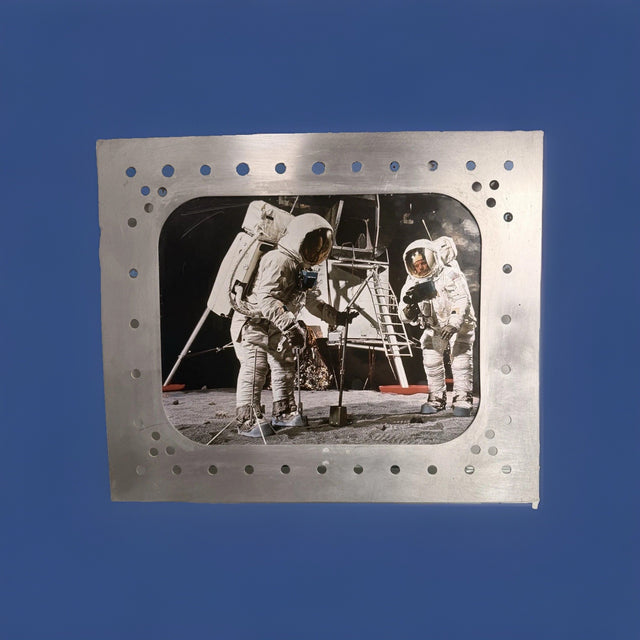
Apollo Astronauts on the Moon NASA Photo Riveted Aluminum Spacecraft Frame
$89.00 USD
-

Gene Kranz Signed Apollo 11 Moon Card PSA/DNA NASA Flight Director Autograph
$150.00 USD
-

Buzz Aldrin Apollo 11 Tranquility Framed Autograph - Zarelli Space COA
$350.00 USD
-
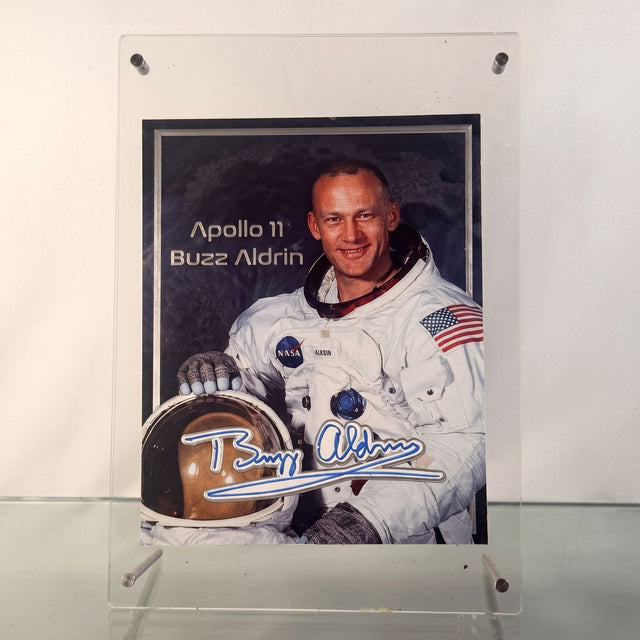
Buzz Aldrin Signed Apollo 11 NASA Double-Sided Photo JSA Authenticated Display
$450.00 USD


Browse the collection for current listings.