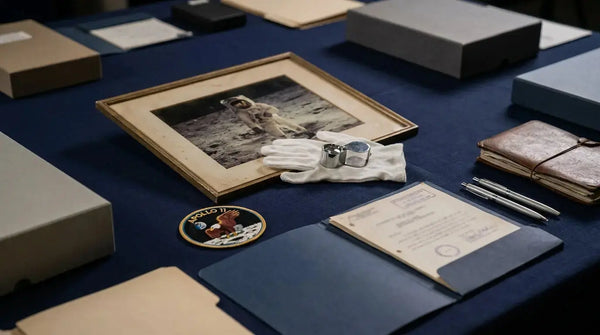
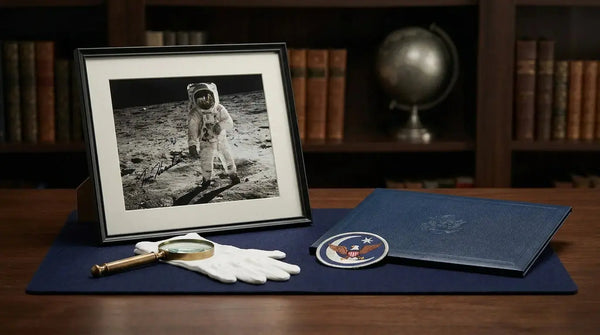
Michael Collins was the Command Module Pilot of Apollo 11 — the man who orbited the Moon alone while Armstrong and Aldrin made history below. His April 2021 passing permanently capped the supply of authentic signatures, making his memorabilia one of the most compelling value opportunities in NASA collecting today, with PSA/JSA graded 8x10 photographs trading at $600–$1,800 and complete Apollo 11 crew sets now permanently irreplaceable.
On July 20, 1969, two men descended to the surface of the Moon. A third remained in orbit, alone, in one of the most profound acts of solitude ever performed by a human being. Michael Collins — Air Force test pilot, Gemini 10 veteran, and Apollo 11 Command Module Pilot — circled the Moon 14 times while Neil Armstrong and Buzz Aldrin became the most famous explorers in history. For 21 hours, Collins was the most isolated person in the universe, sometimes losing all radio contact on the far side. He called it "exhilarating loneliness."
History recorded three names on Apollo 11. Only two became household words. That imbalance — and its slow, ongoing correction — is precisely what makes Michael Collins memorabilia one of the most undervalued propositions in the space collectibles market today.
Michael Collins: The Man Behind the Mission
Born October 31, 1930, in Rome, Italy, to a U.S. Army family stationed abroad, Michael Collins grew up shaped by military service and a restless intellect. He graduated from West Point in 1952, transferred to the Air Force, and ultimately became a test pilot at Edwards Air Force Base — the same proving ground that produced Chuck Yeager, John Glenn, and many of the original Mercury astronauts. NASA selected Collins in its third astronaut class in 1963.
His first spaceflight, Gemini 10 in July 1966, demonstrated the precision NASA demanded of its best pilots. Collins completed two spacewalks — including an ambitious rendezvous with an unmanned Agena target vehicle — and proved himself the unflappable operator the agency needed for the Moon program. Three years later, he was assigned to Apollo 11 as Command Module Pilot, responsible for the spacecraft that would carry all three men to the Moon and bring them home.
The Loneliest Man in the Universe
During the 21 hours Armstrong and Aldrin spent on the lunar surface and in the Lunar Module Eagle, Collins flew Columbia in a 60-by-170-mile orbit above the Moon. Every two hours, as he passed behind the Moon's far side, he was completely cut off from Earth — a silence no human had experienced before or has experienced since in quite the same form. When asked later if he felt lonely, Collins was characteristically precise: he felt isolated, aware of his solitude, but not troubled by it. He had a job to do, and he did it with calm professionalism.
Collins went on to serve as Director of the National Air and Space Museum from 1971 to 1978, overseeing its transformation into the landmark institution it became. He wrote two books, including Carrying the Fire (1974), universally regarded as the finest memoir ever written by an astronaut — disciplined, self-aware, and entirely free of the hagiography that colors so many NASA accounts.
He passed away on April 28, 2021, from cancer, at age 90. With his death, the last chapter closed on the original Apollo 11 crew's ability to sign. Armstrong had stopped publicly in 1994. Collins signed generously and graciously until near the end of his life. That generosity now belongs to history — and to the fixed inventory of certified items that remain.
Why Collins Memorabilia Is Undervalued — and Why That Is Changing
The astronaut autograph market has historically applied a steep hierarchy: Armstrong commands premiums that dwarf all others, Aldrin trades at a significant but secondary level, and Collins has been priced as the third man. That pricing has never accurately reflected historical reality. Collins was not peripheral to Apollo 11 — he was essential. Without the Command Module Pilot, there is no mission, no return, no story. His role required some of the most demanding navigation and docking procedures in the entire program; it was Collins's precision that guaranteed any possibility of bringing the crew home.
The market is beginning to understand this. In the four years since Collins's passing, realized prices for authenticated Collins material have risen 20–35% at major auction houses. The trajectory closely tracks what happened to Armstrong prices in the two to three years following his 2012 death: the permanent supply cap became undeniable, collectors who had delayed acquisition began competing for fixed inventory, and prices moved decisively upward.
Today, PSA/JSA graded examples of the same format trade at $600–$1,800, with the premium tier accelerating as high-grade certified examples become scarcer in active dealer inventory. The correction is underway. The question is how much further it runs. Compare like-for-like signed objects or artifacts with matching mission association, signer, condition, authentication and provenance; a category-wide rate or median mixes different objects.
Michael Collins Memorabilia: Current Market Values
| Item Format | Certification | Typical Range (2025–2026) | Notes |
|---|---|---|---|
| Signed 8x10 Photograph | PSA or JSA | $600–$1,800 | Clean signatures command upper end; inscribed slightly discounted |
| Signed NASA Official Lithograph | PSA or JSA | $800–$2,200 | Apollo 11 mission images premium over portrait shots |
| Signed Book — Carrying the Fire | JSA or LOA | $900–$2,500 | First editions with clean signatures most sought; title page preferred |
| Signed Apollo 11 Insurance Cover | PSA or JSA | $1,200–$3,500 | Philatelic provenance adds material premium; July 1969 postmarks strongest |
| Signed Mission Patch (Apollo 11) | PSA or JSA | $1,500–$4,000 | Crew-signed patches at significant premium over single-signer |
| Signed First Day Cover (FDC) | PSA or JSA | $700–$2,000 | 1969-era postal dates with documented provenance chains strongest |
| Apollo 11 Crew Set — All Three Astronauts | PSA/JSA/Zarelli | $12,000–$35,000+ | Permanently irreplaceable — no new examples can ever be created |
Ranges reflect clean, certified examples; uninscribed preferred in most categories.
The Apollo 11 Crew Set: A Permanently Closed Supply Chain
There is a category of space memorabilia that occupies a unique position in the entire collectibles universe: items bearing the authentic signatures of all three Apollo 11 crew members — Neil Armstrong, Michael Collins, and Buzz Aldrin — on a single piece. Photographs, lithographs, insurance covers, mission patches, and First Day Covers in this category are not merely rare. They represent the entire universe of supply that will ever exist.
Armstrong stopped publicly signing in 1994. He passed in 2012. Collins passed in 2021. Aldrin, now in his mid-90s, has significantly curtailed all signing activity. No new crew-signed Apollo 11 items are being created. Every authenticated example in circulation is part of a fixed, finite pool that diminishes as pieces are absorbed into permanent collections, donated to institutions, or passed between private hands without re-entering the open market.
For collectors with a multi-year investment horizon, this structural reality is unambiguous. The question is not whether authenticated crew-set items will appreciate further — it is at what pace, and whether current price levels represent the last accessible entry point before institutional and ultra-high-net-worth buyers fully recognize the scarcity premium that the specialist market has understood for years.
Gauntlet Gallery applies the Zarelli Space Authentication standard to all crew-set acquisitions — the same benchmark used by the specialist astronaut market's most demanding buyers. Authentication documentation, provenance chains, and chain-of-custody records are preserved alongside every item we certify and offer.
Authentication: What to Know Before You Buy
But as Collins prices have risen steadily since 2021, incentive for forgery has followed. Any acquisition above $500 should carry PSA or JSA certification, and crew-set items warrant the additional rigor of Zarelli Space Authentication.
Collins's signature evolved meaningfully across his life. His post-1969 civilian signing years produced a more relaxed, flowing hand than his active-duty NASA period. Pre-mission signatures from the Gemini 10 era are notably different from his Apollo 11-period hand, which itself continued to evolve through the 1970s and 1980s.
Red Flags for Collectors
- Ungraded items described as "authentic" or "guaranteed" with no third-party certification
- Crew-set items where one or more signatures lack individual PSA/JSA lot numbers
- Collins signatures that appear too uniform — he had a distinctive personal hand variation that forgeries frequently fail to replicate accurately in the descenders and terminal strokes
- Provenance claims to "estate sales" or "private family collections" without documentary support — these are common forgery laundering narratives in the astronaut autograph market
- Pricing significantly below current market for the format — authenticated Collins material does not sell for $150 on general auction platforms; it sells for multiples of that
Collins Among the Apollo-Era Icons: The Value Case
The astronaut autograph market is not a monolith. Armstrong occupies a category of one — first human on the Moon, documented forgery pressure, nearly 30 years of supply restriction before his 2012 death. Aldrin commands strong premiums, though his continued signing activity through his 80s created a larger authenticated supply pool than Armstrong's heavily restricted output ever did. Collins sits between them in historical significance and, currently, below Aldrin in market pricing for equivalent formats.
That gap is the opportunity. A PSA-graded Armstrong 8x10 trades at $8,000–$15,000. A comparable Aldrin example trades at $1,500–$4,000. Collins at $600–$1,800 reflects neither his historical role — essential, irreplaceable, pilot of the spacecraft that brought all three men home — nor the supply permanence that his 2021 passing definitively established. The Apollo 11 crew was Armstrong, Aldrin, and Collins. The market is pricing Collins as though he were Apollo 17.
Among collectors who study the fundamentals, Collins is the consensus best-value entry in Apollo-era autographs. The correction is underway. The question is how far it has left to run — and whether you are positioned before or after the move.
Collecting Michael Collins Memorabilia: Practical Guidance
For collectors entering or expanding in this category, several principles apply consistently across market conditions:
Prioritize certification above all else. The price premium for a PSA or JSA graded Collins piece over an ungraded comparable has only increased since 2021. Certification is not optional at current market levels — it is the difference between an investment and a gamble, and between liquidity and a piece you cannot resell with confidence.
Favor clean signatures. Collins inscribed generously, particularly in his post-NASA public life at museums and speaking events. Pieces inscribed to named individuals carry a modest discount versus clean signatures on the open market. Exceptions exist for historically notable dedications, but as a default, uninscribed examples offer better liquidity and broader buyer appeal.
Apollo 11 imagery commands a premium over portrait shots. Mission imagery connects the piece to the event — and the event is why the piece has value.
Consider crew-set items if the budget allows. The price gap between a single Collins signature and a crew-set piece is substantial. But the structural investment case for crew sets is stronger than for any individual astronaut. The supply is truly permanent; no amount of capital or desire can produce new examples.
Document your provenance chain. Receipts from reputable dealers, auction house records, and certification letters should be preserved alongside every piece. Gauntlet Gallery provides full provenance documentation with every item we sell — the record of ownership history is part of the value of the piece, and it will matter to the next buyer.
The Carrying the Fire Standard
Michael Collins published his memoir Carrying the Fire in 1974. Norman Mailer called it one of the finest books written about the space age. Collins wrote without a ghostwriter, in a voice that was precise, self-deprecating, and entirely his own. He described orbiting the Moon alone not with manufactured drama but with the calm clarity of a professional who had accepted his role and found genuine meaning in it.
That quality — the willingness to do the essential, unglamorous work without demanding the spotlight — is part of what makes Collins's legacy resonate so strongly with collectors and historians alike. He was not forgotten because he was less important. He was overlooked because he was too professional, and perhaps too honest, to insist on being remembered. History and the market are now correcting that oversight. The question for collectors is whether to participate early or late.
Gauntlet Gallery has specialized in authenticated space memorabilia since 2012. Every piece we offer comes with full provenance documentation.
Explore Authenticated Space Memorabilia at Gauntlet Gallery →
Shop Apollo 11
Explore current pieces available from the gallery.
-
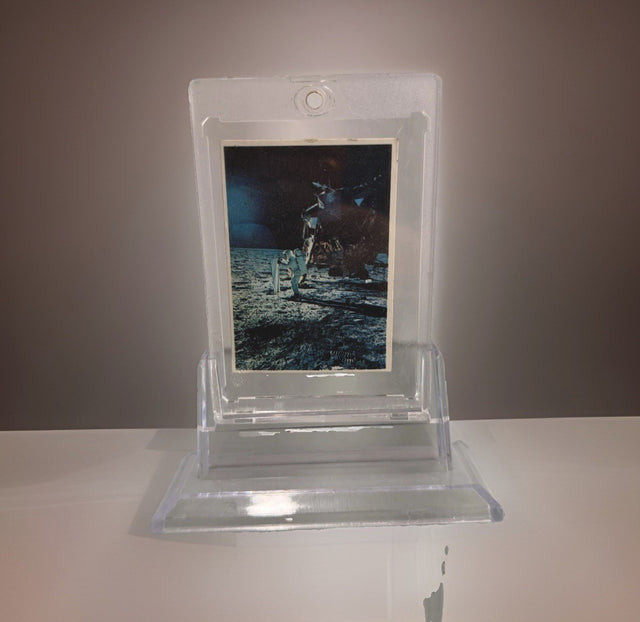
1969 Space Candy Buzz Aldrin Apollo 11 On The Moon Card #19 Taylor-Reed Display
$59.00 USD
-
Apollo 11 Astronaut on the Moon NASA Photo Riveted Aluminum Spacecraft Frame
$89.00 USD
-
Apollo Astronauts on the Moon NASA Photo Riveted Aluminum Spacecraft Frame
$89.00 USD
-

Gene Kranz Signed Apollo 11 Moon Card PSA/DNA NASA Flight Director Autograph
$150.00 USD
-

Buzz Aldrin Apollo 11 Tranquility Framed Autograph - Zarelli Space COA
$350.00 USD
-
Buzz Aldrin Signed Apollo 11 NASA Double-Sided Photo JSA Authenticated Display
$450.00 USD


Browse the collection for current listings.