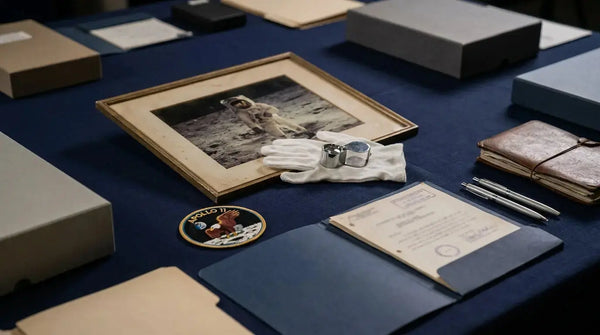
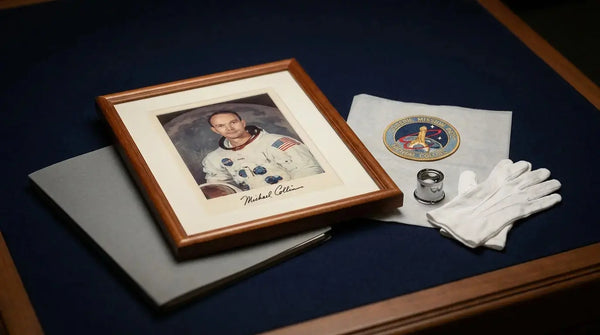
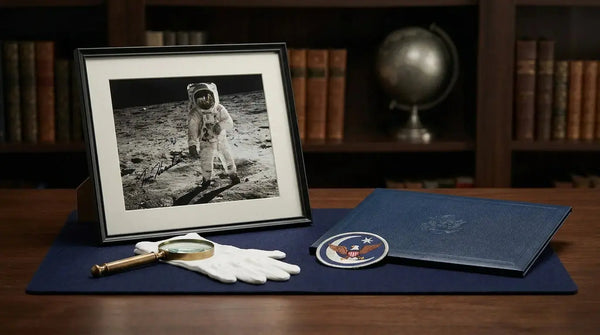
Which astronaut signatures are the rarest and most valuable to collect? The answer is grounded in a single, unyielding economic principle: supply that is permanently fixed against demand that only grows. The astronauts who signed the least — because history cut their careers short or because they chose to stop — command the highest prices and the strongest long-term appreciation. Compare like-for-like signed objects or artifacts with matching mission association, signer, condition, authentication and provenance; a category-wide rate or median mixes different objects.
Why Scarcity Is the Defining Variable in Space Autograph Collecting

Space memorabilia occupies a unique position in the broader collectibles market. Unlike sports or entertainment autographs — where living athletes and celebrities can always produce more supply — the roster of Apollo-era astronauts is closed. Of the 24 men who flew to the Moon, more than half have now passed. Each death is a supply-finalization event: the moment that astronaut's signature transitions from a potentially renewable resource to a permanently fixed one.
The appreciation pattern is well-documented: a living astronaut's signature commands modest premiums, then prices accelerate in the years preceding death as health news circulates, then jump sharply at death, then continue climbing steadily as the fixed supply is absorbed into permanent collections.
The data is unambiguous: deceased Apollo astronauts represent the highest-certainty appreciation model in the entire space collectibles category.
Tier 1 — Maximum Scarcity: The Rarest NASA Signatures in Existence
Neil Armstrong (1930–2012): The Benchmark for All Space Autographs
Neil Armstrong is, by consensus, the most valuable and sought-after autograph in space memorabilia — and one of the most consequential autographs in all of collecting. His stature derives from three compounding scarcity factors that no other astronaut replicates.
First, Armstrong stopped signing publicly in 1994, citing the commercial exploitation of his signature. For the final 18 years of his life, authenticated examples were essentially limited to private signings, charity events, and items already in circulation. Second, his death in August 2012 permanently closed the supply. Third, he was the first human being to walk on another world — a distinction that anchors demand to the deepest levels of human cultural memory.
A lifetime count of authentic signed items is not established here. For astronaut material, distinguish the signature opinion, mission association and any flown provenance, and verify what the named issuer actually examined. Historical importance does not ensure sustained price appreciation.
Uninscribed whole-signed portraits benchmark above $25,000 at the upper tier. These figures represent a market that has been appreciating steadily since Armstrong's 2012 passing — and there is no structural reason for that appreciation to reverse.
Roger Chaffee (1935–1967): The Absolute Scarcity Champion
Roger Chaffee died in the Apollo 1 launchpad fire on January 27, 1967 — three weeks before his 32nd birthday, and before he had the opportunity to sign widely for collectors, through-the-mail requests, or the public events that would follow the triumphant Moon landings. He never flew in space. His total authenticated signing output is extraordinarily small by any measure.
When PSA-graded Chaffee examples surface at auction, they command $3,000–$8,000 for individual signed photographs — prices that reflect near-absolute scarcity rather than celebrity magnitude. A Chaffee signature on a prime piece of NASA material, authenticated and slabbed, is one of the rarest objects in American autograph collecting. Collectors who dismiss Chaffee because he never reached the Moon are missing one of the most structurally sound scarcity investments in the entire field.
The three-member Apollo 1 crew — Grissom, White, and Chaffee — signed together only rarely. Crew-signed items represent what many specialists consider the single most coveted configuration in space memorabilia. When authenticated examples have surfaced, they have commanded five-figure prices with ease.
Tier 2 — Very Scarce: Supply Permanently Capped, Prices Still Rising

Gus Grissom (1926–1967): Apollo 1 Commander, Extreme Rarity
Virgil "Gus" Grissom was the second American in space and one of the most celebrated astronauts of the Mercury and Gemini programs. He died alongside Chaffee and Ed White in the Apollo 1 fire. His signing history is longer than Chaffee's by virtue of a full Mercury and Gemini career — but supply is nonetheless extremely limited relative to his historical stature.
Grissom items from his Mercury and Gemini years carry the most documentary interest, and single-mission-associated pieces (Liberty Bell 7 imagery, Gemini 3 material) command significant premiums. The historical weight of his loss — and the permanent closure of any new supply — ensures that Grissom remains a foundational holding for any serious Apollo-era collection.
Michael Collins (1930–2021): The Undervalued Apollo 11 Crew Member
Michael Collins piloted the Command Module on Apollo 11 while Armstrong and Aldrin walked on the Moon — a detail that has historically suppressed his signature value relative to his crewmates. That suppression represents one of the most consistently discussed valuation gaps in space autograph collecting.
Collins signed actively for decades, meaning supply is larger than Armstrong's. But his April 2021 death permanently capped that supply, and his direct connection to Apollo 11 — the defining mission of the 20th century — provides a demand anchor that grows with each passing generation. Collins's own memoir, Carrying the Fire, is widely regarded as the finest personal account of the astronaut experience; his cultural footprint extends well beyond his flight role. Collectors who view Collins as undervalued relative to his historical significance have a compelling structural argument.
Tier 3 — Scarce but Obtainable: Fixed Supply, Active Market
Buzz Aldrin (Born 1930): Living Legend, Finite Pre-Closure Window
Buzz Aldrin, the second human to walk on the Moon, continues to sign at authorized events and through official channels. His signature is obtainable at living-astronaut prices — but the strategic question for collectors is not whether to buy, but when. Aldrin is 96 years old. The transition to fixed-supply status, when it comes, will be a significant market event. Collectors building Apollo 11 holdings have strong incentive to acquire authenticated Aldrin material now, at prices that still reflect living-signer levels. The post-death appreciation pattern for Armstrong and Collins is the reference model.
John Glenn (1921–2016): American Icon, Supply Now Fixed
John Glenn, the first American to orbit Earth and later a U.S. Senator who returned to space at age 77, was one of the most beloved figures in American public life for six decades. He signed actively throughout his life, creating a larger supply base than most Apollo-era astronauts. His December 2016 death has fixed that supply.
Current market prices — $400–$1,200 for PSA-graded 8x10 photographs — reflect broad accessibility compared to Armstrong or Grissom, and represent an accessible entry point for collectors building space portfolios. Glenn's cultural stature and the supply closure mean that long-term appreciation is structurally supported even at current price levels.
Specialist Tier — The Expert's Opportunity: Robert Farquhar

Robert Farquhar (1932–2015): Halo Orbit Pioneer, Deeply Undervalued
Robert Farquhar is not a household name outside of astrodynamics and deep-space mission planning, but among specialists he is one of the foundational figures of the space age. Farquhar pioneered the halo orbit concept that made the ISEE-3/ICE, WIND, and ACE missions possible, and his trajectory work shaped virtually every deep-space mission profile for half a century. He passed away in 2015.
His signed material exists in tiny quantities and trades at prices far below his scientific significance — a pattern common to technical contributors whose names never became public-facing, but whose work was absolutely essential to the programs that produced the household names. For collectors with domain knowledge in planetary science, orbital mechanics, and mission design, Farquhar represents the kind of deeply undervalued specialist opportunity that precedes significant re-rating when mainstream collectors and institutions discover the gap between historical importance and current market price.
Market Price Reference: Scarcity Rankings at a Glance
| Astronaut | Tier | Status | PSA-Graded 8x10 Range | Key Investment Note |
|---|---|---|---|---|
| Neil Armstrong | 1 — Maximum | Deceased 2012 | $8,000–$20,000+ | Highest demand + capped supply; authentication mandatory |
| Roger Chaffee | 1 — Maximum | Deceased 1967 | $3,000–$8,000 | Absolute lowest total supply of any major NASA figure |
| Gus Grissom | 2 — Very Scarce | Deceased 1967 | $2,500–$6,000 | Apollo 1 commander; Mercury/Gemini hero; rare early-era pieces |
| Michael Collins | 2 — Very Scarce | Deceased 2021 | $800–$2,500 | Undervalued vs. Apollo 11 stature; supply now permanently capped |
| John Glenn | 3 — Scarce | Deceased 2016 | $400–$1,200 | Accessible entry point; fixed supply; high cultural stature |
| Buzz Aldrin | 3 — Scarce | Living | $300–$900 | Apollo 11 connection; acquire before supply-finalization event |
| Robert Farquhar | Specialist | Deceased 2015 | $150–$500 | Deeply undervalued; halo orbit pioneer awaiting re-rating |
Crew-signed pieces, mission-associated material, and uninscribed examples command significant premiums above these benchmarks.
Authentication: The Requirement That Cannot Be Skipped

Gauntlet Gallery has operated in the space memorabilia market since 2012, and the single most consistent finding across 160,000+ comparables is this: authentication is the difference between an appreciating asset and a worthless forgery. For Armstrong material in particular, the circulating forgery rate renders unauthenticated items essentially uncollectible at serious investment scale.
We apply the Zarelli Space Authentication standard to every piece in our collection — the same standard used by RR Auction, Heritage Auctions, and the most sophisticated institutional buyers in the field. We pair Zarelli LOAs with PSA or JSA slab encapsulation for market liquidity.
For collectors building serious holdings, treat unverified authentication as disqualifying — regardless of price or apparent condition. The premium for authenticated material is not merely a quality marker. It is a prerequisite for long-term value preservation in a category where the stakes of getting it wrong are severe.
The Investment Case, Plainly Stated
The astronauts who command the highest prices share one characteristic: their supply is permanently, irreversibly fixed. Armstrong stopped signing in 1994 and died in 2012. Chaffee and Grissom died before most collectors were born. Collins and Glenn signed for decades but are now gone. Each passing year adds more demand — more collectors, more institutions, more generational buyers with deep emotional connections to the space age — against a supply that cannot grow by a single item.
The opportunity for today's collector lies in two places: first, acquiring the finest authenticated examples of already-deceased astronauts at prices that remain rational relative to historical significance; and second, identifying the next supply-finalization event before it occurs — which means acquiring authenticated material from living Apollo-era astronauts while prices still reflect living-signer premiums rather than the post-death scarcity reality.
The Apollo 1 crew represents this thesis in its most extreme form. The smallest total supply, the longest time since death, and demand that has only deepened as Apollo's historical significance grows with distance. These are not speculative assets. They are the most structurally sound pieces of American history available to collectors today.
Browse Gauntlet Gallery's Space Memorabilia Collection
From Apollo 11 crew signatures to Mercury program pioneers, we source only the pieces that meet the authentication bar serious collectors demand.
Shop Space memorabilia
Explore current pieces available from the gallery.
-
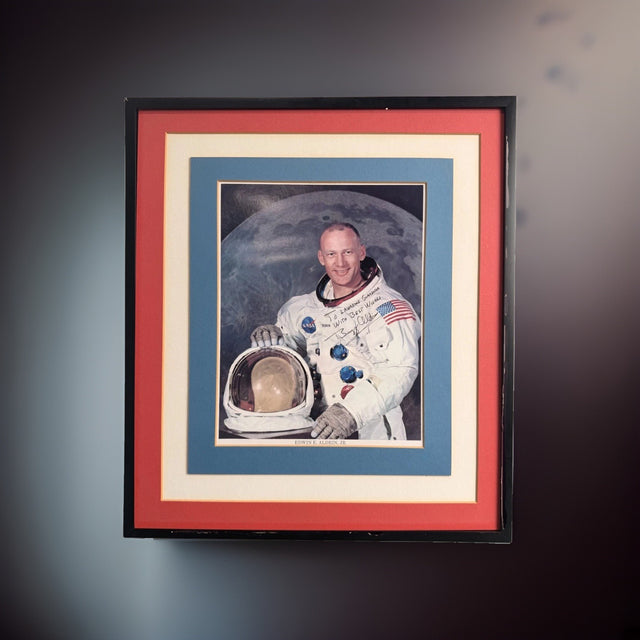
Buzz Aldrin Signed NASA 8x10 Color Photo Personalized Framed JSA LOA
$899.00 USD
-
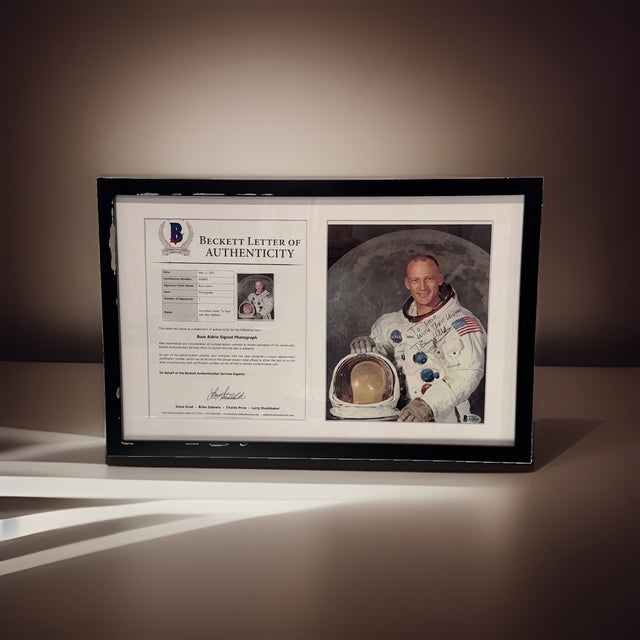
Buzz Aldrin Signed Inscribed Astronaut Photo Framed Beckett LOA A42843
$999.00 USD
-
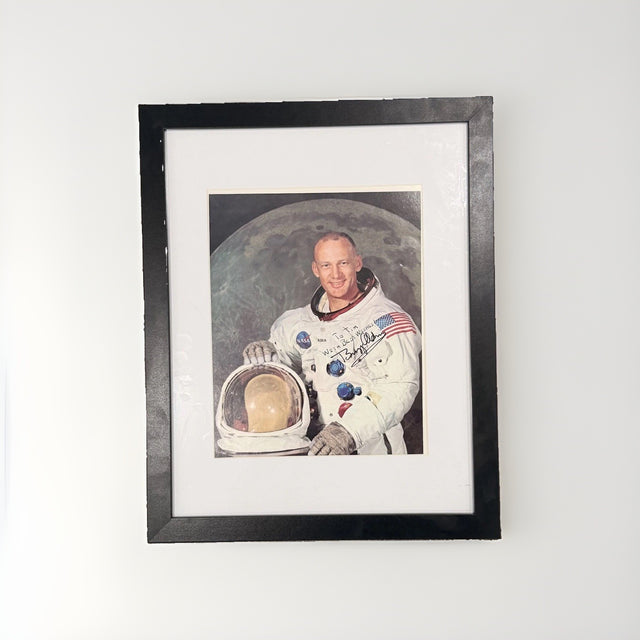
Buzz Aldrin Signed NASA Astronaut Portrait Inscribed To Tim Framed
$850.00 USD
-
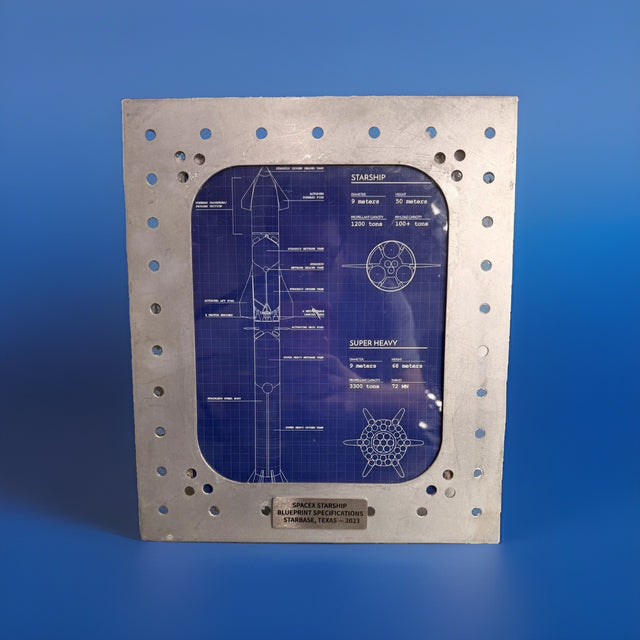
SpaceX Starship Super Heavy Blueprint Metal Display Panel Spacecraft Frame
$59.00 USD
-
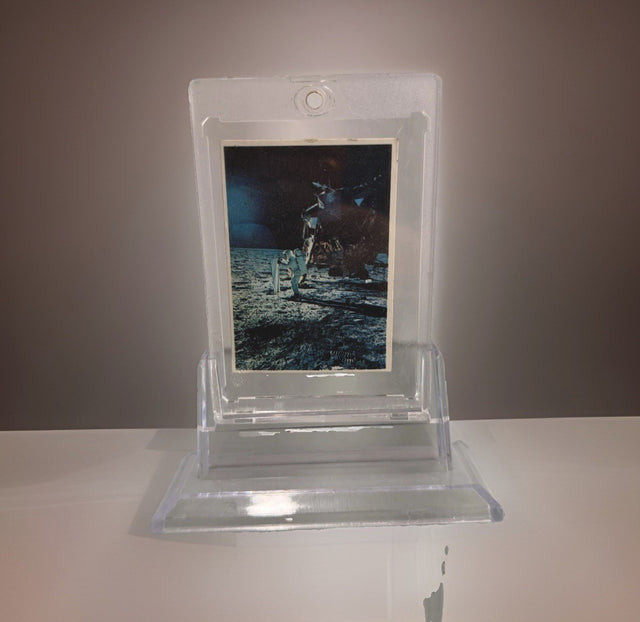
1969 Space Candy Buzz Aldrin Apollo 11 On The Moon Card #19 Taylor-Reed Display
$59.00 USD
-
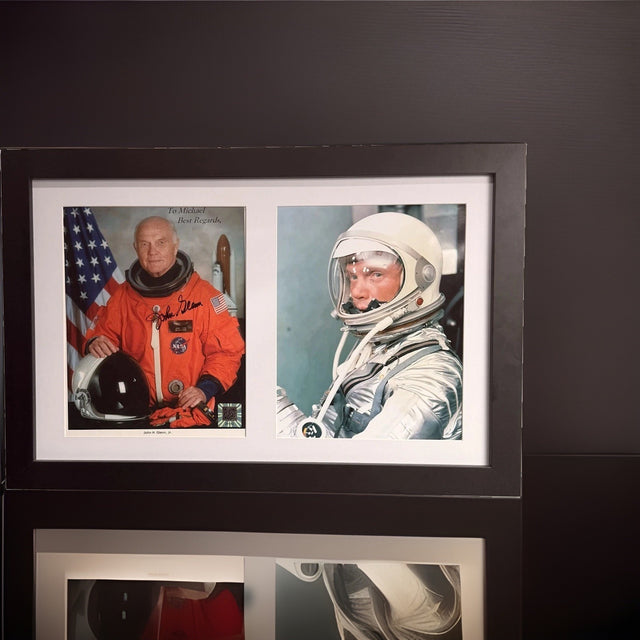
John Glenn Signed Autographed NASA Photo Display JSA Mercury Astronaut Framed
$199.00 USD
Browse the collection for current listings.