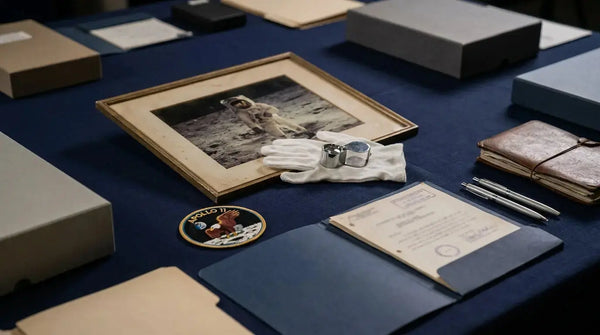
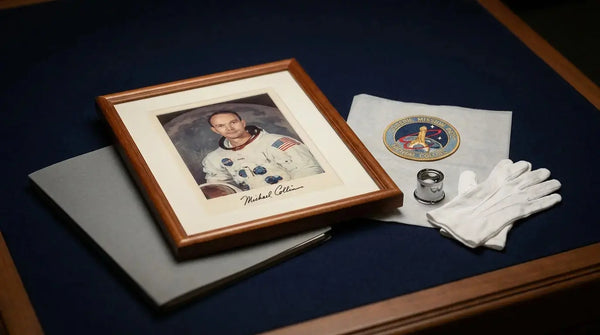
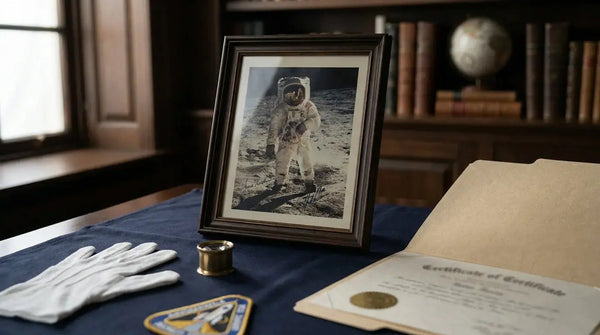
The single most important question for any new space collector: what signed NASA photographs should I collect? The answer is grounded in authentication, scarcity, and the historical weight of the signatures themselves. Signed NASA photographs are the backbone of space memorabilia collecting — visually striking, well-documented in the historical record, and supported by decades of auction results. This guide covers the photograph types that matter most, the signers who drive the market, and the condition standards that protect your investment.
The Four Categories of Collectible NASA Photographs
Not all signed NASA photographs are created equal. Understanding the four principal categories helps collectors allocate capital with precision.
1. Official NASA Portrait Photographs
Official NASA portrait photographs — the formal crew headshots taken at Johnson Space Center before and after each mission — are the most widely signed and most consistently authenticated type in the market. Every Apollo, Gemini, and Mercury astronaut participated in official portrait sessions. These images exist in 8x10 and 11x14 formats and were printed in controlled batches by NASA's photographic laboratory.
Because portrait photographs were signed extensively during astronaut press tours, through-the-mail (TTM) programs, and at organized signing events, the pool of authentic examples is larger than for mission photography. That accessibility makes them the recommended entry point for new collectors — and the relative volume means PSA and JSA have substantial signature exemplar databases to draw from during authentication review.
2. Mission Photography — Lunar Surface Images
Mission photographs — actual images captured during spaceflights, especially the Apollo lunar surface sequences — represent the highest-value tier. These images were taken on Hasselblad cameras carried aboard the Lunar Module, with film magazines returned to Earth and processed by NASA. The resulting images carry NASA catalog numbers (AS11, AS12, AS14 through AS17) that allow precise verification of origin.
Signed mission photography commands a premium because the photograph itself is evidence: it places the signer at the location depicted. A signed lunar surface photograph is simultaneously an autograph and a primary historical document. For that reason, lunar surface prints signed by the mission commander or the depicted astronaut trade at multiples above portrait photographs of equivalent condition.
3. Wire Service and Press Photographs
AP, UPI, and NASA public affairs office press photographs were produced for media distribution during the Space Race era. They frequently carry wire service stamps, caption slugs, and editorial markings on the reverse — provenance data that can anchor the photograph to a specific publication date, signing event, or press pool. A well-documented press photograph with a clean signature and intact wire stamp can equal or exceed the value of an official NASA print depending on the subject matter.
4. Commemorative and Anniversary Photographs
NASA, the Smithsonian, and commercial publishers produced commemorative prints for mission anniversaries — the 10th, 20th, 25th, and 50th anniversaries of Apollo 11 generated particularly large signing runs. While these photographs lack the primary-source weight of official mission prints, they were signed in documented settings (event appearances, organized signings) and frequently carry authentication LOAs from Zarelli Space Authentication, PSA, or JSA. For collectors working at lower price points, anniversary photographs offer a legitimate path into Armstrong and Aldrin material.
Most Collectible Signers: A Market Hierarchy
Neil Armstrong
Neil Armstrong signed memorabilia occupies a category of its own. His 1994 decision to stop signing — enforced with rare exceptions for the remaining 18 years of his life — permanently closed new supply a full 18 years before his 2012 passing. Forgery rates approaching 40% of unverified market inventory make authentication non-negotiable. Gauntlet Gallery applies Zarelli Space Authentication standards and a four-era signature methodology — drawn from our 160,000+ comparable sales database — to every Armstrong acquisition.
The most collectible Armstrong subjects are lunar surface photographs, particularly images from the AS11 sequence taken during the Apollo 11 EVA. Armstrong signed fewer photographs of himself on the Moon (because he was behind the camera for most surface EVA photography) — which makes any authenticated Armstrong signature on a lunar surface image exceptional.
Buzz Aldrin
Buzz Aldrin remained active in signing through his later years, making authenticated examples more accessible than Armstrong material. The highest-value Aldrin photographs are EVA shots from Apollo 11 — images showing Aldrin on the lunar surface, the Sea of Tranquility in the foreground, Earth visible in the visor reflection. These photographs are among the most recognizable images in human history. Signed examples with PSA or JSA authentication trade robustly at auction and through private treaty.
The Aldrin-on-Moon Dual-Signed Phenomenon
The famous Aldrin-on-Moon photographs (NASA catalog AS11-40-5931 and variants) were taken by Neil Armstrong — making Armstrong the photographer and Aldrin the subject. A dual-signed print carries both men's signatures and tells the complete Apollo 11 story. Collectors who acquire an Aldrin-signed lunar surface print should note that a matching Armstrong co-signature transforms the piece into a different category entirely. Dual-signed Armstrong-Aldrin lunar surface photographs are among the most aggressively pursued pieces in the space collecting market.
Michael Collins
Michael Collins orbited the Moon in the Command Module while Armstrong and Aldrin walked the surface — making him, as he wryly noted, "the loneliest man in the universe." Collins signed generously throughout his life and remained accessible to collectors. Orbital photographs, crew portraits, and mission photography signed by Collins are relatively liquid and authenticate cleanly against extensive PSA and JSA exemplar records. Collins material represents strong value for collectors building complete Apollo 11 ensembles.
Current Market Values: Signed NASA Photographs
| Photograph Type & Signer | Format | Estimated Range (Authenticated) |
|---|---|---|
| Neil Armstrong — Lunar Surface (AS11) | 8x10 | $8,000 – $18,000 |
| Neil Armstrong — Official NASA Portrait (WSS) | 8x10 | $12,000 – $28,000 |
| Armstrong + Aldrin Dual-Signed Lunar Surface | 8x10 or 11x14 | $22,000 – $55,000 |
| Buzz Aldrin — Aldrin on Moon / EVA Shot | 8x10 | $1,800 – $4,500 |
| Michael Collins — Orbital / Crew Portrait | 8x10 | $600 – $1,400 |
| Apollo 11 Crew Signed — All Three Signatures | 11x14 Crew Portrait | $18,000 – $40,000 |
| Press Photograph — Armstrong (Wire Stamp, PSA/JSA) | 8x10 | $5,500 – $12,000 |
Values reflect authenticated examples at major auction and private treaty, 2024–2026. Condition, provenance documentation, and inscription status materially affect realized prices. Source: Gauntlet Gallery 160,000+ comparable sales database.
Authentication: The Non-Negotiable Standard
The signed NASA photograph market carries a documented forgery problem that collectors cannot afford to ignore. Armstrong material in particular has been subject to skilled forgeries since at least the 1990s. Three authentication paths are accepted at the highest levels of the market:
- PSA (Professional Sports Authenticator) — the most liquid authentication in the market; a PSA-slabbed or LOA-accompanied Armstrong photograph commands a measurable premium at auction due to buyer confidence in resale.
- JSA (James Spence Authentication) — robust exemplar database for space material, well-accepted at Heritage, RR Auction, and Bonhams.
- Zarelli Space Authentication — specializes exclusively in space memorabilia; considered the most rigorous authentication for high-value Armstrong and Apollo-era pieces. Gauntlet Gallery applies the Zarelli standard across all space category acquisitions.
At Gauntlet Gallery, founded in 2012, every signed NASA photograph in our inventory is cross-referenced against our 160,000+ comparable sales database before acquisition. We apply a four-era signature methodology for Armstrong material, tracking documented signature evolution across his early NASA career, his public signing period, his through-the-mail years, and the extremely rare late-career exceptions. Authentication is not a checkbox — it is the foundation of the investment thesis.
Condition Standards and Storage
A signed NASA photograph is simultaneously a photographic print and an autograph artifact. Both components must be preserved. Surface scratches and fold creases on photographic paper are permanent and can reduce value by 40–60% relative to a Near Mint example. Emulsion damage — white streaks, flaking, or moisture marks — is similarly unrecoverable.
Correct storage is straightforward but non-negotiable:
- Store flat in archival polyester (Mylar) or polypropylene sleeves — never PVC, which off-gasses acids.
- Never roll photographs, even briefly. Rolled storage creates stress cracks in emulsion layers that are visible under raking light.
- If framing, use UV-filtering glazing (UV-filtering acrylic or museum glass). Standard glass transmits UV wavelengths that fade both photographic dyes and ink signatures over years of display.
- Store in a stable environment: 65–70 degrees F, 30–50% relative humidity. Avoid attics, garages, and exterior walls.
When purchasing, request high-resolution scans of both the face and reverse of the photograph. Wire service stamps, NASA catalog number notations, and authentication LOA attachments on the reverse are positive provenance indicators. Any sign of trimming, rebacking, or chemical treatment to the image surface warrants immediate inquiry.
Building a Focused Collection
The most coherent space photograph collections are built around a single mission, a single astronaut, or a single photograph type — not assembled opportunistically across the entire category. A collector focused exclusively on Apollo 11 lunar surface photography, authenticated to Zarelli or PSA standard, builds a collection with genuine narrative coherence and a defensible investment thesis. A collector who mixes Mercury crew portraits with Shuttle-era mission prints across a dozen signers has inventory — not a collection.
For most collectors entering the space photograph market, the recommended sequence is: one authenticated Buzz Aldrin EVA shot as a foundation, then a Michael Collins orbital portrait or crew portrait, then — if the collection thesis and budget support it — a single authenticated Neil Armstrong lunar surface photograph as the centerpiece. Each acquisition should arrive with independent third-party authentication and documented provenance. Every piece should exceed the condition standard you set on your first acquisition.
Space collecting rewards patience and precision. The photographs that defined humanity's greatest achievement deserve the same rigor in their custody.
Gauntlet Gallery has specialized in authenticated space memorabilia since 2012. Our 160,000+ comparable sales database and Zarelli Space Authentication standard underpin every space category acquisition. Browse our current space memorabilia inventory — including signed NASA photographs, mission-flown artifacts, and astronaut autographs — at gauntlet.gallery/collections/space-memorabilia.