Space memorabilia is different from almost every other collecting category.
A signed album connects you to a musician. A screen print connects you to an artist. A game-worn jersey connects you to an athlete.
But an astronaut-signed Apollo photograph connects you to a moment when human beings left Earth, crossed deep space, and stepped onto another world.
That is not marketing language. That is the category.
NASA's Apollo 11 mission page identifies the mission as the first crewed lunar landing, with Neil Armstrong, Buzz Aldrin, and Michael Collins launching on July 16, 1969 and splashing down on July 24, 1969. Armstrong became the first human to set foot on the Moon, Aldrin the second, while Collins served as command module pilot.
For collectors, that historical gravity creates a unique market. Astronaut autographs, mission-flown artifacts, signed NASA photographs, mission patches, covers, maps, checklists, hardware, training material, and flown flags are not just memorabilia. They are physical witnesses to the space age.
But that does not mean every astronaut-signed item is valuable.
The value depends on a specific combination of mission significance, signer rarity, object type, authenticity, provenance, condition, inscription, flown status, legal title, and market demand.
This guide explains how serious collectors evaluate astronaut-signed space memorabilia and how to avoid buying a cool-looking piece with weak evidence.
Because in space collecting, the central question is not just: who signed it?
The better question is: what exactly is this object, how close is it to the mission, and can the story be proven?
Space Memorabilia Is a History Market First

Space memorabilia is not driven by decoration alone. It is driven by history.
The Smithsonian's National Air and Space Museum preserves major spaceflight artifacts, including the Apollo 11 Command Module Columbia. That institutional context helps explain why collectors treat Apollo material as cultural history, not ordinary celebrity memorabilia.
This is the first thing new buyers should understand.
A signed astronaut photo may look simple. It may be an 8x10 NASA portrait, a lunar surface image, a launch photograph, or a crew lithograph. But the value is not only in the ink. It is in the connection between the signer, the mission, the image, and the documented history behind the object.
A Neil Armstrong signature on an Apollo 11 lunar surface photo is not the same category as a later shuttle astronaut signature on a generic NASA portrait. Both can be authentic. Both can be collectible. But they do not carry the same historical charge.
The closer the piece gets to a major mission, a mission-critical role, or a scarce signer, the stronger the collecting gravity.
What Counts as Space Memorabilia?
Space memorabilia is a broad category. Serious collectors usually divide it into several lanes.
Astronaut Autographs
These include signed photographs, crew portraits, NASA lithographs, books, covers, mission patches, maps, charts, models, letters, flight plans, and personal correspondence.
Astronaut autographs are often the entry point for new collectors because they are visually appealing, historically meaningful, and easier to display than large artifacts.
Mission-Flown Artifacts
These are objects that traveled on a mission.
Examples include flown flags, patches, checklists, cue cards, Kapton foil, medallions, covers, cloth fragments, hardware components, and personal preference kit items.
Flown status is one of the strongest value drivers, but only when documented properly.
Crew-Used or Mission-Used Objects
A crew-used object was handled, worn, referenced, or used by an astronaut or mission team. It may or may not have flown.
Examples include training manuals, simulation checklists, mission-control material, recovery items, spacesuit components, engineering hardware, and contractor-used documents.
NASA Photographs and Prints
Original NASA red-number photographs, vintage prints, press photographs, mission photography, and signed images can all be collectible. Value depends heavily on print type, era, image importance, signature, condition, and provenance.
Mission Patches and Covers
Mission patches, postal covers, launch covers, recovery covers, and signed philatelic material are a deep collecting niche. Some are affordable; others become significant when signed by important crews or carried on a mission.
Hardware and Engineering Material
This includes spacecraft components, test articles, contractor equipment, switches, panels, telemetry items, models, and other program artifacts. This lane requires careful title and provenance review.
Modern Space Collectibles
Modern material may include Space Shuttle, International Space Station, SpaceX, Blue Origin, Virgin Galactic, Artemis, and commercial-space items. NASA lists Artemis II as the first crewed Artemis lunar flyby, launched April 1, 2026 and splashed down April 10, 2026, showing that the market is not only nostalgic. New human deep-space history is still being made.
The category is wide. That is why authentication and documentation matter so much.
The Main Value Formula
A useful formula for astronaut-signed memorabilia is:
Value = Signer + Mission + Object + Signature Quality + Authentication + Provenance + Condition + Market Demand
Every part matters.
- A strong signer on a weak object may still be collectible.
- A common signer on a mission-flown object may be very collectible.
- A major mission with poor documentation may become risky.
- A beautiful piece with no authentication may be hard to resell.
- A genuine autograph in poor condition may trade below expectations.
Space memorabilia rewards layered strength. The best pieces usually have more than one reason to matter.
Value Driver #1: Mission Significance
Mission matters.
Apollo 11 is the obvious top-tier mission because it was the first crewed lunar landing. NASA identifies Apollo 11's primary objective as completing President Kennedy's national goal of a crewed lunar landing and safe return to Earth.
But Apollo 11 is not the only meaningful mission.
- Apollo 8 matters because it was the first crewed mission to orbit the Moon.
- Apollo 13 matters because of the survival story and mission drama.
- Apollo 15, 16, and 17 matter because of extended lunar exploration and the Lunar Roving Vehicle.
- Mercury missions matter because they represent America's first human spaceflight era.
- Gemini matters because it developed key rendezvous, docking, EVA, and long-duration techniques needed for Apollo.
- Space Shuttle missions matter when tied to important payloads, firsts, disasters, Hubble, ISS construction, or major astronauts.
- Artemis material may become increasingly important as the program creates the next chapter of lunar exploration.
The mission creates the historical frame.
A John Glenn Mercury item has a different collecting logic than an Apollo 11 crew portrait. A signed Apollo 13 flight-plan page has a different emotional pull than a generic shuttle crew lithograph.
Collectors should ask:
- What mission is represented?
- Was it a first?
- Was it a lunar mission?
- Was it flown?
- Was the signer part of the crew?
- Was the object connected directly to the mission?
- Does the image or object match the mission's historical importance?
The stronger the mission, the less generic the piece feels.
Value Driver #2: Astronaut Role and Rarity
Not all astronaut signatures carry the same value. That is not disrespect. It is market reality.
Collectors generally place a premium on:
- Moonwalkers
- Apollo 11 crew members
- Mercury Seven astronauts
- Commanders of major missions
- Astronauts tied to firsts
- Astronauts with limited autograph availability
- Deceased astronauts
- Full-crew signed items
- Astronauts associated with dramatic or iconic missions
Role matters because spaceflight history is role-specific.
Neil Armstrong was Apollo 11 commander and the first person to step on the Moon. Buzz Aldrin was lunar module pilot and the second person to walk on the Moon. Michael Collins was command module pilot, orbiting the Moon while Armstrong and Aldrin descended to the lunar surface.
That means an Apollo 11 item signed by Armstrong, Aldrin, and Collins carries a different collecting profile than the same image signed by only one crew member.
Full-crew material can be especially strong, but only when each signature is authentic and the object itself makes sense. One weak signature can compromise the whole piece.
Value Driver #3: Object Type
The substrate matters.
A signature is attached to an object. That object affects value.
Signed NASA Photographs
Signed NASA photos are the classic entry point. The image matters enormously.
A signed lunar surface image is usually more desirable than a generic portrait. A mission-specific photograph is usually stronger than a random later print. A vintage NASA photo may be stronger than a modern reproduction, depending on the context.
Crew Lithographs
Crew-signed lithographs are popular because they show the full mission crew. They are especially desirable when complete, clean, and signed by all crew members.
Signed Books
Signed astronaut books can be excellent, especially when first editions, inscribed, or connected to major astronauts. But books are usually less visually immediate than photographs unless the inscription is exceptional.
Postal Covers
Space covers are a serious niche. Launch covers, recovery covers, insurance covers, and mission-related covers can carry strong value when signed by important astronauts or tied to flown status.
Mission Patches
Signed patches can be appealing, but collectors need to distinguish ordinary commemorative patches from flown or crew-related examples.
Maps, Charts, and Flight Plans
Mission documents can be powerful because they connect directly to operations. A signed map or chart can be more compelling than a standard photo if it has mission relevance.
Flown Flags and Patches
Flown flags and patches can be very strong when provenance is direct and documentation is clear.
Hardware
Hardware can be spectacular, but also riskier. A switch, panel, bolt, foil fragment, or spacecraft component requires clear chain of custody and legal title.
The object should match the claim. A signed Apollo 11 lunar surface photo is simple to understand. A flown lunar-module checklist page is much more significant, but it requires much more documentation.
Value Driver #4: Flown Status

In space collecting, flown is one of the most powerful words. It means the object traveled on a space mission. But it is also one of the most abused words.
A piece may be:
- Flown in Earth orbit
- Flown to lunar orbit
- Flown to the lunar surface
- Carried in a Personal Preference Kit
- Carried in an Official Flight Kit
- Crew-used in flight
- Mission-used on the ground
- Training-used
- Commemorative but not flown
- Made from flown material
- Associated with a mission but not flown
Those distinctions are not small. They are the value.
For Apollo-era material, legal title has its own special history. Public Law 112-185 confirmed ownership rights for certain Mercury, Gemini, Apollo, and Apollo-Soyuz astronauts to artifacts from their missions, but specifically excluded lunar rocks and other lunar material.
That legal distinction is critical.
A flown flag from an astronaut's collection with a clear letter is one thing. A claimed Apollo lunar rock offered by an unknown seller is another thing entirely. The first may be collectible. The second should trigger serious caution.
Value Driver #5: Provenance
Provenance is the paper trail. In space memorabilia, provenance can be more important than the object itself.
Strong provenance may include:
- Astronaut-signed letter
- NASA documentation
- Mission manifest
- Personal Preference Kit documentation
- Official Flight Kit documentation
- Auction-house provenance
- Estate documentation
- Prior collection history
- Photographs of the object with the astronaut
- Crew letter or signed certification
- Contractor documentation
- Chain-of-custody records
- Matching serial numbers
- Original receipts or invoices
- Recognized authentication records
The best provenance answers three questions:
- Where did it come from?
- How did it leave NASA or the astronaut's possession legally?
- How do we know this is the same object?
Weak provenance sounds like:
- From a NASA employee.
- Estate find.
- Private collection.
- Believed flown.
- Family says it went to the Moon.
- Purchased years ago.
- Looks like Apollo material.
Those stories may be true. They are not proof.
In space collecting, a story without documentation is atmospheric re-entry without a heat shield.
Value Driver #6: Authentication
Astronaut autographs require specialist authentication.
General autograph authentication can be useful, but space is its own world. Signature habits, mission-era material, NASA photo formats, inscription patterns, autopen issues, secretarial signatures, printed signatures, and era-specific substrates all require category knowledge.
Zarelli Space Authentication describes itself as specializing in astronaut, cosmonaut, and aviation autographs, with more than 25 years of collecting and professional authentication experience.
That kind of specialist review matters because astronaut autographs have category-specific traps.
A collector should know the difference between:
- Hand-signed autograph
- Autopen signature
- Preprint
- Facsimile
- Secretarial signature
- Stamped signature
- Printed inscription
- Authentic signature on the wrong object
- Real autograph with weak provenance
- Autograph authentication vs. flown-status verification
Authentication should match the claim.
A Zarelli, JSA, PSA/DNA, or Beckett opinion may support the autograph. But if the piece is described as flown, the buyer also needs documentation supporting flown status. Autograph authentication alone does not prove the object went to space.
That distinction is everything.
Read our COA guide for collectors or learn how Gauntlet reviews authentication.
Value Driver #7: Inscription Quality
Inscriptions can add value when they connect the piece to the mission, recipient, or historical context.
A generic signature is good. A mission-specific inscription can be better.
Examples of potentially stronger inscriptions include:
- Apollo 11 mission reference
- First Lunar Landing notation
- Mission dates
- Flown to the Moon language, when supported by documentation
- A personal note to a NASA engineer, contractor, or mission participant
- Crew-specific references
- Technical notes or mission memories
But inscriptions can also narrow the buyer pool.
A personal inscription to a known NASA engineer may add context. The same inscription to an unknown recipient may be less broadly desirable. A long inscription can be powerful if historically relevant. It can be less attractive if visually awkward or unrelated.
The best inscriptions do two things: they add historical context and they do not damage visual appeal.
Collectors should read inscriptions closely. Sometimes the inscription is more important than the signature.
Value Driver #8: Condition
Condition always matters.
Paper is fragile. Ink fades. Photos crease. Frames hide damage. Tape stains migrate. Mat burn spreads. Sunlight bleaches. Humidity warps. Poor storage punishes everyone eventually.
For astronaut-signed photos, inspect:
- Corners
- Edges
- Surface gloss
- Creases
- Silvering
- Fading
- Ink contrast
- Signature smearing
- Pinholes
- Tape residue
- Mounting damage
- Back stamps
- NASA numbering
- Frame pressure
- Mat burn
- Trimming
- Water damage
For patches and flags, inspect staining, fading, thread wear, mounting method, adhesive residue, creasing, display damage, and documentation match.
For flown artifacts and hardware, inspect serial numbers, part numbers, labels, engraving, wear patterns, corrosion, modification, restoration, missing components, display mounts, and documentation consistency.
A damaged but historically important object can still be valuable. But condition must be priced honestly.
The phrase "excellent condition for age" is not enough. Serious collectors need photos and specific notes.
Value Driver #9: Market Demand
Space memorabilia has become a recognized auction and gallery category.
Major auction houses now handle NASA, Soviet, and private-sector space history, including flown mission artifacts, astronaut-worn gear, spacecraft hardware, engineering models, space photography, signed material, maps, charts, and items from astronaut and cosmonaut collections.
That does not mean every space item is blue-chip. It means the top of the category has institutionalized.
There is a serious collector base for historically important space objects. But price depends on the exact object. A common signed shuttle lithograph does not behave like an Apollo 11 flown artifact. A signed modern astronaut portrait does not behave like a Mercury Seven group-signed photo. A commemorative patch does not behave like a flown mission patch with direct astronaut provenance.
Market demand follows importance, evidence, and scarcity.
Apollo vs. Shuttle vs. Modern Space

Different eras attract different collectors.
Mercury
Mercury is early, heroic, and foundational. It appeals to collectors who value America's first human spaceflight era and the Mercury Seven.
Gemini
Gemini is underrated by casual collectors but respected by serious space historians. It built the operational skills that made Apollo possible.
Apollo
Apollo is the center of gravity. Lunar missions, moonwalkers, Apollo 11, Apollo 13, and Apollo 17 carry special demand.
Skylab and Apollo-Soyuz
These are important transitional programs. They can offer strong historical value at prices sometimes below Apollo lunar material.
Space Shuttle
Shuttle material is broad. It can be highly desirable when tied to firsts, Hubble, ISS construction, major astronauts, Challenger, Columbia, or flown artifacts with strong provenance.
ISS
International Space Station material connects to long-duration human presence in space. Its value is still maturing.
Commercial Space and Artemis
SpaceX, Blue Origin, Virgin Galactic, and Artemis material may define the next collecting wave. Current material can be speculative, but historically important firsts often become clearer over time.
The mistake is treating every era the same.
Apollo has established scarcity. Artemis is still unfolding. Shuttle is deep but uneven. Mercury is finite and historically potent. Commercial space is newer and needs disciplined documentation.
Red Flags in Space Memorabilia
Slow down when you see:
- NASA moon rock for sale from an unknown seller
- Flown with no documentation
- Autograph COA but no flown-status proof
- No close-up signature photos
- No back-of-photo images
- No provenance trail
- Vague NASA employee estate claims
- Autopen signatures sold as hand-signed
- Secretarial signatures sold as astronaut-signed
- Modern reproductions described as vintage
- Crew-signed items where one signature looks wrong
- Full-crew pieces without full authentication
- A COA from an unknown company
- No return policy
- No auction or gallery history
- No explanation of legal title
- Apollo hardware with no part number or chain of custody
- A seller who cannot distinguish flown, used, issued, and commemorative
One special warning: be extremely cautious with claimed Apollo lunar material. Congress.gov's summary of Public Law 112-185 specifically excludes lunar rocks and other lunar material from the astronaut artifact ownership rights it confirms.
Do not buy Apollo Moon dust from a random listing because the description sounds exciting.
The Flown Language Problem
The word flown should be precise.
Collectors should push sellers to define it.
- Was it flown to Earth orbit?
- Flown around the Moon?
- Flown to the lunar surface?
- Carried in a PPK?
- Carried in an OFK?
- Mounted with flown material?
- Made from metal that includes flown material?
- Signed by someone who flew, but not flown itself?
- Mission-era, but not mission-flown?
These are different claims.
A medallion made with a small amount of flown metal is not the same as an object carried aboard the spacecraft. A signed photograph of a lunar module is not the same as a flown lunar module checklist page. A patch from the mission era is not automatically a flown patch.
If the seller uses flown casually, the buyer should get serious immediately.
The more powerful the claim, the stronger the documentation must be.
Autopen, Preprint, and Secretarial Signatures
Astronaut autographs have a known autopen problem.
NASA and astronaut offices used mechanical or printed signature methods in some contexts, especially for public requests. That means not every signed NASA lithograph is hand-signed.
Collectors should understand:
- Autopen signatures are machine-applied and can mimic real signatures.
- Preprints are printed reproductions of signatures.
- Facsimiles are printed or stamped signatures.
- Secretarial signatures are signed by someone other than the astronaut.
- Hand-signed autographs are personally signed by the astronaut.
Autopen examples can be collectible as NASA history, but they should never be priced as hand-signed autographs.
This is one reason specialist authentication matters.
A general buyer sees ink. A specialist sees pattern, pressure, speed, era, substrate, and whether the signature matches known autopen templates.
Full-Crew Signed Items
Full-crew signed pieces can be excellent. They can also be traps.
A full Apollo 11 crew-signed photo, for example, needs all three signatures evaluated: Armstrong, Aldrin, and Collins. One authentic signature does not authenticate the others.
The same applies to Apollo 13, Mercury Seven, Gemini crews, shuttle crews, and mission-control group-signed material.
Check:
- Are all signatures hand-signed?
- Does the authentication cover every signature?
- Were signatures added at different times?
- Is the image mission-correct?
- Is the photo vintage or later?
- Do the signatures appear natural for each signer's era?
- Does the piece have provenance?
- Are any names missing?
- Are there inscriptions that add context?
A full-crew item is only as strong as its weakest signature.
Signed Photos: What to Look For
For signed astronaut photos, evaluate:
- Image importance
- Mission relevance
- Photographic era
- NASA markings
- Signature placement
- Ink contrast
- Inscription
- Condition
- Authentication
- Provenance
- Whether the image is vintage, later, or modern
- Whether the signature is hand-signed or autopen
- Whether the photo was signed near the mission era or much later
An Armstrong signature on a clean Apollo 11 image is one type of object. A later Aldrin signed photo is another. A Collins signed command module image is another. A John Glenn signed Mercury photo is another.
Each should be valued on its own terms.
The strongest signed photos usually combine iconic image, important signer, clean condition, strong signature, and credible authentication.
Flown Flags, Patches, and Covers

Flown flags, patches, and covers can be among the most displayable and historically compelling space collectibles.
They are small, legible, and easy to understand.
But documentation is everything.
The buyer should look for:
- Astronaut letter
- Mission number
- Crew member association
- Exact object description
- Whether it was carried in PPK or OFK
- Photograph of the item
- Matching frame or display
- Chain of ownership
- Auction record
- Estate or collection source
- Clear distinction between flown and commemorative
A flown American flag carried on an Apollo mission with direct astronaut provenance is a serious object.
A random small flag mounted next to a printed plaque is not the same thing.
Hardware and Spacecraft Components
Hardware is exciting because it feels physical and technical. It is also the most documentation-sensitive lane.
A spacecraft switch, guidance component, panel, foil fragment, cable, flown checklist, or equipment tag may have real historical power. But the buyer must confirm:
- What is the part?
- What system did it belong to?
- Was it flown, spare, test, training, or surplus?
- What mission is it tied to?
- Is there a part number?
- Is there a serial number?
- How did it leave government or contractor control?
- Who owned it previously?
- Is there legal title?
- Has it been modified or restored?
- Is the display mount original or later?
Hardware should never be bought on vibes. With hardware, the paperwork is part of the object.
Legal Title Matters
Space memorabilia is not only an authenticity market. It is also a title market.
Collectors must know whether the seller has the legal right to sell the object.
The 2012 astronaut artifacts law helped clarify title for certain Mercury, Gemini, Apollo, and Apollo-Soyuz artifacts received by astronauts, while excluding lunar rocks and other lunar material.
That law matters because some early space artifacts moved through astronaut collections, estates, and auctions. A clean chain from astronaut to collector is valuable.
For modern space memorabilia, title and transfer rules should be reviewed carefully. Current agency, contractor, commercial-space, and mission memento policies may be more restrictive than Apollo-era collector material.
The practical takeaway: do not assume every NASA-related object is legally transferable.
For expensive space memorabilia, provenance and title should be reviewed together.
Where Gauntlet Gallery Fits
Gauntlet Gallery's space memorabilia collection focuses on flight-flown artifacts, astronaut-signed photographs, mission patches, crew-used equipment, NASA Apollo and Space Shuttle material, ISS-related pieces, and modern commercial space objects. Gauntlet documents mission association, crew connection, flown status where claimed, third-party authentication, and provenance chains where applicable.
That approach matters because space memorabilia is evidence-heavy.
A buyer does not only need a cool Apollo image. They need confidence that the signature is real, the object is correctly described, the flown claim is supported, and the price reflects the actual category.
Gauntlet's model is strongest when the collector wants:
- Authenticated astronaut autographs
- Documented mission association
- Clear condition notes
- Provenance preservation
- Fixed-price buying
- No auction pressure
- No buyer's premium
- A curated selection instead of endless marketplace listings
Space collecting rewards patience and precision. Gauntlet's job is to remove as much uncertainty as possible before the buyer has to make a decision.
View Gauntlet's curation process, explore signed music memorabilia, or read our auction premium guide.
Beginner Buying Strategy
New collectors should start with clean, understandable pieces.
A smart first space memorabilia purchase might be:
- A Zarelli-authenticated astronaut-signed NASA photo
- A JSA, PSA/DNA, or Beckett-authenticated crew lithograph
- A signed book from a major astronaut
- A mission patch with clear provenance
- A signed Apollo or Mercury-era image
- A well-documented shuttle or ISS piece
- A framed display with transparent documentation
Avoid making a first purchase in the most complicated lane: expensive flown hardware with unclear title.
Learn the category first.
A good beginner piece should be easy to explain in one sentence: Buzz Aldrin signed Apollo 11 lunar surface photograph with Zarelli authentication.
That is clear.
Possible flown NASA material from a private estate, believed Apollo era is not clear.
Clarity is your friend.
Advanced Buying Strategy
Advanced collectors can pursue deeper material:
- Apollo 11, 13, or 17 mission-flown objects
- Moonwalker-signed images
- Full-crew signed Apollo photographs
- Mercury Seven group-signed items
- Flown flags or patches with astronaut letters
- Mission-used checklists or cue cards
- Hardware with clear title
- Astronaut estate material
- Training-used artifacts
- Rare inscriptions
- Items tied to major engineers, flight directors, or mission control
The more advanced the object, the more serious the documentation needs to be.
For a $300 signed photo, strong autograph authentication may be enough.
For a $30,000 flown artifact, the buyer needs provenance, title, mission details, condition review, and market comparables.
The price level dictates the evidence level.
The Collector's Checklist
Before buying astronaut-signed space memorabilia, ask:
- Who signed it?
- What mission is represented?
- What role did the signer play?
- What exactly is the object?
- Is the signature hand-signed, autopen, preprint, or facsimile?
- Who authenticated the autograph?
- Does the authentication match the exact item?
- Is the item described as flown, used, issued, or commemorative?
- If flown, what proves it?
- Is there an astronaut letter, mission manifest, or provenance chain?
- Does the seller have legal title?
- Is the condition clearly documented?
- Are there front, back, close-up, and frame photos?
- Does the inscription add value or narrow appeal?
- Is the price based on comparable items with the same signer, mission, object type, authentication, and condition?
- Would another serious collector understand the documentation later?
If the answer is "I don't know" to several of those, do not buy yet.
Space is infinite. Your refund window usually is not.
Bottom Line
Astronaut-signed space memorabilia can be one of the most meaningful collecting categories in the world.
It combines science, exploration, danger, engineering, national ambition, human courage, and visual history. The best pieces are not merely signed objects. They are documented fragments of the space age.
But the category demands discipline.
- Mission matters.
- Signer matters.
- Object type matters.
- Flown status matters.
- Authentication matters.
- Provenance matters.
- Legal title matters.
- Condition matters.
A great space collectible does not rely on one claim. It stands on a chain of evidence.
Buy the piece that gives you chills. Just make sure the paperwork can survive re-entry.
Because in space memorabilia, the best objects do not just tell a story. They prove one.
FAQ
What makes astronaut-signed memorabilia valuable?
The strongest astronaut-signed memorabilia combines an important signer, major mission connection, desirable object type, strong signature quality, credible authentication, clean provenance, good condition, and market demand.
Are Apollo astronaut autographs valuable?
Yes, especially when tied to major missions, moonwalkers, Apollo 11, full-crew signed pieces, vintage NASA photos, or strong inscriptions. Value depends heavily on authenticity, condition, and provenance.
Who authenticates astronaut autographs?
Specialist authentication is important. Zarelli Space Authentication specializes in astronaut, cosmonaut, aviation, and space autographs, while broader autograph authenticators such as JSA, PSA/DNA, and Beckett may also authenticate astronaut signatures.
Does autograph authentication prove an item was flown?
No. Autograph authentication only supports the signature. A flown claim needs separate evidence such as an astronaut letter, mission manifest, Personal Preference Kit documentation, Official Flight Kit documentation, auction provenance, or other chain-of-custody records.
What does flown mean in space memorabilia?
Flown means the object traveled on a space mission. Collectors should clarify whether it flew in Earth orbit, lunar orbit, to the lunar surface, inside a Personal Preference Kit, inside an Official Flight Kit, or as part of spacecraft hardware.
Is it legal to own Apollo flown artifacts?
Some Apollo-era artifacts can be legally owned when they fall within confirmed astronaut ownership rights and have proper provenance. Public Law 112-185 confirmed ownership rights for certain Mercury, Gemini, Apollo, and Apollo-Soyuz astronaut artifacts, but excluded lunar rocks and other lunar material.
Can private collectors own Apollo Moon rocks?
Collectors should be extremely cautious. Public Law 112-185 specifically excludes lunar rocks and other lunar material from astronaut artifact ownership rights. Claimed Apollo lunar material should not be treated like ordinary memorabilia.
Are autopen astronaut signatures collectible?
They can be collectible as NASA-era objects, but they should not be priced as hand-signed autographs. Buyers should require clear disclosure and avoid listings that sell autopen, facsimile, or preprinted signatures as hand-signed.
What is the safest first space memorabilia purchase?
A clean, authenticated astronaut-signed NASA photograph or crew lithograph is usually a strong entry point. Look for mission relevance, strong signature contrast, credible authentication, condition photos, and clear seller guarantees.
Does Gauntlet Gallery sell authenticated space memorabilia?
Yes. Gauntlet Gallery's space memorabilia collection includes astronaut-signed photographs, mission patches, flight-flown artifacts, crew-used equipment, NASA Apollo and Space Shuttle material, ISS-related pieces, and modern commercial space collectibles with authentication and provenance documentation where applicable.
Shop Space memorabilia
Explore current pieces available from the gallery.
-
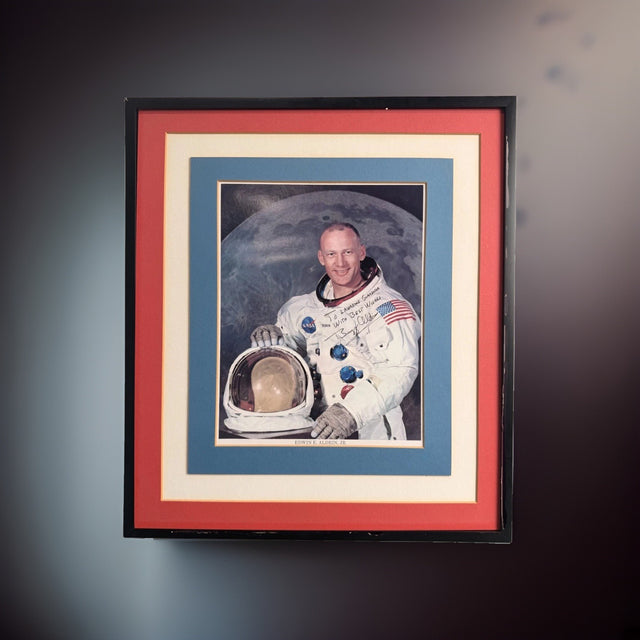
Buzz Aldrin Signed NASA 8x10 Color Photo Personalized Framed JSA LOA
$899.00 USD
-
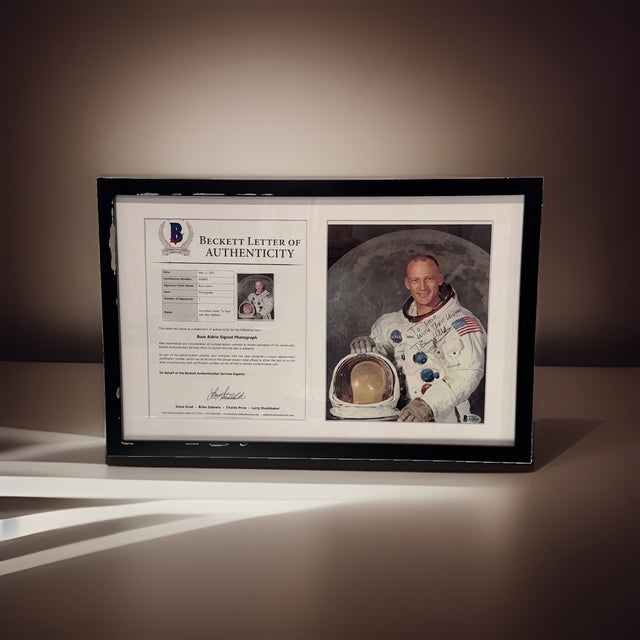
Buzz Aldrin Signed Inscribed Astronaut Photo Framed Beckett LOA A42843
$999.00 USD
-
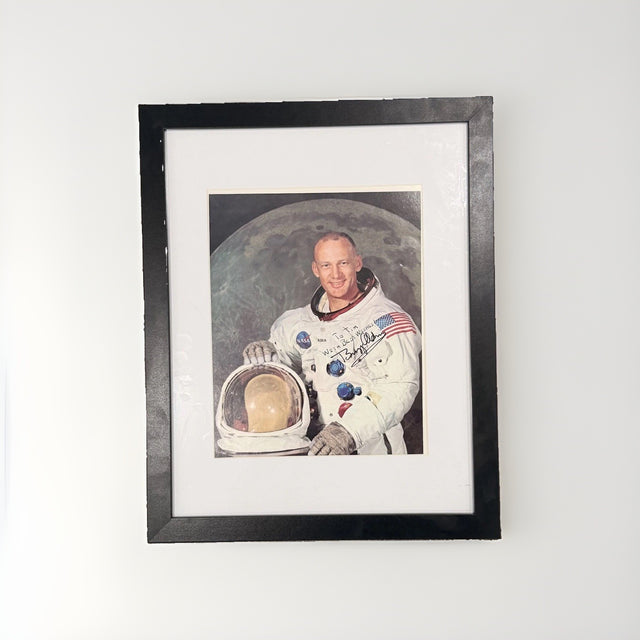
Buzz Aldrin Signed NASA Astronaut Portrait Inscribed To Tim Framed
$850.00 USD
-
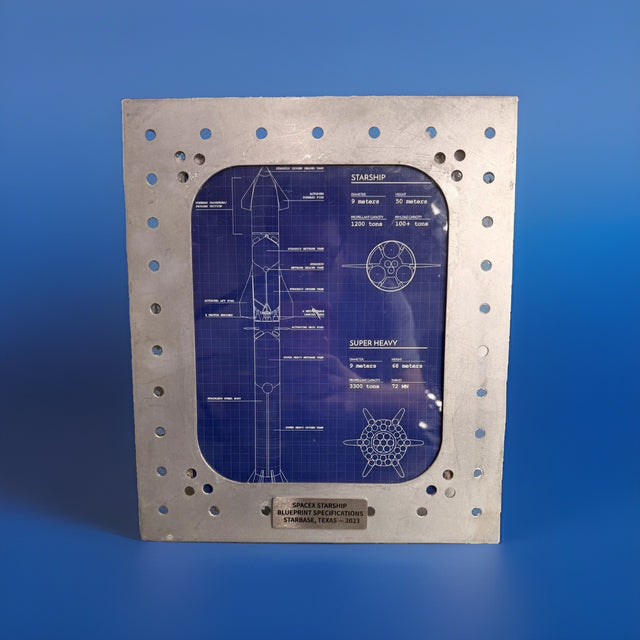
SpaceX Starship Super Heavy Blueprint Metal Display Panel Spacecraft Frame
$59.00 USD
-
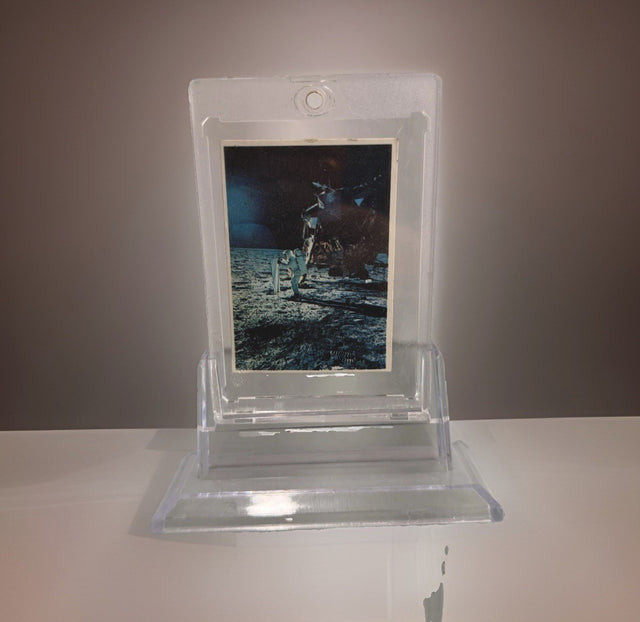
1969 Space Candy Buzz Aldrin Apollo 11 On The Moon Card #19 Taylor-Reed Display
$59.00 USD
-
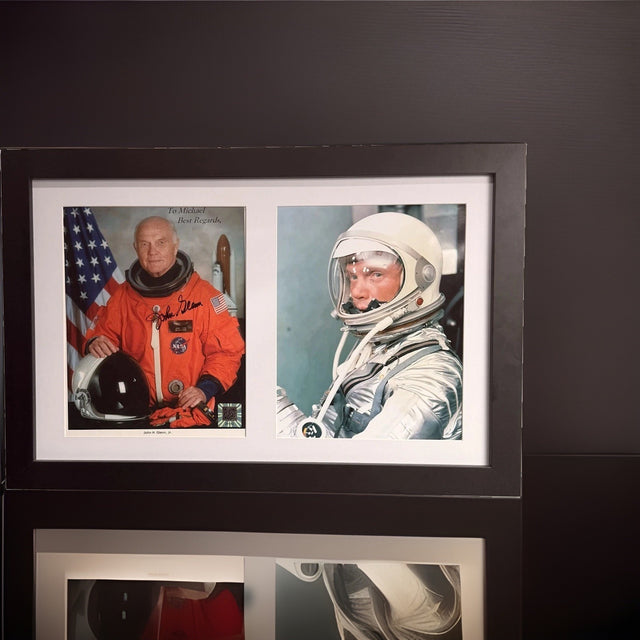
John Glenn Signed Autographed NASA Photo Display JSA Mercury Astronaut Framed
$199.00 USD
Browse the collection for current listings.