A Certificate of Authenticity can be one of the most important documents in collecting.
It can also be one of the most abused.
In art, signed memorabilia, designer figures, space collectibles, and pop-culture objects, sellers love the phrase "comes with COA." It sounds official. It sounds protective. It sounds like the hard work has already been done.
But collectors need to be careful.
A COA is not magic paper.
A certificate is only as strong as the party that issued it, the object it describes, the evidence behind it, and the collector's ability to verify that the certificate actually matches the item being sold.
That difference matters. A legitimate third-party authentication letter can strengthen value, resale confidence, insurance documentation, and buyer trust. A weak or fake COA can do the opposite: create the appearance of legitimacy around an object that may not be authentic at all.
The goal is not to distrust every certificate. The goal is to read certificates intelligently.
Because in collectibles, the most expensive sentence a buyer can believe blindly is: "It has a COA."
What a COA Actually Is

A Certificate of Authenticity is a document, label, card, letter, hologram, database entry, or digital record that identifies an object and states that the object, signature, edition, or claimed attribute has been reviewed or verified by someone.
That "someone" is the whole game.
A COA from an artist's studio, estate, recognized authentication body, reputable gallery, major auction house, or category-specific expert can carry serious weight. A COA from an unknown seller, defunct dealer, no-name website, or invented "authentication company" may mean very little.
At its best, a COA answers several questions:
- What is the object?
- Who made it or signed it?
- What exactly is being authenticated?
- Who authenticated it?
- When was it authenticated?
- Is there a unique certificate number?
- Can that number be verified?
- Does the certificate match the exact physical item?
- Are there images, measurements, edition details, or identifying marks?
- Is the authentication accepted by buyers, galleries, auction houses, and insurers?
At its worst, a COA is just a printed opinion attached to a questionable object.
That is why collectors should never ask only, "Does it have a COA?"
The better question is:
What kind of COA is it, and why should I trust it?
Why Fake COAs Exist
Fake certificates exist because they work.
Forgeries are easier to sell when they are wrapped in paperwork. The buyer sees a hologram, embossed seal, serial number, signature, or formal-looking letterhead and relaxes. That relaxation is exactly what bad sellers want.
The FBI's Operation Bullpen investigation exposed large-scale fraud in the sports and celebrity memorabilia market, including forged autographs and fake certificates. In one FBI summary, the Bureau noted that at least half of items sold in the sports and celebrity memorabilia market were estimated to be forgeries, including many pieces that came with certificates that were also forged.
That investigation is old, but the lesson is not.
Fraud adapts. Paper COAs became hologram COAs. Holograms became database lookups. Database lookups became copied certification numbers. The collector's job is to understand the difference between verification and assumption.
A certificate can support authenticity.
It cannot replace judgment.
The Most Important Rule: Authenticate the Authenticator
Before reading the certificate, evaluate the issuer.
That means asking:
- Is this company known in the category?
- Is it accepted by auction houses, dealers, and advanced collectors?
- Does it maintain a public verification database?
- Does it issue item-specific documentation?
- Does it use tamper-evident labels, images, or unique identifiers?
- Does it have a real address, real submission process, and real reputation?
- Is it still operating?
- Is it qualified for this type of object?
A Beckett, JSA, or PSA/DNA autograph certificate is very different from a seller-made certificate printed at home. A Pest Control certificate for Banksy is very different from a gallery COA claiming to authenticate Banksy without Pest Control. A Zarelli letter for space memorabilia means something different from a generic "NASA collectible" certificate. A manufacturer-issued designer figure NFC or serial authentication is different from a reseller's note saying "guaranteed authentic."
The name on the certificate matters more than the existence of the certificate.
A bad COA does not make a weak object strong.
A COA Should Say Exactly What Is Being Authenticated
Many buyers miss this.
A certificate may authenticate one part of an object, not everything implied by the listing.
For example:
- A COA may authenticate the signature, but not the guitar as stage-used.
- A COA may authenticate a photo, but not the frame, mat, or display.
- A COA may authenticate one artist's signature, but not every signature on a multi-signed item.
- A COA may verify that a designer figure is genuine, but not that the packaging is original or complete.
- A COA may verify a space autograph, but not that the object was mission-flown.
- A gallery COA may document a print sale, but not replace the artist's official authentication body.
This is where expensive misunderstandings happen.
The collector reads "authenticated" and assumes the entire story is authenticated. In reality, the certificate may only support a narrower claim.
A smart buyer looks for the exact language.
- Does it say "hand-signed"?
- Does it say "authentic autograph"?
- Does it say "limited edition print"?
- Does it say "mission-flown"?
- Does it say "stage-used"?
- Does it identify the object by title, year, medium, size, edition number, serial number, or image?
- Does it include photographs of the exact item?
If the listing says more than the certificate says, slow down.
The certificate is the evidence. The seller's story is not.
Certification Number Lookup Is Necessary — But Not Enough

A certification number lookup is one of the first things a buyer should do.
It is not the last thing.
PSA's certificate-verification page lets users verify PSA and PSA/DNA certification numbers, but PSA also warns that certification-number verification does not eliminate risk. PSA specifically notes that criminals may counterfeit PSA documents or inserts using real certification numbers from public sources, and that PSA's database confirms information tied to a number but does not guarantee that a random online listing is the genuine PSA-authenticated item.
That warning is extremely important.
A cert lookup can tell you that a number exists.
It may not prove that the item in the seller's photos is the exact item tied to that number.
That is why buyers should compare:
- Certification number
- Object description
- Signer name
- Number of signatures
- Item type
- Images in the database or LOA
- Sticker or hologram placement
- Condition details
- Edition number
- Serial number
- Unique marks
- Autograph placement
- Dimensions
- Frame or mounting details
A real certification number attached to the wrong object is still a problem.
A copied certification number is still a problem.
A cert that verifies "signed photograph" should not be used to sell a signed guitar.
Trust the database, but inspect the match.
Beckett, JSA, and PSA/DNA: What Their COAs Usually Mean
For autographs and signed memorabilia, three of the most commonly recognized third-party names are Beckett Authentication Services, James Spence Authentication, and PSA/DNA.
They are not identical.
Beckett states that submitted autographs are examined through ink analysis, autograph structure review, and side-by-side comparison with exemplars when needed. Beckett also describes using tools such as a Pro-Scope or video spectral comparator for deeper review, and says authenticated items receive a tamper-evident label with an alphanumeric BAS certification number that can be checked through its online database.
PSA describes its autograph-authentication process as including ink analysis, autograph-structure analysis, object evaluation, side-by-side comparison, and possible use of a video spectral comparator. PSA-certified autographs can be verified publicly through its certification-verification page or mobile application.
JSA distinguishes between Basic Certification and a full Letter of Authenticity. JSA says Basic Certification is generally used for lower-value autographed items and includes a registration card with a unique certification number corresponding to a tamper-evident label, while its full Letter of Authenticity includes more customized documentation.
The takeaway is simple:
A sticker, card, LOA, encapsulated item, and witnessed authentication are not the same thing.
They can all be valid. But they carry different levels of documentation.
Sticker, Card, LOA, Full LOA, Encapsulation: What Is the Difference?
Collectors often use "COA" as a catch-all term.
That creates confusion.
Here is the practical hierarchy.
Sticker or Hologram
A sticker or hologram is usually a tamper-evident label placed directly on the object. It may contain a certification number, QR code, or company logo.
This is useful because it physically links the object to the cert number.
But stickers can be copied, removed, damaged, misplaced, or applied to objects that are hard to inspect. The buyer still needs to verify the number and compare the item.
COA Card
A COA card is a small certificate, often paired with a sticker or hologram. It may list the certification number, signer, and object type.
This is common for lower- to mid-value memorabilia.
It is better than vague seller paperwork, but usually less detailed than a full Letter of Authenticity.
Letter of Authenticity
A Letter of Authenticity, or LOA, is typically more detailed. It may include the signer, item description, certification number, company letterhead, date, and sometimes an image of the item.
A strong LOA is especially useful for higher-value pieces, framed displays, instruments, rare signatures, and objects likely to be resold or insured.
Full LOA With Item Image
This is stronger because the certificate includes an image of the exact item reviewed. Beckett states that, for an additional fee, items can receive an LOA featuring the same certification number and an exact image of the item examined and certified.
For expensive collectibles, item-specific imagery is a major upgrade.
It reduces the risk that a valid certificate is being paired with a different object.
Encapsulation
Encapsulation means the object is sealed in a tamper-evident holder with certification information. PSA says it offers autograph encapsulation in sonically sealed holders designed to protect and display certified autographs.
Encapsulation is common for smaller items such as cards, cuts, tickets, photographs, and certain flat collectibles. It is not practical for large objects like full-size guitars, framed art, or oversized posters.
Witnessed Authentication
Witnessed authentication means the signature was observed as it happened.
PSA describes its In-the-Presence Authentication as real-time witnessed certification at events, signings, or private sessions, with a tamper-evident label issued on the spot.
For autographs, witnessed authentication is often stronger than after-the-fact review because it documents the signing event itself.
That does not mean every non-witnessed autograph is bad. It means witnessed authentication has cleaner provenance.
Seller-Issued COAs: Sometimes Useful, Often Weak
Not every seller-issued COA is worthless.
A reputable gallery, established dealer, artist studio, estate representative, or authorized publisher may issue meaningful paperwork. In some art categories, gallery COAs are normal. In some designer collectible categories, manufacturer or platform authentication may matter more than third-party autograph-style review.
But a seller-issued COA has an obvious conflict:
The same party selling the object is also declaring it authentic.
That does not automatically make it false. It does make it weaker unless the seller has recognized expertise, a documented history, and a strong refund policy.
Be especially careful with COAs that:
- Come from unknown companies
- Have no searchable database
- Use generic language
- Do not describe the exact item
- Have no phone number or active website
- Use stock images
- Have spelling errors or strange formatting
- Do not identify the signer, edition, medium, or object type
- Offer no guarantee
- Use phrases like "believed to be," "in the style of," or "attributed to" while the listing title says "authentic"
A good COA clarifies.
A bad COA fogs the glass.
The COA Must Match the Object

This is the part that separates careful collectors from hopeful buyers.
A certificate can be real and still fail the purchase.
Before buying, compare the certificate to the physical object like a detective with decent lighting and no emotional attachment.
For signed music memorabilia, check:
- Signer name
- Instrument type
- Album title
- Photo image
- Poster title
- Number of signatures
- Signature placement
- Ink color
- Inscription
- Hologram location
- LOA image
- Frame configuration
- Visible scratches, dents, or marks
For art prints, check:
- Artist
- Title
- Year
- Medium
- Dimensions
- Edition number
- Signature location
- Blind stamp
- Publisher
- Printer
- Paper type
- COA issuer
- Frame status
- Condition notes
For designer figures, check:
- Brand
- Edition
- Size
- Colorway
- Packaging
- Serial number
- NFC tag
- Hologram
- Manufacturer label
- Accessories
- Box condition
- Release year
For space collectibles, check:
- Astronaut
- Mission
- Object type
- Autograph vs. flown status
- LOA language
- Mission documentation
- Chain of custody
- Photo match
- NASA markings
- Patch, cover, or artifact details
For framed items, request unframed or close-up photos when possible.
Frames can hide problems. A mat can cover damage. A plaque can imply more than the paperwork supports. A sealed display can make inspection harder. None of that is automatically bad, but it should affect how much documentation you require.
Provenance and COA Are Not the Same Thing
A COA is one form of evidence.
Provenance is the broader ownership and documentation history of the object.
A strong collectible may have both.
Provenance can include:
- Original purchase receipt
- Artist studio invoice
- Gallery invoice
- Auction record
- Estate documentation
- Photograph from the signing
- Witnessed authentication record
- Prior collection history
- Exhibition history
- Publisher documentation
- Correspondence
- Insurance schedule
- Chain-of-custody letter
- Authentication database entry
A COA says, "This was reviewed."
Provenance says, "Here is where it came from and how it traveled."
The best collectibles have a paper trail that makes sense.
The worst collectibles have a dramatic story and no receipts.
"Obtained from a private collection" is not provenance by itself. Neither is "estate find," "backstage signed," "from an industry insider," or "purchased years ago."
Those may be true. They are not proof.
COA Red Flags Collectors Should Know
A COA should raise concern when it has:
- No issuer reputation
- No contact information
- No certification number
- No item description
- No signer or artist name
- No database lookup
- No date
- No signature from the authenticator
- No image of the item for higher-value pieces
- No connection to the object
- No return or authenticity guarantee
- No explanation of what was authenticated
- No clear distinction between original, reproduction, print, facsimile, or hand-signed object
Also be cautious when:
- The certificate looks more polished than the object's evidence.
- The seller photographs the COA but not the signature in detail.
- The certificate number verifies, but the database description is vague.
- The COA authenticates a different object type.
- The seller refuses to show the back of the item.
- The seller says, "The COA is all you need."
- The item is far cheaper than comparable authenticated examples.
- The seller has unlimited supply of supposedly rare signatures.
- The COA issuer seems to exist only on certificates.
A serious seller welcomes verification.
A weak seller rushes the buyer.
The Buyer's COA Checklist
Before purchasing any authenticated collectible, run this checklist:
-
Who issued the COA?
Is the issuer recognized in this category? -
Can the certificate number be verified?
Check the authenticator's website directly, not just the seller's screenshot. -
Does the certificate match the exact object?
Compare description, images, signature placement, edition number, and physical details. -
What exactly is authenticated?
Signature, object, edition, flown status, stage use, provenance, or only part of the claim? -
Is there item-specific imagery?
For higher-value items, a photo on the LOA is much stronger. -
Is the authentication format appropriate for the value?
A basic sticker may be fine for a lower-value item. A rare, high-value piece should usually have deeper documentation. -
Does the seller offer a real guarantee?
Look for refund language, not vague confidence. -
Does the object make sense historically?
The date, medium, edition, item type, and signature should match reality. -
Is the condition documented?
A COA does not necessarily tell you condition. -
Would another serious buyer accept this paperwork later?
Resale matters, even if you do not plan to sell.
If several answers are weak, the risk is not theoretical.
It is already in the room.
Why Gauntlet Gallery Reviews More Than the Certificate

Gauntlet Gallery treats third-party authentication as the beginning of review, not the end.
Gauntlet's model is built around authenticated art, memorabilia, designer toys, space collectibles, and cultural objects, with category-appropriate documentation such as Beckett, JSA, PSA/DNA, Zarelli, TrueCOA, or artist-issued documentation depending on the object type. Gauntlet's site states that every piece ships with the appropriate third-party authentication for its category.
That distinction matters because a COA alone does not answer every collector question.
A buyer still needs to know:
- Is this the right authentication body for this category?
- Does the certificate match the object?
- Is the condition accurately described?
- Is the item priced against real market data?
- Does the provenance make sense?
- Are there category-specific risks?
- Is the piece culturally meaningful or merely available?
For signed music memorabilia, Gauntlet points collectors toward recognized authentication such as JSA, PSA/DNA, Beckett, or ACOA and recommends direct certificate verification with the authenticator.
That is the right mindset.
Authentication is not a sticker hunt. It is a layered review.
The Collector's Mental Model: COA + Object + Provenance + Seller
The strongest purchases usually have four things working together:
1. Strong COA
Issued by the right authenticator for the category.
2. Matching Object
The physical item aligns with the certificate, images, description, edition, and visible details.
3. Sensible Provenance
The ownership story is documented, plausible, and not overhyped.
4. Trustworthy Seller
The seller is transparent, reachable, knowledgeable, and willing to stand behind the item.
If one layer is weak, the others need to be stronger.
A rare autograph with weak provenance needs elite authentication.
A gallery-issued art COA needs a reputable gallery and clear object details.
A designer figure with packaging issues needs stronger serial or NFC verification.
A space collectible claiming mission-flown status needs documentation beyond an astronaut autograph.
Collectors get into trouble when they let one layer do all the work.
A COA cannot carry a bad object, bad provenance, bad seller, and bad price by itself.
That is too much weight for one piece of paper.
What COA Strength Looks Like by Category
Signed Music Memorabilia
Strong documentation usually means Beckett, JSA, PSA/DNA, Roger Epperson/REAL for certain music autographs, ACOA where appropriate, witnessed signing documentation, or a full LOA with item-specific details.
Best signs:
- Clear autograph photos
- Verified cert number
- Full LOA for high-value items
- Matching sticker and certificate
- Object type accurately described
- Strong seller guarantee
Weak signs:
- Generic seller COA
- No close-up signature photos
- No cert lookup
- Modern object allegedly signed by deceased artist
- Full-band item with only one signature authenticated
Street Art and Prints
Strong documentation depends heavily on the artist.
For some artists, the correct COA is artist-issued. For others, a publisher, gallery, estate, or recognized authentication body may matter. Banksy is its own universe: serious Banksy authentication generally runs through Pest Control, not a random gallery certificate.
Best signs:
- Artist or publisher COA
- Edition number
- Matching signature
- Correct dimensions
- Known publisher or printer
- Gallery invoice
- Condition disclosure
Weak signs:
- Vague "Banksy style" wording
- No edition details
- No provenance
- COA from unrelated seller
- Mismatched dimensions
- Unsigned COA where signed documentation is expected
Designer Figures and Vinyl Collectibles
Strong documentation often means original packaging, serial number, NFC or platform authentication, manufacturer records, release details, and clean condition.
Best signs:
- Original box
- Serial or NFC match
- Known edition and colorway
- Release-year accuracy
- Complete accessories
- Condition photos
Weak signs:
- No packaging
- Suspiciously low price
- Poor paint quality
- Wrong labels
- Missing edition details
- Seller cannot show underside, box, or serial features
Space Memorabilia
Space is documentation-heavy. A signed astronaut photo is one thing. A mission-flown artifact is another. The COA must support the exact claim.
Best signs:
- Zarelli or other recognized space-specialist authentication
- NASA documentation
- Mission-specific provenance
- Crew or estate letter
- Clear distinction between signed, flown, used, issued, or commemorative
Weak signs:
- Generic "NASA COA"
- No mission details
- Autograph cert used to imply flown status
- No chain of custody
- Vague Apollo language without documentation
What a COA Does Not Prove
A COA does not automatically prove:
- That the item is fairly priced
- That the condition is excellent
- That the frame is archival
- Use dated completed sales for the same artist, release, format and condition, recording the venue, currency and fees. Asking prices and broad archive totals do not establish a realized sale price or future return.
- That the seller is trustworthy
- That every claim in the listing is true
- That the object is rare
- That the object is investment-grade
- That the item will be accepted by every auction house
- That the authentication can never be challenged
This is where collectors need clear thinking.
Authentication is one input.
It is not the entire purchase decision.
A real signed item can be overpriced.
An authentic print can be damaged.
A genuine designer figure can have a crushed box.
A real astronaut signature can be on a low-value reproduction.
A valid COA can be attached to an object with poor resale appeal.
Authenticity protects against one major problem.
It does not solve every problem.
The Best COAs Reduce Future Friction
Good documentation is not only about feeling confident today.
It is about making the object easier to insure, lend, display, consign, appraise, or resell later.
A future buyer will ask the same questions you should ask now:
- Who authenticated it?
- Can I verify it?
- Does the paperwork match?
- Is the condition clear?
- Is the provenance credible?
- Will an auction house accept it?
- Can I explain this object quickly and confidently?
The better the documentation, the less friction later.
That is why serious collectors often pay more for strong paperwork. They are not paying for paper. They are paying for reduced uncertainty.
And in collectibles, reduced uncertainty has value.
Bottom Line
A Certificate of Authenticity can be powerful.
But "has COA" is not the finish line.
It is the starting point.
Collectors should read every certificate with disciplined curiosity. Who issued it? What does it actually authenticate? Can it be verified? Does it match the object? Is the provenance consistent? Is the seller credible? Is the documentation strong enough for the price?
A good COA answers questions.
A bad COA hopes you stop asking them.
Buy the object you love. Buy the artist, musician, astronaut, designer, or cultural moment that means something to you. But before you trust the paperwork, make the paperwork earn your trust.
Because in collecting, confidence is not created by a certificate.
It is created by evidence.
FAQ
Does a COA prove an item is authentic?
Not by itself. A COA is evidence, but its strength depends on who issued it, what it authenticates, whether it can be verified, and whether it matches the exact object being sold.
Can COAs be faked?
Yes. Fake certificates are a known issue in the memorabilia and collectibles market. The FBI's Operation Bullpen investigation found forged memorabilia accompanied by forged certificates, which is why collectors should verify both the certificate and the object.
Is a PSA, Beckett, or JSA COA reliable?
PSA, Beckett, and JSA are widely recognized third-party autograph authenticators. Their documentation is generally much stronger than unknown seller-issued COAs, but collectors should still verify certification numbers and confirm that the certificate matches the exact item. PSA specifically warns that certificate-number verification does not eliminate all risk.
What is better: a sticker COA or a Letter of Authenticity?
It depends on the item and value. A sticker or basic card may be acceptable for lower-value items, while higher-value pieces are better supported by a full Letter of Authenticity with item-specific details or images.
What should I check before trusting a COA?
Check the issuer, certification number, item description, signer or artist name, object type, date, image match, hologram or sticker match, edition number, and whether the certificate supports every claim made in the listing.
Is seller-issued COA enough?
Sometimes, but only when the seller is a reputable gallery, artist studio, estate, publisher, or recognized dealer with strong category expertise and a clear guarantee. A seller-issued COA from an unknown source is weak documentation.
What does "witnessed authentication" mean?
Witnessed authentication means the signature was observed as it happened. PSA's In-the-Presence Authentication, for example, is designed to certify signatures in real time at events, signings, or private sessions.
Why does Gauntlet Gallery review COAs instead of just accepting them?
Because a COA alone does not answer every buyer question. Gauntlet reviews the certificate, object, provenance, category fit, condition, and market context before offering a collectible, using category-appropriate authentication for art, music, space, designer figures, and cultural objects.
Available at Gauntlet Gallery
Explore current pieces available from the gallery.
-

1963 Farquhar Earth in Space Transparent Celestial Globe 16" Compass VTG
$699.00 USD
-

1967 Beatles Richard Avedon STERN Original Posters Set of 4 Linen Backed Copy
$999.00 USD
-
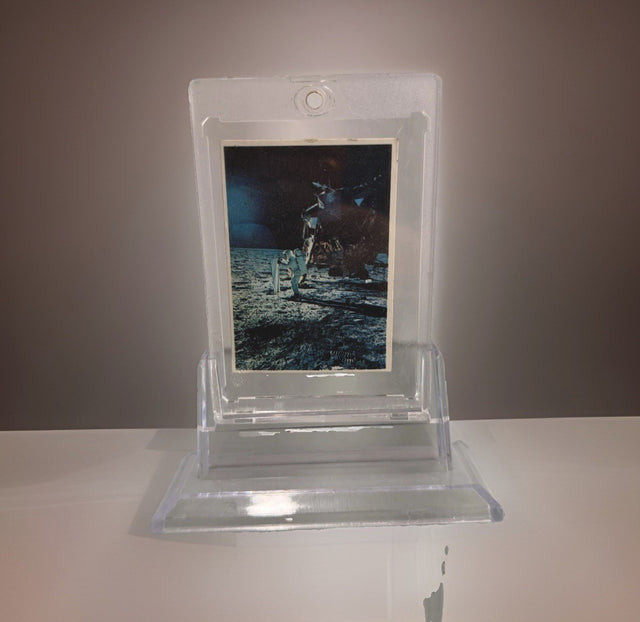
1969 Space Candy Buzz Aldrin Apollo 11 On The Moon Card #19 Taylor-Reed Display
$59.00 USD
-

1980 Polo Player Green Pink Chalk Pastel Bears Andy Warhol Signature AS-IS
$399.00 USD
-

After Andy Warhol Moon Landing Line Drawing 5/50 w/ Astronaut Autographs As-Is
$175.00 USD
-

After John Lennon "I Do" Framed Print, Marked A/P Unverified
$99.00 USD


Browse the collection for current listings.