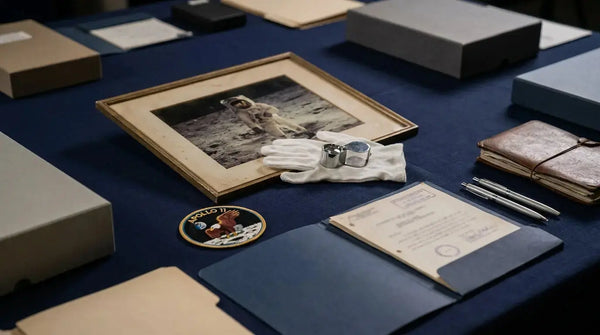
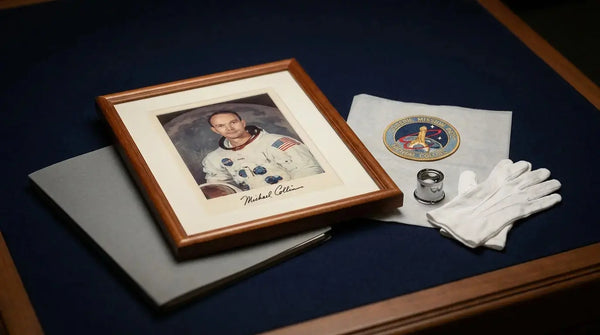
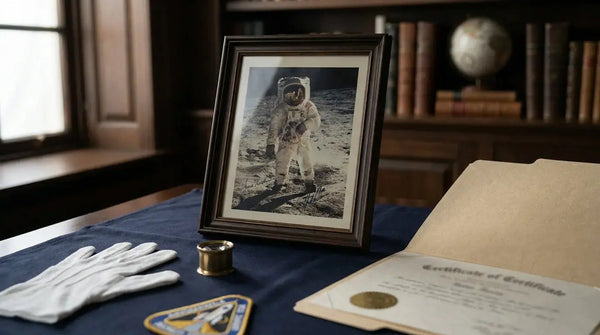
On July 20, 1969, Neil Armstrong stepped off the lunar module ladder and onto the surface of the Moon — becoming the first human being in history to walk on another world. More than five decades later, his signature remains one of the most sought-after in the entire autograph market: structurally scarce, historically documented for forgery rates approaching 40%, and anchored by a cultural permanence no other collectible category can match. Whether you are building a space collection for the long term or evaluating a single acquisition, this guide delivers everything you need to buy, authenticate, and value Armstrong-signed memorabilia with confidence.
Who Was Neil Armstrong, and Why Does His Signature Matter?
Neil Alden Armstrong (1930–2012) was a naval aviator, test pilot, aerospace engineer, and NASA astronaut who commanded Apollo 11, the first crewed mission to land on the Moon. His "one small step" announcement on July 20, 1969 was heard by an estimated 600 million people — the largest live television audience in history to that point. Armstrong later taught aerospace engineering at the University of Cincinnati, served on the Rogers Commission investigating the Space Shuttle Challenger disaster, and maintained a notably private public life until his death from cardiovascular surgery complications on August 25, 2012.
Armstrong's signature occupies a singular position in the collectibles market for four structural reasons:
- Fixed, finite supply. Armstrong stopped signing publicly in 1994 — 18 years before his death. That decision permanently closed the supply of new authentic signatures. Combined with his 2012 passing, the total authentic supply is fully distributed and declining as pieces are absorbed into permanent collections.
- Cultural permanence. The Apollo 11 mission is the most universally recognized scientific achievement of the 20th century. Armstrong commands a reverence premium with no parallel in sports, entertainment, or political autograph collecting.
- Documented forgery pressure. With approximately 40% of market inventory estimated to be forged, authenticated, documented examples carry a substantial premium over undocumented comparables. The forgery risk has not declined — if anything, current-generation skilled hand forgeries require microscopic examination, ink analysis, and exemplar comparison to detect.
- Inscription rarity. Armstrong's through-the-mail practice was to inscribe pieces ("To John, Best Wishes, Neil Armstrong"), meaning clean, uninscribed examples are a scarcer sub-class commanding significant premiums at auction.
The Four Signature Eras: A Collector's Framework
Armstrong's signature evolved measurably across four documented eras. Era-matching — verifying that the signature form is consistent with the date of the document or photograph — is the single most important preliminary step any buyer can take before proceeding to formal authentication.
| Era | Years | Key Characteristics | Market Frequency |
|---|---|---|---|
| Pre-NASA | 1955–1962 | Formal connected script; deliberate letter formation; uncommon on market | Rare |
| NASA / Apollo | 1963–1972 | Classic tall-and-lean form; bold pen pressure; the most collected and most forged era | Most Common |
| Post-Apollo | 1973–1989 | Steady, slightly compressed form; consistent across this 16-year period | Common |
| Late / Block | 1990–1994 | Fatigued letterforms with block-print characteristics; idiosyncratic spacing; often mistaken for forgeries | Uncommon |
Critical era-matching note: Finding a Classic NASA-era signature (1963–1972 form) on a document dated 1991 is a structural red flag. Authentic Late / Block era signatures are frequently mis-flagged as forgeries precisely because of their apparent crudeness — fatigued, idiosyncratic letterforms are genuine characteristics of aging, not evidence of forgery. Conversely, forgers attempting Late / Block era signatures produce letters that are too geometric and too evenly spaced compared to Armstrong's authentic handwriting. Pre-NASA (1955–1962) examples are uncommon on the open market and command substantial premiums when they surface.
The Major Signed Formats: What Armstrong Signed and Why It Matters
Armstrong signed across a wide range of formats throughout his career. The format is the primary value driver after authentication quality — understanding the hierarchy is essential for informed buying.
Whole-Signed-Space (WSS) Portraits: The benchmark format in space autograph collecting. NASA-issued full-figure portrait photographs showing Armstrong in his spacesuit, signed in the white-space field below the image. These are the reference point for the entire Armstrong market. Uninscribed examples are a rarer sub-class within the WSS category and command the highest prices.
Apollo 11 Crew-Signed Items: Photographs or crew cards bearing the signatures of all three Apollo 11 crew members — Armstrong, Buzz Aldrin, and Michael Collins. Crew-signed items command premiums above single-signed examples, particularly on official NASA mission photographs. The difficulty is that Aldrin and Collins both continued signing actively after Armstrong stopped in 1994, creating a forgery incentive specifically for Armstrong's signature on otherwise genuine multi-signed pieces.
Signed 8x10 Photographs: The most common format at auction and the entry point for most collectors. Prices range widely based on subject matter, inscription status, condition, and authentication quality.
Flown Artifacts: Items that accompanied Armstrong to space — most commonly flown flags, covers (FDC and cachet), and crew insignia patches. These require additional documentation establishing the flight provenance beyond the signature authentication itself. Gauntlet Gallery's 160,000+ comparable sales database includes extensive flown artifact comps for reference.
Books and Documents: Signed copies of Armstrong's autobiography First Man (co-authored with James Hansen), signed mission reports, contracts, and other documents. First-edition First Man inscribed signed copies are particularly collectible as the only major book project Armstrong participated in during his lifetime.
Lithographs and Limited Editions: Official NASA lithographs and commercial limited-edition prints signed by Armstrong, typically produced in runs of 500–2,500. Edition size and certificate documentation significantly affect value.
How to Authenticate Neil Armstrong Signatures
Authentication is the single most consequential decision in Armstrong collecting. With forgery rates estimated at approximately 40% of open-market inventory, an unauthenticated Armstrong item carries substantial risk regardless of price. The following framework — applied by Gauntlet Gallery to every Armstrong acquisition — covers the primary verification tools available to collectors.
Step 1: Apply the Era Test
Before spending money on formal authentication, confirm that the signature's form is consistent with the period represented by the document or photograph. Use the four-era framework above. A mismatch between signature form and document date is disqualifying without further investigation.
Step 2: Apply the Flag Test
For whole-signed-space (WSS) portraits — the most valuable and most frequently forged format — the Flag Test is the fastest and most reliable screening tool available. Documented by authenticator Steve Zarelli in 2001 and published in Relics of the Space Race (Russ Still, 3rd edition), the test requires 60 seconds and no equipment:
Armstrong consistently placed his signature below and to the right of the flag patch on WSS portrait photographs. Authentic examples never cross into the interior of the flag patch. Any signature that intersects the flag patch interior on a WSS portrait is a near-certain forgery.
Step 3: Screen for Autopen
Seven distinct NASA autopen patterns exist for Armstrong, documented from the mid-1960s through the early 1970s. These mechanical signatures were produced to handle the hundreds of autograph requests Armstrong received weekly during his peak fame period. The autopen overlay test is definitive: if two Armstrong signatures are perfectly identical in size and letter-by-letter form when overlaid, autopen is confirmed. Authentic hand-signed examples always show natural variation in pen pressure, line weight, and character proportions. Autopens are collectible as historical artifacts but should be priced at a small fraction of authentic hand-signed examples.
Step 4: Commission Formal Authentication
Authentication bodies are not equal in weight for Armstrong material. The hierarchy matters for both verification quality and resale liquidity:
Zarelli Space Authentication (Steve Zarelli) is the gold standard. Zarelli maintains the deepest exemplar database in space autograph authentication and is the recognized specialist authenticator for RR Auction, Heritage Auctions, and Bonhams. For any Armstrong piece above $5,000, a Zarelli Letter of Authenticity (LOA) is the preferred primary authentication document.
PSA/DNA (Professional Sports Authenticator) is a credible secondary authenticator for Armstrong material. PSA's broader celebrity and sports autograph database makes it a strong general authenticator, though it carries less category-specific depth than Zarelli for space items. PSA certification alone is acceptable for items below $5,000.
JSA (James Spence Authentication) is similarly credible as a secondary authenticator. JSA certification is acceptable for lower-value items but is best used in conjunction with Zarelli for high-value acquisitions.
Dual certification (Zarelli + PSA/DNA or JSA) is Gauntlet Gallery's recommended standard for Armstrong items above $10,000. Dual certification provides both deep space-category expertise and the broad market recognition needed for future resale liquidity.
Forensic document examination from a qualified forensic document examiner is recommended for acquisitions above $50,000. This layer identifies anachronistic inks (modern ballpoint formulations on a claimed 1969 photograph), substrate inconsistencies (modern reprint paper stock versus period-correct photo paper), and physical anomalies invisible to optical examination alone.
Auction provenance from RR Auction, Heritage Auctions, Bonhams, or Sotheby's functions as Tier 2 authentication. Archival lot records from these houses — particularly where Zarelli certification was part of the original consignment record — represent strong secondary documentation for any piece that has passed through major auction.
Authentication Red Flags: Summary Checklist
- Signature form inconsistent with claimed date (era mismatch)
- Signature crosses the interior of the flag patch on a WSS portrait
- Two examples with identical letter-by-letter overlay (autopen)
- No authentication documentation on items priced above $2,000
- Authentication from unknown or unrecognized third parties only
- Item described as "uninscribed" but provenance chain is unclear
- Price significantly below market comparables (a discount is not a deal — it is a warning)
Neil Armstrong Signed Item Price Guide
The following price ranges are drawn from Gauntlet Gallery's 160,000+ comparable sales database and reflect 2024–2025 auction and private market results. All prices assume proper authentication (Zarelli, PSA/DNA, or JSA certification). Undocumented or single-source-authenticated pieces will trade at material discounts to these benchmarks.
| Format | Condition / Notes | Price Range |
|---|---|---|
| Signed 8x10 Photo | Inscribed, PSA/JSA certified | $2,500–$5,000 |
| Signed 8x10 Photo | Uninscribed, Zarelli + PSA/JSA dual certified | $8,000–$15,000 |
| WSS Portrait | Inscribed, Zarelli certified | $12,000–$20,000 |
| WSS Portrait | Uninscribed, Zarelli + dual certified, benchmark quality | $25,000–$40,000+ |
| Apollo 11 Crew-Signed Photo | All three signatures, NASA-issue format, Zarelli certified | $15,000–$35,000 |
| Signed Index Card / 3x5 | PSA/JSA certified | $1,500–$3,500 |
| Signed Book (First Man) | First edition, inscribed, PSA/JSA certified | $4,000–$8,500 |
| Signed Flown Flag | With flight provenance documentation, Zarelli certified | $30,000–$75,000+ |
| Signed Limited Edition Lithograph | Official NASA or Smithsonian edition, with COA, PSA/JSA | $3,500–$7,500 |
| Pre-NASA Signed Document | 1955–1962 era, verified provenance | $5,000–$12,000 |
| Signed First Day Cover (FDC) | Apollo 11 cachet, PSA/JSA certified | $2,000–$5,500 |
Note: Prices reflect 2024–2025 auction realizations. Private market transactions typically run 10–20% below auction hammer prices before buyer's premium. Items with exceptional provenance — original TTM envelope chains, NovaSpace event documentation, or documented prior auction history with Zarelli certification — may exceed the upper bounds listed above.
What Makes an Armstrong Piece Rare?
Not all Armstrong signatures are equal in scarcity or value. The following factors drive meaningful premiums above baseline pricing:
- Uninscribed examples. Armstrong's standard practice was to add personalized inscriptions, making clean uninscribed signatures a rarer sub-class.
- Pre-1994 TTM (through-the-mail) provenance. Pieces with original envelope chains demonstrating direct correspondence with Armstrong before his 1994 signing retirement carry the strongest provenance.
- Pre-NASA era (1955–1962). Uncommon on the market; the earliest authenticated examples command significant premiums when they surface.
- Flight provenance artifacts. Flown flags, covers, and patches with documented mission provenance are among the rarest and highest-value items in the entire space collectibles category.
- Apollo 11 mission-specific subject matter. Photographs taken on the lunar surface or during the mission itself, signed, are more scarce than general NASA portraits.
- Dual certification with strong chain of custody. Items with Zarelli + PSA/DNA certification and a clear documented chain from signing event to current seller are the most liquid and command the highest prices at major auction.
The Armstrong Market: Supply, Demand, and Investment Thesis
Armstrong stopped signing in 1994. He died in 2012. The total authentic supply was fixed over a decade ago and is declining annually as pieces enter permanent museum and institutional collections. Gauntlet Gallery's 160,000+ comparable sales database tracks this structural compression in real time: authenticated Armstrong 8x10s that cleared $5,000 at auction in 2015 routinely reach $10,000–$15,000 today with equivalent documentation.
Major auction houses — RR Auction, Heritage Auctions, Bonhams, and Sotheby's — continue to see robust demand for well-documented material. Zarelli-certified WSS portraits at benchmark quality with clean documentation exceeded $30,000 at the top end in 2024–2025. Crew-signed Apollo 11 photographs with full three-astronaut signatures and strong provenance documentation cleared $25,000–$35,000 at comparable auction events.
The investment thesis for Armstrong material is straightforward: fixed supply, permanently closed source, and anchored demand from one of the most universally recognized human achievements in history. The primary risk is authenticity — which is precisely why the authentication framework above is not optional for any serious acquisition.
Gauntlet Gallery was founded in 2012 and has been applying structured authentication methodology to space memorabilia acquisitions since inception. Our 160,000+ comparable sales database — built over more than a decade of market participation — is the analytical foundation for every pricing and authentication recommendation we make.
Frequently Asked Questions
Q: How do I know if my Neil Armstrong signature is real?
A: Start with era-matching: confirm the signature form matches the four-era framework for the period on the document. Apply the Flag Test if it is a WSS portrait. Screen for autopen by comparing your item to known examples for mechanical overlay. Then commission formal authentication from Zarelli Space Authentication (primary) and PSA/DNA or JSA (secondary) before any transaction above $2,000.
Q: What is the most valuable type of Neil Armstrong signed memorabilia?
A: Flown artifacts with documented mission provenance are the rarest and highest-value category, trading at $30,000–$75,000 or more. Among more commonly available formats, uninscribed WSS portraits with dual Zarelli + PSA/DNA certification are the benchmark format, regularly exceeding $25,000–$40,000 at major auction.
Q: When did Neil Armstrong stop signing autographs?
A: Armstrong substantially retired from signing publicly in 1994. He continued to sign in limited private circumstances after that date, but at greatly reduced frequency. His 2012 death permanently closed the supply of new authentic signatures.
Q: Is PSA/DNA certification enough for Neil Armstrong autographs?
A: PSA/DNA certification is credible for items below $5,000. For acquisitions above $5,000, Zarelli Space Authentication is the preferred primary authentication document due to Zarelli's depth of Armstrong-specific exemplar expertise. For items above $10,000, dual certification — Zarelli plus PSA/DNA or JSA — is Gauntlet Gallery's recommended standard.
Q: How many items did Neil Armstrong sign during his lifetime?
A: Estimates based on documented TTM correspondence logs, event signing records, and auction archives suggest approximately 55,000 authentic hand-signed items before his 1994 retirement from public signing. With approximately 40% of open-market inventory estimated to be forged, the effective supply of authenticated items is significantly lower.
Q: What is the Flag Test for Neil Armstrong autographs?
A: The Flag Test, documented by authenticator Steve Zarelli, is a 60-second screening tool for WSS portrait photographs: Armstrong consistently placed his signature below and to the right of the flag patch, never crossing into its interior. Any signature that intersects the flag patch interior on a WSS portrait is a near-certain forgery.
Shop Authenticated Space Memorabilia at Gauntlet Gallery
Gauntlet Gallery applies Zarelli Space Authentication standards, four-era signature methodology, and real-time comparable sales data from our 160,000+ record database to every space memorabilia acquisition. Every piece in our collection arrives with documented authentication and transparent provenance.