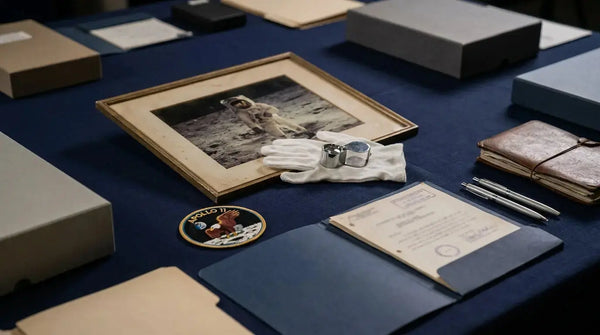
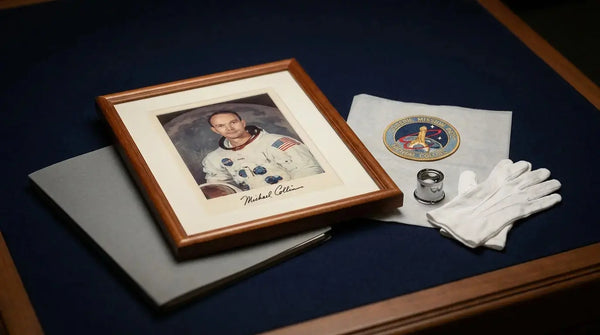
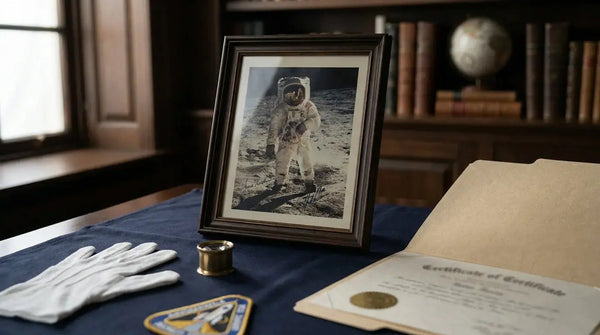
Three names define the human story of the Apollo program: Buzz Aldrin, who descended the lunar module ladder onto the Sea of Tranquility on July 20, 1969; Michael Collins, who orbited the Moon alone while his crewmates made history; and John Glenn, the Mercury-era pioneer whose 1962 Friendship 7 flight made America's space age feel possible. Signed memorabilia from these three astronauts represents some of the most historically significant — and financially consequential — collectibles available in any category. Supply is permanently constrained: Glenn died December 8, 2016; Collins on April 28, 2021; and Aldrin's active signing has dramatically reduced. Every authenticated piece now competes on a fixed or declining supply curve against a collector base that has grown materially since the Apollo 55th anniversary momentum of 2024.
Gauntlet Gallery has tracked over 160,000 comparable sales records across auction houses, dealer transactions, and private sales from 2002 to the present. That database, combined with our authentication partnerships with Zarelli Space Authentication, PSA/DNA, and JSA, makes this guide the most data-grounded resource available for collectors evaluating Apollo astronaut material — whether they are buying their first signed photograph or completing a museum-quality collection.
The Apollo 11 Crew: Historical Context and Collectibility

Buzz Aldrin
Edwin "Buzz" Aldrin Jr. served as Lunar Module Pilot on Apollo 11 and was the second human to walk on the Moon. Born January 20, 1930, Aldrin's signing career spans more than five decades, creating both opportunity and authentication complexity. He signed prolifically through private signings organized by Buzz Aldrin Enterprises (BAE), at public events, and through mail requests (TTM) in the 1960s through 1990s. His signature evolved substantially across eras: the compact, angular "Edwin E. Aldrin Jr." of the early NASA years gave way to the broader "Buzz Aldrin" script he used after legally adopting "Buzz" as his given name in 1988.
The primary authentication risk for Aldrin material is not hand forgery — it is autopen and secretarial signature contamination. NASA produced multiple documented autopen patterns; the most widely referenced is the "Edwin" pattern (1968–1972), used under his birth name. A secondary autopen pattern circulated through at least 1979. Gauntlet Gallery's authentication team estimates that 20–25% of Aldrin material offered on general resale platforms carries some form of autopen or secretarial signature, making specialist verification non-negotiable for any piece above $500.
Michael Collins
Michael Collins piloted the Command Module Columbia during Apollo 11, maintaining the spacecraft in lunar orbit while Aldrin and Neil Armstrong walked on the Moon. Born October 31, 1930, Collins was known among collectors for a signing style that remained remarkably consistent across decades — a flowing, confident script that changed less dramatically than either Aldrin's or Glenn's over their careers. Collins signed at NovaSpace private signings organized by Kim Poor, at select public events, and through occasional personal correspondence.
Collins's death on April 28, 2021 was a structural market event: authenticated Collins material increased 50–80% in the months following his passing, and those gains have proven durable. The primary authentication concern for Collins material is the documented 1969 entourage forger — active during the Apollo 11 world tour from September through November 1969 — who forged all three Apollo 11 crew signatures on envelopes, photographs, and covers. Collins himself acknowledged this forgery activity at a 2005 NovaSpace private signing. The forgery rate for Collins material offered online is estimated at 10–15%, lower than Aldrin's autopen contamination but consequential for buyers without specialist review.
John Glenn
John Herschel Glenn Jr. became the first American to orbit Earth on February 20, 1962, aboard Friendship 7. Later a United States Senator from Ohio (1974–1999) and the oldest person to fly in space (Discovery STS-95, 1998), Glenn was arguably the most publicly accessible of the three subjects — signing through the John Glenn Archives at Ohio State University, through his Senate office, at public events, and via authorized dealer programs. He died December 8, 2016.
Glenn's accessibility as a signer is reflected in his price structure: floor-tier signed photographs are more affordable than comparable Aldrin or Collins examples, but the premium tier — NASA-era material, flown items, and handwritten letters — commands prices consistent with the other Apollo legends. The most important authentication consideration for Glenn is era-matching: his NASA-era signature (compact, somewhat angular) differs materially from his Senate-era signature (looser, more stylized) and his post-2000 signature (simplified, smaller). PSA/DNA and JSA both maintain strong Glenn exemplar databases; Zarelli Space Authentication covers all eras of Glenn's career.
Signature Evolution and Era Identification

Understanding how each astronaut's signature evolved is a prerequisite for authentication — a signature that doesn't match the claimed period is an immediate red flag regardless of what any COA says.
Buzz Aldrin era guide: Pre-1988 material signed "Edwin E. Aldrin Jr." or "E.E. Aldrin Jr." Post-1988 material signed "Buzz Aldrin." The transition to "Buzz" was clean and documented; a piece dated before 1988 with a "Buzz" signature warrants scrutiny. The autopen risk is concentrated in 1968–1979 material; pieces from this era require Zarelli Space Authentication review regardless of other provenance documentation.
Michael Collins era guide: Collins's signature is notably stable across decades, making era-mismatch less common as a forgery indicator. The primary marker is pen pressure and ink consistency — his authentic signatures show natural variation in line weight that autopen and many hand-forged examples lack. The 1969 entourage forgeries specifically target covers and envelopes from the September–November 1969 period; any such item from that window requires specialist review.
John Glenn era guide: Four distinct signing eras are documented. Mercury era (1959–1963): compact, upright script, "J. Glenn" or "John Glenn." NASA period (1963–1974): fuller signature, consistent letterforms. Senate era (1974–1999): looser, more horizontal orientation. Post-retirement (1999–2016): simplified, smaller, with occasional tremor visible in late-career examples. Era-matching the document to the expected signature form is the first authentication step for any Glenn piece.
Collaborations and Multi-Signature Items
Multi-astronaut signatures — particularly Apollo 11 full-crew pieces signed by Aldrin, Collins, and Neil Armstrong — represent the apex of the market by both price and historical significance. Armstrong's death on August 25, 2012 created the same structural supply constraint that Collins's and Glenn's deaths later produced, and Armstrong signatures carry the highest individual premiums. A fully authenticated Apollo 11 crew photograph signed by all three commands the upper end of the ranges listed below.
Other high-value multi-signature configurations include:
- Mercury Seven crew signatures (Glenn plus Shepard, Grissom, Carpenter, Cooper, Schirra, Slayton) on group photographs or NASA lithographs
- Apollo program "all-flown-crew" signatures across multiple missions on a single limited-edition print
- Dual-signed Aldrin/Collins items from documented private signings where both subjects were present simultaneously
Multi-signature items require each individual signature to be authenticated independently. A piece where Armstrong's signature is authenticated but Collins's is questionable is worth materially less than a piece where all signatures carry Tier 1 or Tier 2 authentication.
Apollo Astronaut Memorabilia Price Guide

All ranges based on Gauntlet Gallery's 160,000+ comparable sales database, reflecting secondary market transactions from 2022–2025. Prices shown are for authenticated pieces with documentation meeting Tier 2 standards or above. Undocumented or story-only pieces typically trade at 30–50% of these ranges.
| Item | Subject | Documentation Level | Market Range |
|---|---|---|---|
| Signed 8x10 photograph | Buzz Aldrin | General provenance / single LOA | $400–$900 |
| Signed 8x10 photograph | Buzz Aldrin | Dual-certified (Zarelli + PSA/DNA) | $1,800–$4,500 |
| Signed NASA lithograph | Buzz Aldrin | Dual-certified | $600–$1,400 |
| Apollo 11 mission-specific signed photo | Buzz Aldrin | Tier 2+ provenance | $2,500–$8,500 |
| Handwritten letter (ALS) | Buzz Aldrin | Zarelli + auction provenance | $5,000–$22,000 |
| Signed 8x10 photograph | Michael Collins | General provenance / single LOA | $600–$1,200 |
| Signed 8x10 photograph | Michael Collins | NovaSpace private signing COA | $1,200–$2,800 |
| Apollo 11 crew-signed photograph (all 3) | Aldrin + Collins + Armstrong | Tier 2+ all three signatures | $3,500–$12,000 |
| Handwritten letter (ALS) | Michael Collins | Zarelli LOA + auction house | $4,000–$18,000 |
| Mission-era government cover | Michael Collins | Single specialist LOA | $500–$1,500 |
| Signed 8x10 photograph | John Glenn | General provenance / single LOA | $250–$600 |
| Signed 8x10 photograph | John Glenn | Dual-certified (Zarelli + JSA) | $700–$1,800 |
| Signed Friendship 7 mission cover | John Glenn | Single specialist LOA | $400–$1,200 |
| Handwritten letter (ALS) | John Glenn | Zarelli + auction provenance | $3,500–$15,000 |
| Flown mission flag (authenticated flown) | Any Apollo 11 crew | NASA certification + Zarelli | $8,000–$45,000+ |
How to Authenticate Astronaut Signatures
Authentication for Apollo astronaut memorabilia operates on a tiered confidence model — not a simple pass/fail. The tier you need depends on the price of the piece and the risk you are willing to carry.
The Five-Tier Authentication Framework
Tier 1 — Direct-channel primary provenance. Items purchased directly from the astronaut, their official enterprise (Buzz Aldrin Enterprises / BAE), or documented at a named private signing with original event paperwork. For Glenn, items sold through Ohio State's Glenn Research Center gift program or documented controlled public signings qualify. For Collins, items sold at NovaSpace private signings with Kim Poor-issued COA. Tier 1 requires no supplemental authentication — it is the gold standard.
Tier 2 — Zarelli Space Authentication LOA. Steve Zarelli is the leading specialist authenticator for Apollo-era astronauts. His exemplar database covers Buzz Aldrin, Michael Collins, and John Glenn across all career signing eras. A Zarelli Letter of Authenticity (LOA) carries more weight than any other specialist document in the space collecting field. Gauntlet Gallery requires Zarelli authentication for all transactions above $2,500.
Tier 3 — Major auction house provenance. A documented lot record from RR Auction, Heritage Auctions, Bonhams, or Sotheby's provides strong secondary provenance. These houses conduct internal authentication review and bear reputational and legal liability for every lot they represent. Tier 3 provenance is acceptable for most buyer purposes but should be supplemented with Zarelli review for pieces above $5,000.
Tier 4 — General authenticator LOA. PSA/DNA, JSA, and Beckett Authentication Services (BAS) provide acceptable LOAs for material under $1,500. All three maintain astronaut exemplar databases, though their space-collecting depth is less specialized than Zarelli's. For items between $1,500 and $2,500, Gauntlet Gallery recommends supplementing a general authenticator LOA with Zarelli Space Authentication review before purchase.
Tier 5 — UACC registered specialist dealer COA. A Certificate of Authenticity from a multi-decade dealer registered with the Universal Autograph Collectors Club carries weight proportional to the dealer's documented reputation. Dealer COAs alone are insufficient for items above $2,500 without supplemental specialist review.
Specific Red Flags by Subject
Buzz Aldrin — autopen and secretarial detection: Autopen signatures show mechanically perfect line consistency with no natural pen pressure variation. Compare any potential Aldrin piece against known authenticated exemplars from the same era. The "Edwin" autopen pattern (1968–1972) is the most commonly encountered; look for unnaturally smooth line edges and identical letter proportions across multiple examples from the same source. Any Aldrin piece from 1968–1979 requires Zarelli review.
Michael Collins — 1969 entourage forgeries: The documented 1969 forger targeted envelopes, first-day covers, and photographs during the Apollo 11 world tour. Forgeries typically show the correct letter shapes but lack Collins's characteristic forward lean and ink depth variation. Any cover or envelope claimed to be from September–November 1969 warrants specialist review regardless of other documentation.
John Glenn — era mismatch: The most common error in Glenn authentication is failing to era-match the signature form to the document date. A Senate-era signature (post-1974) on a Mercury-era document is not necessarily a forgery — Glenn did sign such items on request — but it is a documentation question that should be addressed by the seller. Post-2000 Glenn signatures often show reduced line quality; this is authentic age-related variation, not forgery, but it should be reflected in condition grading.
Where to Buy Apollo Astronaut Signed Memorabilia

Where you buy determines the authentication floor you receive. Not all sources apply equal diligence, and the price difference between a documented and undocumented piece can be 50–70% of total value — making source selection a financial decision, not just a convenience one.
Gauntlet Gallery
Founded in 2012, Gauntlet Gallery applies Zarelli Space Authentication, PSA/DNA, and JSA verification to Apollo astronaut memorabilia before offering any piece for sale. Our 160,000+ comparable sales database provides the pricing context to ensure you pay market rate, not a premium over market. Every authenticated piece in our space memorabilia collection comes with complete provenance documentation and a 100% authenticity guarantee. Browse our current inventory at Gauntlet Gallery Space Memorabilia.
Major Auction Houses
RR Auction, Heritage Auctions, Bonhams, and Sotheby's all conduct specialist Apollo astronaut sales. These houses provide the strongest secondary market price validation and maintain lot archives that support resale documentation for buyers. The premium tier — Apollo 11 crew pieces, flown items, and ALS letters — most commonly surfaces at major auction. Buyers should add 20–25% buyer's premium to hammer prices when calculating total cost.
UACC-Registered Specialist Dealers
Dealers registered with the Universal Autograph Collectors Club (UACC) and with documented multi-decade specialization in space collecting represent a reliable secondary source for mid-tier material ($500–$5,000). Ask for the dealer's authentication documentation chain before purchasing; a reputable specialist dealer will have Zarelli or major auction house provenance on any piece they stand behind.
Private Signing Events (for Buzz Aldrin)
Buzz Aldrin Enterprises (BAE) has historically organized controlled private signing sessions, producing Tier 1 provenance with original event paperwork. These sessions have become less frequent as Aldrin has reduced his public commitments, making documented BAE signing pieces increasingly scarce. When authentic BAE event documentation exists — signed program, event certificate, or photograph showing Aldrin signing the specific item — it represents the highest confidence level available for Aldrin material.
Sources to Approach with Caution
General resale platforms (eBay, Whatnot, general auction sites) without specialist authentication review carry material risk for Apollo astronaut memorabilia. Gauntlet Gallery's analysis of 160,000+ transactions indicates that 20–25% of Aldrin material and 10–15% of Collins material on general platforms carries authentication problems — autopen, secretarial, forgery, or misrepresented provenance. At any price above $300, independent expert review is cheaper than the cost of an authentication error.
Investment Considerations: Apollo Astronaut Memorabilia as a Collectible Asset
The Apollo astronaut memorabilia market has structural characteristics that support long-term appreciation: permanently closed supply from three deceased subjects (and Aldrin's dramatically reduced signing pace), a growing institutional collector base, and the irreplaceable historical narrative of the Apollo program. Gauntlet Gallery's database shows handwritten letters (ALS) and mission-flown items appreciating 15–25% annually in the 2020–2025 period for top-tier authenticated pieces — outperforming many traditional collectible categories.
Three principles apply for buyers approaching this market with investment intent:
Authentication quality is the largest value driver after category. The spread between a Tier 2-authenticated piece and a Tier 5 or undocumented piece of the same item is typically 50–70% of value. Authentication is not a cost center; it is the primary price determinant.
Premium tier holds and appreciates; floor tier is volatile. Apollo 11 crew-signed photographs, handwritten letters, and flown items have shown consistent appreciation and secondary market liquidity. TTM pieces with general provenance are more volatile and less liquid in the secondary market.
Death events create durable price floors. Glenn's death in December 2016, Collins's in April 2021, and Armstrong's in August 2012 each produced 50–100% price increases that sustained rather than reversed. The same structural dynamic applies to any material reduction in Aldrin's ability to sign.
Frequently Asked Questions
Can I authenticate Apollo astronaut memorabilia myself?
Collectors can develop useful evaluation skills — learning era-specific signature characteristics, identifying common autopen patterns, and recognizing provenance documentation gaps — but self-authentication is not a substitute for specialist review for purchases above $500. Zarelli Space Authentication, PSA/DNA, and JSA all offer submission services. Gauntlet Gallery can facilitate Zarelli review for pieces under consideration before purchase.
Does a COA from a frame shop or general antique dealer have value?
No. COAs from parties without documented astronaut exemplar databases and specialist expertise carry no authentication weight. The value of an LOA is entirely a function of the issuer's expertise, exemplar database depth, and accountability. Unknown shops, frame stores, and general dealers do not meet this standard.
Are NASA-era signatures worth more than later signatures?
Generally yes, particularly for Aldrin and Glenn, where the historical document context adds value. A signed NASA photograph from the active mission era typically commands 30–60% more than a signed 8x10 from the same subject signed in retirement, assuming comparable authentication documentation.
Conclusion: Building a Sound Apollo Astronaut Collection
Buzz Aldrin, Michael Collins, and John Glenn represent three distinct chapters in American space history, and the memorabilia market reflects that distinction in pricing, authentication requirements, and collector demand. Whether you are acquiring your first signed photograph or building a museum-quality Apollo collection, the principles are consistent: source through established channels, require Zarelli Space Authentication for any piece above $2,500, era-match signatures to document dates, and use Gauntlet Gallery's comparable sales database as your pricing anchor.
Supply will not grow. Demand will. The collectors who build documented, authenticated holdings in this category today are acquiring pieces that a growing market will compete for in every year ahead.