Two titans, two opposite markets

Shepard Fairey and Banksy are routinely mentioned in the same breath. Both rose from street culture into blue-chip recognition. Both weaponize accessible imagery for political ends. Both are mass-collected. And yet, the moment you put real sales data next to each name, they stop looking like peers and start looking like opposites — two fundamentally different markets that happen to share a wall in the popular imagination.
This deep dive compares them across every dimension a collector should care about: market size and price, the structure of each market, the men behind the work, their themes, their authentication regimes, accessibility, liquidity, risk, and cultural standing. The pricing is drawn from the same consolidated sales database for both artists — 61,259 Shepard Fairey sales and 13,229 Banksy sales (cleaned, at or above a $90 analytics floor) — so the comparison is genuinely apples-to-apples.1
The one-sentence version: at the median, the two markets are surprisingly close; at the top, they are not even on the same planet. Banksy’s median sale ($349) is modestly above Fairey’s ($268), but Banksy’s average sale ($3,592) is six times Fairey’s ($604), and Banksy’s ceiling — a single $16.1 million result — is roughly seventy times Fairey’s $232,000 top sale.2 Everything else in this comparison flows from that one structural fact.
As always, this is historical market description, not investment advice or an appraisal of any specific object.3
A note on method
Both artists are analyzed from the same master sales database of more than 250,000 collectible records spanning 31+ artists, filtered to each name, cleaned of sub-$90 noise and sentinel scrape prices, and summarized with robust statistics — medians and percentiles rather than means, because art prices are log-normal and a few high results distort any average.4 Using one database for both removes the apples-to-oranges problem that plagues most “X vs Y” art comparisons, where each artist’s numbers come from a different source with different cleaning.
One caveat stated up front: Banksy’s market includes a small number of museum-grade originals selling for millions, and even robust statistics strain at that kind of tail. Where the tail matters, we show it explicitly rather than letting it hide inside an average.5
The market, by the numbers
Here is the core comparison, both artists, same database, same cleaning:
| Statistic | Shepard Fairey | Banksy |
|---|---|---|
| Cleaned sales analyzed | 61,259 | 13,229 |
| Median sale | $268 | $349 |
| Geometric mean | $332 | $401 |
| Arithmetic mean | $604 | $3,592 |
| 75th percentile | $549 | $800 |
| 90th percentile | $2,007 | $2,005 |
| 99th percentile | $3,200 | $6,936 |
| Maximum sale | $232,538 | $16,115,000 |
| Share of sales over $1,000 | 16.1% | 19.6% |
| Share over $10,000 | 0.1% | 0.5% |
| Share over $100,000 | 0.00% | 0.06% |
Table 1 — Shepard Fairey vs. Banksy, full market comparison.6
Read this table slowly, because it contains the entire story.
At the median and the 90th percentile, the two markets are remarkably similar. Banksy’s median ($349) is about 30% above Fairey’s ($268), and at the 90th percentile they are nearly identical (~$2,000 each). For the typical collector buying a typical piece, these two markets feel comparable — both are accessible, both transact heavily in the low hundreds, both reach about $2,000 at the 90th percentile.7
Then the tail diverges violently. Banksy’s arithmetic mean ($3,592) is six times Fairey’s ($604) — a gap that exists only because of the high end, since their medians are close. The 99th percentile pulls apart ($6,936 vs $3,200). And the maximum is the chasm: Banksy’s $16.1 million single result versus Fairey’s $232,538.8 One in every ~1,700 Banksy sales clears $100,000; for Fairey, essentially none do. They are the same market at the bottom and different worlds at the top.
This is the data signature of two different artists doing two different things — and it is worth understanding why.
The barbell versus the staircase

The shape of each market tells you how to collect it.
Fairey is a staircase. His market climbs in orderly steps: an accessible base around $268, a sweet spot in the $250–$550 band, a scarcity tier in the high hundreds, large-format and early work in the low thousands, and a thin apex topping out in the low six figures.9 Each step is populated, liquid, and predictable. It is, fundamentally, a print market — editioned works made to be owned by many people, priced by image, edition, format, and condition. You can enter at any step and know roughly what you are getting.
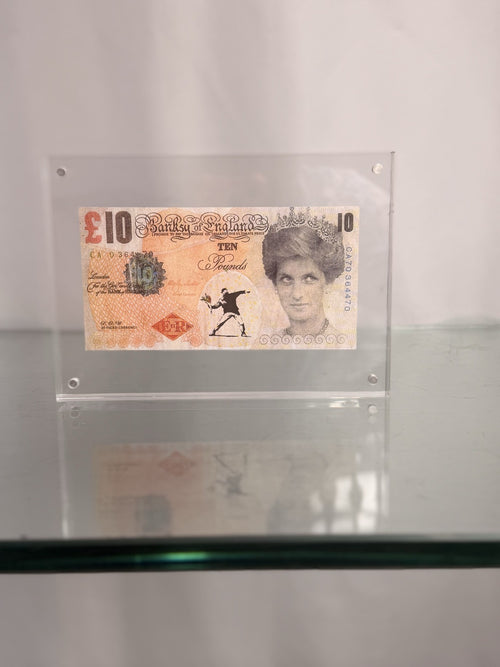
Banksy is a barbell. His market is heavily weighted at two extremes with a thinner middle. At one end sits an enormous volume of accessible material — Dismaland souvenirs, posters, the Gross Domestic Product “Welcome Mat,” unsigned prints — much of it transacting in the low hundreds.10 At the other end sit unique originals and signed, Pest Control-authenticated editions that reach hundreds of thousands to millions. A single eight-figure original accounts for the dataset’s $16.1 million ceiling.11 There is far less orderly “middle” than in Fairey’s market; you are largely choosing between accessible souvenirs/prints and stratospheric fine art, with a narrower band between.
This single structural difference drives nearly every practical distinction that follows — accessibility, authentication, liquidity, and risk all look different because the underlying markets are shaped differently.
The men behind the work: a brand versus a ghost
The deepest difference is not in the art; it is in the identity.
Shepard Fairey is a public brand. Born in 1970, RISD-trained, he built OBEY Giant from the 1989 “Andre the Giant Has a Posse” sticker campaign into a globally recognized identity, and became a household name through the 2008 Obama “HOPE” portrait now held by the Smithsonian National Portrait Gallery.12 He signs his work, runs a documented release operation through OBEY, gives interviews, and stands behind his output in person. The brand is the man, and the man is reachable, legible, and consistent.
Banksy is a ghost. His identity remains officially unconfirmed, and the anonymity is not incidental — it is central to the work and the market. He releases through cryptic channels, stages interventions (Dismaland in 2015, the Walled Off Hotel, the 2018 self-shredding of “Girl with Balloon” at auction), and authenticates exclusively through a deliberately opaque body, Pest Control.13 The anonymity creates scarcity of contact as well as scarcity of object: there is no studio to call, no signing table, no public figure to verify provenance. That opacity concentrates value and risk in ways Fairey’s transparency does not.
This is the human root of the barbell-versus-staircase divide. Fairey’s transparency supports a broad, liquid, trust-by-documentation print market. Banksy’s anonymity supports a market where authenticated objects command enormous premiums precisely because authentication is hard, scarce, and gatekept.
Themes and visual language
Both artists trade in political dissent rendered in instantly legible imagery — but their dialects differ.
Fairey works in the visual grammar of propaganda: high-contrast red/black/cream palettes, stencil-like portraiture, repeating patterns, bold sans-serif typography, and iconography (the OBEY star, the Andre face) engineered for repetition and recognition. His subjects span power, dissent, war, surveillance, capitalism, music, and portraiture — Obama, RBG, John Lewis, Ali, countless musicians. The aesthetic is constructive, designerly, poster-like; it wants to be reproduced.14
Banksy works in the visual grammar of satire: stencilled vignettes, dark humor, visual punchlines, and subversive juxtapositions (rats, the girl with the balloon, riot police, monkeys). Where Fairey builds an icon, Banksy lands a joke — usually at the expense of authority, war, capitalism, or the art market itself. The 2018 shredding was the purest expression: a work that critiques the commodification of art by destroying itself at the moment of its own record sale.15
Both are political; both are accessible; both are mass-reproduced. But Fairey’s work is a poster, made to be owned widely, and Banksy’s is a prank made permanent, where the most valuable examples are unique interventions, not editions.
Authentication: the single biggest practical difference

For a collector, no dimension separates these two artists more sharply — or more consequentially — than how authenticity is established. Get this wrong and the price data above is meaningless.
Banksy is authenticated by Pest Control, and Pest Control alone. Pest Control is the official body Banksy established to authenticate his work; a genuine Pest Control certificate is the market’s gold standard, and its absence is, for high-value pieces, disqualifying. Critically, Pest Control authenticates a narrow band of work and famously does not authenticate street pieces or much souvenir/unofficial material. This is why so much accessible “Banksy” material — Dismaland souvenirs, certain posters — trades without Pest Control authentication, and why the gap between an authenticated and unauthenticated Banksy can be the entire value of the object.16 Gauntlet Gallery does not claim Pest Control authentication on its pieces; Dismaland-era material is presented with its original event-issued documentation and provenance, not as Pest Control-certified.17
Shepard Fairey issues no artist certificate of authenticity at all. There is no “Pest Control” equivalent. Authenticity for a Fairey is established by a chain of evidence: the hand-signature, the edition numbering, reconciliation to the documented OBEY Giant drop record (date, edition size, format), and a clean provenance trail.18 This is more forgiving in one sense — there is no single gatekeeper who can refuse you — and more demanding in another: the burden of assembling the chain falls on the buyer or the dealer.
The practical upshot is stark. Banksy authentication is binary and gatekept — you either have Pest Control or you are in the wilderness, and the price reflects which. Fairey authentication is evidentiary and reconstructable — you assemble signature, edition, drop record, and provenance into confidence. A collector comfortable in one regime is not automatically comfortable in the other, and the risk profiles are completely different.
Accessibility: where you actually enter each market
Despite Banksy’s million-dollar headlines, both artists have a genuinely accessible entry point — but they look different.
Entering the Fairey market is straightforward: the median signed print is around $268, the most-traded images are deeply liquid, and you can buy a recognizable, numbered screenprint of a known image for a few hundred dollars with confidence, on the open market.19 The staircase means your entry point is clear and your next step up is visible.
Entering the Banksy market accessibly means, in practice, the Dismaland and souvenir tier. The single most-traded Banksy “work” in the data is the Dismaland cluster — over 1,500 records at a ~$238 median — accessible, iconic, and tied to one of street art’s most documented events.20 This is precisely the lane Gauntlet Gallery occupies for Banksy: the 2015 Dismaland material, presented with provenance and event documentation, as the accessible, real way to own a piece of the Banksy story without a Pest Control-certified five-figure outlay.21 The barbell means your accessible entry (Dismaland/souvenir) and the fine-art tier (Pest Control originals) are far apart, with little orderly middle between them.
So both artists are “accessible” — but Fairey’s accessibility is the bottom of a continuous staircase, while Banksy’s accessibility is one end of a barbell, structurally separated from his fine-art market.
Liquidity, risk, and the tail
Liquidity favors Fairey. With 61,259 cleaned sales versus Banksy’s 13,229, and a market built on editioned prints that trade constantly, Fairey is the more liquid name at the collector level. You can buy and sell a typical Fairey quickly at a knowable price.22 Banksy’s accessible tier (Dismaland, posters) is also liquid, but his fine-art tier is, by nature, thin — apex Banksys trade rarely and at auction, not on demand.
Risk profiles differ in kind, not just degree. Fairey’s risk is evidentiary: did you correctly assemble the authentication chain, and is the condition/edition as represented? It is a risk you can largely manage with diligence. Banksy’s risk is binary and severe: a piece is Pest Control-authenticated or it is not, and the unauthenticated market is riddled with misattribution and outright fakes. The downside of getting a high-value Banksy wrong is catastrophic in a way that is rarer in the Fairey market.23
The tail rewards Banksy — for those who can reach it. Banksy’s 0.5% of sales over $10,000 and 0.06% over $100,000 represent a genuine fine-art apex that Fairey simply does not have; Fairey’s ceiling is the low six figures, Banksy’s is eight.24 But that apex is gatekept by Pest Control, priced beyond most collectors, and illiquid. It is a different game entirely from collecting either artist’s accessible work.
Cultural and institutional standing

Both artists have crossed from the street into the institution, but along different paths.
Fairey’s institutional moment is the Obama “HOPE” image entering the Smithsonian — a singular piece of American political iconography that secured his place in the canon, supported by museum shows and a recognized design legacy.25 His cultural weight is iconographic: he made images that became part of the visual record of their moment.
Banksy’s institutional standing is more paradoxical. He is arguably the most famous living artist on earth, commands eight-figure auction results, and stages interventions that become global news — yet he operates against the institution, and his most celebrated act (the shredding) was an attack on the auction market that simultaneously cemented his value within it.26 His cultural weight is event-driven: he makes moments that become news.
Both are, by any measure, blue-chip cultural figures. But Fairey’s significance is anchored in specific iconic images, while Banksy’s is anchored in anonymity, intervention, and a running critique of the very market that prices him in the millions.
So which should you collect?
The data refuses to crown a winner because the two are not competing for the same collector. The honest framework:
Collect Fairey if you want a deep, liquid, accessible print market where you can build a real collection at three-figure prices, where authentication is reconstructable through evidence rather than gatekept, and where you value clarity, breadth, and the ability to buy and sell with confidence. Fairey is the collector’s market — orderly, navigable, and forgiving of diligence.27
Collect Banksy (accessibly) if you want a piece of the most famous name in street art and a connection to its most documented moments — the Dismaland and souvenir tier is the real, accessible way in, with the clear understanding that this material trades on provenance and event documentation rather than Pest Control certification.28
Pursue Banksy’s fine-art tier only if you can operate in the Pest Control regime, absorb five-to-eight-figure prices, and accept thin liquidity and binary authentication risk. That is a different activity from collecting — it is fine-art investment, and it demands fine-art infrastructure.29
For most collectors, the answer is not “either/or” but “both, at their accessible tiers”: Fairey for the depth and liquidity of his print market, and Banksy for an iconic, provenance-backed piece of street-art history. They are complementary, not competing — which is exactly how a serious street-art collection tends to hold both.
Frequently asked questions
Is Banksy more valuable than Shepard Fairey? At the median, only modestly — Banksy’s typical sale ($349) is about 30% above Fairey’s ($268). At the top, enormously: Banksy’s average sale is 6x higher and his ceiling ($16.1M) is ~70x Fairey’s ($232K). Banksy has a fine-art apex Fairey lacks; their accessible markets are comparable.30
Which is easier to start collecting? Fairey, for most people. His market is a continuous, liquid staircase starting around $268 with reconstructable authentication. Banksy’s accessible entry is the Dismaland/souvenir tier (~$238 median), which is also affordable but is structurally separated from his fine-art market.31
Why is authentication so different between them? Banksy authenticates exclusively through Pest Control, a gatekept body that does not certify much street or souvenir material — so authentication is binary and decisive. Fairey issues no artist COA; authenticity is built from signature, edition numbering, the OBEY drop record, and provenance. One is gatekept; the other is evidentiary.32
Does Gauntlet Gallery sell Pest Control-authenticated Banksy? Gauntlet Gallery does not claim Pest Control authentication. Its Banksy offering centers on the 2015 Dismaland material, presented with original event documentation and provenance — the accessible, real way to own a piece of the Banksy story.33
Which appreciates better? Neither artist’s accessible tier shows guaranteed appreciation — both are broad markets where outcomes are image-specific (see our dedicated Fairey appreciation study). Banksy’s fine-art apex has produced spectacular individual results, but those are illiquid, gatekept, and not representative of the accessible market most collectors transact in.34
Are they really comparable artists? Culturally, yes — two titans of street art with political messaging and mass recognition. As markets, no: Fairey is a deep, orderly print market; Banksy is a barbell of accessible souvenirs and stratospheric originals. Same wall in the imagination; different planets in the data.35
The bottom line
Shepard Fairey and Banksy are the two names that define street art for most of the world, and the data shows they earned that status by opposite routes. Fairey built a transparent, brand-driven, deeply liquid print market where a collector can navigate a clear staircase from $268 to the low six figures, authenticating by evidence. Banksy built an anonymous, intervention-driven, barbell market where accessible souvenirs coexist with eight-figure originals, authenticated by a single gatekeeper. Their medians nearly touch; their ceilings are seventy times apart. For the collector, the lesson is not which is “better” — it is that they are different instruments for different goals, and the smartest street-art collections own both, each at the tier where it makes sense.
Caveats and limitations
- Tail sensitivity. Banksy’s statistics are shaped by a handful of museum-grade originals; the median and percentiles are robust, but the mean and maximum reflect rare apex events and should not be read as typical.36
- Authentication scope. Pricing reflects sales as recorded; it does not distinguish Pest Control-authenticated from unauthenticated Banksy at every tier, which materially affects value at the high end.37
- Data sourcing. Both artists are drawn from the same aggregated marketplace-and-auction database (WorthPoint-dominant), best read as the accessible secondary market rather than the top-tier auction ceiling.38
- Not advice. Historical and descriptive only; not an appraisal, prediction, or investment advice.39
Footnotes
Data current as of the master sales database analyzed June 2026. Every figure is drawn from recorded secondary-market sales. Browse authenticated street art at gauntlet.gallery, explore our Banksy Dismaland Buyer’s Guide and Shepard Fairey Buyer’s Guide, and see how to spot a fake.
-
Master sales database (250,000+ records across 31+ artists), filtered to each artist, cleaned of sub-$90 listings and sentinel scrape prices: Shepard Fairey n=61,259; Banksy n=13,229. ↩
-
Fairey median $268, mean $604, max $232,538; Banksy median $349, mean $3,592, max $16,115,000. ↩
-
Informational only; not investment advice or an appraisal. ↩
-
Robust statistics (median/percentile/geometric mean) used because art prices are log-normal; $90 floor and sentinel exclusion applied to both artists identically. ↩
-
Banksy’s high tail (museum-grade originals) is shown explicitly via mean and maximum rather than hidden in an average. ↩
-
Computed from the master sales database, both artists, identical cleaning. Percentiles and shares as listed. ↩
-
Median $349 (Banksy) vs $268 (Fairey) ≈ +30%; 90th percentile ~$2,000 for both. ↩
-
Mean $3,592 vs $604 (≈6x); p99 $6,936 vs $3,200; max $16,115,000 vs $232,538. ↩
-
Fairey market structure per the companion Shepard Fairey market-overview and budget guides. ↩
-
Banksy accessible tier: Dismaland souvenirs, posters, Gross Domestic Product “Welcome Mat,” unsigned prints, transacting largely in the low hundreds. ↩
-
The $16.1M maximum corresponds to a unique Banksy canvas result; apex originals dominate the top of the market. ↩
-
Shepard Fairey biographical facts: b. 1970; OBEY Giant from the 1989 “Andre the Giant Has a Posse” campaign; 2008 Obama “HOPE” image held by the Smithsonian National Portrait Gallery (widely documented). ↩
-
Banksy: officially unconfirmed identity; interventions including Dismaland (2015) and the 2018 self-shredding of “Girl with Balloon”; authentication via Pest Control (widely documented). ↩
-
Fairey visual language: high-contrast red/black/cream, propaganda-style portraiture, repeating patterns, OBEY iconography. ↩
-
Banksy visual language: stencilled satire and visual punchlines; the 2018 shredding as a critique of art commodification. ↩
-
Pest Control is Banksy’s official authentication body and the market gold standard; it does not authenticate much street/souvenir material, so accessible “Banksy” material often trades without it, creating large authenticated-vs-unauthenticated value gaps. ↩
-
Gauntlet Gallery does not claim Pest Control authentication; Dismaland-era material is presented with original event documentation and provenance. ↩
-
Shepard Fairey issues no artist COA; authenticity established via signature, edition numbering, OBEY Giant drop record, and provenance chain. ↩
-
Fairey accessible entry: ~$268 median signed print, deep liquidity, open-market availability. ↩
-
Banksy “Dismaland” canonical cluster: 1,571 records, ~$238 median — the most-traded accessible Banksy material in the dataset. ↩
-
Gauntlet Gallery’s Banksy focus is the 2015 Dismaland material with provenance and event documentation. ↩
-
Liquidity: 61,259 Fairey vs 13,229 Banksy cleaned sales; Fairey’s editioned-print market is the more liquid at the collector level. ↩
-
Risk profiles: Fairey evidentiary/manageable; Banksy binary (Pest Control or not) with severe downside on misattribution at the high end. ↩
-
Banksy: 0.5% of sales over $10,000, 0.06% over $100,000 — a fine-art apex Fairey lacks (Fairey >$10k = 0.1%, >$100k ≈ 0%). ↩
-
Fairey institutional standing: Obama “HOPE” in the Smithsonian; museum shows; design legacy. ↩
-
Banksy: among the most famous living artists; eight-figure auction results; the 2018 shredding critiqued the market while reinforcing his value within it. ↩
-
Fairey collecting case: deep, liquid, accessible, evidentiary authentication. ↩
-
Banksy accessible collecting case: Dismaland/souvenir tier on provenance and event documentation. ↩
-
Banksy fine-art tier: Pest Control regime, five-to-eight-figure prices, thin liquidity, binary authentication risk. ↩
-
Median +30% (Banksy); mean ~6x; max ~70x. ↩
-
Fairey easier entry (continuous staircase); Banksy accessible via Dismaland/souvenir tier. ↩
-
Authentication contrast: Pest Control (gatekept, binary) vs Fairey evidentiary chain. ↩
-
Gauntlet Gallery does not claim Pest Control; Dismaland material with event documentation and provenance. ↩
-
Appreciation is image-specific in both accessible markets (see Fairey appreciation study); Banksy’s apex results are illiquid and unrepresentative. ↩
-
Culturally comparable; structurally different markets (staircase vs barbell). ↩
-
Banksy mean/max reflect rare apex events; median/percentiles robust. ↩
-
Recorded sales do not uniformly distinguish Pest Control-authenticated from unauthenticated Banksy. ↩
-
Both artists from the same WorthPoint-dominant aggregated database; read as accessible secondary market. ↩
-
Informational only; not financial or investment advice. ↩