Executive Summary
Shepard Fairey is the most liquid, most-traded street-art name after Banksy, with a catalogued output of 450+ editioned prints, 100+ institutional holdings across the Smithsonian National Portrait Gallery, MoMA, V&A, LACMA, and Boston ICA, and a 2023 auction record of $950,000 for the original HOPE collage at Santa Monica Auctions. The OBEY GIANT print market has matured from skater-poster culture into a museum-grade micro-asset class with five distinct print tiers, well-documented edition structures, and a forgery rate estimated at approximately 30% of online listings — making authentication literacy the single most important skill a collector can develop.
📊 Verified Market Data: See current prices for 300 Shepard Fairey prints in Gauntlet Gallery's Shepard Fairey Price Guide — median sale prices, 5-year CAGR, and last recorded transactions from 32,614 comparable sales.
Gauntlet Gallery has tracked Fairey market comps since 2012 and applies archive-matched provenance standards across every tier from standard screen prints to HPM hand-painted multiples.
Market Overview

Scale and Growth
The global street art print market exceeded $500 million in annual transaction volume as of 2024. Within that market, Shepard Fairey occupies a structurally advantaged position: deep and accessible edition catalogue, institutional museum placement, frequent new releases that sustain collector attention, and a defining cultural work — the 2008 Barack Obama HOPE portrait — that permanently reset price floors across his entire catalog.
The 2008 HOPE moment was the single most significant market inflection point in Fairey's career. Prior to 2008, Fairey ran smaller editions (50–500 prints) and operated primarily within skater and street-art subcultures. Post-2008, edition sizes standardized at 450–700 prints, institutional placements multiplied, and the per-print floor for authenticated signed editions moved up and has never retreated below it.
2024–2025 Market Drivers
Institutional demand floor: MoMA, V&A, the Smithsonian National Portrait Gallery, and LACMA all hold Fairey works. This institutional placement creates a structural price floor that the pre-HOPE era never had. When museums hold an artist's work, secondary market buyers are purchasing within a system that has peer validation from the world's most credible collecting institutions.
Auction record escalation: The three original HOPE collages are essentially off the market. One is in the Smithsonian's permanent collection. One sold at Heritage Auctions in 2022 for $735,000. The third sold at Santa Monica Auctions in 2023 for $950,000 — a new Fairey artist auction record. Each sale resetting the benchmark lifts comp values across every tier in the post-2008 catalog.
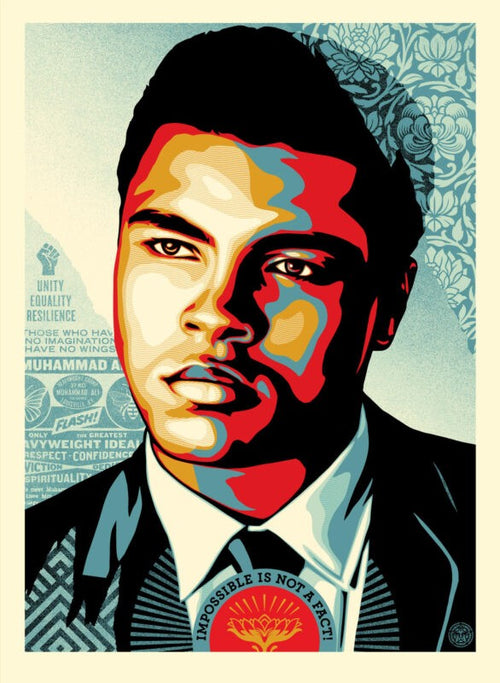
Cultural-anchor subject premiums: Political and cultural-icon subjects — HOPE, Ruth Bader Ginsburg, Martin Luther King Jr., Nelson Mandela, John Lennon — outperform generic OBEY-imagery pieces by 3–5x in recent comp windows. Collectors who anchor their acquisitions on these subjects benefit from both symbolic and financial compounding.
Re-edition complexity: Fairey frequently re-releases popular subjects (RBG, MLK, Mandela, Lennon) with new edition numbers and variant specifications. A 2022 RBG reprint trades materially differently from a 2014 first run of the same subject. Collectors who track the OBEY GIANT release archive closely outperform those who rely on generic market comps.
Authentication Guide

The Standard Authentication Chain
OBEY GIANT prints are unusual in the street art market: Shepard Fairey's studio ships primary releases without COAs by default. There is no Pest Control equivalent — no official secondary-market authentication body analogous to what Banksy's studio provides. This makes physical print markers and archive verification the load-bearing elements of authentication.
Primary-Source Authority:
- OBEY GIANT release archive (obeygiant.com) — The definitive primary-source authority. Every authenticated edition can be matched to a specific listing on the OBEY GIANT site with date, edition size, and variant details. If a print cannot be matched to the archive, the provenance chain is broken.
- Original shipping tube or dealer invoice from a documented OBEY drop — For pieces valued above $5,000, the original primary-market receipt is required documentation. OBEY drops ship without COAs, so the receipt is the strongest provenance artifact.
- Heritage Fine Art or Phillips Editions auction-house lot reference — For HPMs and originals, a major auction house lot record carries significant provenance weight. Both Heritage and Phillips maintain Fairey catalog entries and have published detailed lot notes on significant Fairey works.
Physical Authentication Markers:
- Pencil signature, lower right — fluid, slight rightward slant; compare against known exemplars on the OBEY GIANT site. Uniform ink thickness with no pen lifts is a forgery tell.
- Edition number, lower left, pencil format X/YYY — must match the release record's edition cap exactly. Printed (not pencil) edition numbers indicate an offset reproduction.
- OBEY GIANT blind-deboss embossed seal — crisp, deep impression, typically lower right. A faint, absent, or misplaced seal requires investigation.
- Paper substrate — authentic standard editions print on approximately 290gsm Coventry Rag with substantial weight, warmth, and deckle edges. Thin, glossy, or bright-white paper is a definitive red flag.
Authentication Spend Guide by Tier:
- Under $1,500: Archive listing match + visual exam (paper, ink, seal, signature)
- $1,500–$8,000: Archive match + original receipt or dealer invoice
- $8,000–$40,000: Archive + receipt + auction-house lot reference
- Over $40,000: Full provenance chain + condition report + auction record (mandatory for institutional resale)
Price Guide
Pricing reflects 2023–2025 observed hammer prices and dealer transactions on Heritage, Phillips, Artsy, and authenticated dealer networks. All ranges represent authenticated, condition-sound material. Condition-compromised or unverified pieces trade at 30–50% of these figures.
Five-Tier Price Table
| Print Tier | Edition Size | At-Drop Price | Resale Range (Authenticated) | Notes |
|---|---|---|---|---|
| Standard Screen Print | 300–700 | $60–$150 | $300–$1,500 | Most common tier; commodity pricing on generic OBEY subjects |
| Large-Format Screen Print | 300–600 | $200–$400 | $1,000–$4,000 | Subject premium significant at this tier |
| Letterpress Edition | 50–150 | $300–$800 | $1,500–$5,000 | Tactile impression on reverse is authentication marker |
| Diamond Dust / Metallic | 60–200 | $500–$1,200 | $2,000–$8,000 | Hand-applied; uneven texture confirms authenticity |
| HPM Hand-Painted Multiple | 5–25 | $2,000–$6,000 | $8,000–$40,000+ | Highest forgery risk; requires three-source provenance |
| Post-2008 Original (mixed media) | 1 | N/A | $25,000–$950,000+ | HOPE record: $950K, Santa Monica Auctions 2023 |
Subject Premium Multipliers
| Subject Category | Price Multiplier vs. Generic OBEY Subject |
|---|---|
| HOPE, RBG, MLK, Mandela, Lennon | 1.5x–2x base tier price |
| Letterpress or Diamond Dust variant | Additional 2x–3x |
| HPM of anchor subject | Additional 5x–10x |
| Original of anchor subject | Additional 50x–500x |
Condition Impact
Sun fading and creases destroy 30–60% of authenticated value. A standard signed screen print that comps at $1,200 in pristine condition may trade at $480–$840 with visible UV fade. Budget $300–$700 per print for proper conservation framing with 99% UV-filtering acrylic to protect value.
What Makes a Piece Valuable

Six factors determine where within a tier a specific Fairey print lands:
1. Subject Matter
Cultural-anchor subjects (HOPE, RBG, MLK, Mandela, Lennon) are the most important value driver. Generic OBEY-imagery prints trade at the lower end of their tier with limited appreciation momentum.
2. Edition Size
Sub-100 editions (letterpress and HPM tiers) command 4–10x the per-print value of standard 450–700 edition runs.
3. Print Tier and Variant
Diamond Dust and metallic surface prints command premiums over flat-stock editions. HPMs represent the highest-value manufactured tier and require the most rigorous provenance verification.
4. Condition
Mint condition with original shipping tube is the canonical collector configuration. Prints must be stored flat at 65–72°F and 40–55% relative humidity. Direct sunlight destroys the reds and yellows in Fairey's palette first.
5. Provenance Documentation
Original receipts double buyer confidence and are required at $5,000+. The OBEY GIANT archive listing match is the primary authority regardless of tier.
6. Timing to Exhibition Cycles
Major museum shows lift comps 15–30% during and immediately after the exhibition. The ICA Boston 2009 solo retrospective established this pattern.
10 Red Flags and Fake Detection
Approximately 30% of Fairey prints listed online are estimated to be forgeries. Apply the following detection protocols before any purchase.
Red Flag 1: Price Below Market Floor
Any signed, numbered Fairey edition listed under $500 should be assumed a forgery. Any listing more than 30% below current Heritage or Phillips comps requires a substantive explanation.
Red Flag 2: Printed Edition Number or Printed Signature
Authentic Fairey editions are signed and numbered in pencil. A 10x loupe will reveal whether the signature is graphite (catches light directionally) or reproduced (flat, possibly showing halftone dots at magnification).
Red Flag 3: Paper Stock Fails the Touch and Color Test
Authentic Fairey standard editions print on approximately 290gsm Coventry Rag — substantial weight, cream/off-white warmth, deckle edges. Digital reproductions print on bright white, lightweight stock.
Red Flag 4: Ink Is Flat Under Raking Light
Real screen print ink sits proud of the paper surface. Hold the print at 10–15 degrees from the surface under a desk lamp. Authentic ink catches raking light and shows three-dimensional relief. Fake offset or inkjet ink is completely flat.
Red Flag 5: No OBEY GIANT Archive Match
If the print cannot be matched to a specific release listing on obeygiant.com, the provenance chain is broken. Sellers who cannot name the exact release year, edition size, and paper stock are disqualified.
Red Flag 6: Letterpress Without Tactile Reverse Impression
For letterpress editions, flip the print over before any other test. Letterpress printing physically impresses the paper — the reverse should show embossed texture. No reverse impression is a definitive forgery tell.
Red Flag 7: AP Fraud and High-Volume Sellers
Artist Proof (AP) designations are the highest-value forgery target. A seller listing 50+ different street art prints at significant prices is indicating wholesale counterfeit sourcing.
Red Flag 8: Suspicious Seller Language
Forgery listing phrases include: "Purchased at retail in Japan," "Signed by hand," "Artist proof or AP" without documentation, "Acquired from a gallery closing," "Faded/aged signature," "From the estate of..." If three or more appear in a single listing, walk away.
Red Flag 9: Diamond Dust With Uniform Machine-Applied Texture
Authentic Diamond Dust variants show uneven, hand-application texture. Machine-applied or sprayed forgeries lack the organic unevenness of hand-application. Inspect Diamond Dust in person whenever possible.
Red Flag 10: HOPE Imagery Without Documented Provenance
The HOPE image has been reproduced thousands of times. Any "vintage HOPE poster" listing without OBEY GIANT paperwork or auction-house provenance is almost certainly not what it claims to be.
Collector FAQ
Q: What is the single most important thing to verify when buying a Shepard Fairey print?
A: Match the print to the OBEY GIANT release archive at obeygiant.com. Every legitimate edition is documented with a specific listing, date, edition size, and variant details. If the print cannot be matched to the archive, the provenance chain is broken regardless of what certificates or signatures accompany it.
Q: Do Shepard Fairey prints come with a Certificate of Authenticity?
A: OBEY GIANT primary releases ship without COAs by default. The provenance standard for Fairey is: OBEY GIANT archive listing match plus original shipping tube or dealer invoice from a documented OBEY drop. Third-party paper certificates are common in the forgery market precisely because buyers expect a COA.
Q: What are the five print tiers and which offers the best collector value?
A: The five tiers are Standard Screen Print ($300–$1,500 resale), Large-Format Screen Print ($1,000–$4,000), Letterpress Edition ($1,500–$5,000), Diamond Dust/Metallic ($2,000–$8,000), and HPM Hand-Painted Multiple ($8,000–$40,000+). For most collectors entering the market, Letterpress editions of cultural-anchor subjects at under-150 edition sizes represent the best risk-adjusted entry point.
Q: How much does subject matter affect resale value?
A: Subject matter is the largest value driver within any given tier. Cultural-anchor subjects — HOPE, RBG, MLK, Mandela, Lennon — outperform generic OBEY-imagery pieces by 3–5x in recent comp windows.
Q: What happened to the HOPE original collages and why does it matter for print values?
A: Only three original HOPE collages were ever produced. One is in the Smithsonian National Portrait Gallery's permanent collection. One sold at Heritage Auctions in 2022 for $735,000. The third sold at Santa Monica Auctions in 2023 for $950,000 — Shepard Fairey's current auction record. Each record sale resets comp benchmarks across the entire post-2008 catalog.
Q: How should I store and frame a Fairey print to protect its value?
A: Store prints flat in archival folders — never rolled long-term. Maintain stable temperature at 65–72°F and 40–55% relative humidity. When framing, use museum or 99% UV-filtering acrylic, an acid-free mat, and archival mounting with corners only. Budget $300–$700 per print for proper conservation framing.
Q: Which auction houses are recommended for selling Fairey prints above $3,000?
A: Heritage Auctions and Phillips Editions are the recommended resale venues for editions trading above $3,000. For the $500–$3,000 band, Artsy, authenticated dealer networks, and Gauntlet Gallery are the appropriate venues.
Q: What is an HPM and why does it command such a large premium?
A: HPM stands for Hand-Painted Multiple. These are small editions — typically 5–25 copies — where Shepard Fairey has applied hand-painted accents directly to a signed and numbered edition base. The premium over a standard screen print of the same subject ranges from 5x to 10x. Require OBEY GIANT archive listing plus original receipt plus an auction-house lot reference as three-source provenance before transacting.
Why Gauntlet Gallery

Gauntlet Gallery was established in 2012 in San Francisco — active in the Fairey market since the direct aftermath of the HOPE inflection. Over a decade of Fairey transaction history, provenance documentation, and archive-matching capability represents category depth that generalist platforms and newer entrants cannot replicate.
160,000+ Comparable Sales Database: Gauntlet Gallery's pricing intelligence draws on more than 160,000 comparable sales across authenticated street art and contemporary editions, with current comp data across all five Fairey print tiers.
Archive-Matched Provenance Standards: Gauntlet Gallery's Fairey acquisitions are verified against the OBEY GIANT archive before being offered for sale — edition by edition, release by release.
Condition Grading at Point of Sale: Condition is graded at point of acquisition and disclosed to buyers before transaction — protecting buyers from discovering condition issues after purchase.
Full Tier Coverage: The Fairey inventory spans the full tier stack: standard signed screen prints, large-format editions, letterpress, Diamond Dust variants, and HPMs, with documented provenance at the level appropriate to each piece's value.
Browse authenticated Fairey inventory with archive-matched provenance at Gauntlet Gallery.
Related Categories
Banksy Prints: The most liquid, most-traded name in street art above Fairey. Banksy's Pest Control authentication body provides the definitive secondary-market COA — a structural difference from the Fairey archive-match standard.
KAWS Editions: KAWS and Fairey represent parallel tracks in the street-art-to-institutional pipeline. KAWS's companion figure editions and print catalog have developed a robust authentication ecosystem at comparable price points.
Death NYC: Death NYC mashup compositions are among the most counterfeited street art editions alongside Fairey works. The Death NYC authentication standard runs through the artist-signed COA with consistent reverse stamp, edition number, year, and artist mark.
Political and Protest Art: Fairey's political print catalog sits within a broader market for artist-editioned protest and political works. Warhol political prints, Barbara Kruger editions, and artist multiples from the 1980s–2000s political art tradition command similar institutional premiums for cultural-anchor subjects.
Gauntlet Gallery — Authenticated Art and Memorabilia | gauntlet.gallery | 160,000+ comparable sales | Street art editions, political prints, and authenticated contemporary works.
Pricing data reflects observed 2023–2025 transactions on Heritage, Phillips, Artsy, and authenticated dealer networks. All ranges represent authenticated, condition-sound material. Consult a specialist before transacting at significant value.