A Jersey City kid who spent his nights climbing over New York bus shelters to alter Calvin Klein advertisements grew up to sell a single painting for $14.7 million at Sotheby's Hong Kong — and along the way built a collectibles market worth more than $2 billion that now generates over $200 million annually in auction and secondary market volume alone. Brian Donnelly, known to the world as KAWS, occupies a position no designer-toy artist has ever reached: simultaneous credibility at Phillips, Sotheby's, Christie's, and Bonhams, alongside mass-market drops at Uniqlo, the MoMA Design Store, and Dior boutiques.
This guide exists because that scale creates a problem: with an estimated 40–60% counterfeit rate on open marketplaces and factory-grade fakes appearing within 72 hours of every new drop, buying KAWS without expert authentication knowledge is a coin flip at best. Gauntlet Gallery has catalogued 160,000+ comparable sales across street art and contemporary collectibles and maintains one of the most granular KAWS authentication datasets in the secondary market. What follows is everything you need to buy, authenticate, price, and invest in KAWS with confidence.
Who Is KAWS?

Brian Donnelly was born in Jersey City, New Jersey, in 1974. He studied illustration at the School of Visual Arts in New York, graduating in 1996 — the same period he was already active as a graffiti writer in the New York City underground. His tags in the early 1990s gave him the name KAWS, four letters chosen for their visual properties rather than their meaning, which has since become one of the most recognizable signatures in contemporary art.
Authentication and pricing questions are exactly what we handle daily. Browse KAWS figures that have already been through our verification process.
Shop KAWS FiguresThe move that defined the early KAWS mythology was not gallery work — it was bus shelter alterations. Throughout the mid-to-late 1990s, Donnelly gained unauthorized access to the advertising panels inside bus shelters and phone booths across Manhattan, replacing or defacing Calvin Klein, Levi's, and Hennessy advertisements with his own characters: figures with X-eyes, skull-like features, and the skeletal crossbones motif that would become his trademark. These alterations were photographed before removal and circulated through graffiti zines and, eventually, the early internet — reaching a global audience without a single gallery show.
That streetwear and graffiti credibility opened Japan's door. By the late 1990s, KAWS was working with Bounty Hunter, Hajime Sorayama, and the Tokyo street-culture scene that would eventually birth the designer toy movement. His first COMPANION figure — a deconstructed Mickey Mouse with skull hands, X-eyes, and crossbones detailing — was produced in limited numbers in 1999 and sold through Tokyo shops. The immediate sellout and the secondary market premium that followed within weeks established the model KAWS has operated ever since: scarcity-engineered drops, edition-specific distribution, and a secondary market that reliably prices authenticated pieces above retail from the moment of release.
OriginalFake, KAWS's own retail label, ran from 2006 to 2013 and produced the era that now commands the highest secondary market premiums. When OriginalFake closed in 2013, that chapter became permanently finite — and those pieces began appreciating as a distinct, closed tier. The Medicom Toy collaboration that followed, combined with institutional validation from the Brooklyn Museum, NGV, and MoMA, completed the transition from underground street artist to formally collected contemporary art figure.
KAWS's Artistic Style and Characters
KAWS's visual language is immediately recognizable and deliberately borrowed. His characters are cartoon figures — Mickey Mouse, the Michelin Man, SpongeBob SquarePants, the Smurfs, Snoopy, Pinocchio — hollowed out, X-eyed, and reconstructed with skull motifs, crossbones hands, and a deliberate desaturation of their original optimism. The X-eye is the core motif: two intersecting lines that replace the expressive animated eyes of corporate cartoon characters with something that reads simultaneously as unconscious, dead, overwhelmed, or stoned depending on the viewer's register.
This cartoon deconstruction philosophy is what drives KAWS's crossover appeal. For collectors who grew up with these source characters, the work is simultaneously nostalgic and melancholy — familiar forms stripped of their commercial innocence. For younger collectors encountering the work through Supreme drops or the Dior collaboration, the figures read as pure aesthetic objects: the crossbones hands, the X-eyes, and the rounded skull forms cohere into a visual identity that functions as luxury streetwear in three dimensions.
The Core Characters
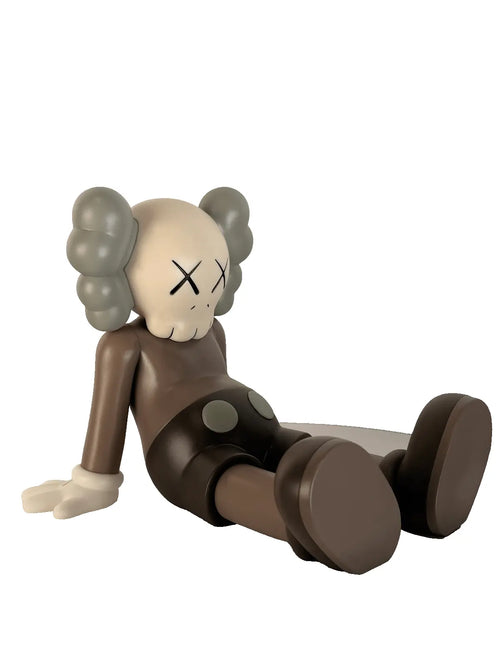
COMPANION is KAWS's original and definitive character — a full-body figure with the skull-and-crossbones hand motif, X-eyes, and the articulated anatomy that distinguishes high-value figures from mass-market production. COMPANION exists in 400% (approximately 11 inches) and 1000% (approximately 28 inches) formats. The 1000% format commands a premium in every colorway and edition due to material cost, tooling complexity, and suppressed supply relative to 400% counterparts.
BFF (introduced 2013) is a secondary character identified by a heart motif on the chest and a slightly softer, rounder silhouette than COMPANION. BFF represents KAWS's expansion into a younger collector demographic and has appeared in vinyl figure and plush toy formats across Uniqlo drops and museum editions. BFF vinyl figures resell in the $500–$2,000 range depending on colorway and documentation.
CHUM is a Michelin Man-derived character with the X-eye and skull-hands treatment. ACCOMPLICE is a rabbit-skull hybrid that appears in collaborative and limited contexts. Both command secondary market premiums when produced as limited editions, but neither has the brand recognition or resale depth of COMPANION.
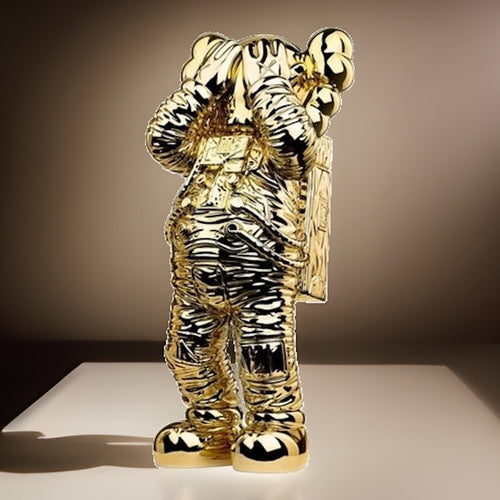
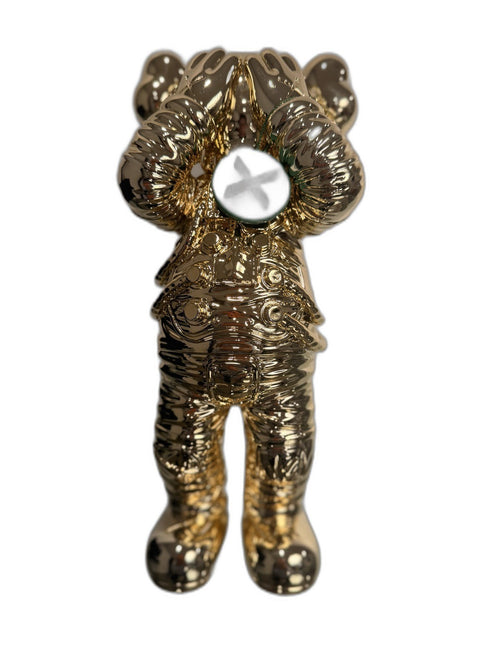
HOLIDAY figures and inflatables are event-specific drops tied to particular cities — inflatable COMPANION and BFF forms installed publicly in Hong Kong's Victoria Harbour, London, Seoul, and elsewhere, with companion collectible releases tied to each event drop. City-specific Holiday pieces with intact event documentation command premiums that reflect genuine scarcity — the documentation cannot be replicated.
Key Collaborations

KAWS's collaboration history is the architecture of his crossover from underground art figure to global luxury brand. Each major collaboration created a new buyer segment and a new floor price — and, correspondingly, a new forgery incentive.
Dior x KAWS (2018–2019) is the collaboration that conclusively moved KAWS into the luxury tier. Kim Jones, then artistic director of Dior Men, brought KAWS into a full collection: figures, accessories, clothing, and the Bee figure rendered in KAWS's X-eye signature style. Dior boutique exclusivity meant distribution was genuinely limited globally. Fully documented Dior x KAWS pieces — with boutique receipt, Dior dust bag, and Dior-format authentication tags — trade at $2,500–$8,000 in current secondary market activity. This collaboration also established that KAWS documentation requirements are category-specific: Dior pieces without all three documentation elements are unverifiable as authentic Dior x KAWS works.
Jordan Brand collaborations placed KAWS's visual language on Air Jordan 4 and Air Jordan 3 silhouettes in edition-limited colorways that sold out instantly and traded at significant premiums. The Jordan collaboration introduced KAWS to a sneaker collector audience that brought both new buyers and, inevitably, new counterfeit economics to the broader KAWS market.
Uniqlo drops (2016–present) are the mass-market tier — T-shirts, plush BFF figures, and accessories sold through Uniqlo retail globally at accessible price points. Uniqlo authentication requires country-of-origin codes and care label formats matching Uniqlo retail specification; tag location and stitch density verification are required for BFF plush. The Uniqlo collaboration introduced KAWS to a consumer audience that had no prior connection to street art or designer toys.
Sesame Street (2018) placed KAWS's COMPANION character alongside Elmo and other Sesame Street figures in a set of vinyl figures and plush toys that merged KAWS's X-eye aesthetic with one of the most recognizable childhood IP properties in the world.
Pharrell Williams, Supreme, and BAPE collaborations in the early 2000s cemented KAWS's credibility in the streetwear hierarchy — making him a reference point for the entire collector-toy-streetwear ecosystem before that ecosystem had a name.
The cumulative effect of this collaboration history is a secondary market with genuine liquidity across multiple buyer demographics, institutional auction records at major houses, and a cultural footprint wide enough to ensure demand continuity across market cycles.
The KAWS Collectible Hierarchy
Understanding where a specific KAWS piece sits within the collectible hierarchy is the foundation of accurate valuation and appropriate authentication requirements.
Open Edition Figures
Open Edition COMPANION figures produced by Medicom Toy (2013 and later) are the broadest category. Not edition-numbered, available through multiple authorized channels, and produced in higher quantities than limited releases. Open Edition Companions in standard colorways resell in the $800–$2,500 range with original packaging and documentation. These are the most frequently counterfeited pieces by volume because the production economics are favorable to forgery at this price range.
Limited Edition Figures
Limited Edition figures — museum editions (MoMA Design Store, NGV, Brooklyn Museum), event-specific drops (AllRightsReserved Hong Kong), and collaboration pieces (Dior, Jordan Brand) — command premiums based on edition size, distribution channel, and documentation completeness. Museum editions outperform standard retail colorways across all formats. The OriginalFake era (2006–2013) represents the apex of the limited edition tier: permanently closed, finite in supply, and appreciating as a distinct collector category.
Signed Prints
KAWS's signed and numbered prints, published through Pace Prints, NGV, and the Brooklyn Museum, occupy a category that bridges the collectible toy market and the fine art print market. Prints are signed and numbered in pencil (XX/YY format) and produced on heavy archival stock. Pace Prints documentation is the primary provenance authority. Signed prints from museum and gallery editions range from $400 to $6,500 depending on edition size, publisher, and condition.
NFC and OneCOA Authentication
For high-value figures, Gauntlet Gallery's authentication canon applies OneCOA NFC chip documentation — a tamper-evident physical authentication layer that creates a verifiable record that travels with the piece through future resale. NFC verification adds a layer that no counterfeit can replicate without access to the underlying authentication infrastructure, making it the strongest available provenance mechanism for vinyl figures above the $1,500 threshold.
KAWS Figures in Stock
Verified pieces from the Gauntlet Gallery collection — sealed, checked, and ready to ship.

KAWS Time Off BFF Vinyl Figure Blue 2023 Medicom Toy 14" Reclining with Box
$276
View This Piece
KAWS Holiday Indonesia Accomplice Black Vinyl Figure 11.5" 2023 NEW Sealed NFC
$578
View This Piece
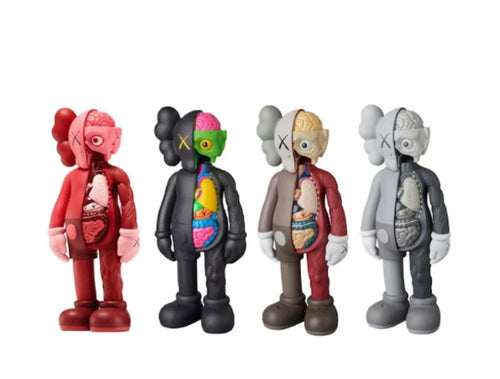
KAWS Companion Flayed Open Edition Black Medicom Toy Dissected Sealed New Figure
$600
View This PieceKAWS Price Guide
The following ranges reflect observed secondary market transactions aggregated from Gauntlet Gallery's 160,000+ comparable sales database, Phillips, Sotheby's, Christie's, Heritage Auctions, Bonhams auction records, and StockX and GOAT platform data. All figures are USD. Data current as of mid-2025. Ranges reflect the 5th–95th percentile of observed transactions; outlier results and distressed sales are excluded.
| Format | Edition Status | Condition | Observed Resale Range | Appreciation Potential |
|---|---|---|---|---|
| Companion 1000% | OriginalFake era / Dior collab / top-tier colorways | Excellent, original box | $3,500 – $18,000 | Very High — finite supply, closed era |
| Companion 1000% | Standard (MoMA, museum, recent retail) | Excellent, original box | $1,200 – $4,500 | High — institutional pedigree |
| Companion 1000% | Standard | Good, no box | $800 – $2,200 | Moderate — documentation gap |
| Companion 400% | OriginalFake era / hot collab colorways | Excellent, original box | $700 – $3,000 | Very High — closed era |
| Companion 400% | Standard (common-tier and museum) | Excellent, original box | $280 – $900 | Moderate |
| 2006 Five Years Later (Blush/Red OriginalFake) | OriginalFake era flagship | Excellent, original box | $3,000 – $12,000 | Very High — single most valuable figure target |
| BFF Figure (vinyl) | Any colorway | Excellent, original box | $500 – $2,000 | Moderate-High |
| Holiday Inflatable / Plush | City-event drops, full packaging | Mint, sealed, event documentation | $250 – $1,500 | Moderate — documentation-dependent |
| Dior x KAWS (full Dior documentation) | Boutique-authenticated | Excellent with receipt + dust bag | $2,500 – $8,000 | Very High — documentation gates value |
| Signed / Numbered Print (Pace, NGV, Brooklyn Museum) | Museum / gallery editions | Excellent, unframed | $400 – $6,500 | High — institutional print provenance |
| Open-edition signed print | Any edition | Excellent | $200 – $800 | Low-Moderate |
Price Floor Rules
Certain price thresholds function as counterfeit flags in the KAWS market. A Companion 1000% from any major release priced under $1,000 is almost certainly counterfeit. A Companion 400% from a hot collab priced under $300 should be treated as suspect. An Open Edition Companion of any colorway priced under $600 is unverifiable at minimum. When a listing violates a known price floor, treat it as counterfeit until proven otherwise through documented third-party authentication.
KAWS Investment Track Record

The investment case for KAWS is not theoretical. It is documented across a series of specific milestones that establish the appreciation trajectory across formats.
In April 2019, The Kaws Album — a 2005 painting depicting the Simpsons family rendered in KAWS's X-eye style — sold at Sotheby's Hong Kong for HK$115.97 million ($14.7 million USD), setting a new auction record for the artist and placing KAWS definitively in the institutional contemporary art conversation. The estimate had been $1.1 million. The realized price was more than 13x the high estimate. This was not a single anomaly — it was the result of a decade of sustained institutional validation and secondary market development.
At the figure level, the appreciation track record is equally documented. Authenticated OriginalFake era Companion figures purchased at original retail in the 2006–2010 window have appreciated 5–20x in the secondary market. The 2006 Five Years Later (Blush/Red colorway), originally retailed in the sub-$200 range at Tokyo boutiques, now clears $3,000–$12,000 at auction for authenticated examples in excellent condition with original packaging.
The Dior x KAWS collaboration (2018–2019) illustrates the power of institutional partnership on secondary market pricing. Pieces documented through Dior's own authentication infrastructure now trade at $2,500–$8,000 — representing meaningful appreciation from original boutique retail prices for collectors who retained full documentation.
Structural factors that support continued appreciation: OriginalFake supply is permanently finite and decreasing as pieces enter permanent collections. KAWS's museum exhibition history is expanding, not contracting — the NGV partnership, Brooklyn Museum shows, and institutional print publishing programs create recurring institutional validation events that reset floor prices upward. The collaboration pipeline with Dior, Jordan Brand, and others has introduced new buyer demographics at each stage, expanding the collector base without diluting authenticated scarcity.
Documentation completeness is the most underappreciated value driver in the entire market. A Companion 1000% with original box, retailer receipt, and StockX or GOAT authentication commands a meaningful premium over an otherwise identical figure with missing packaging. The box and hangtag are the most counterfeited elements — which means the presence of original, authenticated packaging on a legitimate piece is a genuine differentiator that the secondary market prices accordingly.
How to Authenticate KAWS Figures: Five Physical Checkpoints
Authentication for KAWS figures is category-specific and format-specific. No single universal COA provider exists for KAWS. Medicom Toy does not issue COAs — any figure accompanied by a self-issued "Medicom COA" is a red flag. The following five checkpoints apply to all vinyl COMPANION and BFF figures.
Checkpoint 1: The NFC Chip and OneCOA Documentation
For high-value figures (above $1,500), Gauntlet Gallery's authentication canon applies OneCOA NFC chip documentation. Physical NFC verification creates a tamper-evident record that can be read via smartphone — and cannot be replicated without access to the OneCOA authentication infrastructure. On secondary market purchases, request the NFC documentation alongside any StockX or GOAT authentication pass. For pieces without NFC documentation, auction house lot records with matching photographs from Phillips, Sotheby's, Christie's, Heritage Auctions, or Bonhams constitute the next strongest provenance tier.
Checkpoint 2: Box and Packaging Quality
Packaging is the most-counterfeited element on KAWS Companions. Sealed condition is not authentication — it is a manufacturing state. Authentic packaging indicators: foil or silver stamp present on the box, no pixelation or registration blur in box graphics, no strong chemical off-gassing smell, and sticker placement consistent with the documented format for that edition. Missing box on a high-tier 1000% combined with the narrative "lost the box" is a common presentation for counterfeits sold without packaging. Any included COA with a Medicom or AllRightsReserved figure is a disqualifying red flag — these releases do not ship with COAs.
Checkpoint 3: X-Eye Geometry and Vinyl Finish
The X-eye is KAWS's signature motif and the most examined element in authentication. Authentic XX eyes are equal in size with sharp, crisp intersections. Asymmetric X-eye sizes, rounded corners at the X intersection, or any tilt are disqualifying. Under a 10x loupe, paint edges on authentic X-eye detail are razor-crisp; counterfeits show diffusion and bleeding. Authentic KAWS vinyl is soft, pliable, high-grade material with a matte-to-satin finish. Counterfeits use rigid, brittle, or tacky vinyl. The head sphere on authentic figures is perfectly round; an oval or flattened top is a counterfeit tell.
Checkpoint 4: Joint Articulation and Internal Structure
Authentic COMPANION 1000% uses screw-base assembly with internal structural ribs. Counterfeits use snap construction or thin-walled hollow shells. Authentic joints move smoothly with no visible pins and no panel gaps. Counterfeit joints are floppy or stuck, and often show visible assembly pins or misaligned panel seams. This test requires physical handling — photograph-based authentication cannot reliably catch joint construction issues, which is one reason in-hand verification photographs from the seller are a minimum requirement on any purchase above $500.
Checkpoint 5: Foot Stamp Verification
Era-correct foot stamp text is one of the five most decisive authentication checks for KAWS figures. Authentic 2006 OriginalFake pieces read: OriginalFake ©2006 MEDICOM TOY. Post-2013 Medicom Toy releases read: ©KAWS .XX MEDICOM TOY YYYY CHINA. On authentic pieces, ink sits in embossed text channels and does not bleed into surrounding vinyl texture. On counterfeits, stamps are often ink-printed (not embossed), show the wrong font, are missing marks, or bleed visibly into surrounding vinyl. A wrong or missing foot stamp is a disqualifying finding — no other positive test overrides it.
Weight Test
Authentic KAWS Companion 400% figures in standard ABS releases weigh approximately 340 grams. Counterfeits run 15–30% lighter — a differential immediately obvious when an authentic and a suspect piece are held simultaneously. If evaluating without an authentic comparator, ask the seller for the exact weight. Cheap flat-rate shipping on a Companion 1000% is a proxy tell: the authentic piece's mass is incompatible with budget shipping rates.
Red Flags: How to Spot a Fake KAWS Figure

The economics of KAWS counterfeiting are straightforward: a factory-grade fake that costs $80–$120 to produce sells for $1,200–$4,500 to an uninformed buyer. This profitability ensures the counterfeit supply chain is permanently active and continuously improving. These are the six categories of red flags that signal a counterfeit or unverifiable listing.
Price Floor Violations
Any Companion 1000% from a major release listed under $1,000, any Companion 400% from a hot collab listed under $300, and any Open Edition Companion listed under $600 violates known market floors. Legitimate below-market pricing does not exist at this frequency — floor violations are counterfeit signals, not bargain opportunities.
Seller Pattern Red Flags
Sellers with 30+ KAWS pieces of one collab are factory-volume sellers. All listing photos being official press shots with no in-hand verification photographs is a significant flag — authentic sellers can photograph their actual inventory. No returns accepted on a high-value collectible. Seller accounts under 6 months old with sudden high-value listings. Feedback scores under 98% with counterfeit-related negative content. Lot listings ("3 KAWS figures, various") — authentic pieces are not liquidated in lots by legitimate collectors.
Provenance Claim Red Flags
"Bought during the Hong Kong drop" without timestamped receipts or app confirmations. "Dior store exclusive" without boutique receipt and Dior dust bag. "OriginalFake era — rare colorway" without era-correct foot stamp documentation. "Prototype" or "artist proof" — KAWS does not release prototypes publicly; any such claim is fraudulent. The same Holiday inflatable serial number appearing across multiple sellers.
Where to Buy Authentic KAWS Figures
The source of purchase is the single highest-leverage authentication decision a collector makes. The difference between primary market and open marketplace purchasing is not primarily about price — it is about counterfeit exposure.
Primary Market
kawsone.com is KAWS's official direct-to-consumer drop channel. Drops sell out in minutes; registration and notification setup in advance of announced drops is required. Primary market purchasing eliminates counterfeit risk entirely and establishes original retailer provenance.
AllRightsReserved handles KAWS event drops in Hong Kong and Asia-region events. App confirmations and timestamped purchase receipts from ARR constitute strong event-specific provenance for Holiday and event-exclusive figures.
Authorized gallery partners — including designated contemporary art galleries carrying KAWS prints and signed editions — provide gallery receipt documentation that constitutes primary provenance for prints and collaboration pieces.
Verified Secondary Market
Heritage Auctions, Phillips, Sotheby's, Christie's, and Bonhams all carry KAWS consignments that have passed internal authentication review. Auction house lot records with matching photographs constitute strong provenance for pieces that have passed through the auction market.
StockX and GOAT provide platform-level authentication services that are recognized as strong provenance documents in the secondary market. StockX and GOAT-authenticated figures carry a verifiable authentication record that future buyers can reference.
Gauntlet Gallery authenticates all KAWS inventory using the full 6-criteria framework — box and hangtag quality, vinyl color and finish, X-eye geometry, joint articulation, edition foot stamps, and print stock and signature — before any piece is listed. Every KAWS piece at Gauntlet Gallery includes an authentication summary documenting which checks were performed and what evidence was reviewed. For high-value figures, OneCOA NFC documentation is applied. Buyers do not need to run their own authentication — the work has been done and is documented in the listing.
Open Marketplaces: Proceed With Extreme Caution
eBay, Whatnot, Depop, and Mercari carry a 40–60% counterfeit rate on KAWS Companions. If purchasing from these platforms, require: in-hand verification photographs (not press shots), foot stamp photographs under good lighting, original box with visible foil stamp, exact weight information, and a returns-accepted policy. Never purchase a high-value KAWS piece from an open marketplace without StockX, GOAT, or specialist authentication documentation in hand.
Frequently Asked Questions
How do I verify a KAWS COMPANION figure is authentic before buying?
Run the 8-point checklist: box quality and era-correct packaging, plastic finish (soft and pliable, not rigid or tacky), X-eye geometry (equal size, sharp intersections, no tilt), crossbones stroke accuracy, joint articulation (smooth movement, no visible pins, no panel gaps), foot stamp (correct text, crisp embossed ink, no diffusion), price floor check (does the asking price clear the known market floor for this edition), and provenance (original retailer receipt, StockX or GOAT authentication pass, or auction house lot record). For pieces above $1,000, always request StockX, GOAT, OneCOA NFC, or specialist KAWS authentication before purchasing.
What is the counterfeit rate for KAWS figures on eBay and open marketplaces?
The estimated counterfeit rate on open marketplaces — eBay, Whatnot, Depop, Mercari — is 40–60% on KAWS Companions, among the highest of any collectible category. Factory-grade counterfeits share tooling pipelines with legitimate Medicom Toy production. New fakes appear within 72 hours of every major drop. There is effectively zero financial recourse on direct-marketplace counterfeit purchases.
Do KAWS figures come with a Certificate of Authenticity?
No. Medicom Toy and AllRightsReserved KAWS figures do not ship with COAs. Any figure accompanied by a self-issued "Medicom COA" or "AllRightsReserved COA" is a red flag — the seller is attempting to paper over a counterfeit with a fabricated document. Authentic KAWS figures are verified through original retailer receipts, StockX or GOAT passes, OneCOA NFC documentation, and auction house lot records — not self-issued COAs.
What is the OriginalFake era and why does it command a premium?
OriginalFake was KAWS's own retail label, operated from 2006 to 2013. The 2013 final OriginalFake release closed that chapter permanently, making pre-2013 OF pieces a finite, non-reproducible supply tier. The 2006 Five Years Later (Blush/Red colorway) is the flagship OriginalFake piece, regularly clearing $3,000–$12,000 at auction. Era-correct foot stamp verification ("OriginalFake ©2006 MEDICOM TOY") is one of the five critical authentication checks for pieces claiming OriginalFake provenance.
How do I authenticate a KAWS print?
Authentic KAWS prints are produced on heavy archival stock. Numbering and signature are in pencil in XX/YY format — ink signatures are disqualifying on any pencil-documented edition. Under 10x magnification, authentic prints show no halftone dots in the signature area; visible halftone dots indicate an inkjet reproduction. Primary provenance documents are publisher documentation from Pace Prints, NGV, or Brooklyn Museum. For prints above $400, authentication by a specialist or review of original publisher receipts is recommended.
What is the Dior x KAWS collaboration and what documentation is required?
The Dior x KAWS collaboration (2018–2019) produced figures and accessories sold exclusively through Dior boutiques globally. Authentic pieces require three documentation elements: Dior boutique receipt, Dior dust bag, and Dior-format authentication tags. A figure without all three documentation elements cannot be authenticated as a Dior x KAWS piece. Prices for fully documented Dior x KAWS pieces range from $2,500 to $8,000 in current secondary market trading.
KAWS BFF vs COMPANION — which should I buy?
COMPANION is KAWS's original and most valuable character, commanding $1,200–$18,000+ depending on edition and era. BFF (introduced 2013) is a secondary character with a younger collector fanbase, typically reselling in the $500–$2,000 range for vinyl. If long-term investment appreciation is the primary goal, COMPANION — especially OriginalFake era or top-tier collab colorways — has the stronger documented track record. BFF offers a lower entry point and broad cultural recognition through Uniqlo distribution. Both require the same authentication rigor.
What KAWS limited editions have the best investment track record?
OriginalFake era Companion 1000% pieces (2006–2013) have shown 5–20x appreciation from original retail. The 2006 Five Years Later Blush/Red colorway regularly clears $3,000–$12,000 at auction. The Dior x KAWS collaboration (2018–2019) with full documentation trades at $2,500–$8,000. Signed and numbered prints from Pace Prints, NGV, and the Brooklyn Museum have shown consistent appreciation. Documentation completeness — original box, retailer receipt, and StockX/GOAT authentication — is the most underappreciated value driver across all formats.
Where is the safest place to buy authentic KAWS figures?
Primary market: kawsone.com, AllRightsReserved, and authorized gallery partners. Verified secondary market: Heritage Auctions, Phillips, Sotheby's, Christie's, StockX, GOAT, and specialist dealers like Gauntlet Gallery where all inventory is authenticated before listing. Open marketplace platforms (eBay, Whatnot, Depop, Mercari) carry a 40–60% counterfeit rate and require independent third-party authentication documentation before any purchase above $300.
Why Gauntlet Gallery
Gauntlet Gallery was established in San Francisco in 2012 — before the current KAWS market boom established its present floor prices and before the counterfeit supply chain scaled to its current sophistication. That history means Gauntlet Gallery's authentication knowledge was built during the early OriginalFake era, when authentication standards were being established rather than reverse-engineered after the fact.
Gauntlet Gallery's 160,000+ comparable sales database across street art, contemporary collectibles, and authenticated memorabilia provides a statistical pricing foundation that individual dealers and general marketplaces cannot replicate. Pricing at Gauntlet Gallery is anchored to observable secondary market data — not aspirational list prices.
Authentication specificity sets Gauntlet Gallery apart from general authenticators. The framework separates Medicom-produced KAWS figures from BE@RBRICK-format KAWS pieces, documents counterfeit patterns by specific category and era, and applies the full 6-criteria check across Companion 400%, Companion 1000%, BFF, Chum, Accomplice, Holiday inflatables, Uniqlo plush, Dior collaborations, and signed prints. A general authenticator may recognize a fake — Gauntlet Gallery can tell you which factory produced it, which tell is most decisive for that edition, and what documentation tier the authentic version requires.
The OneCOA with NFC chip authentication layer adds a tamper-evident physical record to every high-value figure — providing buyers with verifiable documentation that travels with the piece through future resale. Zero counterfeit risk on listed inventory: every KAWS piece at Gauntlet Gallery has passed the full authentication checklist before listing. Buyers receive an authentication summary with each purchase documenting which checks were performed and what evidence was reviewed.
Browse Gauntlet Gallery's authenticated KAWS collection →
Collect with confidence
Every KAWS figure we sell is verified before it is listed. Browse the current inventory, or read how we authenticate on our COA page.
Shop KAWS Figures