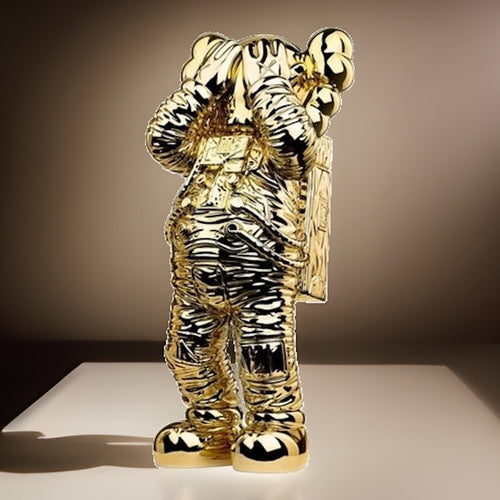
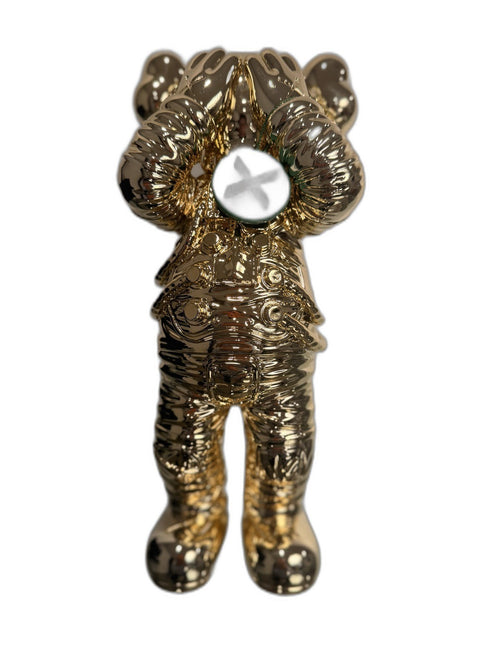
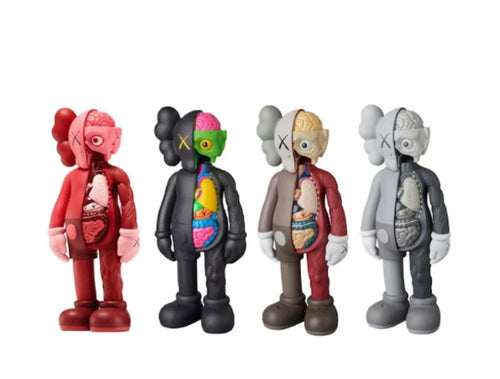
How does KAWS compare to traditional art investment? KAWS occupies a distinct lane from Picasso, Warhol, and Basquiat. Legacy artists offer multi-decade auction histories, deeper liquidity, and price stability earned across market cycles. KAWS delivers accelerated appreciation since 2019 with lower entry points but carries cultural-moment risk those blue-chip names have already transcended.
The Investment Lens: KAWS vs Legacy Contemporary Artists

Art-as-investment buyers have rarely had a comparison this stark. On one side: Pablo Picasso, Andy Warhol, and Jean-Michel Basquiat — three artists whose names alone move global capital. On the other: KAWS (Brian Donnelly, born 1974 in Jersey City, NJ), whose 25-year career produced a $14.7 million auction record when The KAWS Album sold at Sotheby's Hong Kong in April 2019.
This piece compares both camps as investments — not as art-historical statements. Drawing on Gauntlet Gallery's 160,000+ comparable sales database, we examine auction depth, liquidity, risk profile, and entry point so collectors can decide which exposure fits their portfolio.
Auction History and Price Discovery
Price discovery is the foundation of any art investment. The longer and deeper an artist's auction history, the more confidently a buyer can underwrite future value.
Picasso, Warhol, Basquiat: Multi-Decade Track Records
Picasso's secondary market is roughly a century deep. Warhol's market began maturing in the 1970s and was fully institutionalized by the 1990s. Basquiat, despite his death in 1988, has held a continuous and deepening auction record for nearly four decades. All three have survived multiple recessions, taste cycles, and generational handoffs of collectors.
KAWS: 25 Years, Accelerated Post-2019
KAWS first crossed into formal auction channels in the late 2000s, but the true inflection point was April 2019, when The KAWS Album realized $14.7 million at Sotheby's Hong Kong — more than 14 times its high estimate. Since then, auction volume has climbed sharply, with annual KAWS market activity now exceeding $200 million across Phillips, Sotheby's, Christie's, Heritage, and Bonhams.
Investment Comparison Table

| Attribute | Picasso / Warhol / Basquiat | KAWS |
|---|---|---|
| Auction history depth | 30 to 100+ years | ~15 years of formal auction data; explosive post-2019 |
| Annual secondary market volume | Hundreds of millions to billions per artist | $200M+ documented across major houses |
| Print entry point (typical range) | $5,000 to $50,000+ for signed editions | $500 to $8,000 for signed editions |
| Liquidity | Deep — multiple auction houses, dealers, advisors | Improving — Phillips, Sotheby's, plus StockX/GOAT for figures |
| Cultural-moment risk | Transcended — canonical status | Present — still actively defining legacy |
| Forgery exposure | Established authentication infrastructure | High counterfeit rate; provenance is the thesis |
| Diversification within the artist | Paintings, prints, drawings, ceramics | Prints, vinyl figures, sculpture, plush, collaborations |
Liquidity: Deeper Infrastructure for Legacy Artists
Liquidity in art is not the same as liquidity in equities. For Picasso, Warhol, and Basquiat, an owner has multiple realistic exit ramps: any of the major evening sales at Christie's, Sotheby's, or Phillips; specialist dealers; private sales desks; and an advisory ecosystem built around their work. Bid depth at the top end is consistently strong.
KAWS liquidity has improved dramatically but remains shallower at the high end. Signed prints and standard Companion figures trade actively on the documented secondary market and through platforms like StockX and GOAT, which have created a verified resale layer. However, marquee paintings and unique sculptures still depend on a smaller pool of committed collectors — primarily concentrated in Asia and the United States.
Risk Profile: Cultural-Moment Risk

What Legacy Artists Have Transcended
Picasso, Warhol, and Basquiat are no longer subject to "is this artist still relevant?" risk. Their inclusion in major museum collections, art-historical surveys, and university curricula has effectively removed cultural-moment risk from the equation. Their prices fluctuate with macro liquidity and taste cycles, not with whether the artist remains in vogue.
Where KAWS Still Sits
KAWS is in the middle of defining his long-term legacy. He has institutional validation — Brooklyn Museum, National Gallery of Victoria, MoMA Design Store editions — and he commands seven- and eight-figure prices at auction. But because his career is ongoing and his work straddles fine art and designer collectibles, KAWS remains exposed to cultural-moment risk in a way that legacy artists are not.
This is not a bearish call. It is a structural reality every art-as-investment buyer should price in.
Entry Point: Where KAWS Wins on Accessibility
For a buyer deploying $500 to $10,000 into art, the comparison gets interesting fast.
- KAWS signed prints: generally range from approximately $500 to $8,000 on the documented secondary market, depending on edition, era, and condition.
- Picasso signed prints: typically start around $5,000 and extend well past $50,000 for desirable editions.
- Warhol signed prints: screenprints from the Marilyn, Soup Can, and Flowers series often command mid-five to low-six figures.
- Basquiat editioned works: rarer due to his short career; authenticated editions sit in five- and six-figure ranges.
The KAWS entry point is roughly an order of magnitude lower than Picasso prints and meaningfully lower than Warhol or Basquiat editions. For a collector building a first art-investment position, KAWS lets you own an authenticated, signed work by a globally recognized living artist for the cost of a single Warhol catalog.
When KAWS Makes Sense (and When It Doesn't)

KAWS Makes Sense When
- You want exposure to a living artist whose market is still expanding.
- Your budget is $500 to $25,000 and you want signed, edition-limited work rather than open-market posters.
- You are comfortable underwriting some cultural-moment risk in exchange for higher appreciation potential.
- You value diversification across mediums — prints, vinyl figures, sculpture — under one artist.
Legacy Artists Make Sense When
- You prioritize price stability and institutional consensus over upside.
- Your budget supports five- to six-figure entries comfortably.
- You want exit options that do not depend on a still-evolving collector base.
- You are building a long-duration art portfolio meant to outlive a single taste cycle.
The Authentication Imperative
Whichever side of this comparison you choose, provenance is the entire investment. KAWS in particular has one of the highest counterfeit rates of any living artist, with fakes appearing within days of each new drop. Gauntlet Gallery, founded in 2012, has built one of the most granular KAWS authentication datasets in the secondary market, drawing on a 160,000+ comparable sales database across street art and contemporary collectibles.
For a deeper look at building a KAWS-focused position, see our KAWS Collector Guide.
Browse Authenticated Works
Ready to deploy capital into authenticated, signed work — KAWS or otherwise? Browse the full Gauntlet Gallery collection to see current inventory with full provenance.