Has KAWS outperformed the S&P 500? Yes — in select, blue-chip segments. From 2009 to 2025, the S&P 500 delivered roughly 14% annualized total return (about 4x cumulative with dividends reinvested). Documented KAWS Original Companion examples from the same window have appreciated 15x to 20x or more, outpacing the index on price alone.
The Setup: Why This Comparison Matters in 2026
Between 2009 and 2025, two asset classes told remarkable stories. The S&P 500 emerged from the 2008 financial crisis and compounded through one of the longest bull runs in market history. In parallel, KAWS (Brian Donnelly, born 1974, Jersey City, NJ) transitioned from a street-art and designer-toy figure into a formally collected contemporary artist with auction records at Phillips, Sotheby's, and Christie's — including the $14.7 million sale of The KAWS Album at Sotheby's Hong Kong in April 2019.
For collectors and allocators asking whether KAWS belongs alongside equities, the honest answer is nuanced. KAWS is not a portfolio replacement. It is an alternative speculative asset class with a different risk, liquidity, and income profile. This piece walks through the data Gauntlet Gallery has assembled from our 160,000+ comparable sales database, and explains where KAWS has outperformed — and where the comparison breaks down.
The Benchmark: S&P 500 Total Return, 2009-2025
Using the post-crisis trough as a starting point, the S&P 500 with dividends reinvested compounded at roughly 14% annualized through year-end 2025. A $10,000 position at the start of 2009 grew to approximately $40,000 by 2025 — a 4x cumulative return. Over shorter windows the figure varies, but the long-run picture is clear: equities have been one of the most reliable wealth-building vehicles of the last fifteen years.
That return came with daily liquidity, an income stream (the S&P 500 dividend yield averaged ~1.8% over the window), no storage cost, no authentication risk, and tax-advantaged treatment in retirement accounts. These are the structural advantages KAWS cannot match.
The Comparison: KAWS Original Companion (1999)
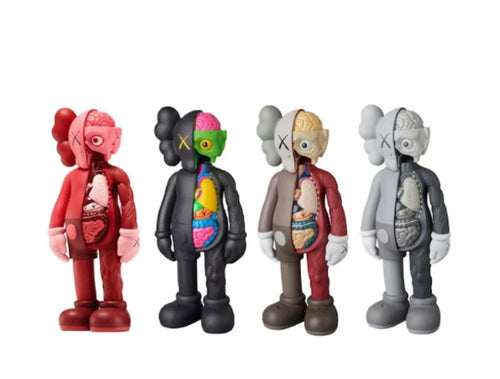
The clearest like-for-like comparison is the KAWS Original Companion, released in 1999 in three colorways — Brown, Black, and Grey — through Bounty Hunter. These figures predate the OriginalFake era and represent the canonical entry point for KAWS vinyl collecting.
Brown Original Companion — Documented Secondary Market Range
| Year | S&P 500 Index Level (approx.) | KAWS Original Brown Companion (documented range) | Notes |
|---|---|---|---|
| 2009 | ~900 | $1,500-$2,500 | Pre-institutional validation era |
| 2013 | ~1,800 | $3,000-$5,000 | OriginalFake closes; supply frozen |
| 2019 | ~3,200 | $15,000-$25,000 | KAWS Album sets $14.7M record |
| 2025 | ~5,900 | $30,000-$70,000 | Auction and private sale band |
Across the same 2009-2025 window, the S&P 500 produced roughly 4x. A Brown Original Companion acquired near the low end of the 2009 range and sold near the mid-band in 2025 returned 15x to 20x or more on price alone. Black and Grey colorways have followed similar trajectories, with edition sizes and condition heavily influencing where any individual piece lands within the range.
Major Paintings and Unique Works
At the gallery-art tier, the comparison widens further. KAWS paintings and unique sculptures sold at major houses through the 2010s for five and low six figures have, in numerous documented secondary market cases, resold for seven and eight figures by the early 2020s. The $14.7 million result for The KAWS Album in April 2019 was a watershed — but it was a confirmation of a trend, not an anomaly.
Where the Comparison Breaks Down
If price appreciation were the only variable, KAWS would look like a clear winner in this window. It is not the only variable. Five structural caveats matter.
1. No Income Stream
The S&P 500 pays dividends. KAWS does not. A meaningful portion of the index's total return comes from reinvested income — and that income is taxed at qualified dividend rates and compounds inside tax-advantaged accounts. KAWS appreciation is pure capital gain, realized only at sale, and typically taxed at the higher collectibles rate (28% federal long-term in the U.S.) rather than the 15-20% long-term capital gains rate on equities.
2. Storage, Insurance, and Authentication Costs
An S&P 500 ETF costs a few basis points per year to hold. A KAWS figure carries real ongoing costs: climate-controlled storage or display, fine-art insurance riders (typically 1-2% of insured value annually), and authentication expenses when buying or selling. Over a fifteen-year hold, these costs compound and meaningfully reduce net return.
3. Illiquidity
S&P 500 shares trade in milliseconds during market hours. A KAWS figure may take weeks to months to sell at fair market value, especially at the higher end. Auction cycles are quarterly. Private sales require buyer matchmaking. In a forced-liquidation scenario, the realized price can be 20-40% below the documented secondary market mid-band.
4. Counterfeit Risk
The KAWS market has one of the highest counterfeit rates of any living artist's work — Gauntlet Gallery's authentication data estimates 40-60% of open-marketplace listings are inauthentic. Equities have no analogous risk. Authentication adds friction, cost, and the possibility of catastrophic loss if a piece turns out to be fake.
5. Concentration and Drawdown
The S&P 500 is 500 companies. A KAWS allocation is, by necessity, a small number of individual pieces. Drawdowns in single-figure colorways can be sharp and prolonged — collectibles markets do not benefit from index-style diversification. The 2022-2023 correction in designer-toy and contemporary collectible prices saw many KAWS pieces decline 30-50% from 2021 peaks before partially recovering.
When KAWS Makes Sense Alongside Equities
The comparison is asymmetric. KAWS is not a substitute for the S&P 500. It is a candidate for a small, deliberate sleeve of an alternative asset allocation, alongside categories like fine wine, watches, and other contemporary art. Three conditions tend to make KAWS allocation rational:
- Long horizon. Ten-plus year holds smooth out the illiquidity and absorb the cost drag.
- Authenticated provenance from the start. Buying from a vetted source with full documentation eliminates the catastrophic-loss tail. Gauntlet Gallery, founded in 2012, has built its authentication practice around exactly this need.
- Position sizing as alternative, not core. Treating a KAWS allocation as 1-5% of liquid net worth — not 25% — keeps the concentration risk inside acceptable bounds.
For collectors who already love the work, the financial case is a bonus, not the thesis. For pure financial allocators, the S&P 500 remains the more defensible vehicle. The two are not in opposition; they answer different questions.
Further Reading
For collectors evaluating specific KAWS pieces, our KAWS Collector Guide walks through edition-by-edition pricing, authentication signals, and the OriginalFake-era timeline in depth.