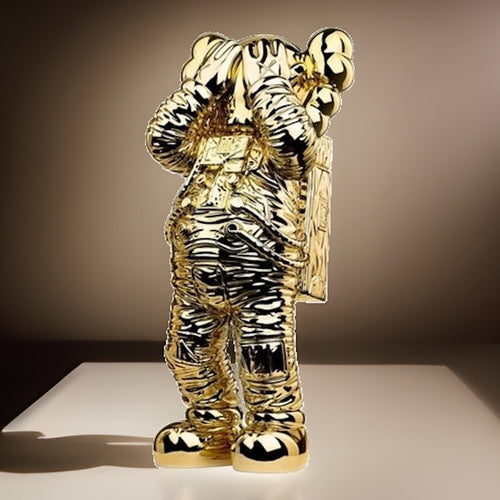
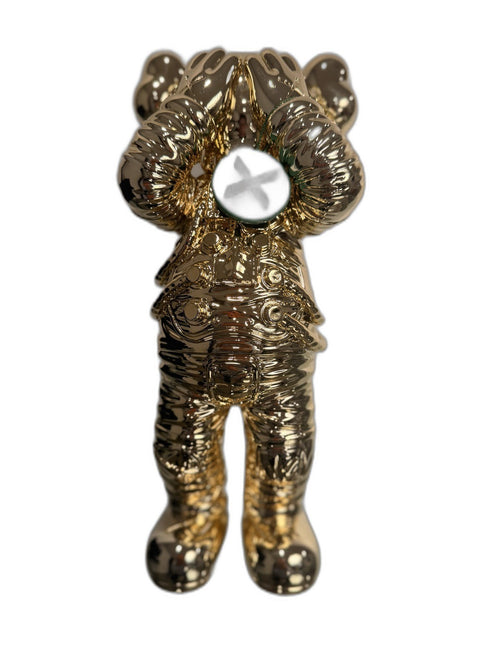
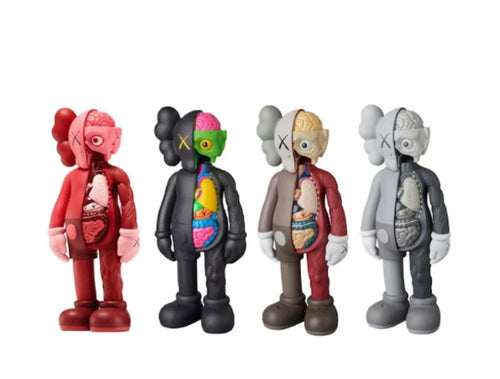
How does KAWS compare to gold as an asset? Gold is a high-liquidity store of value that returned roughly 2.7x cumulatively from 2009 to 2025, while top KAWS works have appreciated 20x to over 1,000x in the same window. Gold offers stability and inflation hedging; KAWS offers asymmetric cultural upside with meaningfully higher risk and lower liquidity.
The Asset Allocation Question Every Modern Collector Faces
For decades, gold has anchored the "alternative asset" sleeve of serious portfolios. It is liquid, globally priced, and carries thousands of years of monetary memory. But over the past fifteen years, a new class of cultural assets has emerged with return profiles that traditional stores of value simply cannot match. KAWS — the studio name of Brian Donnelly, born 1974 in Jersey City, NJ — sits at the apex of that category. His record-setting $14.7 million sale of The KAWS Album at Sotheby's Hong Kong in April 2019 reframed the conversation around what a "collectible" can be worth on the open market.
Gauntlet Gallery, founded in 2012, has tracked these two asset classes side by side across more than 160,000 comparable sales. The conclusion is not that one beats the other. The conclusion is that they answer different questions for different parts of a portfolio.
Returns: 2009 to 2025 in Hard Numbers
The starting point matters. 2009 captured both gold emerging from the global financial crisis and KAWS still in his early secondary-market phase, with OriginalFake (Tokyo) still open and museum recognition still ahead of him.
Gold: The Reliable Compounder
Gold traded near $900 per troy ounce in early 2009. By 2025, spot gold had climbed past $2,400 per ounce — a cumulative move of roughly 2.7x, or an annualized return in the mid-single-digit range before storage and insurance costs. That is not a number designed to excite. It is designed to preserve.
KAWS: The Asymmetric Outlier
Top KAWS works over the same window tell a different story. Documented secondary market activity shows leading editions, paintings, and sculptures appreciating 20x to over 1,000x for the rarest pieces — with The KAWS Album itself moving from a low-six-figure private sale range pre-2019 to its $14.7M Sotheby's HK hammer. Signed editioned prints from the OriginalFake era have appreciated multiples on their original retail. Companion sculptures in limited editions have followed similar trajectories.
Head-to-Head Comparison Table
| Attribute | Gold | KAWS (Top Tier) |
|---|---|---|
| 2009-2025 cumulative return | ~2.7x | 20x to 1,000x+ (top works) |
| Liquidity | High — 24/7 global spot market | Low to moderate — auction cycles, dealer network |
| Price transparency | Single global spot price | Comp-driven, edition-specific |
| Inflation hedge | Historically strong | Correlated to cultural cycles, not CPI |
| Cultural moment risk | None | High — taste, relevance, generational |
| Counterfeit risk | Low (assay-verifiable) | High — authentication is non-negotiable |
| Storage cost | Vault fees, insurance | Climate-controlled storage, insurance |
| Aesthetic / display utility | None | High — the asset is the experience |
| Tax treatment (US) | Collectible (28% LT cap gains) | Collectible (28% LT cap gains) |
Why Gold Earns Its Place
Liquidity and Price Discovery
Gold's case is structural. You can buy or sell an ounce at any hour on any continent within a tight bid-ask spread. There is one global price, quoted continuously. That liquidity premium is genuinely valuable, especially in stress periods when private markets freeze.
Monetary Memory
Central banks hold gold. Sovereigns settle in gold during currency crises. Gold has functioned as a store of value across every continent for thousands of years. That history is not a guarantee, but it is a base case that no cultural asset can claim.
Zero Cultural Risk
Gold does not need to remain in fashion. A 1909 gold sovereign is functionally identical to a 2025 bullion bar in monetary terms. The asset never has to defend its cultural relevance.
Why KAWS Captures the Asymmetric Upside
Cultural Compounding
KAWS has done something only a handful of contemporary artists have managed: institutional credibility at Phillips, Sotheby's, and Christie's plus mass-market distribution through Uniqlo, Dior, and the MoMA Design Store. That dual track creates a constantly expanding buyer base for the gallery-grade material at the top of the pyramid.
Engineered Scarcity
OriginalFake closed in 2013. That entire era is now a finite, permanently closed supply. Companion releases are edition-limited. Holiday inflatable events are city-specific. Each closed door tightens the float on what came before.
Asymmetric Return Profile
The downside on a properly authenticated, well-stored top-tier KAWS work is meaningful but bounded. The upside, as the 2019 record demonstrated, is uncapped. Few assets offer that shape.
The "Both" Portfolio: Why Sophisticated Collectors Hold Each
The collectors Gauntlet Gallery sees across our 160,000+ comparable sales database increasingly do not treat this as either/or. The pattern is barbell allocation:
- Gold as the defensive sleeve — liquid, inflation-hedged, culture-agnostic capital preservation.
- KAWS and adjacent contemporary as the cultural speculation sleeve — illiquid, higher-conviction, asymmetric upside.
The portfolio thesis is straightforward. Gold preserves the floor. KAWS, when chosen carefully and authenticated rigorously, raises the ceiling.
What This Means If You Are Sizing a Position
Three practical considerations:
- Authentication is the entire investment thesis. An unauthenticated KAWS work is not an asset — it is a decoration with downside. Provenance documentation, edition verification, and condition reports are non-negotiable.
- Tier matters more than name. A KAWS-branded mass-market item and a signed OriginalFake-era edition are not the same asset class, even though they share the artist. Top-tier works drove the headline returns.
- Hold period should match liquidity profile. Gold can be exited in hours. Top KAWS works are usually best treated as five-plus-year holdings, with exit timed to auction cycles.
For collectors building a serious KAWS position, our KAWS Collector Guide covers tier-by-tier authentication, OriginalFake-era pricing, and the specific editions our comp database flags as long-duration holds.
Closing the Loop
Gold and KAWS are not competing answers to the same question. Gold answers "how do I preserve capital across decades and regimes." KAWS answers "where can I take cultural risk with asymmetric upside." A modern alternative-asset allocation has room for both — and the collectors building generational portfolios increasingly hold each for what only that asset can deliver.
Browse the full Gauntlet Gallery collection to see the specific KAWS works and authenticated contemporary pieces currently available, each with full comp history from our 160,000+ sales database.