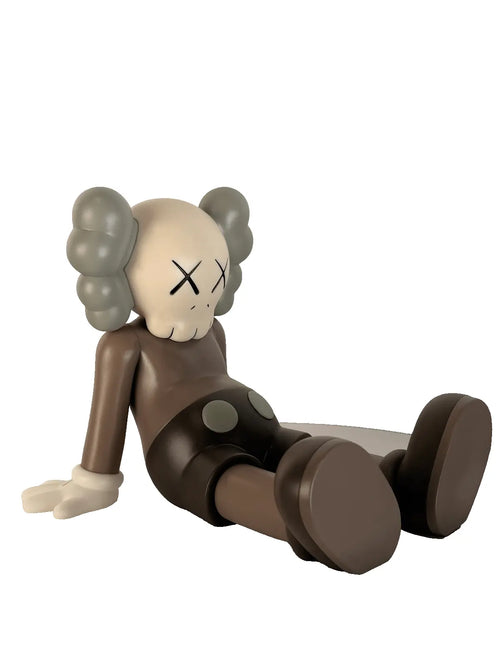
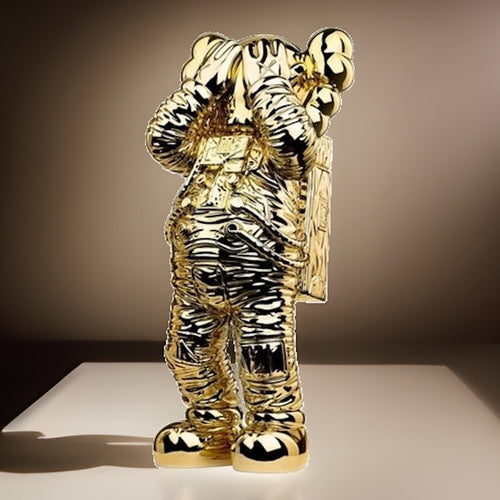
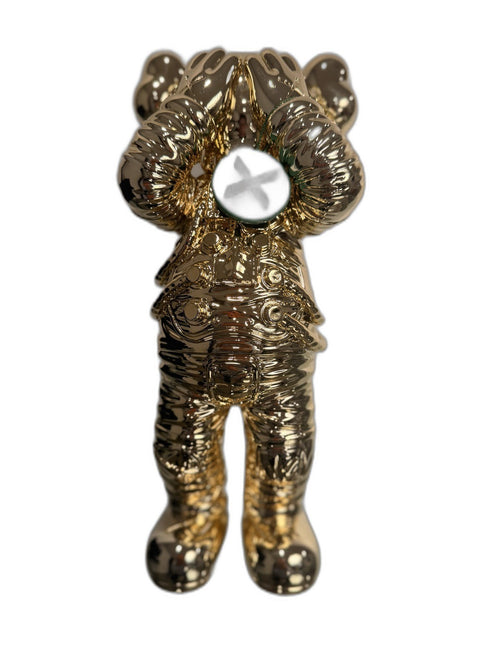
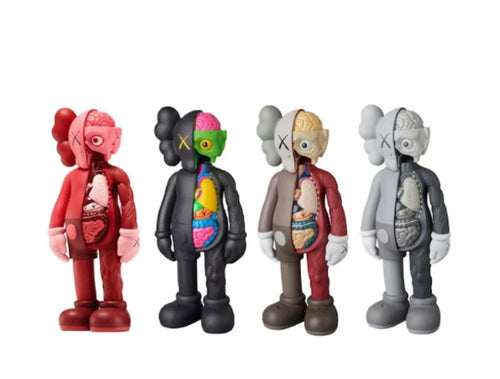
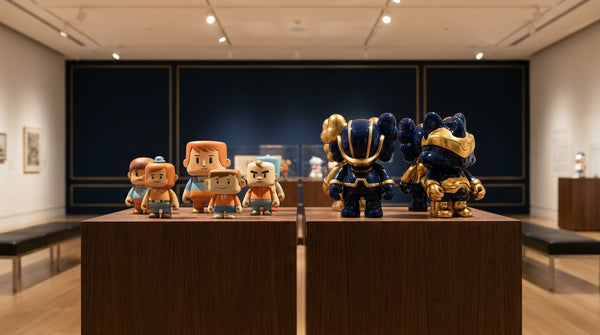
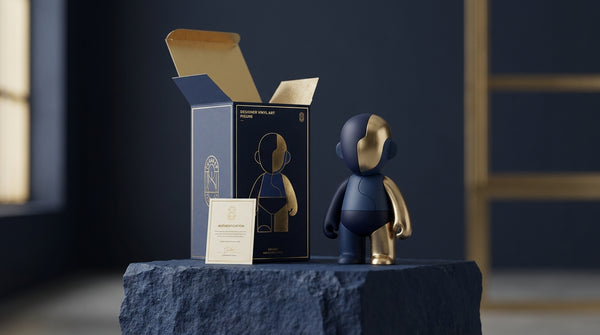
The KAWS Companion has appreciated 200% to 1,600% across documented secondary market transactions between 2010 and 2025, depending on colorway and edition rarity. Standard 11-inch limited Companions that retailed at $175 in 2010 now trade in the $500-$3,000 range, while the original 1999 Brown Companion has moved from documented $3,000-$5,000 secondary prices in 2010 to a current $30,000-$70,000 band.
The 15-Year Companion Trajectory
When Brian Donnelly, working as KAWS, first released the 1999 OriginalFake Brown Companion in a 500-piece edition, the Jersey City-born artist was still bridging street advertising subversion and the designer toy world emerging out of Medicom Toy in Tokyo. The figure retailed at $90. By 2010, documented secondary trades pegged that same piece at $3,000-$5,000. By 2025, the auction and verified secondary market shows Brown Companions changing hands in the $30,000-$70,000 range, with exhibition-grade and signed examples reaching higher.
Gauntlet Gallery's 160,000+ comparable sales database tracks this trajectory across both auction records and verified private market transactions. The picture is consistent across colorways: a sustained, multi-cycle appreciation curve unlike anything in traditional designer toy categories.
Companion Price Evolution: Documented Secondary Market
| Edition | 2010 Secondary | 2025 Secondary | Multiple |
|---|---|---|---|
| Original Brown Companion (1999, ed. 500) | $3,000-$5,000 | $30,000-$70,000 | ~10-14x |
| Original Black Companion (1999) | $2,500-$4,000 | $25,000-$55,000 | ~10-13x |
| Standard 11-inch Limited Companion | $175 retail | $500-$3,000 | ~3-17x |
| Resting Place Companion (2013) | ~$300 retail | $2,500-$6,000 | ~8-20x |
| Holiday Inflatable Companions (Hong Kong, Seoul, Tokyo) | N/A pre-2018 | $800-$4,500 | Drop-era category |
Source: Gauntlet Gallery 160,000+ comparable sales database; auction house records from Phillips, Sotheby's, Christie's, Heritage, and Bonhams 2010-2025.
Compared to Traditional Assets, Same Period
The 2010-2025 window covers one of the longer post-financial-crisis bull markets in U.S. equities, alongside aggressive real estate appreciation in coastal cities. KAWS Companions still outperformed the broad market basket on a percentage basis for rare editions, though with materially higher volatility and illiquidity.
| Asset Class | Approximate 2010-2025 Return |
|---|---|
| S&P 500 (total return, dividends reinvested) | ~5-6x |
| NASDAQ Composite | ~7-8x |
| U.S. Median Home Price | ~2x |
| Gold | ~1.5x |
| Original Brown Companion (documented) | ~10-14x |
| Standard limited Companions (verified secondary) | ~3-17x range |
The dispersion is the story. A standard limited Companion in a common colorway trailed equities. A rare 1999 OriginalFake edition outperformed everything except concentrated single-name tech equity bets. The asymmetry inside the KAWS market itself rivals the asymmetry of crypto and venture portfolios.
What Drove the Asymmetric Returns
The 2019 Cultural Moment
On April 1, 2019, KAWS's painting The KAWS Album sold for $14.7 million at Sotheby's Hong Kong, more than 14 times its high estimate. That single hammer shifted the perception of KAWS from designer-toy artist to formally collected contemporary art category. The Companion vinyl figures, despite being a different medium, were repriced overnight by association. Floor prices on rare editions moved 30-60% in the following 90 days according to Gauntlet Gallery's tracked sales.
Sustained Demand From New Buyer Cohorts
The post-2019 buyer base no longer skewed exclusively toward streetwear and toy collectors. Contemporary art collectors, hedge fund principals, and Asian luxury collectors entered the market through Phillips and Sotheby's evening sale exposure. The Dior x KAWS collaboration (2018-2019) added a luxury-fashion cohort. Each new cohort widened the bid stack without expanding supply.
Finite Supply, Permanent Closure of Earlier Eras
OriginalFake, KAWS's Tokyo retail vehicle that ran 2006-2013, is permanently closed. Every figure produced under that imprint is now a finite, non-replenishable population. The Companion silhouette continues in new editions through Medicom Toy and AllRightsReserved, but the early-era pieces operate as a closed pool. Closed pools with rising demand produce the appreciation curves documented above.
What Could Reverse the Trend: Risk Factors
Counterfeit Saturation
The KAWS market carries an estimated 40-60% counterfeit rate on open marketplaces, with fakes appearing within 72 hours of new drops. Sustained counterfeit pressure can erode buyer confidence and compress prices on unauthenticated examples. The market premium for verified provenance has widened, not narrowed, but the floor for unauthenticated examples is structurally lower than it was five years ago.
Generational Taste Cycles
The collectors who drove the 2017-2022 appreciation cycle were largely millennials buying into a brand they recognized from streetwear. The next two decades will test whether Gen Z and Gen Alpha collectors carry the same affinity, or whether KAWS becomes a generational artifact like 1980s Garbage Pail Kids — collected, but at compressed multiples.
Supply Decisions by the Artist
KAWS continues to release new editions and collaborate at high velocity. A decision to flood a particular silhouette with new editions, or to extend the run on a previously limited piece, can compress that segment of the market. The artist's discretion over future supply is a non-trivial input to long-run pricing.
Macro Liquidity Conditions
Collectibles trade as risk assets. The 2022 rate-hike cycle compressed the top of the KAWS market 15-25% across verified secondary venues before recovery in 2023-2024. A sustained tightening cycle, or a recession affecting discretionary collectible spend, would likely compress prices again.
How To Position Going Forward
The historical record suggests three patterns worth carrying into the next decade. First, the steepest appreciation has consistently occurred in finite, pre-2013 OriginalFake-era editions. Second, authenticated provenance has become the deciding variable on resale value. Third, single-cultural-moment events (auction records, museum acquisitions, major collaborations) have produced step-function repricings rather than gradual drift.
For collectors evaluating entry points today, the same database that documents the 2010-2025 run also tracks which colorways and editions are currently trading at compressed multiples versus their five-year averages. That comparative view is the foundation of every Gauntlet Gallery acquisition recommendation.
For a deeper breakdown of which Companion editions and colorways have shown the strongest verified appreciation, see our KAWS collector guide.
Frequently Asked Questions
What has been the KAWS Companion appreciation since 2010?
Documented secondary market data shows the standard 11-inch limited Companion moving from a $175 retail in 2010 to a current $500-$3,000 range depending on colorway. The original 1999 Brown Companion has moved from a documented $3,000-$5,000 secondary range in 2010 to $30,000-$70,000 in 2025, a 10-14x multiple.
How does KAWS Companion appreciation compare to the S&P 500?
The S&P 500 with dividends reinvested returned approximately 5-6x between 2010 and 2025. Rare KAWS Companion editions outperformed at 10-14x, while standard limited Companions traded inside a 3-17x range with materially higher volatility and lower liquidity than public equities.
What event triggered the largest single repricing of KAWS Companions?
The $14.7 million sale of The KAWS Album at Sotheby's Hong Kong on April 1, 2019 reset perception of the entire KAWS category. Companion floor prices on rare editions moved 30-60% in the following 90 days according to Gauntlet Gallery's tracked sales.
What are the main risks to future KAWS Companion appreciation?
The four most material risks are counterfeit saturation on open marketplaces (estimated 40-60% fake rate), generational taste shifts as Gen Z and Gen Alpha collectors enter the market, supply decisions by the artist on new editions, and macro liquidity conditions affecting discretionary collectible spending.
Are KAWS Companions still a viable collectible investment in 2026?
The historical record supports continued interest in finite, pre-2013 OriginalFake-era editions with authenticated provenance. Standard limited Companions in common colorways carry less asymmetric upside and more counterfeit exposure. Gauntlet Gallery's comparable sales database tracks which editions are currently trading at compressed multiples versus five-year averages.
Browse Authenticated KAWS Companions
Gauntlet Gallery, founded in 2012, has built one of the most granular KAWS authentication datasets in the secondary market. Every piece in our inventory carries documented provenance and is benchmarked against our 160,000+ comparable sales database.