The KAWS auction record history traces a remarkable arc: from low five-figure sales in the late 2000s, to the first $1M+ paintings around 2017, to the watershed $14.7M sale of The KAWS Album at Sotheby's Hong Kong on April 1, 2019. That single result repriced the entire market and remains the public benchmark today.
Few contemporary artists have a more legible auction record curve than Brian Donnelly, the Jersey City-born artist (b. 1974) who works as KAWS. The path from subway-billboard interventions in the 1990s to nine-figure secondary market activity is documented in roughly a dozen pivotal sales — and understanding that timeline is essential to pricing, authenticating, and forecasting KAWS today. At Gauntlet Gallery, founded in 2012, we maintain a 160,000+ comparable sales database spanning street art and contemporary collectibles, and KAWS is one of the most actively tracked artists in our index.
Why the KAWS Auction Timeline Matters
Auction records are not just trophies. For a living artist whose market spans museum-grade paintings, signed limited-edition prints, vinyl figures, and mass-market collaborations, the auction curve is the single clearest signal of institutional legitimization. Every $1M threshold crossed pulls up the floor on every related KAWS object — prints, BFFs, Companions, and even Uniqlo collaborations track the auction tape with a measurable lag.
The KAWS curve is unusually steep. Most artists who reach $1M at auction took 20–30 years to do so. KAWS compressed that timeline to roughly a decade, and then doubled it again inside 24 months. That acceleration documents not only the artist's rise but a structural change in how the contemporary art market values graphic, character-driven imagery from artists with street art origins.
The KAWS Auction Record Timeline
The table below summarizes the documented arc of KAWS at major auction houses, drawn from public auction records at Phillips, Sotheby's, Christie's, Heritage Auctions, and Bonhams. Where exact figures are not publicly verifiable, we use documented secondary market ranges.
| Period | Market Phase | Documented Range (Major Paintings) | Primary Venues |
|---|---|---|---|
| 2008–2011 | Early auction visibility | Low five figures to roughly $50K–$100K | Phillips, Heritage Auctions |
| 2012–2016 | Crossover acceleration | Six figures becoming routine for major canvases | Phillips, Sotheby's, Christie's |
| 2017 | First $1M+ painting at auction | $1M+ tier breached | Phillips (London / New York) |
| 2018 | Multiple $1M–$2M paintings | $1M–$2M tier becomes recurring | Phillips, Sotheby's, Christie's |
| April 1, 2019 | The KAWS Album record | $14.7M (HK$115.97M) | Sotheby's Hong Kong |
| 2020–2025 | Stabilization at elevated baseline | Major paintings ~$1M–$5M; figures and prints repriced upward | Phillips, Sotheby's, Christie's, Heritage |
The Pre-2017 Era: From Subway Posters to Six Figures
KAWS's auction history at major houses begins meaningfully in the late 2000s and early 2010s, when Phillips and Heritage Auctions started accepting his canvases and sculptures alongside more traditional contemporary lots. Through 2011, most major paintings cleared in the documented $50K–$100K band, with sculptural editions and unique works occasionally pushing higher. This period coincided with the operation of OriginalFake (KAWS's Tokyo retail concept, 2006–2013), which kept primary market scarcity tightly controlled.
By 2013–2016, the auction tape showed six-figure results becoming routine for major canvases. This was the crossover phase — the moment KAWS stopped being categorized purely as a street art or designer toy phenomenon and started appearing in evening sales rotations alongside more traditionally credentialed contemporary artists.
The 2017 Inflection: First $1M+ Painting
The first verified $1M+ KAWS painting result at auction landed in 2017, with Phillips a primary venue for that breakthrough. Once the $1M threshold was crossed, the rest of the consignment market repriced in real time — major canvases that would have estimated at $300K–$500K a year earlier were re-estimated north of $1M.
2018: $1M–$2M as the New Normal
Across 2018, multiple major KAWS paintings cleared the $1M–$2M band at Phillips, Sotheby's, and Christie's. The frequency mattered more than any single result: collectors and consignors could now point to a recurring tape rather than a single outlier print. This is the year the institutional thesis on KAWS solidified.
April 1, 2019: The KAWS Album at Sotheby's Hong Kong
The defining sale came on April 1, 2019, when The KAWS Album (2005) — KAWS's reinterpretation of The Beatles' Sgt. Pepper's Lonely Hearts Club Band cover — sold at Sotheby's Hong Kong for HK$115.97M, equivalent to approximately US$14.7M. The painting had been estimated at HK$6M–8M (roughly $760K–$1M) and ultimately sold for nearly 15 times its low estimate.
That sale did two things simultaneously. First, it set the public benchmark that still anchors the KAWS market today. Second, it accelerated the Asia-Pacific bid for KAWS — a structural buyer base that has not retreated in the years since. Every subsequent major Phillips Hong Kong, Sotheby's Hong Kong, and Christie's Hong Kong contemporary evening sale has included serious KAWS lots.
2020–2025: Stabilization at an Elevated Baseline
In the years following the $14.7M sale, the KAWS auction market did what mature markets do after a record: it stabilized at an elevated baseline rather than retreating to pre-record levels. Major paintings have generally cleared in the $1M–$5M band, with figures, sculptures, and signed prints repricing upward in sympathy.
Three patterns stand out across recent auction cycles:
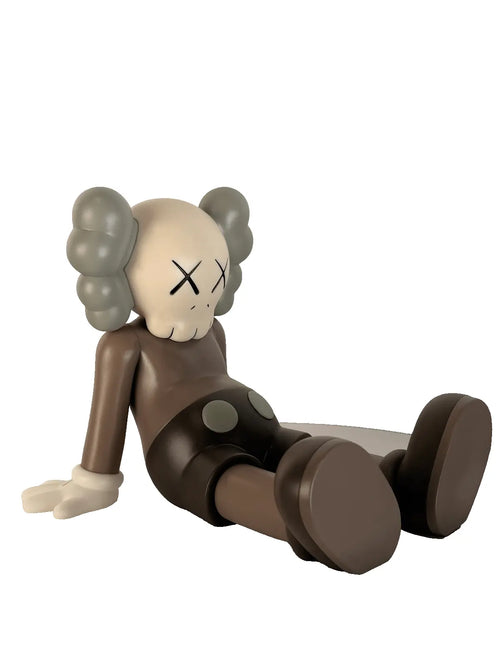
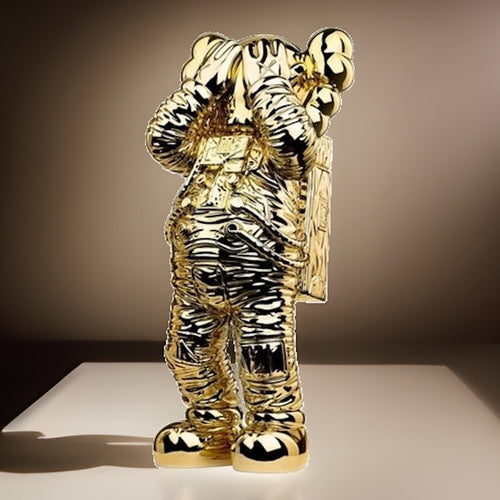
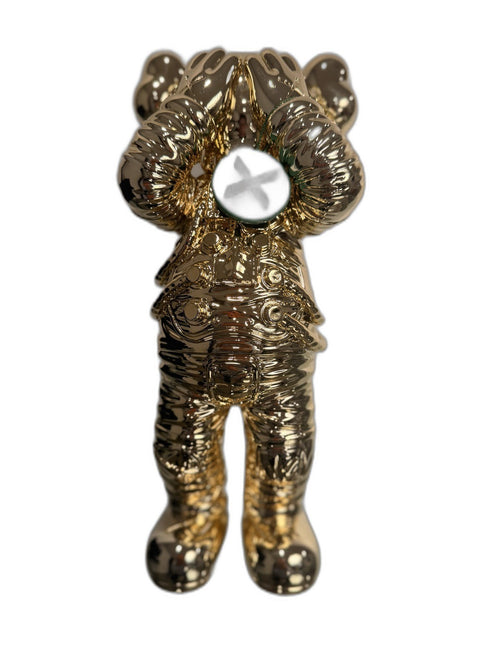
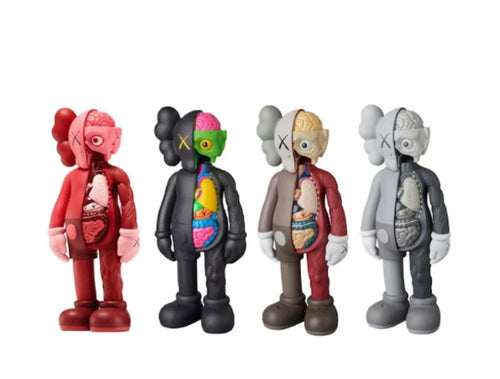
- Figures and editions: Major Companion sculptures, BFF figures, and Holiday inflatables routinely clear five and six figures at Phillips and Heritage Auctions, with rare colorways and early OriginalFake-era pieces commanding sharp premiums.
- Signed prints: Signed, numbered KAWS prints with verifiable provenance now trade in a documented secondary market range substantially above their primary issue prices, particularly for sold-out editions from the 2010s.
- Paintings: Major canvases continue to anchor the $1M–$5M band, with standout consignments capable of clearing significantly higher when provenance and condition align.
What This Means for Collectors Today
The KAWS auction timeline is, at its core, a story of legitimization. From low five-figure clearances in the late 2000s to a $14.7M public record inside roughly a decade, the curve documents one of the most efficient market formations in contemporary art. For collectors evaluating KAWS today, three takeaways matter most:
- Provenance is the entire investment thesis. Counterfeit risk on KAWS work — particularly figures and prints — is structurally higher than for almost any other living artist. Authenticated chain of custody is non-negotiable.
- The 2019 record is not a ceiling. The post-2019 market has stabilized at an elevated baseline, not retraced. Major paintings continue to clear in the $1M–$5M band consistently.
- Comparable sales discipline matters. Pricing any KAWS object — figure, print, or painting — without anchoring to documented auction comps is how collectors overpay. For deeper guidance on assembling a KAWS collection, see our KAWS collector guide.
Pricing KAWS the Gauntlet Gallery Way
Every KAWS object in our inventory is priced against our internal 160,000+ comparable sales database, with documented secondary market ranges anchored to the auction tape at Phillips, Sotheby's, Christie's, and Heritage Auctions. We do not invent numbers — we cite them.
Browse the current Gauntlet Gallery inventory at gauntlet.gallery/collections/all to see how the auction timeline translates into today's secondary market pricing.