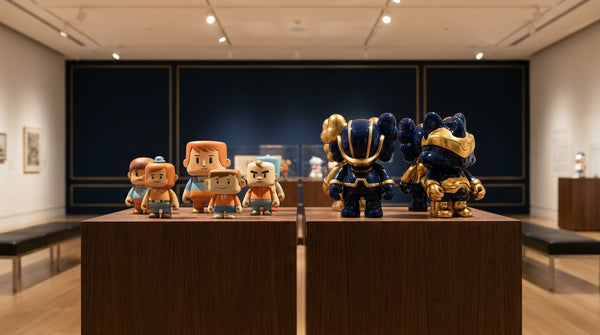
Buy KAWS during bear-market stabilization periods — when secondary prices on recent releases dip at or below primary retail, and Heritage time-to-sale stretches past 30 days. Sell into bull-market cultural peaks: museum exhibition openings, anniversary years, and record-setting auction weeks. The patient collector who buys in the lull and exits at the headline consistently outperforms the impulse buyer.
Why KAWS Behaves Like Two Different Assets
KAWS (Brian Donnelly, born 1974, Jersey City, NJ) sits at an unusual intersection. He is simultaneously a blue-chip contemporary artist with a $14.7M auction record (The KAWS Album, Sotheby’s Hong Kong, April 2019) and the most-collected designer-toy figure on the planet. That dual identity means his market does not behave like a single asset — it behaves like two correlated but distinct markets stacked on top of each other.
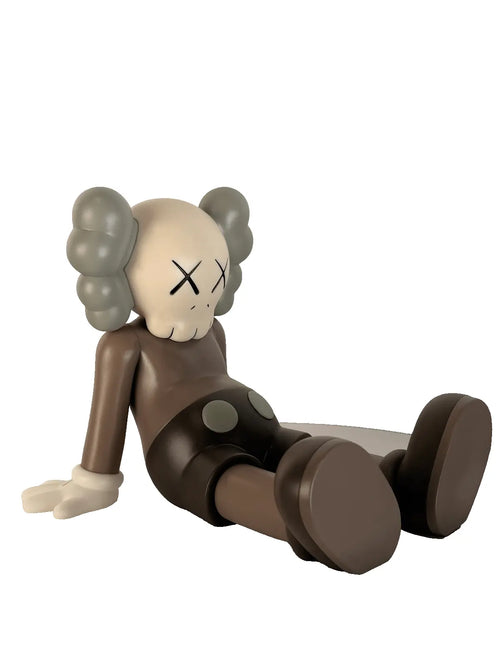
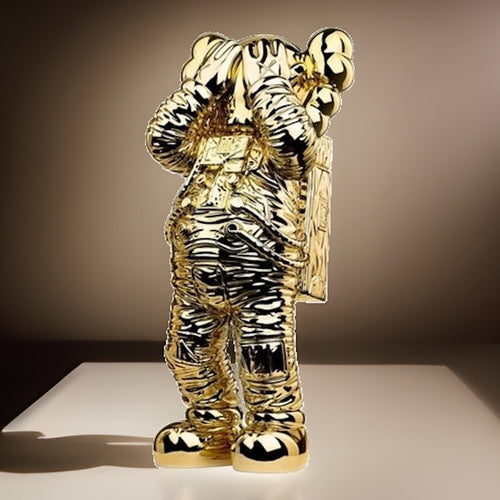
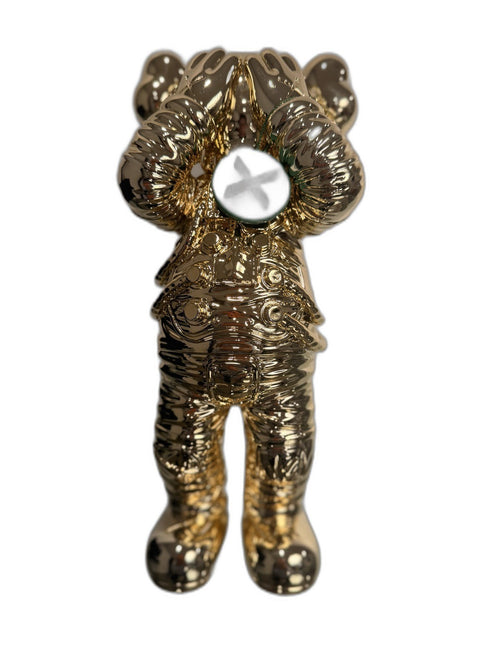
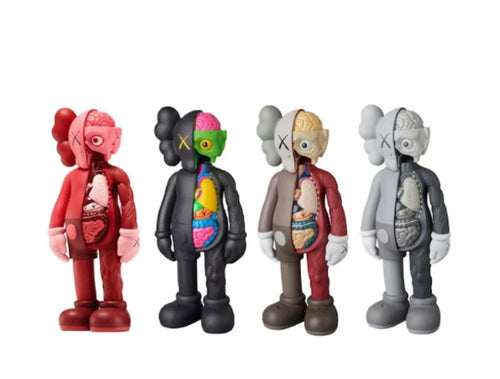
The fine-art tier (signed prints, original paintings, unique sculptures) tracks the broader contemporary art cycle. The collectibles tier (Companions, BFFs, Holiday inflatables, Uniqlo BFFs, BE@RBRICK collaborations) tracks streetwear-and-sneaker sentiment, which moves on a faster, sharper cycle. When both tiers rise together, you get a bull market. When both compress together, you get the buying window most collectors miss because they’re watching the headlines instead of the order book.
At Gauntlet Gallery — founded in 2012 — we maintain one of the largest comparable-sales datasets in this space, with 160,000+ documented sales across street art and contemporary collectibles. The patterns below come directly from that dataset.
Bull Market Signals: When KAWS Is Running Hot
A KAWS bull market doesn’t announce itself — it leaves fingerprints. By the time mainstream press is covering a record sale, the move is largely priced in. The signals below tend to lead the price action by weeks or months.
Signal 1: Museum Exhibition Announcements
Institutional validation is the single most reliable bull catalyst. When a major museum announces a KAWS solo exhibition — Brooklyn Museum, National Gallery of Victoria, Mori Art Museum, Serpentine — the entire secondary market reprices within days. Editions tied to the exhibition (museum-store releases, signed catalogs, exhibition posters) typically see the sharpest moves, but the halo effect lifts unrelated Companions and prints as well.
Signal 2: Compressing Primary Drop Sell-Out Times
When a KAWSONE.com or AllRightsReserved drop sells out in minutes rather than hours, demand is outpacing supply. When subsequent drops sell out faster than the prior drop, you are in an accelerating market. This is a high-conviction bull signal because it precedes — rather than follows — the secondary-market markup.
Signal 3: Auction Record-Setting Sales
The April 2019 The KAWS Album sale at Sotheby’s Hong Kong ($14.7M, against an estimate of roughly $1M) was the canonical example. Records of this magnitude reset the perceived ceiling for the entire artist and pull mid-tier work upward. Watch Phillips, Sotheby’s, Christie’s, and Heritage Auctions weekly result reports for outsized estimate-to-hammer ratios.
Bear Market Signals: When KAWS Is Cooling
Signal 1: Secondary Prices Below Primary Retail
The clearest bear signal is also the simplest. When a recent Companion or BFF release trades on the documented secondary market below the price it sold for on KAWSONE.com or DSMNY, demand has softened relative to supply. This is a buying signal for patient collectors and a hold signal for everyone else.
Signal 2: Lengthening Time-to-Sale on Heritage
Heritage Auctions is the most transparent volume marketplace for KAWS collectibles. When average time-to-sale on Companions stretches from same-week to two-to-four weeks — and bids cluster at low estimates rather than blowing through high estimates — the market is in a cooling phase.
Signal 3: Quiet Press Cycle
Bear markets in KAWS are characterized by an absence of headlines. No new museum show announcements, no Dior or Uniqlo collaboration rumors, no record-setting auction results. Boring is bearish — and boring is where the opportunity hides.
The Gauntlet Gallery Bear/Bull Framework
| Market Condition | Leading Signal | Action | Holding Period |
|---|---|---|---|
| Bull — Acceleration | Museum show announced; drops sell out in minutes | HOLD existing; trim weakest pieces | Distribute into peak |
| Bull — Euphoria | Auction record set; mainstream press coverage | SELL anniversary editions, fashion collabs | Exit non-core within 60 days |
| Neutral — Drift | Steady secondary at modest premium to retail | ACCUMULATE selectively at sub-comp prices | 3–5 year hold |
| Bear — Compression | Secondary at-or-below primary retail | BUY high-quality pieces with provenance | 5–10 year hold |
| Bear — Capitulation | Heritage time-to-sale 30+ days; press silent | BUY aggressively — flagship Companions, signed prints | 5–10 year hold; expect next cycle |
The Optimal Buying Window: Stabilization After Correction
The single best window to buy KAWS — across our 160,000+ comparable sales — is not the bottom of a bear market. It is the stabilization period that follows a correction. Catching the absolute bottom is luck. Catching stabilization is a process.
Stabilization shows up in the data as: (1) secondary prices that stop falling and trade in a tight range for 60–90 days, (2) Heritage time-to-sale that contracts back from 30+ days to under three weeks, and (3) primary drops that begin selling out again, even if not at the velocity of the prior bull. By the time all three appear, the worst is behind you and the patient capital that bought into the lull has a meaningful cost-basis advantage.
The Optimal Selling Window: Cultural Moment Peaks
The mirror of the stabilization buy is the cultural-moment sell. Anniversary years (the 20th anniversary of the original Companion, for example), the opening week of a major museum exhibition, and the seven-day window following a record-setting auction result are the moments when retail demand peaks and bid-ask spreads compress in the seller’s favor.
Sellers who pre-position inventory before these moments — placing pieces with auction houses and trusted dealers in the 60-day window leading up to the catalyst — consistently outperform sellers who try to list reactively after the news breaks.
The Patient Collector Advantage
KAWS is volatile. That volatility is not a bug — it is the source of the opportunity. Collectors who treat the secondary market as a one-way street (buy when it’s hot, sell when it’s hotter) are competing with every other emotional buyer for the same scarce supply. Collectors who treat it as a cycle — accumulating in the quiet quarters and distributing into the loud ones — are running a different game entirely.
For a deeper breakdown of which KAWS editions, sculptures, and prints have held value best across full cycles, see our KAWS Collector Guide.
Ready to Build a Cycle-Aware KAWS Position?
Every piece in our inventory is authenticated against the Gauntlet Gallery 160,000+ comparable sales database and matched to the appropriate KAWS authentication chain. Browse the Gauntlet Gallery collection →