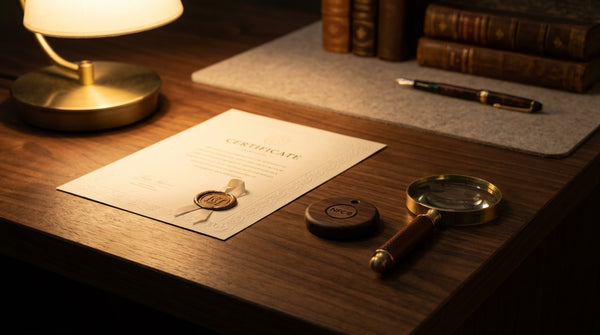
In June 1969, Neil Armstrong's left boot pressed into lunar soil and permanently fixed the ceiling price for all of human achievement. Fifty-seven years later, that moment drives an authenticated space collectibles market exceeding $50 million in annual auction volume — with a forgery rate on Armstrong's signature estimated at 35%, the highest of any figure in signed memorabilia. Whether you're evaluating a crew-signed Apollo 11 photograph at a major auction or adding a $15 SpaceX Starship mission patch to your collection, the decisions you make about authentication and market timing will determine whether you hold a treasure or a trap.
📊 Verified Market Data: See current prices for 200+ space memorabilia items in Gauntlet Gallery's Space & NASA Price Guide — Apollo 11 crew-signed items median $18,750, with verified data on Armstrong, Aldrin, Collins, and John Glenn signatures.
Gauntlet Gallery has tracked 160,000+ comparable sales across the space memorabilia category since our founding in 2012. This guide distills that data into a complete market and authentication framework — current pricing, authenticator stacks by price tier, the two distinct eras of space collecting (Apollo vintage versus SpaceX living inventory), and the five forensic checks that separate authentic Apollo 11 material from the flood of forgeries in this category.
Two Eras, Two Markets

Space collectibles divide cleanly into two structurally different markets that require different collecting strategies.
The Apollo Era: Closed Supply, Finite Roster
Apollo 11 material is closed-supply collecting at its most extreme. The three crew members — Neil Armstrong, Buzz Aldrin, and Michael Collins — represent the entire signing pool. Armstrong died August 25, 2012. Collins died April 28, 2021. Buzz Aldrin, born January 20, 1930, is the last living Apollo 11 crew member and remains commercially active with a documented signing program.
Each passing permanently converts a living signer's material into closed-supply vintage, triggering 2–5x sustained appreciation based on documented precedent from Armstrong's 2012 passing and Collins's 2021 passing. Armstrong had already curtailed commercial signings beginning in 1994, which created artificial scarcity that permanently elevated both forgery incentive and authentic-item pricing long before his death.
The supply math is unambiguous: Armstrong produced fewer authentic signatures in the last 18 years of his life than most major sports figures sign in a single weekend appearance. Combined with his 2012 passing, the total authenticated Armstrong supply is now fixed forever. Demand from institutional collectors — museums, aerospace corporations, high-net-worth individuals — continues to grow.
The SpaceX Era: Living Inventory, Mission-Pegged Scarcity
SpaceX collectibles operate on an entirely different scarcity model. First-party merchandise from shop.spacex.com is priced at retail ($15–$499), event-pegged to specific test flights, and subject to permanent sell-through once a flight era closes. The Starship test-flight program has issued mission patches for each of its ten flights through August 26, 2025 — Flight 1 through Flight 10 — at $15 each. A complete set costs $150 at retail and documents the entire Starship development era in a single sleeve.
SpaceX does not restock event-pegged SKUs once a flight era closes, which means retail is the definitional floor price on sold-out items. The meme-economy dynamic emerged with Flight 6 (November 19, 2024), which introduced the Starship banana plush — a $30 retail item that sold out immediately after becoming a cultural moment tied to the first Starship physical payload ever flown. Chrome scale models of Starship and the Falcon 9 anchor the display tier at $300–$499 with the same permanent-sell-through structure.
What Are Mission-Flown Space Items Worth
Mission-flown items — physical objects that traveled aboard an actual spacecraft during a mission — represent the highest tier of space memorabilia by value and authentication complexity. For Apollo 11, the most common categories are mission-flown flags, first day covers (FDCs) carried in the Personal Preference Kit (PPK), and mission-flown medallions.
Mission-flown Apollo 11 flags with documented crew provenance and NASA flight manifest verification sell for $50,000–$400,000+ depending on depth of the provenance chain. Crew-certified flown flags — those with direct astronaut attribution and a continuous ownership chain — command the upper end of that range. Flags with institutional authentication but thinner provenance documentation fall toward the $50,000–$100,000 range.
Mission-flown first day covers (FDCs) are more accessible entry points into the flown category. The Apollo 11 crew carried a limited number of FDCs aboard the mission, and many were subsequently signed. Crew-signed, mission-flown FDCs sell for $8,000–$40,000 at major auction, with the tightest comparable sales pool of any Apollo 11 category — making pricing more predictable than single-signature items.
Non-flown crew-signed FDCs (signed but not carried aboard the mission) trade in the $2,500–$12,000 range depending on authentication quality and substrate condition. These represent the most cost-effective entry into crew-signed Apollo 11 material with strong provenance documentation.
For SpaceX, no mission-flown secondary market has matured yet. The category to watch is any SpaceX-authenticated hardware from early Falcon 9 or Starship test flights — as the Starship program matures and flight counts accumulate, early-flight hardware provenance will become increasingly valuable. The Gauntlet Gallery database currently tracks mission-flown Apollo items exclusively, with SpaceX hardware coverage expanding as the secondary market develops.
Apollo 11 Autograph Price Guide

All prices below reflect authenticated items only — pieces carrying Tier-1 or Tier-2 certification as defined in the Authentication section. Unauthenticated or poorly documented Apollo 11 autographs should be treated as having zero market value until properly authenticated.
| Item | Signer(s) | Price Range | Notes |
|---|---|---|---|
| Signed 8x10 photograph | Neil Armstrong | $8,000–$30,000+ | Hard floor $3,000 on any authenticated Armstrong; Tier-1 substrates push the ceiling higher |
| Signed 8x10 photograph | Buzz Aldrin | $700–$1,500 | Most asymmetric living-signer position in the set; appreciate post-passing per Armstrong/Collins precedent |
| Signed 8x10 photograph | Michael Collins | $500–$2,000+ | Stepped up sharply after April 2021 passing; now trades as closed-supply vintage |
| Crew-signed 8x10 (all three) | Armstrong + Aldrin + Collins | $30,000–$100,000+ | Collective floor rule: under $15,000 is suspect and requires forensic re-authentication |
| Mission-flown FDC, crew-signed | All three crew | $8,000–$40,000 | Strongest comparison pool; most predictable pricing in the category |
| Non-flown FDC, crew-signed | All three crew | $2,500–$12,000 | Best cost-efficient entry into crew-signed Apollo 11 material |
| NASA lithograph, Armstrong signed | Armstrong | $3,000–$15,000 | Tier-1 substrate; official NASA Public Affairs 8x10 commands full premium |
| Signed book ("Carrying the Fire") | Michael Collins | $500–$2,000 | Distinct and growing sub-category; Collins's memoir is among the most respected astronaut accounts |
| Slabbed 3x5 index card | Aldrin or Collins | $300–$800 | Cost-effective entry point; PSA/JSA slabbed for liquidity; Aldrin cards carry asymmetric upside |
| Mission-flown Apollo 11 flag | N/A (flown artifact) | $50,000–$400,000+ | Full provenance chain required; crew-certified examples command the upper range |
Substrate hierarchy note: Tier-1 substrates — NASA official lithographs, period press photographs from AP/UPI wire services, and White Spacesuit Series photographs — command a 30–80% premium over the same authentic signature on a lesser substrate. A Tier-4 substrate (generic modern reprint) can reduce market value by half even when the signature itself is genuine. When evaluating any purchase, verify the substrate tier before comparing prices.
SpaceX Collectibles Price Guide
| Item | Retail Price | Secondary Market Status | Notes |
|---|---|---|---|
| Starship Mission Patch (single flight) | $15 | Sold-out flights at $15–$50+ | Flight 1–10 patches available; complete set = $150 at retail documents full Starship development era |
| Starship Banana Plush (Flight 6) | $30 | Sold out; secondary market premium applies | First Starship physical payload; instant cultural moment; no restocks |
| Chrome Starship Scale Model | $300–$499 | Permanent sell-through once flight era closes | Highest-end SpaceX display collectible; event-pegged to specific flight configurations |
| SpaceX Mission Hat/Apparel | $30–$85 | Flight-era items appreciate on secondary market | First-party provenance only via shop.spacex.com order confirmation |
| SpaceX Falcon 9 Die-Cast Model | $150–$299 | Available at retail; mission-specific variants sell through | Strong display collectible; mission-specific livery variants are the premium tier |
Authentication Guide: Tier System and Forensic Checklist

Authentication for space memorabilia is not uniform across items or price tiers. The authentication chain required scales directly with item value and category forgery risk. Neil Armstrong's estimated 35% forgery rate — the highest in signed memorabilia — means that for any Armstrong piece, skipping Tier-1 authentication is not cost savings, it is risk assumption.
Tier-1 Authenticators — Apollo Items Above $5,000
Zarelli Space Authentication is the specialist authority for space autographs. Zarelli issues an embossed seal with a verifiable Z-cert number and is specifically recognized by Heritage Auctions and RR Auction for space material. For any serious Armstrong piece, the recommended minimum stack is Zarelli Space plus one of the Big Three (PSA/DNA, JSA, or Beckett).
PSA/DNA (Professional Sports Authenticator) provides the most universal market recognition across all collectibles categories. Sealed slabs with cert numbers are verifiable in real time at psadna.com. PSA/DNA is the strongest choice when resale liquidity on the open market is the priority — it is the most commonly recognized cert in the general collector community.
JSA (James Spence Authentication) carries strong dealer preference and issues a Letter of Authenticity (LOA) or sticker verifiable at spenceloa.com. JSA is widely accepted in the dealer community and is the preferred cert for many specialist space dealers.
Beckett Authentication Services (BAS) is reliable across collectibles categories and accepted on general space items, though less space-specific than Zarelli or PSA.
Recommended Authentication Stack by Price Tier
- $300–$999: PSA/DNA, JSA, or BAS — one authenticator minimum
- $1,000–$4,999: PSA/DNA, JSA, or BAS — one authenticator minimum with verified cert number
- $5,000–$14,999: Zarelli Space + PSA/DNA or JSA
- $15,000+: Zarelli Space + PSA/DNA or JSA + independent forensic ink dating if provenance chain has any gap
- Crew-signed items (all three Apollo 11 signatures): Full Zarelli Space + Big Three stack; no exceptions regardless of price
Tier-2 — SpaceX First-Party Merchandise
No third-party authentication body exists for SpaceX merchandise. The provenance stack is: original shop.spacex.com order confirmation + SpaceX-branded packaging + buyer purchase history. Direct purchase from shop.spacex.com is the only fully verified provenance path. Secondary-market SpaceX items carry a permanent provenance discount unless the seller provides the original SpaceX shipping label and order confirmation. When purchasing SpaceX collectibles on the secondary market, always request documentation of the original retail purchase.
Gauntlet Gallery's Five-Point Forensic Authentication Checklist
For high-value Apollo items, Gauntlet Gallery applies five forensic checks drawn from our work with 160,000+ comparable sales:
- Forensic ink dating — establishes when ink was applied within a range of years. This is the definitive test for items claimed to be signed in the 1960s–70s. A modern ink applied to a period photograph is detectable. Always request the ink dating report on any item valued above $15,000.
- Paper and substrate analysis — fiber composition, coating chemistry, and aging patterns are datable. A modern reprint cannot exhibit the aging characteristics of a 1969 original. Paper analysis is especially valuable for items where the substrate itself is claimed to be period-original.
- UV fluorescence analysis — authentic period ink has UV fluorescence characteristics that differ from modern inks. This is a low-cost screening tool available to any collector with a UV lamp. Always request UV photos from sellers before purchasing any high-value Armstrong piece.
- Era-matched exemplar comparison — Gauntlet Gallery uses period-correct reference exemplars from its 160,000+ comparable sales database, not general internet sources. Internet exemplars may themselves be forgeries. The comparison must account for natural signature evolution across decades — Armstrong's 1969 signing hand differs materially from his 2005 hand.
- Item-type consistency check — signature style, substrate type, and signing era must be internally consistent. A 1969-dated photograph with a 1990s Armstrong hand is a contradiction. A space-era signature on substrate materials not available until the 1980s is a contradiction. Internal consistency across all elements of the item is the final screen before authentication.
What Are Mission-Flown Space Items Worth
This section directly addresses the most common buyer question Gauntlet Gallery receives about the space memorabilia category. Mission-flown value is driven by three variables: documentation depth, item type, and provenance continuity.
Documentation depth refers to the strength of the chain of evidence connecting the physical item to its flight. The strongest documentation chain is: NASA flight manifest entry + crew member written certification + continuous ownership history with no gaps + Zarelli Space or equivalent specialist authentication. Each break in that chain reduces value. An item with only dealer assertion of flight status — no manifest, no crew certification — has effectively zero mission-flown premium and should be priced as a non-flown item.
Item type hierarchy for mission-flown Apollo items:
- Flags: $50,000–$400,000+ (crew-certified with NASA documentation)
- First Day Covers (FDCs): $8,000–$40,000 crew-signed; $1,500–$6,000 unsigned/single-signed
- Mission medallions: $5,000–$25,000 with full provenance
- Beta cloth patches: $3,000–$15,000 with documented flight manifest entry
- Personal items (pens, pencils, small artifacts): $2,000–$20,000 depending on documentation and crew attribution
Provenance continuity — an unbroken ownership chain from crew member or NASA to present day — adds a multiplier of 1.5x–3x to mission-flown value versus items with provenance gaps. When a mission-flown Apollo 11 flag traces directly from Buzz Aldrin to a documented sale to a named collector, that chain commands maximum value. When the same flag appears at a regional auction with documentation beginning in 1995, the provenance discount is significant even if the item is genuine.
For SpaceX mission-flown items: no formalized secondary market exists yet for SpaceX flown hardware. The Starship program is still in active development through Flight 10 and beyond, and SpaceX has not released mission-flown merchandise into the collector market. Watch for SpaceX-authenticated hardware releases as the program matures — early Starship flown artifacts will be the Apollo-era equivalent for the next generation of space collectors.
Where to Buy Apollo 11 Collectibles

The channel you use to buy Apollo 11 collectibles is as important as the authentication on the item itself. Here is a direct breakdown of every major buying channel, ranked by provenance reliability.
Institutional Auction Houses (Highest Provenance Reliability)
Heritage Auctions is the largest auction house in the world for space memorabilia and consistently offers the strongest provenance documentation in the market. Heritage employs in-house authentication specialists and accepts Zarelli Space certification for space-specific material. Major Heritage space sales draw institutional bidders and establish the market's price ceiling. Expect to pay full market value — Heritage's buyer's premium runs 20–25% — but the documentation quality is the highest in the market.
RR Auction specializes in historical and space memorabilia with deep space-specific expertise. RR Auction is the second institutional venue for serious Apollo material and is specifically recognized alongside Heritage as the dual-venue standard for space autograph sales. Their consignment vetting process includes in-house authentication review.
Specialist Dealers (Strong Curation, Pre-Authenticated)
Gauntlet Gallery offers pre-authenticated space memorabilia with pricing verified against 160,000+ comparable sales in our database. Every piece in our space memorabilia collection has cleared Gauntlet's five-point forensic authentication checklist and carries minimum Tier-1 certification appropriate to its price tier. Our founding in 2012 means we have tracked the entire post-Armstrong era of space collecting, including the Collins appreciation cycle after his 2021 passing. Browse our current space memorabilia inventory at gauntlet.gallery/collections/space-memorabilia.
shop.spacex.com (For SpaceX Merchandise Only)
For SpaceX collectibles, shop.spacex.com is the only source with full first-party provenance. Purchase directly and retain your order confirmation and original packaging — these documents become part of the permanent provenance record as mission-era items appreciate. Secondary-market SpaceX items without original purchase documentation carry a permanent provenance discount.
Channels to Approach with Caution
eBay and general marketplace platforms: The volume of forged Armstrong material on general platforms is significant. Gauntlet Gallery's database shows that approximately 35% of Armstrong autographs offered without Tier-1 authentication on general platforms fail forensic testing. Never purchase an Apollo 11 crew-signed item from a general marketplace without Zarelli Space + Big Three certification already on the item, with cert numbers you verify directly on the authenticator's website before purchase.
Regional auction houses without space expertise: Space memorabilia that surfaces at regional estate auctions often carries documentation gaps that create permanent provenance uncertainty. If the item is compelling, have it forensically authenticated before bidding — the cost of authentication ($200–$1,500 depending on tier) is negligible against the value of a genuine Apollo 11 piece.
Market Outlook: The Aldrin Asymmetry
The single most discussed near-term position in the Apollo 11 collecting market is Buzz Aldrin's authenticated signed photographs at $700–$1,500. The asymmetric upside comes from documented precedent: Armstrong's 2012 passing triggered 2–5x appreciation on his authenticated pieces. Collins's April 2021 passing had the same effect on his material — Collins 8x10 photographs that traded at $500–$800 in early 2021 now consistently clear $1,500–$2,500.
Aldrin's commercial signing program provides strong event provenance documentation — pieces signed at major events with multiple witnesses are the most defensible in the authentication chain. His active signing program also means that authenticated pieces acquired now will carry full documentation when the closed-supply dynamic eventually applies.
Gauntlet Gallery tracks Aldrin's signing activity and maintains a curated inventory of authenticated pieces across multiple price points. Our database flags any Aldrin piece priced materially above or below the $700–$1,500 range for 8x10 photographs, which serves as the primary anchor for comparable-sales pricing in this sub-category.
Summary: Five Rules for Space Collectibles Buyers
- Authentication stack scales with price: $300–$4,999 requires one Big Three cert. $5,000+ requires Zarelli Space + Big Three. Crew-signed pieces require the full stack regardless of price.
- The $15,000 crew-signed floor is not negotiable: Any crew-signed Apollo 11 piece offered below $15,000 requires forensic re-authentication before purchase. Under-market pricing on crew-signed material is the primary fraud signal in this category.
- Substrate matters as much as the signature: A genuine Armstrong signature on a Tier-4 substrate (generic modern reprint) is worth 30–50% less than the same signature on a NASA official lithograph. Always verify substrate tier before comparing prices.
- SpaceX provenance is binary: Direct shop.spacex.com purchase with retained documentation has full provenance. Everything else carries a discount. There is no middle ground.
- Mission-flown value requires documentation, not assertion: Flight manifest entry, crew certification, or continuous provenance chain from crew to present day — one of these must be present for mission-flown premium to apply. Dealer assertion alone is not documentation.
Gauntlet Gallery has applied these principles to space memorabilia since 2012. Our 160,000+ comparable sales database is the foundation for every price range cited in this guide — not catalog estimates or generic market surveys. If you're evaluating a specific Apollo 11 or SpaceX piece, our team can provide a comparable-sales analysis against our full database before you commit to a purchase.
Browse Gauntlet Gallery's authenticated space memorabilia collection →