Did KAWS outperform tech stocks? For a small handful of museum-grade KAWS paintings, yes — top works delivered returns that dwarfed the NASDAQ-100's ~18% annualized 2009-2025 run. But that headline obscures the truth: most KAWS works tracked closer to, or below, tech-stock returns, with far higher volatility and friction. Here is the data-driven comparison.
The Headline: Two Asset Classes, One Bull Run
The 2009-2025 window has been historically generous to risk assets. The NASDAQ-100 compounded at roughly 18% annualized over that period — a figure that captures the longest equity bull run in modern history, driven by zero-interest-rate policy, mega-cap tech earnings growth, and a global liquidity flood. KAWS (Brian Donnelly, born 1974, Jersey City NJ) rode the same liquidity wave, but through a fundamentally different transmission mechanism: cultural cachet, institutional validation, and edition-controlled scarcity.
Gauntlet Gallery — founded in 2012 and tracking 160,000+ comparable sales across street art and contemporary collectibles — has watched both markets accelerate side-by-side. The verdict from our dataset: KAWS is not one asset class. It is at least three, and each behaved very differently against the NASDAQ benchmark.
Comparing the Returns: NASDAQ-100 vs KAWS Tiers
| Asset | 2009 Reference | 2019-2025 Peak Range | Approx. Annualized | Volatility |
|---|---|---|---|---|
| NASDAQ-100 Index | ~1,300 | ~20,000+ | ~18% | Moderate |
| KAWS major paintings (top tier) | Low six figures (documented secondary market) | $14.7M record (The KAWS Album, Sotheby's HK, April 2019) | Extreme outlier — small sample | Very high |
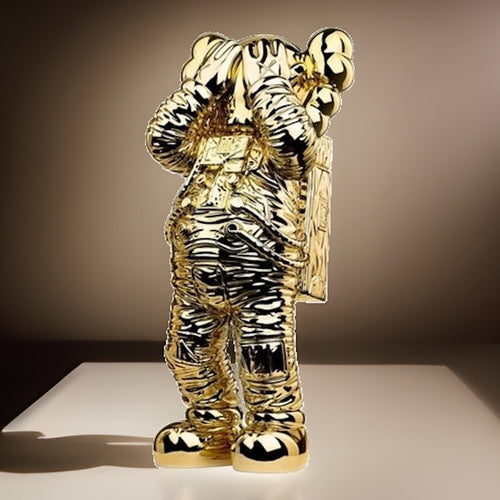
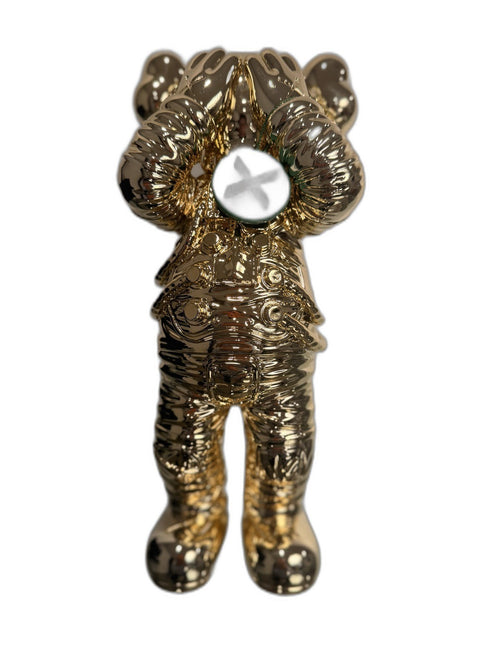
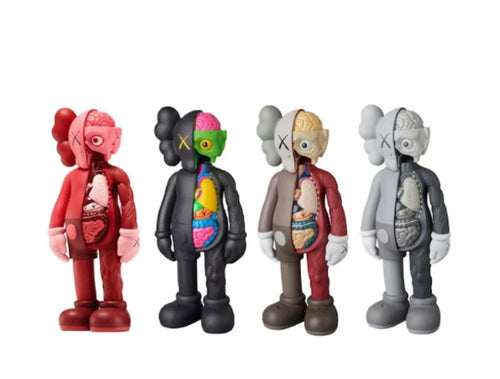
| KAWS limited figures (BFF, Companion editions) | Issue price (low-to-mid hundreds at release) | Documented multi-thousand secondary market | Comparable to NASDAQ range | High |
| KAWS mass-market (Uniqlo, OriginalFake plush) | Retail issue | Modest secondary lift | Below NASDAQ | Lower but illiquid |
Sources: Gauntlet Gallery 160,000+ comparable sales database; Sotheby's Hong Kong April 2019 evening sale results; NASDAQ-100 historical index levels.
The $14.7M Outlier
The single most-cited KAWS data point is The KAWS Album (2005), which sold at Sotheby's Hong Kong on April 1, 2019 for HKD 115.97M (approximately USD 14.7M including buyer's premium), against a high estimate of roughly USD 1M. The painting had previously traded in the documented secondary market at a small fraction of that level. This is the data point that drives every "KAWS beat the S&P" headline.
It is also a single transaction. The sample size of seven-figure KAWS paintings is small enough that drawing an asset-class-wide CAGR from it is statistically dishonest. Investors who anchor on $14.7M outcomes for an entry-level collection are anchoring on a lottery ticket.
Limited Figures: Where KAWS Looks Most Like Tech
The middle tier — limited Companion and BFF vinyl figure editions, signed limited-edition prints, and AllRightsReserved Hong Kong event releases — is where the comparison to NASDAQ becomes meaningful. These editions, sized in the hundreds to low thousands, have shown documented secondary market appreciation that broadly tracks high-beta tech equities: roughly comparable annualized returns, with periodic 30-50% drawdowns mirroring tech-stock corrections in 2020, 2022, and the post-2022 reset.
For a deeper breakdown of which editions, dates, and authentication chains drive this tier, see our KAWS Collector Guide.
Different Drivers, Same Tailwind
What Drives NASDAQ-100 Returns
- Earnings growth. Mega-cap tech compounded revenue and free cash flow at multiples of GDP for the entire window.
- Multiple expansion. Zero-rate environments pushed P/E multiples to historically wide ranges.
- Index mechanics. Passive flows mechanically bid up the top weights.
What Drives KAWS Returns
- Cultural cachet. Museum acquisitions (Brooklyn Museum, NGV, MoMA Design Store), institutional validation at Sotheby's, Christie's, and Phillips.
- Scarcity engineering. Edition-limited drops, OriginalFake's 2013 closure permanently capping that era's supply.
- Collaboration velocity. Dior (2018-2019), Uniqlo BFF cycles, and Hong Kong AllRightsReserved drops each created new buyer cohorts and new price floors.
The shared driver is global liquidity. When the tide goes out — as it briefly did in 2022 — both asset classes correct, and KAWS corrects harder because there is no earnings backstop.
Risk Profile: Where the Two Diverge
Liquidity
NASDAQ-100 exposure trades in milliseconds with bid-ask spreads measured in basis points. A KAWS painting trades on an auction calendar with 10-25% buyer's premiums, 10-20% seller's commissions, and 6-18 month exit windows. The frictional cost of round-tripping a KAWS work eats a meaningful share of headline appreciation.
Authentication Risk
An index fund cannot be counterfeited. A KAWS work can — and on open marketplaces, an estimated 40-60% of listings are fake. Counterfeits appear within 72 hours of each new drop. This is why authenticated provenance is not optional; it is the entire investment thesis. Gauntlet Gallery maintains one of the most granular KAWS authentication datasets in the secondary market specifically to address this risk.
Cultural Risk
Tech stocks fall when earnings fall. KAWS values can fall when cultural narrative shifts — a risk with no equity analog. The artist is alive, productive, and continuing to release work, which both supports and caps the market.
Bottom Line for the Allocator
KAWS is not a substitute for NASDAQ exposure. It is a high-beta, low-liquidity, culturally-correlated alternative that has produced extraordinary returns for a small number of top-tier works and broadly comparable returns for the limited-figure middle tier. The mass-market layer has underperformed the index after friction.
For collectors building exposure, the rational path is the middle tier — authenticated limited figures and signed editions with documented secondary-market history — sized as a satellite allocation, not a core holding. Browse the current curated selection at Gauntlet Gallery.