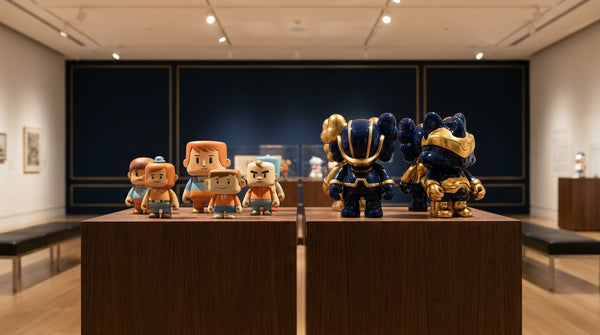
Quick answer for collectors: If you have $500–$8K and want liquidity, buy KAWS prints. If you have $5K–$50K and want broad collector demand with NFC-verifiable authenticity, buy figures. If you have $100K+ and a multi-year horizon, paintings carry the highest appreciation ceiling but the lowest liquidity. Each tier rewards a different investor profile.
Why the KAWS Market Splits Into Three Tiers

Brian Donnelly — born 1974 in Jersey City, NJ — built a body of work that simultaneously trades at Sotheby’s, drops on Uniqlo shelves, and ships in cardboard boxes from AllRightsReserved. No other living artist has structured their market this way. For investors, that creates three distinct asset classes inside a single artist name, each with its own liquidity profile, authentication chain, and risk surface.
Gauntlet Gallery, founded in 2012, has catalogued more than 160,000 comparable sales across street art and contemporary collectibles. The KAWS subset of that database is one of the most granular tier-by-tier datasets in the secondary market. The patterns below come from that record.
The Three-Tier Comparison at a Glance
| Tier | Documented Secondary Range | Liquidity | Appreciation Ceiling | Authentication Chain | Best For |
|---|---|---|---|---|---|
| Paintings | $100K – $15M | Low | Museum-tier | Gallery provenance, auction catalog history | Patient capital, multi-year horizon |
| Figures | $175 – $50K | Medium | Strong, edition-driven | NFC tag + OneCOA on recent releases | Broadest collector base |
| Prints | $500 – $8K | High | Steady, edition-size dependent | Hand-signed, numbered, gallery provenance | First-time buyers, faster turnover |
Tier 1: Paintings — The Museum-Tier Allocation

KAWS paintings sit at the institutional end of the market. The benchmark sale is The KAWS Album, which fetched approximately $14.7M at Sotheby’s Hong Kong in April 2019 — a result that reset the ceiling for every subsequent painting consigned to auction. Documented secondary market sales for major canvases now span roughly $100K to $15M depending on scale, period, and provenance.
Investment Characteristics
- Liquidity: Low. A painting can take 6–18 months to consign, market, and clear at a major house.
- Appreciation ceiling: Highest of the three tiers. Institutional validation from Brooklyn Museum, NGV, and MoMA exhibitions has compressed the gap between KAWS and blue-chip contemporary peers.
- Risk surface: Provenance gaps, condition issues, and macro auction cycles. Forgery risk is lower than figures because canvases require gallery-level provenance to enter the auction system.
- Holding period: 5–10 years to capture a full appreciation cycle.
Who Should Buy
Buyers with $250K+ in discretionary art capital, an existing collection that signals seriousness to consignment specialists, and the patience to hold across auction cycles. Paintings are not a liquidity vehicle — they are a generational allocation.
Tier 2: Figures — The Broadest Collector Base
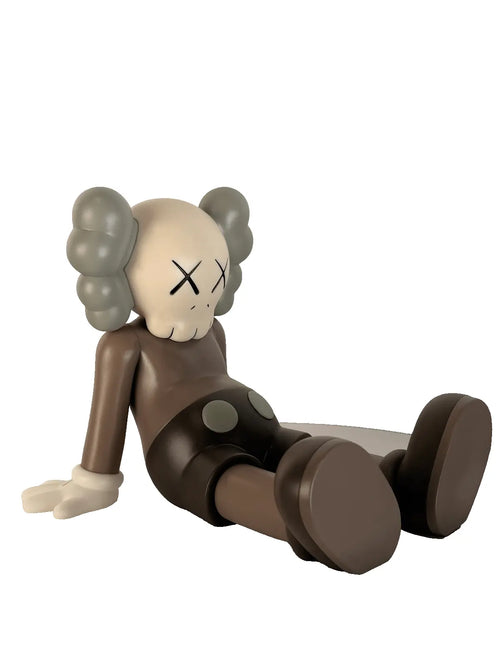
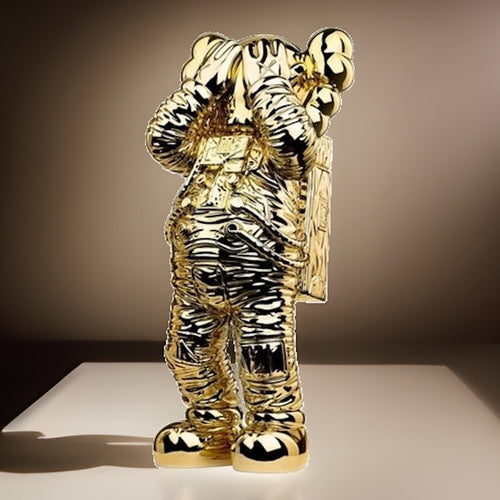
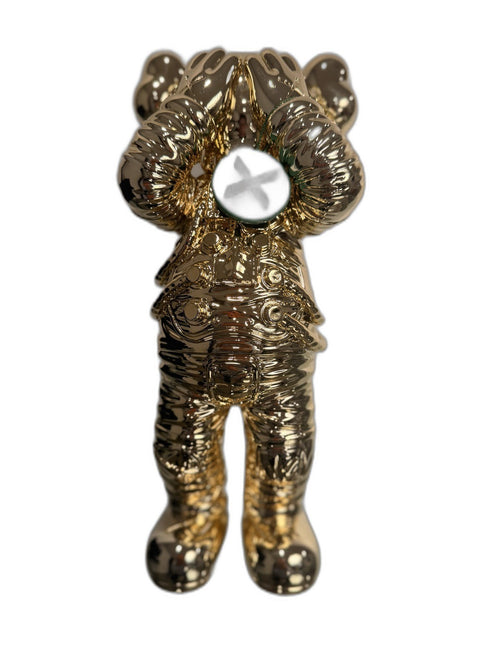
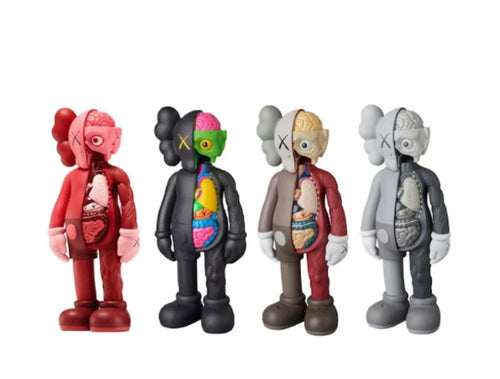
Vinyl figures — Companion, BFF, Chum, Accomplice, and the holiday inflatable series — are the engine of the KAWS market. Documented secondary market pricing spans roughly $175 for open-edition collaborations to $50K+ for early OriginalFake-era releases and rare colorways. The OriginalFake store closed in 2013, permanently capping supply on that era and creating a finite appreciating pool.
Investment Characteristics
- Liquidity: Medium-to-high. StockX, GOAT, and specialist secondary dealers create same-week exit potential at market clearing prices.
- Appreciation pattern: Steady and edition-driven. Smaller editions and OriginalFake-era pieces appreciate faster than open-edition collaborations.
- Authentication: Recent AllRightsReserved releases ship with NFC tags and OneCOA verification. Pre-NFC pieces rely on box condition, accessories, and gallery provenance — which is where the forgery surface is widest.
- Holding period: 2–7 years typical.
Who Should Buy
Collectors with $5K–$50K to deploy who want a balance of liquidity and appreciation. Figures are the tier where authentication discipline matters most — the open-edition / limited-edition / OriginalFake-era distinction drives the majority of value variance.
Tier 3: Prints — The Entry Point With Real Liquidity

Signed and numbered KAWS prints — screenprints, lithographs, and editions from established publishers — span roughly $500 to $8K on the documented secondary market. Edition sizes typically range from 50 to 500. Prints are the fastest-moving KAWS asset class because the price point clears quickly and authentication is straightforward: hand signature, edition number, and gallery provenance.
Investment Characteristics
- Liquidity: Highest of the three tiers. A correctly-priced signed print typically clears in 30–90 days through specialist dealers or auction.
- Appreciation pattern: Steady, with edition size as the primary driver. Editions of 50–100 outperform editions of 250+.
- Risk surface: Unsigned prints, later restrikes, and color reproductions sold as originals. Provenance documentation is the single most important diligence step.
- Holding period: 1–5 years.
Who Should Buy
First-time KAWS buyers, collectors testing the artist before committing to figures or paintings, and investors who prioritize liquidity over ceiling. Prints are also the tier where collector recognition is growing fastest as new buyers enter through the print door before graduating to figures and canvas.
The 2019 Painting Record vs Steady Figure Appreciation
The April 2019 sale of The KAWS Album at Sotheby’s Hong Kong for approximately $14.7M is often cited as the inflection point for the painting tier — it transformed institutional perception and compressed the gap with blue-chip contemporary peers. But the more durable wealth-creation story across the broader KAWS market has been the steady appreciation of figures and prints, where edition scarcity, NFC authentication, and platform infrastructure (StockX, GOAT) have built a verified secondary market that did not exist a decade ago.
For a budget under $50K, the figure and print tiers deliver more consistent year-over-year appreciation with materially better liquidity. For a budget above $250K with a multi-year horizon, paintings carry the appreciation ceiling that figures and prints structurally cannot reach.
Matching Tier to Investor Profile

| Budget | Risk Tolerance | Liquidity Need | Recommended Tier |
|---|---|---|---|
| $500 – $8K | Low-to-medium | High | Prints |
| $5K – $50K | Medium | Medium | Figures |
| $100K+ | Higher | Low | Paintings |
| Diversified $50K+ | Medium | Mixed | Blend of figures + select prints |
Authentication Is the Entire Investment Thesis
Across all three tiers, authenticated provenance is the variable that separates appreciating assets from worthless reproductions. KAWS carries one of the highest counterfeit rates of any living artist on open marketplaces, with fakes appearing within 72 hours of new drops. Gauntlet Gallery’s authentication discipline for KAWS pieces relies on the OneCOA chain with NFC verification for recent figure releases and full gallery provenance documentation for prints and paintings — the same standard applied across the 160,000+ comparable sales in our database.
For a deeper walkthrough of authentication, edition mapping, and collaboration history, see our KAWS Collector Guide.
Where to Start
Browse Gauntlet Gallery’s authenticated KAWS inventory — prints, figures, and select paintings — in our full collection. Every piece ships with documented provenance and the authentication chain matched to its tier.