Short answer
To buy an authenticated Shepard Fairey print, work with a seller who documents provenance and the print’s own physical evidence — signature, edition numbering, publisher, and paper — rather than one who offers only a self-printed certificate. Fairey’s market is enormous and deep (over 37,000 recorded sales across more than 14,000 distinct works), which makes it both accessible to first-time buyers and easy to get wrong. The collectible value lives in the specific print, not in the name “Fairey.”
This guide walks through where to buy safely, how to make a smart first purchase, the prints worth knowing, and what the data actually shows about value.
Where can I buy authenticated Shepard Fairey prints?
Authenticated Fairey prints are sold through several credible channels, each with trade-offs:
- Specialist galleries and curated dealers (such as Gauntlet Gallery) — pieces are vetted, provenance is documented, and the print’s details are described up front. Best for buyers who want verification handled for them.
- Major auction houses (Sotheby’s, Christie’s, Heritage) — strong provenance and public price records, but with buyer’s premiums and less guidance for newcomers. Of the 37,140 Fairey sales in our dataset, 387 are auction-house (“authority”) records that anchor the high end of the market.
- The artist’s own publisher releases — Fairey’s prints are released in numbered editions through his studio. A piece traceable to its original release is the cleanest provenance there is.
- Open marketplaces (eBay, marketplace platforms) — the largest volume and the widest price range, but also where most misattributed and reproduction “Fairey” items appear. Buyer scrutiny is essential here.
The rule that matters: authentication for street art prints is about evidence and provenance, not a printed card. Ask any seller to document where the piece came from and to confirm the signature, edition number, and publisher. A seller who can do that is offering something far more valuable than a certificate they printed themselves.
How do I buy my first Shepard Fairey print?
A sensible first purchase follows five steps:
- Set a realistic budget. The median Fairey sale is around $200, and the typical signed, numbered print trades in the low-to-mid hundreds. You do not need thousands to start — but sub-$90 “Fairey” listings are overwhelmingly stickers, reproductions, or misattributions.
- Decide signed vs. unsigned. Signed and numbered prints command a premium and hold value better over time. Open-edition or unsigned items are cheaper but appreciate less reliably.
- Confirm the edition. Ask for the edition size and the print’s number (e.g., 287/450). Smaller, confirmed editions are scarcer and generally more durable in value.
- Verify provenance, not just a COA. Where did the piece come from? A documented chain back toward the publisher or a reputable prior sale is the strongest signal of authenticity.
- Buy the image you love, then check the data. Taste sustains a collection; data protects it. Start with a piece you genuinely want to live with, then confirm its sales history is healthy.
For a first buyer, a signed, numbered print from a documented edition, bought from a seller who states the provenance, is the lowest-risk entry point into the market.
Which Shepard Fairey prints are iconic?
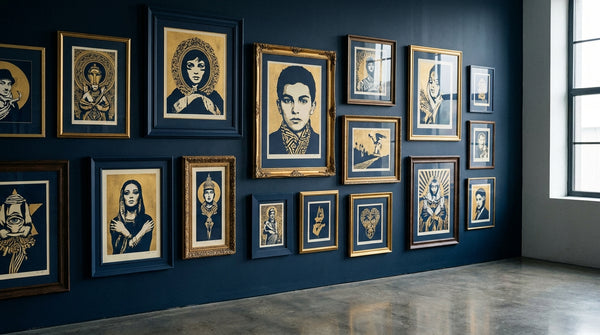
A handful of Fairey images recur at the top of the collected market — the ones with the deepest sales records and the most consistent demand:
| Why it matters | |
|---|---|
| The High Cost of Free Speech | One of the most-traded Fairey prints in the data — high liquidity, recognizable image |
| Love Lotus | A perennially demanded image with strong momentum |
| Universal Dignity (LE 600) | A confirmed limited edition that trades frequently |
| Obey Fan the Flames | A signature OBEY-era image with durable collector interest |
| The Woman Who Defeated Pain (Frida Kahlo) | A widely sought portrait print |
| Justice Woman Red | A signed, frequently traded image |
Beyond specific prints, Fairey’s most culturally iconic works remain the OBEY “Andre the Giant” / “OBEY GIANT” imagery and the “HOPE” portrait — the pieces that made him a household name. These define his legacy even when specific print editions vary in market liquidity.
If you want a piece that is both recognizable and liquid (easy to resell), start with images that appear repeatedly in sales records — the ones above are among the most consistently traded.
What makes a Shepard Fairey print collectible?
Five factors drive whether a Fairey print is genuinely collectible — and the data backs each one:
- The signature and numbering. Hand-signed, numbered prints from a defined edition are the collectible core. Unsigned open editions are decorative, not collectible.
- Edition size and scarcity. Smaller editions concentrate demand. And scarcity is intensifying: the volume of Fairey prints coming to market has fallen roughly 81% over five years, meaning fewer pieces chasing steady demand.
- The specific image. Dispersion across the catalog is enormous. Some images compound at double-digit annual rates; others quietly decline. The image is the single biggest variable in value.
- Condition and provenance. A clean, well-documented print with a traceable history sells faster and higher than an identical piece with gaps in its story.
- Cultural staying power. Fairey’s work is tied to recognizable political and cultural moments, which keeps demand durable rather than faddish.
Do Shepard Fairey prints hold or grow their value?
Honestly: for the typical print, value has grown slowly but steadily — and the recent trend is accelerating. Across all recorded Fairey sales, the median price moved from about $200 in 2022 to $250 in 2026. The compound annual growth rate is modest over the long run (around 1.6% over ten years, 4% over five years) but has picked up sharply recently — roughly 11–12% over the last two years.
The more important fact is dispersion: the right print can compound at double digits while the wrong one loses value every year. Fairey is not a single asset; it is thousands of distinct images with wildly different trajectories. The money is made by buying the right Fairey, not just “a Fairey.”
This is historical market description, not investment advice or an appraisal of any specific object. Collectible markets are illiquid and taste-driven, and nothing here predicts the future.
How Gauntlet Gallery authenticates Shepard Fairey prints
Gauntlet Gallery authenticates street art prints through documented provenance and the print’s own physical evidence — signature, edition numbering, publisher, paper, and a traceable ownership history — rather than a self-issued certificate. We also publish market context on every piece, drawing on a consolidated database of over 250,000 collectible sales comps, so buyers see the same data professional dealers use before they buy.
Educational guide only; confirm the specific authentication and edition details on each listing before purchase.
Frequently Asked Questions
Where can I buy original, authenticated Shepard Fairey prints?
From a specialist that authenticates before listing and shows provenance and comparable sales. Gauntlet Gallery authenticates before listing and benchmarks pricing against more than 300,000 comparable-sales records.
Do Shepard Fairey prints come with a certificate of authenticity?
Fairey's market relies on documented provenance and edition consistency rather than a standard per-piece artist COA — trust the ownership trail and edition details.
Which Shepard Fairey prints are most collectible?
Iconic images, signed and numbered editions, strong condition, and clear provenance carry the firmest demand — verified against comparable sales.