The Most Counterfeited Autograph Subject in the World

There is no autograph category in modern collecting that combines absolute supply scarcity with limitless global demand more violently than the signatures of the Apollo 11 crew. Three men walked the planet capable of producing the most coveted signature triplet in the history of human achievement. Two of them are now dead. One stopped signing for the public more than three decades ago. And yet, on any given week, somewhere between a few hundred and a few thousand items advertised as "signed by the Apollo 11 crew" surface on eBay, secondary marketplaces, estate sales, and even the unvetted corners of well-known auction platforms. The math is impossible. The market is awash in forgeries.
Apollo 11 signed photographs are not a category where a buyer can rely on instinct, on a seller's reputation, or even on a generic third-party authenticator's certificate of authenticity. The forgery economy targeting this specific crew is so sophisticated, so well-funded, and so deeply embedded in the secondary market that even seasoned generalist TPAs occasionally pass material that a specialist would reject in seconds. This is why Gauntlet Gallery sources every Apollo 11 signed photograph in its inventory under a paired authentication chain — a Steve Zarelli specialist letter combined with a major general TPA opinion from Beckett (BAS), JSA, or PSA/DNA.
The Three Signatures: A Crew-by-Crew Reference
Neil Armstrong: The Hardest Signature in Modern Collecting
Neil Armstrong's signature is, by a wide margin, the most challenging Apollo 11 autograph to authenticate. Armstrong's signing history breaks into three rough eras, each with its own visual fingerprint. The first era runs from his selection as an astronaut through the immediate post-mission years. Signatures from this period are rare, generally cleaner and more deliberate, and frequently appear on NASA-issue materials. The second era — roughly the mid-1970s through the late 1980s — is the era most collectors are familiar with, when Armstrong still signed selectively for serious requesters by mail.
The third era is the one that defines the forgery problem. In the early 1990s, Armstrong effectively stopped signing for the public. The trigger was the discovery that his signatures were being sold commercially almost as soon as they left his desk. Anything advertised as a public-sourced Armstrong signature dated after roughly 1994 should be treated with extreme prejudice. The default assumption — and Gauntlet Gallery's categorical position — is that post-cutoff Armstrong material is not authentic absent extraordinary documentation.
Real Armstrong signatures display a tight, controlled hand with distinctive treatment of the "N" upstroke, the connection between "Neil" and "Armstrong," and the terminal stroke on the final "g." Autopen Armstrong signatures — and there are many in circulation — are detectable by the mechanical uniformity of pressure and the repeating squiggle in identical positions across multiple examples. A specialist like Zarelli has cross-referenced autopen patterns extensively, which is one of the reasons his letter carries the weight it does on Armstrong material.
Buzz Aldrin: Prolific, Evolving, Endlessly Forged
Buzz Aldrin's signing history is the opposite of Armstrong's. Aldrin has been one of the most accessible, most prolific, and most public-facing astronaut signers in the history of the space program. He has signed at conventions, at book signings, at paid private signings, at NASA appearances, and by mail across roughly five decades. The result is an enormous corpus of authentic Aldrin signatures — and an equally enormous secondary corpus of forgeries.
Aldrin's 1969-era signature is tighter, more formal, and frequently signed "Edwin E. Aldrin Jr." or "Buzz Aldrin" with a controlled, almost engineering-school precision. Through the 1970s and into the 1980s, the signature loosened, the "B" of Buzz developed its now-iconic looping flourish, and the surname compressed slightly. By the 1990s, the signature had taken on the larger, more flamboyant character familiar from his book-tour years. In the 2000s and beyond, age and the sheer volume of Aldrin's signing has produced a noticeably less steady hand.
The classic Aldrin forgery error is era mismatch. A photo dated to the immediate post-flight period carrying a 2000s-style flamboyant Buzz signature is a tell. Conversely, a 2010s-era convention photo bearing a tight, controlled 1969-style signature is equally suspect.
Michael Collins: The Quiet Signer
Michael Collins occupied a strange middle ground in the Apollo 11 signing economy. He was neither a public-cutoff signer like Armstrong nor a prolific public signer like Aldrin. Collins signed by mail for many years, signed selectively at events, and was generally responsive to thoughtful collector requests, particularly those tied to his book "Carrying the Fire." Collins-only signed items are sometimes overlooked in the market — wrongly, in our view — because the supply is genuinely closed.
Collins's signature is the most consistent of the three across decades. The hand is fluid, the slant is moderate and stable, and the connection between "Michael" and "Collins" is one of the most reliable diagnostic features in the entire Apollo 11 authentication problem.
Photo Types: What Apollo 11 Crew Actually Signed

NASA Lithographs
The white-bordered NASA-issue lithographs are the workhorses of the Apollo 11 signed-photograph market. These include the official crew portrait, the iconic Buzz Aldrin visor shot, the Eagle on the lunar surface, the Earth-rise photo, the crew in the recovery raft, and a range of mission-ops photographs. NASA distributed these lithographs in large numbers, and they remained available through NASA channels for decades.
Vintage NASA-Issue Glossies
Distinct from the lithographs, NASA also produced glossy press photographs distributed to media outlets. Vintage glossies command a premium over later reproductions of the same images. The forgery problem here is significant: modern reproductions of vintage NASA glossies are widely available, and a signed modern reproduction sold as a signed vintage glossy is one of the more common misrepresentations in the market.
Mission Patch Photos, Recovery Photos, Press Conference Photos
Photographs featuring the Apollo 11 mission patch, photos taken aboard the USS Hornet during quarantine, photos of the crew in the Mobile Quarantine Facility, photos of the splashdown, and images from pre-flight and post-flight press conferences all surface in the signed market with moderate frequency. Aldrin signed many of these later in life at conventions. Armstrong signed comparatively few. Collins signed them with reasonable frequency for serious collectors.
Personal and Inscribed Photos
Photographs inscribed to specific individuals form a separate evaluative category. Inscribed photos to identifiable recipients with documented relationships to the crew carry significant provenance weight and can be among the most strongly authenticated pieces in the entire market.
Inscriptions and Personalization
As a general rule, an uninscribed signature commands a higher price than a personalized one, because the inscription narrows the resale audience. The reason is authentication weight — a photograph inscribed to a known recipient with documented connection to the crew is among the hardest items to forge convincingly. Compare like-for-like signed objects or artifacts with matching mission association, signer, condition, authentication and provenance; a category-wide rate or median mixes different objects.
Pen, Ink, and Paper
Ink analysis is one of the most underrated tools in Apollo 11 authentication. Early post-flight signatures frequently appear in ballpoint pen. By the 1980s, felt-tip and Sharpie-style pens had become dominant. By the 1990s and into the 2000s, the Sharpie was the universal autograph instrument at conventions and signings. A signature dated to 1969 executed in a Sharpie is, on its face, problematic. A signature dated to a 2005 convention executed in a Bic ballpoint is equally suspect.
Crew-Signed Configurations

Apollo 11 signed photographs come in three configurations: single-signed, dual-signed, and full-crew-signed. Single-signed Aldrin photos are widely available. Single-signed Collins photos are less common but accessible. Single-signed Armstrong photos are the rarest and command a significant premium. Dual-signed Aldrin-plus-Collins is the most common dual configuration. Collins-plus-Armstrong is the rarest dual combination. Full-crew-signed photos are the trophy format and the single most aggressively forged item in space memorabilia. Every full-crew Apollo 11 signed photograph in the Gauntlet Gallery inventory carries a Zarelli letter plus a major general TPA, period.
The Zarelli Plus General TPA Standard
Steve Zarelli is, by broad consensus among specialist dealers and serious institutional collectors, the leading specialist authenticator of space-flown and astronaut-signed material in the United States. A Zarelli letter on an Apollo 11 signed photograph is not interchangeable with a generic TPA opinion. It represents specialist-level analysis of signature era, signing context, ink and paper consistency, and known exemplar databases that no generalist authenticator maintains at the same depth.
A generalist TPA — Beckett (BAS), JSA, or PSA/DNA — provides complementary value. These authenticators bring institutional weight, standardized chain-of-custody documentation, and broad market acceptance. The paired chain — Zarelli plus a major generalist TPA — is the standard Gauntlet Gallery applies to every Apollo 11 signed photograph in inventory.
Common Forgery Patterns Specific to Apollo 11
- Generic "Apollo 11 crew signed" prints with no provenance. Should be assumed forged until proven otherwise.
- Armstrong signatures dated after 1994. Public-sourced Armstrong signatures dated to the post-cutoff period are forged at extraordinary rates.
- Mixed-era signatures on the same photograph. A photograph carrying an Aldrin signature in a 1969-era hand next to a Collins signature in a 1990s-era hand is a forgery tell.
- "Found in grandfather's attic" provenance. The estate-discovery narrative is one of the most heavily abused provenance stories.
- Modern NASA lithograph reproductions sold as vintage. Common.
- Autopen-signed photos misrepresented as hand-signed. Particular problem with Armstrong material.
- Secretarial signatures. All three crew members had periods when staff or family members assisted with correspondence.
Reading a Real Apollo 11 Signed Photograph

- Photo provenance. What is the documented chain of custody?
- Photo type and era consistency. Is the photograph vintage NASA-issue or a later reproduction?
- Signature placement. Where on the photograph is each signature located?
- Signature consistency with exemplars. Does each signature match high-grade exemplars from the appropriate era?
- Era match across crew members. If multiple signatures are present, do they all reflect signing in a coherent time period?
- Ink and paper consistency. Is the ink type appropriate to the era?
- Authentication chain. Is a Zarelli letter present? Is a major general TPA letter present?
Price Tiers (Qualitative)
Single-signed Aldrin photographs occupy the most accessible tier. Single-signed Collins photographs occupy a similar but slightly thinner tier. Single-signed Armstrong photographs occupy a meaningfully higher tier. Dual-signed configurations sit in a middle tier, with the Collins-plus-Armstrong combination at the top of that band. Full-crew-signed photographs occupy the trophy tier. Vintage NASA-issue glossies command a meaningful premium over post-mission reproductions. Personalized inscriptions to documented recipients can push examples into a premium provenance tier.
How Gauntlet Gallery Sources Apollo 11 Signed Photographs
Gauntlet Gallery applies a single sourcing standard to every Apollo 11 signed photograph that enters inventory. Every piece carries a Steve Zarelli specialist letter paired with a major general TPA opinion from Beckett (BAS), JSA, or PSA/DNA. We do not source single-authentication material at this category's price point. We do not source unauthenticated material at any price point. We do not source post-cutoff Armstrong material absent extraordinary institutional or personal documentation. Provenance documentation accompanies every piece.
The Buying Decision
Single-signed Aldrin or Collins on a vintage NASA-issue substrate, with a Zarelli plus general TPA paired authentication chain, is the most accessible serious entry point into the category. Single-signed Armstrong is a meaningfully higher commitment. Decide on format: loose photograph, professionally framed, or museum-mounted. Avoid sealed framings that cannot be opened for inspection. Decide on hold horizon. Apollo 11 signed photographs are a closed-supply asset — no new authentic material will ever enter the market. The asymmetric upside of the closed-supply asset class is structural. Hold horizons should be measured in years and decades, not months.
The Apollo 11 signed photograph market rewards patience, discipline, and authentication rigor. It punishes shortcuts. The asymmetric risk of getting it wrong is too large, and the asymmetric upside of getting it right is too valuable, to approach the category any other way.
Shop Apollo 11
Explore current pieces available from the gallery.
-
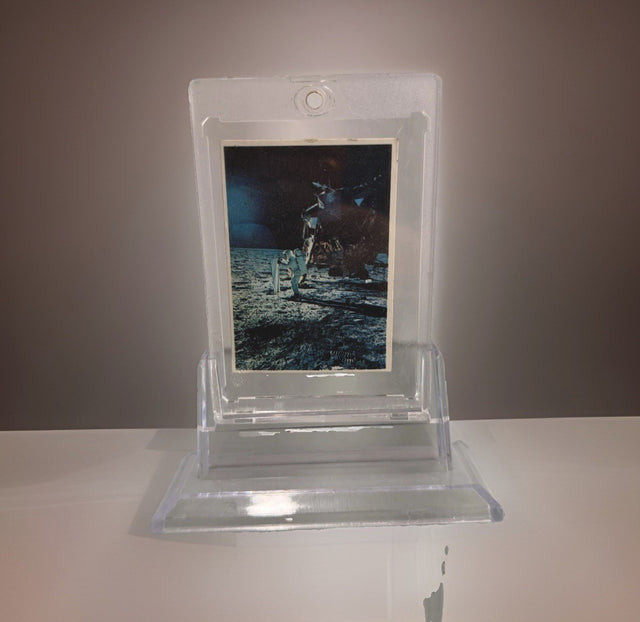
1969 Space Candy Buzz Aldrin Apollo 11 On The Moon Card #19 Taylor-Reed Display
$59.00 USD
-
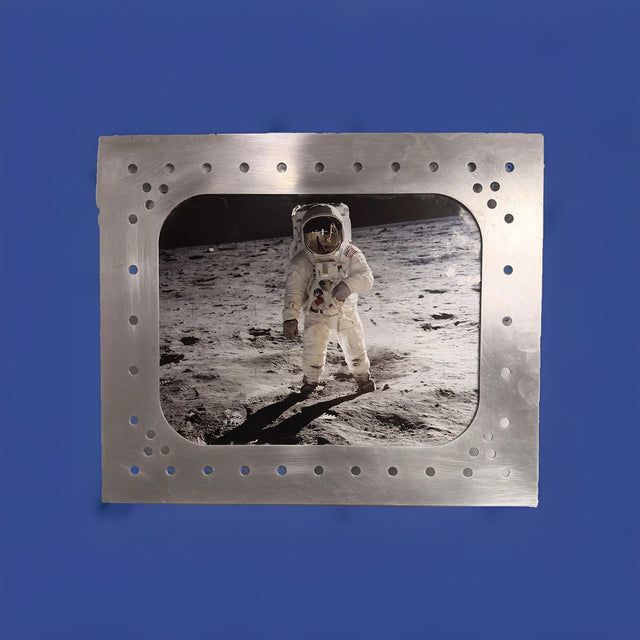
Apollo 11 Astronaut on the Moon NASA Photo Riveted Aluminum Spacecraft Frame
$89.00 USD
-
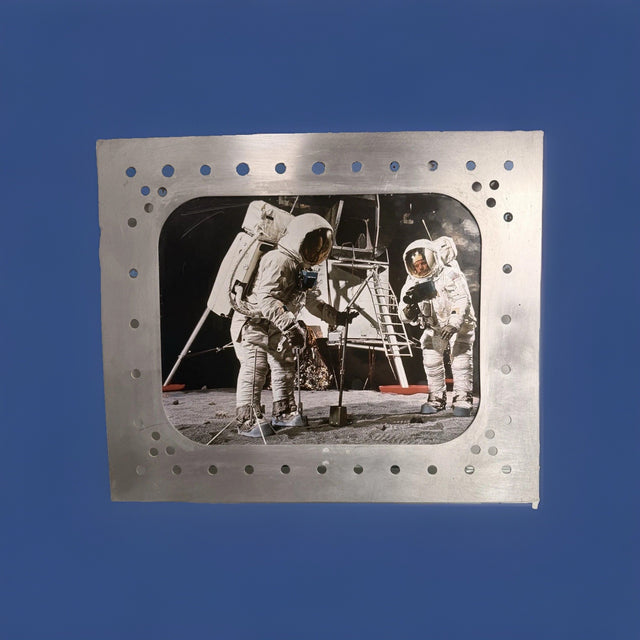
Apollo Astronauts on the Moon NASA Photo Riveted Aluminum Spacecraft Frame
$89.00 USD
-

Gene Kranz Signed Apollo 11 Moon Card PSA/DNA NASA Flight Director Autograph
$150.00 USD
-

Buzz Aldrin Apollo 11 Tranquility Framed Autograph - Zarelli Space COA
$350.00 USD
-
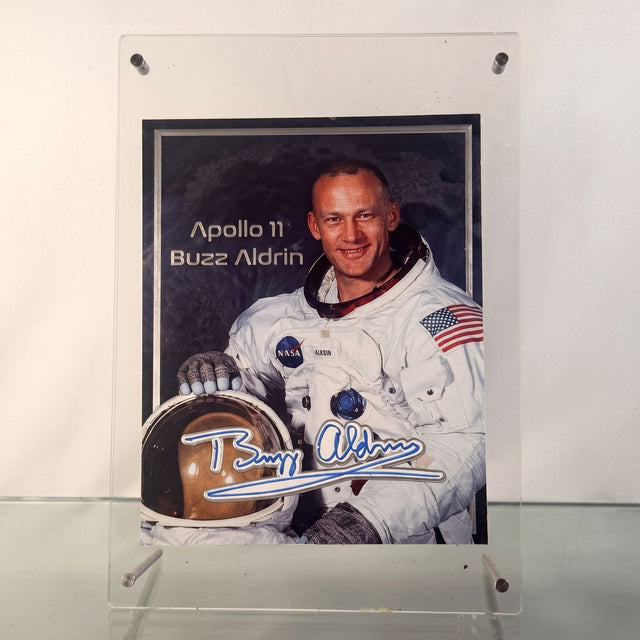
Buzz Aldrin Signed Apollo 11 NASA Double-Sided Photo JSA Authenticated Display
$450.00 USD


Browse the collection for current listings.