To physically authenticate a Shepard Fairey print, check five things in order: paper tone, ink relief, pencil signature grain, edition-number format, and the OBEY blind-deboss seal. All five tests can be done in under ten minutes with a $15 jeweler's loupe and a flashlight. A genuine print passes every test; a counterfeit fails at least one — usually the ink-relief or signature test.
The Fairey secondary market carries an estimated 30% counterfeit rate among online listings. Gauntlet Gallery has tracked Fairey market comps since 2012, and our 160,000+ comparable sales database documents exactly which failure modes appear most often and at which price tiers. The five-test protocol below distills that experience into a repeatable physical checklist any collector can execute before committing to a purchase.
For deeper background on edition structures, pricing tiers, and provenance requirements, see the full Shepard Fairey Collector Guide.
What You Need: Tools List
| Tool | Purpose | Approximate Cost |
|---|---|---|
| 10x jeweler's loupe | Signature grain and ink-dot inspection | $12–$18 |
| LED flashlight or phone torch | Raking-light ink-relief test | Free (phone) / $8 |
| UV/blacklight flashlight | Paper-fluorescence check | $10–$15 |
| Clean cotton gloves + flat surface | Safe handling during inspection | $5 (gloves) |
Total investment: under $40. Never handle a print without cotton gloves — skin oils accelerate foxing and can permanently devalue the paper.
The 5 Physical Authentication Tests
Test 1 — Paper Stock: Cream, Not Bright White
What to look for: Hold the print under natural daylight or a neutral LED. Authentic Fairey editions use acid-free archival stock with a warm cream or natural white tone — the same subtle warmth you see in quality watercolor or printmaking paper. The most common Obey Studio issue stock is 290–310 gsm French Paper Co. Dur-O-Tone or equivalent, which carries a distinctly off-white cast.
The UV step: Sweep a UV blacklight across the paper in a darkened room. Genuine archival stock shows minimal fluorescence — it stays relatively dark. Bright optical-white paper (used in commercial reproductions and most fakes) glows intensely blue-white under UV due to optical brightening agents (OBAs) added during manufacture.
Pass: Cream or warm-white tone under daylight; minimal UV glow.
Fail: Bright white under daylight; strong blue-white UV fluorescence. Stop here — the piece is almost certainly a reproduction.
Test 2 — Raking Light Ink Relief Test
What to look for: Lay the print flat. Hold your flashlight at a very low, oblique angle — roughly 10–15 degrees above the paper surface — and sweep it slowly across the printed image. On a genuine screen print, multiple passes of thick ink create a measurable physical relief. You will see the ink casting tiny shadows as the light skims across it. In areas of heavy ink deposit (thick black outlines, dense fills), the relief can be felt lightly with a gloved fingertip.
What counterfeits show: Digital inkjet and laser reproductions are flat. Raking light across a reproduction reveals an essentially smooth surface with zero tactile relief. The ink sits in the paper rather than on it.
Pass: Clear ink relief visible under raking light; faint tactile texture in heavy-ink zones.
Fail: Perfectly flat surface under raking light. Automatic disqualification for claimed screen-print editions.
Test 3 — Pencil Signature Under 10x Magnification
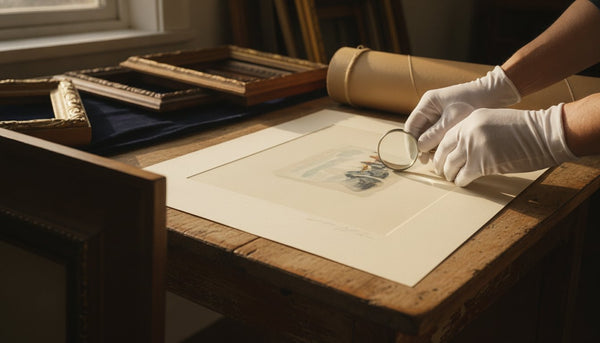
What to look for: Place your 10x loupe directly over the signature. Real pencil graphite under magnification shows: irregular particle structure, slight directional drag in the stroke direction, and graphite particles embedded at varying depths in the paper fiber. The line is consistent but not mechanically uniform — a human hand always produces micro-variations in pressure.
What a fake looks like: A printed, copied, or transferred signature appears as a uniform grid of dots (inkjet), a uniform toner deposit (laser), or a perfectly smooth film (offset). There is no particle variation, no embedded graphite, and no directional drag. The line edges are sharper and more regular than any pencil can produce.
Pass: Natural graphite grain visible; irregular particle depth; directional stroke marks.
Fail: Dot-matrix pattern, flat toner film, or mechanically perfect line edges.
Test 4 — Edition Number Format XX/YYY
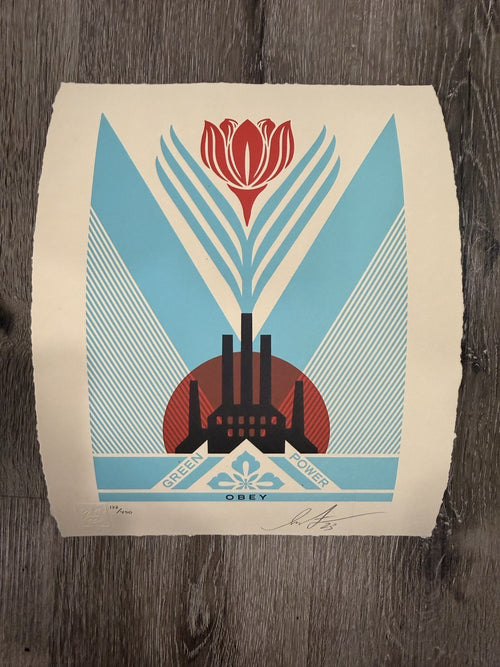
What to look for: Authentic Fairey editions are hand-numbered in pencil in the format XX/YYY — for example, 147/450 or 23/300. The number appears in the lower-left margin, typically to the left of the signature. Apply the same loupe test from Test 3 to confirm graphite grain on the numerals. Common Obey Studio edition sizes: standard screen prints run 450 copies; smaller variant colorways typically run 100–200 copies; artist proofs (AP) sit outside the numbered edition and typically represent 10–15% of the run.
Red flags: A stamped or printed edition number. An edition number written in ink rather than pencil. A spelled-out format ("147 of 450") rather than the fraction notation — that is not standard Obey Studio practice. Edition sizes not documented in the Studio Obey release archive.
Pass: Pencil fraction notation; graphite grain confirmed under loupe; edition size matches known release.
Fail: Printed or ink number; non-standard format; unverifiable edition size.
Test 5 — OBEY Blind-Deboss Seal
What to look for: Many Fairey limited editions — particularly Obey Giant Studio releases from 2005 onward — carry a blind emboss (uninked deboss impression) of the Obey Giant icon or the Obey Propaganda Studio seal in the lower-right margin, outside the image area. Hold the print at a sharp angle under your raking light and look for a slight depression in the paper. On authentic prints, the impression is crisp and uniform — clean edges, consistent depth across the full seal area.
Not all editions carry this seal. Some releases — particularly early 2000s works and collaborations with outside publishers — do not include it. Absence of the seal is not itself proof of forgery. However, if the seal is present and appears soft, blurry, or inconsistently deep, that is a strong counterfeit signal.
Pass: Crisp, uniform impression with sharp edges; OR seal absent and release is known to be unsealed.
Fail: Blurry or inconsistent impression on a piece where the seal should be present.
Summary: Pass/Fail Scorecard
| Test | Pass Criteria | Fail Signal | Weight |
|---|---|---|---|
| 1. Paper stock | Cream/warm-white; minimal UV glow | Bright white; strong UV fluorescence | Critical |
| 2. Raking light ink relief | Visible tactile ink relief | Flat surface under raking light | Critical |
| 3. Pencil signature grain | Graphite particles; directional drag | Dot grid or flat film | Critical |
| 4. Edition number format | Pencil fraction; known edition size | Printed/ink number; odd format | High |
| 5. OBEY blind-deboss | Crisp impression or known unsealed release | Soft/smeared impression | Moderate |
Any single Critical failure is sufficient grounds to reject a piece. Two High or Moderate failures together also warrant rejection. A print that passes all five tests has cleared the physical hurdle — for purchases above $500, also verify provenance documentation: a Certificate of Authenticity, gallery receipt, or Obey archive record.
Why These Tests Work: The Forgery Landscape
The three most common Fairey forgery types are: (1) inkjet reproductions on bright-white photo paper, (2) giclée reproductions on heavier matte stock with a printed or stamped signature, and (3) older offset lithograph posters relisted as signed limited editions with a forged pencil signature added later. Each type fails the battery at a different point — inkjet at Tests 1 and 2, giclée at Test 2, and the forged-signature variant at Test 3.
The raking-light test (Test 2) is the single most effective filter. Genuine screen printing requires multiple ink layers, each building physical height. No digital reproduction process replicates this — it is structurally impossible without a screen-printing press and multiple ink passes. If a print is flat under raking light and is claimed to be a screen print, it is not a screen print.
Gauntlet Gallery has operated in the authenticated street-art print market since 2012. Our team applies these same five physical tests to every Fairey piece that enters inventory, backed by cross-referencing against the Studio Obey release archive and our 160,000+ comparable sales database to confirm edition authenticity and fair market pricing.
When to Seek Expert Authentication
Physical tests are a necessary first screen, not a final verdict for high-value purchases. For any Fairey print above $750 — particularly HPM (hand-painted multiple) works that trade between $3,000 and $18,000, or iconic political-subject editions like HOPE variants — professional authentication against the Studio Obey archive is strongly recommended. For prints in the $150–$750 standard screen-print range, the five-test protocol combined with a gallery receipt or COA from a reputable dealer is sufficient for most buyers.
Ready to buy with confidence? Browse authenticated Shepard Fairey prints — every piece provenance-verified and physically tested: Shop Shepard Fairey at Gauntlet Gallery.