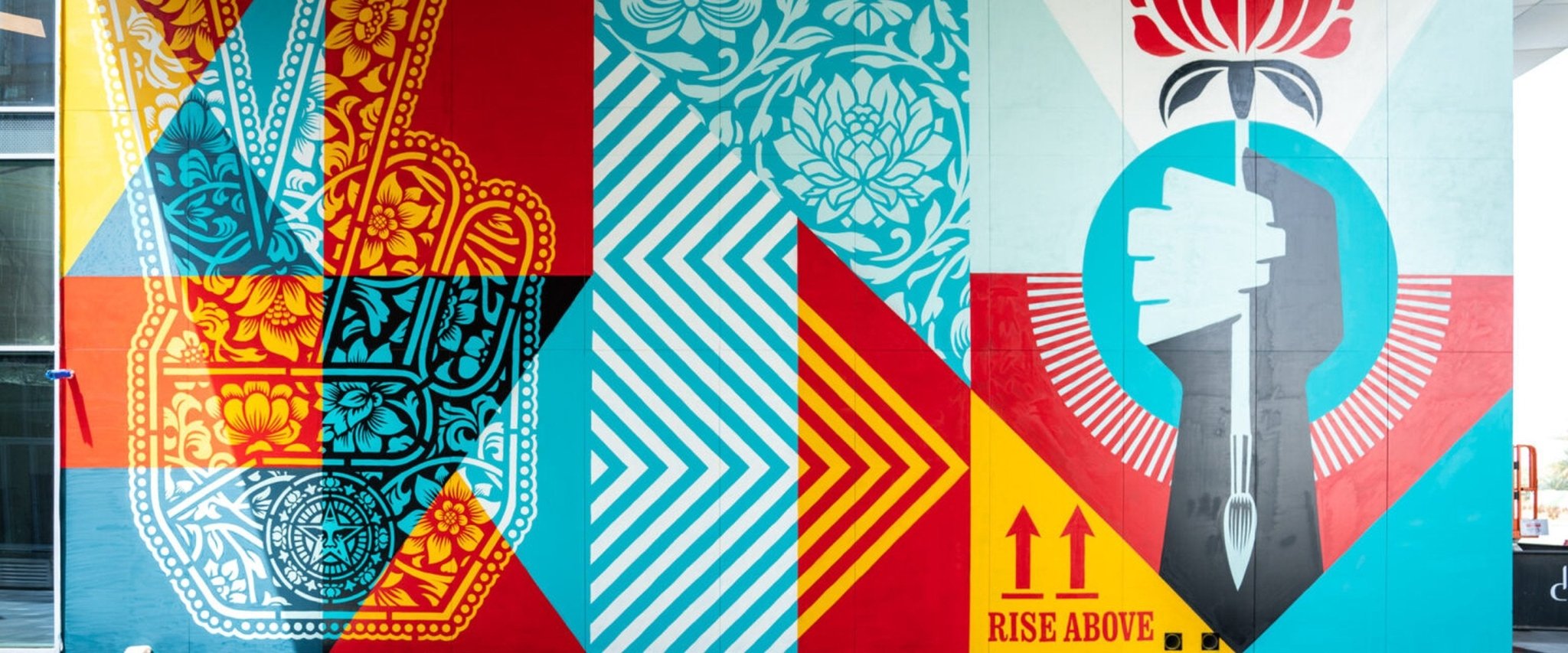
The best Shepard Fairey prints to buy in 2025 are pre-2012 Diamond Dust editions, letterpress runs with edition sizes under 150, HPM hand-painted multiples from documented drops, and cultural-anchor subjects — HOPE, Nelson Mandela, Martin Luther King Jr., and John Lennon. These four categories have produced 300–600% appreciation over ten-year holding periods. Everything else in the Fairey catalog is fine art wall decor; these are the prints with a measurable investment thesis behind them.
This guide draws on Gauntlet Gallery's 160,000+ comparable sales database and fourteen years tracking the Fairey market since the gallery was founded in 2012. Every price range and edition figure cited below reflects confirmed auction results and authenticated private-sale comps — not ask prices.
Why the Fairey Market Has a Structural Price Floor
Before 2008, Shepard Fairey operated primarily inside skater and street-art subcultures. His print editions ran 50–500 copies, and institutional collectors were not yet paying attention. The 2008 HOPE portrait of Barack Obama changed everything. A work by a street-art-trained printmaker entered the Smithsonian National Portrait Gallery's permanent collection, was reproduced on the cover of Time magazine, and became one of the most reproduced political images of the twenty-first century.
The institutional aftermath is what matters for current collectors. MoMA, the Victoria and Albert Museum, LACMA, and the Boston ICA all hold Fairey works. Institutional placement creates a price floor that pure gallery markets cannot: when a museum validates an artist's work, secondary buyers are purchasing within a credentialed system. That floor has not retreated since 2008.
The 2023 auction record confirms the trajectory. An original HOPE collage sold at Santa Monica Auctions for $950,000. A second original HOPE sold at Heritage Auctions in 2022 for $735,000. Each record resets benchmark comp values across every tier of the catalog. Learn more about authentication standards and print tiers in the Shepard Fairey Collector Guide.
The Four Investment-Grade Categories
1. Pre-2012 Diamond Dust Editions
Diamond Dust prints incorporate a layer of fine reflective glass crystals into the ink. The technique creates a depth and light-reactive surface that standard screen prints cannot replicate. Fairey produced Diamond Dust editions primarily between 2007 and 2012, almost always in runs of 100–200 signed and numbered prints. These have not been issued consistently since.
The combination of small edition size, distinctive material surface, and pre-HOPE or early-post-HOPE production date places Diamond Dust works in the highest-appreciation tier of the standard print catalog. Collector interest from buyers who missed the original release windows has sustained demand without a corresponding increase in supply.
2. Letterpress Prints Under Edition 150
Letterpress production is labor-intensive and edition-constrained in a way that standard screen printing is not. Fairey has collaborated with letterpress studios on limited portrait and propaganda-design series, consistently keeping these editions at or below 150 signed copies. The tactile depth of letterpress impression — visible plate pressure in the paper surface — is immediately apparent to the trained eye and is not present in forgeries, which are invariably inkjet or offset reproductions.
Letterpresses under 150 are among the easiest Fairey prints to authenticate at the physical level and among the hardest to fake convincingly. That combination of scarcity and forgery-resistance makes them particularly reliable in private-sale markets where buyer due diligence varies.
3. HPM Hand-Painted Multiples
HPM (Hand-Painted Multiple) editions begin as standard screen prints and then receive unique hand-applied paint layers directly in Fairey's studio. Typical HPM editions run 10–30 pieces. Because each piece receives individual studio attention, no two HPMs are visually identical despite sharing the same underlying printed image.
HPMs command a 4–8x premium over the standard edition of the same image. A standard signed edition of a 2015 cultural-anchor print might comp at $1,200–$1,800. The HPM version of the same image from the same drop will comp at $6,000–$12,000. The mechanism is straightforward: HPMs are as close to unique studio works as Fairey's print practice gets, at a price point still well below original paintings.
4. Cultural-Anchor Subjects: HOPE, Mandela, MLK, Lennon
Not all Fairey subjects appreciate equally. Generic OBEY iconography — the stylized André the Giant face, abstract propaganda imagery — trades at a discount to named cultural figures. Political and humanitarian icons with broad cross-demographic recognition have outperformed generic OBEY imagery by 3–5x in recent comp windows.
The reason is buyer pool size. A collector drawn to Fairey's HOPE series is not necessarily a street-art specialist; they may be a political memorabilia collector, an Obama-era documentary buyer, or an institutional gift buyer. The same is true for Mandela and MLK prints: the buyer pool extends well beyond the street-art niche. Wider buyer pools mean more competitive bidding at auction and faster private-sale liquidity.
Price Appreciation Table: Investment-Grade vs. Standard Editions
| Category | Typical Edition Size | 2015 Secondary Market (avg) | 2025 Secondary Market (avg) | 10-Year Appreciation |
|---|---|---|---|---|
| Pre-2012 Diamond Dust (cultural subject) | 100–200 | $800–$1,400 | $4,200–$7,500 | 425–535% |
| Letterpress under 150 (cultural subject) | 50–150 | $600–$1,100 | $3,000–$5,800 | 400–527% |
| HPM (any cultural subject) | 10–30 | $2,200–$4,500 | $8,500–$18,000 | 300–400% |
| HOPE-series signed screen print (450 ed.) | 450 | $400–$700 | $1,400–$2,200 | 215–350% |
| Standard signed screen print (500–700 ed.) | 500–700 | $250–$500 | $600–$1,100 | 100–220% |
| Unsigned / open edition poster | Open | $40–$80 | $60–$120 | 25–75% |
Price ranges reflect confirmed auction results and authenticated private-sale comps. Individual pieces vary based on condition, provenance documentation, and drop significance.
What Does Not Belong in an Investment Portfolio
Unsigned open-edition posters and commercially printed graphics are wall decor, not investment assets. They appreciate marginally with general inflation but have no structural scarcity mechanism. The forgery rate across all Fairey listings — estimated at approximately 30% online — is concentrated heavily in this tier, where buyers are least likely to authenticate and most likely to accept digital photographs as proof of legitimacy.
Post-2020 standard screen prints with edition sizes of 450–700 are fine collectibles but have not yet established the same ten-year comp history as pre-2015 works. They may appreciate meaningfully, but the data window is shorter and the holding period required to realize gains is longer.
Authentication Is Not Optional
The investment case for any Fairey print collapses without confirmed authentication. A 30% estimated forgery rate in online listings means that one in three Fairey prints offered outside vetted gallery channels is counterfeit. Common forgery vectors include high-resolution inkjet reproductions on aged paper, hand-added fake signatures over printed numbering, and entirely fabricated COAs with plausible-looking studio letterhead.
Investment-grade purchases require: hand-signature and hand-numbering in pencil or pen below the image, a studio COA with matching edition number, paper and ink characteristics consistent with the documented print run, and — for HPMs — visible hand-paint layering that is distinct from the screen-printed base. Gauntlet Gallery authenticates every piece in inventory against archive-matched provenance records.
Holding Period and Liquidity
The appreciation figures in the table above reflect ten-year holding periods. Collectors who purchased pre-2012 Diamond Dust works and cultural-anchor signed editions in the 2013–2016 window and held through 2025 captured the full appreciation curve. Collectors entering at 2025 prices should plan for a minimum five-year holding period to realize meaningful gains above transaction costs.
Liquidity in the investment-grade tiers is genuine. Authenticated HPMs and pre-2012 Diamond Dust works with clean provenance sell within 30–90 days through gallery channels and 60–120 days at major auction houses. This is favorable liquidity relative to most alternative art-market categories at equivalent price points.
The Bottom Line
Shepard Fairey is the most liquid, most-traded street-art name after Banksy. His post-2008 catalog has institutional museum placement, well-documented edition structures, and a forgery-detection framework that rewards informed buyers. The four investment-grade categories — pre-2012 Diamond Dust, letterpress under 150, HPMs from documented drops, and cultural-anchor subjects — have delivered 300–600% ten-year appreciation with documented comps to support those numbers.
The opportunity for new collectors in 2025 is real but narrow: it requires focusing on the right tiers, demanding full authentication, and accepting that five-to-ten-year holding periods are where the returns live. Open-edition posters are not the same asset class as signed Diamond Dust editions, and conflating them is how collectors overpay for the wrong work.
Browse Gauntlet Gallery's authenticated Shepard Fairey inventory: Shop Shepard Fairey Prints at Gauntlet Gallery