An AP (Artist Proof) sits outside the numbered run and was historically reserved for the artist's personal archive. On a genuine Shepard Fairey print, it means real scarcity: typically 10% of the main edition size, hand-annotated in pencil, and worth a 20–40% premium over an equivalent numbered copy. A standard numbered edition — say, 125/450 — is the mainstream commercial release. The notation tells you exactly where your print sits in the edition hierarchy, and that hierarchy directly determines resale value.
Understanding these designations is not optional for serious Fairey buyers. With a forgery rate estimated at approximately 30% of online listings, the difference between a genuine AP and a faked one is the difference between a $1,200 asset and a worthless piece of paper. This guide decodes every tier.
The Five Edition Tiers in Fairey's Catalogue
Fairey's print market has a well-defined tier structure. The tiers are not marketing language — they correspond to real differences in production method, scarcity, and resale liquidity. From most accessible to most valuable:
| Edition Type | Typical Pencil Annotation | Typical Quantity | 2024–2026 Price Range (signed) | Resale Liquidity |
|---|---|---|---|---|
| Standard Numbered | 125/450 (lower right) | 300–700 | $400–$900 | High |
| PP (Printer Proof) | PP 3/15 (lower left) | 10–20 | $700–$1,400 | Medium-High |
| AP (Artist Proof) | AP 5/20 (lower left) | 15–50 | $800–$1,600 | High |
| Variant Edition | Variant 10/100 or color designation | 50–150 | $600–$1,800 | Medium-High |
| HPM (Hand-Painted Multiple) | HPM 1/1 or HPM X/XX | 1–20 | $2,500–$8,000+ | Medium (specialist buyers) |
Artist Proofs: Real Rarity vs the Forgery Problem
What a Genuine AP Looks Like
A legitimate Shepard Fairey AP carries a pencil annotation in the lower-left margin — for example, AP 3/20. The “AP” appears first, followed by the proof's individual number out of the total AP run. In a standard post-2008 Fairey release with a main edition of 450, you might see an AP run of 20–30 copies.
The pencil work is critical. On genuine Fairey prints, the AP annotation and the signature (lower right) share the same hand — the pencil weight, letter formation, and pressure are consistent. Fairey's signature evolved over the years, so cross-referencing against authenticated examples from the same release period is essential.
What Forgeries Look Like
The most common Fairey forgery is not a forged print — it is a genuine numbered print with an altered or added AP notation. Sellers acquire a legitimate 125/450 print and alter the annotation to read “AP.” Signs that flag this:
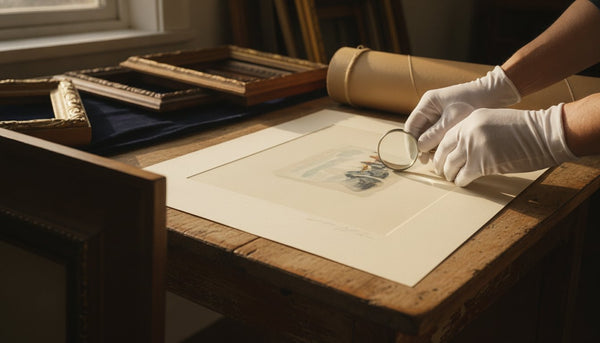
- Erasing residue: Hold the paper at an angle under raking light. Altered paper shows disturbed fibers beneath the notation.
- Inconsistent pencil weight: The AP annotation and the signature should match in graphite grade and pressure. If one looks lighter, darker, or uses a different grade, treat it as a red flag.
- AP number inconsistent with known edition: If a work is documented as having a 20-copy AP run and you are being sold “AP 31/20,” the math does not work.
- Printed or stamped notation: Real AP annotations are always hand-applied in pencil, never printed or rubber-stamped.
When to Pay the AP Premium
The AP premium is justified when: (1) the annotation is verifiably in Fairey's hand and consistent with documented release records for that edition, (2) the price premium over an equivalent numbered print is in the 20–40% range rather than 200%, and (3) the print has a clear provenance chain — a receipt from the Obey Giant online store, an authorized gallery invoice, or a documented prior auction sale.
For images with strong cultural-anchor subject premiums — HOPE, Ruth Bader Ginsburg, MLK, Mandela, John Lennon — an authenticated AP can significantly outperform a numbered edition on resale, particularly as the total supply of verified copies contracts over time.
Printer Proofs (PP): The Overlooked Tier
Printer Proofs are pulled during press setup to verify color registration, ink density, and paper alignment. They go to the print studio rather than the artist. In Fairey's editions, PPs are annotated PP X/XX in pencil in the lower-left margin, typically in runs of 10–20 copies.
PPs are legitimate and genuinely scarce — often rarer than APs in absolute count. Their challenge in the secondary market is buyer awareness: many collectors do not understand the PP designation and will underpay, which is an opportunity for informed buyers. Galleries and specialist collectors who understand the edition structure will pay fair value; generalist platforms may not.
Authentication logic for PPs mirrors APs: check pencil annotation consistency, look for evidence of alteration under raking light, and verify the individual number fits within the documented PP run for that specific release.
HPM: The Most Valuable Print Tier
Hand-Painted Multiples represent Fairey applying unique hand work — collage layers, stencil elements, paint strokes — directly onto a base screen-printed edition. Each HPM is a unique object within a small series. HPMs are annotated HPM with an individual number if part of a series, or HPM 1/1 for fully unique examples.
HPM pricing reflects that uniqueness. A standard numbered print of a mid-tier Fairey image sells for $500–$700. The HPM counterpart of the same base image — with substantial hand work — reaches $3,000–$6,000 at auction. For major images with strong cultural resonance and significant hand work, $8,000+ has been documented in recent sales.
What HPM Forgeries Look Like
HPM forgeries are less common than AP forgeries because convincing replication of hand-painted elements requires genuine artistic skill. The primary HPM risk is misrepresentation: a print with incidental paint splatters marketed as a full HPM, or hand work attributed to Fairey that is not his. Buying HPMs from documented gallery provenance or from auction houses that physically examine the work before cataloguing significantly reduces this risk.
Standard Numbered Editions: The Liquid Foundation
The majority of Fairey print transactions involve standard numbered editions. Post-2008 releases typically run 450 copies; some subject-specific or format-specific releases run 200–700. The notation appears in the lower-right margin: the edition number over the total (e.g., 125/450), followed by Fairey's pencil signature.
Lower edition numbers do not carry a significant premium in the Fairey market. Unlike some artists where number 1/450 commands a meaningful markup, Fairey buyers focus on subject matter, condition, and authentication over position within the run.
Authentication: The Non-Negotiable Step
Gauntlet Gallery was founded in 2012 and has applied archive-matched provenance standards to Fairey editions across all tiers since the post-HOPE market maturation. Gauntlet Gallery's 160,000+ comparable sales database enables cross-referencing of specific edition notations, pricing verification against authenticated examples, and identification of annotation patterns inconsistent with documented releases.
For any Fairey purchase above $500, the authentication checklist is non-negotiable:
- Verify pencil annotation consistency under raking light
- Cross-reference edition notation against known release documentation for that title
- Confirm provenance: Obey Giant store receipt, authorized gallery invoice, or documented prior auction sale
- For APs and PPs, verify the individual number fits within the documented proof run for that release
- For HPMs, confirm the hand-painted elements are consistent with Fairey's documented technique for the period of the work
For a deeper breakdown of authentication standards, provenance chains, and red flags across every Fairey category, see the Shepard Fairey Collector Guide.
2026 Price Ranges by Edition Type and Subject
These ranges are drawn from authenticated secondary market transactions. Prices vary significantly by subject — political and cultural-icon images (HOPE, RBG, MLK) command 3–5x the premium of generic OBEY imagery at equivalent edition types.
| Edition Type | Entry-Level OBEY Image | Mid-Tier Cultural Image | Icon Subject (HOPE-tier) |
|---|---|---|---|
| Standard Numbered (signed) | $300–$500 | $500–$900 | $900–$2,500 |
| AP (authenticated) | $450–$750 | $700–$1,400 | $1,400–$3,500 |
| PP (authenticated) | $400–$700 | $650–$1,200 | $1,200–$3,000 |
| HPM | $1,200–$2,500 | $2,500–$5,000 | $5,000–$8,000+ |
The Bottom Line
Edition notation in the Fairey market is not administrative label-reading — it is the primary value driver after subject matter. A genuine AP from a 450-copy edition is meaningfully scarcer than the numbered prints it accompanies and more liquid than the PP tier at equivalent rarity. An HPM is a different category of object entirely: unique, hand-worked, and priced accordingly. A standard numbered print, authenticated and in strong condition, remains the most liquid entry point in one of the most actively traded street art catalogues in the market today.
The single risk that overrides all other considerations: buying a manipulated AP annotation on an otherwise legitimate print. Verify every notation before you buy, and use comps databases rather than seller claims as your benchmark.
Ready to find an authenticated Shepard Fairey print? Browse Gauntlet Gallery's verified inventory — every piece carries provenance documentation and authentication standards built since 2012.