The Year Neil Armstrong Stopped Signing Everything Changes

1994.
That's the year Neil Armstrong largely withdrew from the autograph market. No more open signings. No more mail requests. No more dealer accommodations. The first man on the moon decided his signature had become a commodity he wanted no part of, and he pulled back with a finality that the hobby has been reckoning with ever since.
If you're buying a Neil Armstrong autograph today — or evaluating one already in your collection — that single year is the most important piece of context you can have. Not the paper. Not the ink. Not even the photo itself.
The cutoff.
Because everything signed after 1994 carries an elevated burden of proof, and a significant percentage of what circulates in the market right now doesn't clear that bar.
Why Armstrong Walked Away
Armstrong wasn't reclusive in the way mythology sometimes paints him. He gave interviews. He appeared at select events. He was, by most accounts, a gracious and thoughtful man who understood what his name meant to history.
What he didn't want was to be a signature machine.
The specific trigger was discovering that signed items he'd provided — often freely, to people he assumed were genuine fans or charitable recipients — were ending up at auction for serious money within weeks. Dealers and middlemen were working the system aggressively. Armstrong, famously private and uncomfortable with the commercialization of his achievement, found the whole enterprise distasteful.
So he stopped. Not entirely, not forever — he did sign selectively in private contexts through the rest of his life, for people he knew personally, at specific events where he felt the situation was genuine. But the open pipeline closed.
He died in 2012.
That 18-year window between the cutoff and his death is where the market gets complicated, and where forgeries and misattributed signatures have done enormous damage.
The Scale of the Forgery Problem in Space Memorabilia
To understand why the Armstrong cutoff matters so much, you need to understand how bad the broader problem got before anyone really organized a response.
FBI Operation Bullpen, which ran through the late 1990s and produced major indictments in 2000, focused primarily on sports memorabilia — but it illuminated the mechanics of how forgery operations scale. Forgers weren't producing one or two items. They were producing thousands. The same infrastructure — skilled penmen, corrupt authenticators, willing dealers — that flooded the sports market with fake Jordan and Mantle signatures was available to anyone who wanted to apply it elsewhere.
Space memorabilia was a natural target. The subjects are famous. The items are expensive. The authentication infrastructure, at the time, was underdeveloped compared to sports. And crucially, the most valuable subject — Armstrong — had stopped signing publicly, which meant any "new" supply entering the market deserved immediate scrutiny.
If he stopped signing publicly in 1994, where exactly did this item signed in 1998 come from?
That's the question every buyer should be asking. Sometimes the answer is legitimate. Often it isn't.
What Authentic Post-1994 Armstrong Looks Like (And Why That's Complicated)

Here's the honest truth about post-1994 Armstrong signatures: some are real.
He signed for personal friends. He signed for astronaut colleagues. He signed at a small number of private events and corporate appearances where the circumstances felt right to him. Authenticated examples exist from the late 1990s through the early 2000s, and some of these have legitimate provenance chains.
But "legitimate provenance chain" is doing a lot of work in that sentence.
Provenance for a post-1994 Armstrong signature needs to be airtight. We're talking about direct documentation of the circumstances: who was present, what the occasion was, ideally photographic evidence of the signing itself. A letter from a credible witness. Something that answers the origin question with specificity rather than vague assertion.
"Acquired from a private collector" is not provenance. "Came from a dealer who got it from another dealer" is not provenance. These are the kinds of statements that should make you slow down and ask harder questions.
Pre-1994 Armstrong: The Safer Zone (With Caveats)
Pre-1994 Armstrong signatures exist in greater authenticated volume. The Apollo era produced enormous quantities of signed material — NASA lithographs, mission photos, crew cards, FDCs (first day covers), presentation pieces. Armstrong signed prolifically during his public years, particularly in the decade following Apollo 11.
But "pre-1994" doesn't automatically mean "authentic." Forgers don't date their work, and the early years of space collecting weren't characterized by rigorous authentication. Plenty of pre-1994 forgeries exist, some of them quite convincing to the untrained eye.
What pre-1994 origin does is remove one specific red flag — the implausibility of origin. It doesn't substitute for proper authentication.
The Authentication Hierarchy for Space Memorabilia
Space memorabilia authentication has three primary pillars, with a specialist layer that separates serious collectors from the rest of the market.
-
Beckett Authentication Services (BAS)
Beckett is a credible first-tier authenticator with a verifiable process and public record. For space memorabilia, BAS grading carries weight in the market and is widely accepted by auction houses. Their process involves in-person examination and a documented chain of custody for submitted items.
-
JSA (James Spence Authentication)
JSA is the second major authenticator with broad market acceptance. Note the distinction between JSA Basic (a quick opinion, less documentation) and a full JSA LOA (Letter of Authenticity, which involves more rigorous examination and carries more weight). For high-value space items, you want the LOA, not just the Basic stamp.
Would you buy a six-figure item based on a cursory opinion?
-
PSA/DNA
PSA is the dominant name in the broader autograph authentication space and maintains extensive reference databases. PSA certification should always be verified through their online certification-verification system — PSA has issued specific warnings about counterfeit PSA slabs and certificates circulating in the market. If a PSA label can't be verified through their system, treat it as if it doesn't exist.
-
Zarelli Specialist Letter
This is the layer that separates serious space collecting from generalist autograph collecting. A Zarelli specialist letter — from recognized space memorabilia specialist John Zarelli — provides context and expertise that general authenticators simply don't have. Zarelli's familiarity with the specific signing habits, known variants, and provenance patterns of major astronauts including Armstrong means his opinion carries disproportionate weight on significant pieces.
For any Armstrong signature above a certain value threshold, a Zarelli letter isn't optional. It's what separates a piece that top collectors will take seriously from one that creates friction at resale.
The authentication canon at Gauntlet Gallery for space memorabilia requires all three major authenticators (BAS, JSA, PSA) plus a Zarelli specialist letter on significant pieces. Not two out of four. Not "well, PSA is there so we're good." The full stack.
Reading the Signature Itself: What Changes Armstrong's Hand
Forensic document examiners and experienced space memorabilia specialists have documented distinct periods in Armstrong's signature evolution. Understanding these periods isn't about becoming a self-taught authenticator — it's about knowing enough to ask the right questions.
The Classic Period (Apollo Era Through the 1970s)
Armstrong's Apollo-era signature is fluid and relatively expansive. The "N" in Neil shows characteristic construction. The "A" in Armstrong has specific traits in how the apex forms and how the crossbar sits. The overall character of the signature in this period reflects someone who signed frequently and with some comfort in the act.
The Transition Period (1980s)
Through the 1980s, Armstrong's signature shows gradual compression. He was signing less frequently for public purposes, and the signature reflects this — slightly more deliberate, some subtle changes in letter formation. Pieces from this period exist in meaningful quantity but require attention to these transitional characteristics.
The Later Period (Post-1994 Where Authenticated)
Authenticated late-period Armstrong signatures show further evolution. The signature becomes more compact, the pen pressure varies differently than in earlier examples. Forgers working from reference images of classic Apollo-era signatures often produce pieces that look "right" in a general sense but carry tell-tale period inconsistencies — the classic-era flourishes on a supposedly late-period piece, or vice versa.
This is exactly the kind of analysis a Zarelli specialist letter addresses and that generalist authenticators may not catch with the same precision.
The Item Type Matters as Much as the Signature

What Armstrong signed matters for understanding both value and authenticity risk.
| Item Type | Relative Availability (Pre-1994) | Forgery Risk Level | Notes |
|---|---|---|---|
| NASA Lithographs / Official Photos | High | High | Most commonly forged category; huge existing supply of unsigned copies |
| First Day Covers (FDCs) | High | Moderate-High | Popular in earlier era; postmark provides some dating context |
| Books / Publications | Moderate | Moderate | Unsigned copies widely available; full provenance important |
| Crew Cards | Moderate | High | Mission crew cards with full crew signatures command premium; multi-sig forgery risk |
| Personal Items / Inscribed Pieces | Low | Lower (with provenance) | Specificity of inscription can authenticate; needs tight provenance |
| Flown Items | Very Low | Very High | Highest value category; most rigorous documentation required; NASA records cross-reference essential |
Flown items — objects with documented history of having traveled to space — represent the apex of the space memorabilia market. The authentication burden on these is extreme. NASA has records. Mission archives exist. The chain of custody from space to your hands should be documentable through multiple independent sources, not just a seller's assertion.
Can you trace this piece from the mission manifest to today, step by step, without gaps?
If the answer is no, the premium commanded by "flown" provenance isn't justified.
The Full Apollo 11 Crew Situation
Armstrong didn't sign alone on Apollo 11. Buzz Aldrin and Michael Collins were there too, and crew-signed items — particularly those bearing all three signatures — carry significant additional value and proportionally significant forgery risk.
Aldrin has remained more accessible to the signing market than Armstrong. Collins was moderately accessible before his death in 2021. The combination of Armstrong's scarcity, Collins' post-2021 scarcity, and Aldrin's continued (if selective) availability creates a specific dynamic in full crew items.
Forgers understand this dynamic. A full crew signed Apollo 11 photograph, if authentic and well-documented, is a serious piece. The forgery operation targets exactly these high-value configurations. The presence of an authentic Aldrin signature alongside a forged Armstrong and forged Collins is not unheard of — it complicates visual authentication and can lend false credibility to the ensemble.
Full crew items need individual evaluation of each signature, not just a holistic impression that "it looks right."
Why the Secondary Market Gets This Wrong
The secondary market for space memorabilia — auction houses, dealers, show vendors, online platforms — gets Armstrong authentication wrong for several interconnected reasons.
First, the generalist problem. Many auction specialists are experts in, say, sports or entertainment memorabilia. Space is a category they handle but don't specialize in. Their authentication resources are calibrated for their primary categories. The nuances of Armstrong's signing history and the specific markers that distinguish period-appropriate signatures from forgeries aren't necessarily in their repertoire.
Second, the provenance inflation problem. Sellers know that provenance adds value, so provenance gets inflated. "From the collection of a former NASA employee" sounds compelling. It might even be true. But it doesn't document how that former NASA employee came to possess a signed Armstrong photo, or whether it was authentic when they acquired it. Provenance requires specificity and verification, not just appealing context.
Third, the authentication layering problem. A piece with one authenticator's opinion gets resold to someone who adds a second opinion, and the accumulation of documentation creates an impression of rigor that may not exist. PSA certification on a previously JSA-certified item doesn't double the authentication quality — it just adds another opinion. If the underlying piece is a forgery, multiple opinions on a forgery is still a forgery.
How many authentication stickers does it take to make a fake signature real?
The answer is zero. Documentation doesn't transform the underlying object. The object either is what it is, or it isn't.
Red Flags

Here is what should make you stop and ask harder questions before any Armstrong autograph purchase.
-
Post-1994 origin with vague provenance
If the item is represented as signed after 1994 and the provenance story is "from a private collection" or "dealer sourced," that's not provenance. That's an absence of provenance dressed up as a statement.
-
Authentication from a single source only
One authenticator's opinion, even a reputable one, is not sufficient for a significant Armstrong piece. The absence of a Zarelli specialist letter on anything above a certain value threshold is itself a flag. Why wasn't the specialist consulted?
-
PSA certification that can't be verified online
PSA has been explicit about counterfeit certifications circulating in the market. If a PSA label is present but the certification number doesn't return a valid result through PSA's verification system, walk away. Full stop.
-
Signature characteristics inconsistent with claimed period
An Armstrong signature that displays classic Apollo-era characteristics but is represented as late-period (or vice versa) should prompt expert examination. Not just a visual impression — actual forensic-level examination.
-
Price significantly below market for the category
Authentic, well-documented Armstrong signatures command serious prices. If something is priced dramatically below where comparable authenticated examples trade, the correct response is not excitement. It's suspicion. Why is this one cheap?
-
Flown provenance without NASA cross-reference
Any claim that an item flew on a mission needs to be checkable against NASA archival records. A seller's claim or a generic COA asserting "flown" provenance without external documentation is not sufficient.
-
Rushed transaction pressure
Legitimate sellers of significant pieces don't pressure timelines. If you're being pushed to decide before you can do due diligence, the urgency is a feature of the transaction for a reason that benefits the seller, not you.
-
Missing JSA LOA in favor of JSA Basic
For significant pieces, the distinction between JSA's Basic opinion and a full JSA LOA matters. If a seller is presenting JSA Basic as equivalent to a full Letter of Authenticity, they either don't understand the distinction or they do and are hoping you don't.
What Proper Documentation Actually Looks Like
For a serious Armstrong piece to clear the bar that careful collectors and institutional buyers expect, here's what the documentation stack should include.
-
Provenance narrative
Specific, verifiable origin story. Named individuals, specific occasions, corroborating documentation where possible. The more specific, the better. Generic statements of origin are a red flag, not a feature.
-
BAS certification
Full Beckett examination with certificate number. Verifiable through Beckett's system.
-
JSA Letter of Authenticity (full LOA, not Basic)
Full JSA examination with LOA documentation. Certificate number verifiable through JSA's system.
-
PSA/DNA certification
PSA slab or certificate with certification number that returns a valid result through PSA's online certification-verification system. If it can't be verified, it doesn't count.
-
Zarelli specialist letter
For significant pieces, this is not optional. The specialist's opinion on period consistency, signing characteristics, and any provenance considerations is the layer that separates a properly documented piece from a generically authenticated one.
-
Photographic documentation
High-resolution images of the signature, the document verso, any labels, COAs, and associated documentation. Ideally, photographic evidence of the signing itself where such evidence exists.
The Collector Mindset That Protects You
The collectors who don't get burned in the Armstrong market share a common trait: they treat skepticism as a feature, not an obstacle.
The default posture when evaluating any significant Armstrong signature should be: this is probably not authentic until the evidence convinces me otherwise. Not the reverse. Extraordinary pieces require extraordinary documentation, and the burden of proof rests with the provenance, not with your desire to own the piece.
This runs counter to how many collector transactions feel in the moment. You find something you want. You want reasons to buy, not reasons to walk. A good seller, a convincing story, a plausible narrative — these lower your guard at exactly the moment your guard needs to be up.
The Armstrong market specifically rewards patience. Genuine, well-documented pieces surface at auction and through reputable dealers regularly enough that there's no scarcity of opportunity. The scarcity is in the documentation quality, and that's the constraint that should govern your decisions.
Buy the documentation. The signature comes with it.
Red Flags Summary
Before we close, here's the condensed version for quick reference.
- Post-1994 origin + vague provenance = stop
- Single authenticator on a significant piece = ask why
- PSA certification that can't be verified online = walk away
- Period-inconsistent signature characteristics = expert review required
- Price dramatically below market = suspicion, not excitement
- Flown provenance without external documentation = unverified claim
- Rushed transaction = seller's urgency, not yours
- JSA Basic presented as equivalent to JSA LOA = misrepresentation
- No Zarelli letter on a significant piece = incomplete authentication
Bottom Line
Neil Armstrong's 1994 signing cutoff isn't a footnote. It's the organizing principle of the authentication challenge in the most important category of space memorabilia.
Everything signed after that year carries elevated scrutiny by definition, because the legitimate supply dramatically contracted while demand — and therefore forgery incentive — only grew. The gap between what exists in the market and what can be authenticated to the highest standard is real, and it's significant.
The authentication framework exists for exactly this reason. BAS, JSA, and PSA provide the foundation. A Zarelli specialist letter provides the expertise layer that turns foundation into conviction. Provenance narrative provides the origin story that makes the whole chain coherent.
Without all of it, you're not buying a Neil Armstrong autograph. You're buying a story about one.
Gauntlet Gallery handles space memorabilia with the full authentication stack required. If you're evaluating a piece or looking for guidance on what proper documentation should look like for a specific item, reach out directly. This is exactly the kind of conversation we're here for.
Frequently Asked Questions
Did Neil Armstrong completely stop signing autographs in 1994?
Not completely, but the public pipeline closed. After 1994, Armstrong signed selectively — for personal acquaintances, at very specific private occasions, and in circumstances where he felt the signing wasn't being commercialized. What ended was the open-access signing that had produced large volumes of authenticated material through the earlier decades. Post-1994 authentic examples exist, but they're fewer in number and require particularly rigorous documentation because the normal verification of "he was signing publicly at this time" no longer applies.
Why does the Zarelli specialist letter matter if I already have PSA, BAS, and JSA?
The three major authenticators are generalists operating at scale. They examine enormous volumes of material across dozens of categories. Their expertise is broad by necessity. John Zarelli's specialization in space memorabilia means he brings category-specific knowledge — the particulars of Armstrong's signing history, the period characteristics of his signature, the known provenance patterns for significant pieces — that generalist authenticators may not have at the same depth. For significant pieces, that specialist layer is what separates authentication that satisfies knowledgeable buyers from authentication that raises questions at resale.
How do I verify a PSA certification is genuine?
PSA's website provides a certification verification tool where you can enter the certification number from a PSA slab or certificate and confirm it matches the described item in their database. PSA has issued warnings about counterfeit slabs and certificates circulating in the market, so the verification step is not optional. If the number doesn't return a matching result, the PSA documentation cannot be treated as valid regardless of how authentic it appears physically.
What's the difference between a JSA Basic opinion and a JSA LOA?
JSA Basic is a quick examination that results in a stamp or sticker opinion. It's faster and less expensive, which also means it's less rigorous. A JSA LOA (Letter of Authenticity) involves a more thorough examination and results in a formal letter with detailed documentation. For significant space memorabilia, the LOA is the appropriate level of JSA authentication. Basic opinions are more appropriate for lower-value items where the economics of full LOA examination don't pencil out. When a seller presents a JSA Basic on a high-value piece as equivalent to a full LOA, treat that as a flag.
Are pre-1994 Armstrong signatures automatically trustworthy?
No. Pre-1994 origin removes one specific red flag — the implausibility of origin in a period when Armstrong wasn't signing publicly — but doesn't substitute for authentication. Pre-1994 forgeries exist in meaningful quantities. The authentication requirements don't change based on claimed date; what changes is the nature of the scrutiny. For pre-1994 pieces, you're asking whether the signature is genuine. For post-1994 pieces, you're asking both whether it's genuine and where it plausibly came from.
What makes flown space memorabilia different from regular signed pieces?
Flown items — objects with documented history of having been carried on a space mission — represent the apex of the market and the highest authentication burden. The claim of "flown" provenance requires documentation that goes beyond autograph authentication into mission archival records. NASA maintains records of items carried on missions, and those records can be cross-referenced against provenance claims. A seller's assertion or a generic certificate claiming "flown" status without external documentary support is not a verified claim — it's an assertion. The premium commanded by authentic flown provenance is significant, which means the incentive to fraudulently claim it is also significant.
I have an Armstrong signature I inherited. How do I evaluate it?
Start with the basics: What do you know about when and where the family member obtained it? Are there any letters, photographs, or records of the circumstances? The more specific the family story, the more useful it is as provenance. Then have the piece examined by at least one of the major authenticators — PSA, BAS, or JSA — to get a baseline opinion. For anything that comes back as authenticated and appears to have meaningful value, pursue the full stack: all three major authenticators and a Zarelli specialist letter. Don't assume family provenance alone establishes authenticity; it provides useful context, but the signature itself needs to be examined.
Does Gauntlet Gallery buy or broker Armstrong autographs?
Gauntlet Gallery works with space memorabilia that meets our authentication standards — which means the full stack of BAS, JSA, PSA, and Zarelli specialist letter for significant pieces, combined with documented provenance. We don't cut corners on documentation requirements because the resale market for serious collectors demands rigor, and our reputation is built on pieces that hold up to scrutiny. If you have a piece you're looking to evaluate, sell, or authenticate through the appropriate channels, reach out directly. The conversation doesn't cost anything, and knowing where your piece actually stands in the market is always worth having.
Shop Space memorabilia
Explore current pieces available from the gallery.
-
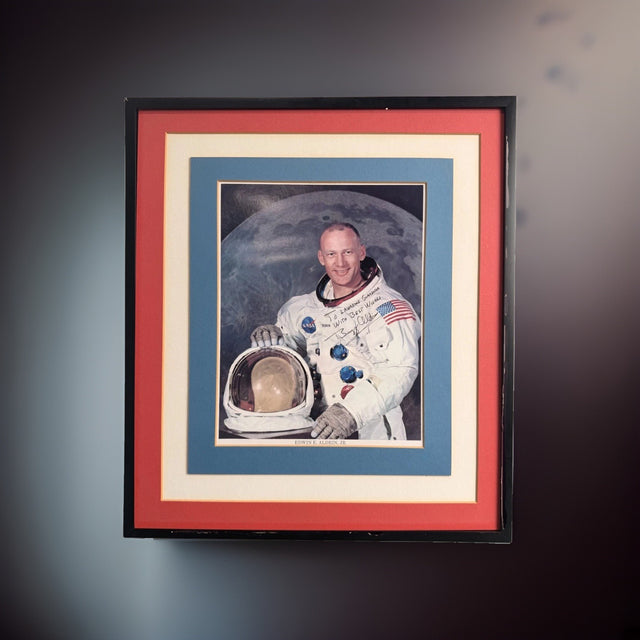
Buzz Aldrin Signed NASA 8x10 Color Photo Personalized Framed JSA LOA
$899.00 USD
-
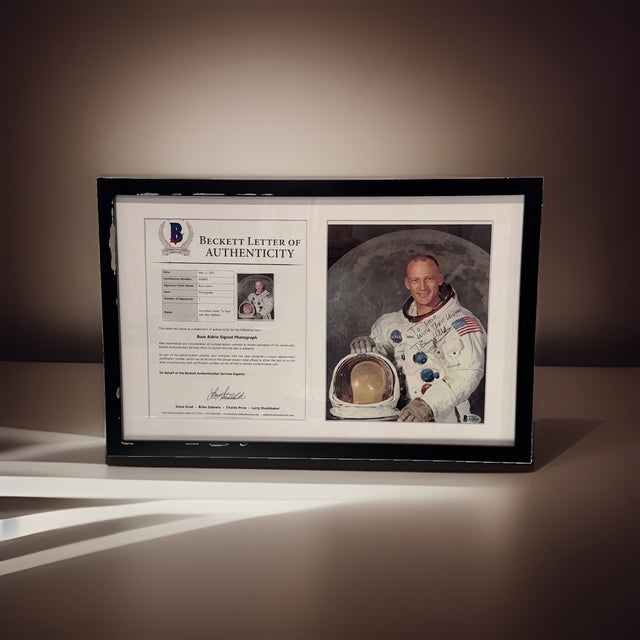
Buzz Aldrin Signed Inscribed Astronaut Photo Framed Beckett LOA A42843
$999.00 USD
-
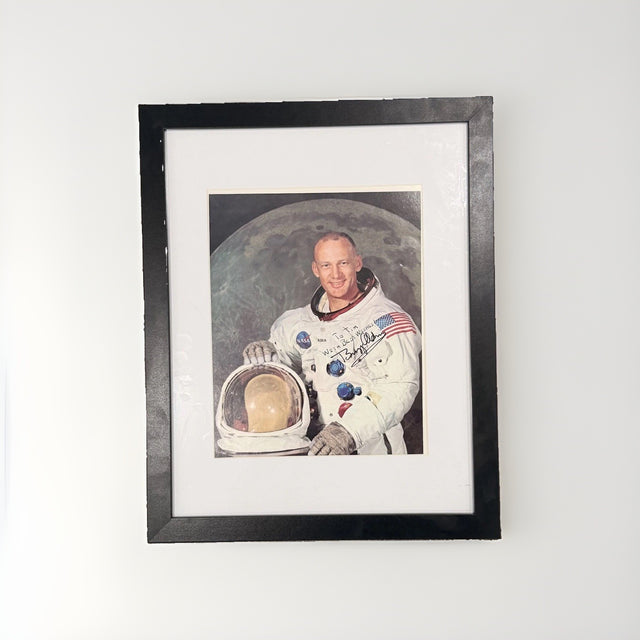
Buzz Aldrin Signed NASA Astronaut Portrait Inscribed To Tim Framed
$850.00 USD
-
SpaceX Starship Super Heavy Blueprint Metal Display Panel Spacecraft Frame
$59.00 USD
-
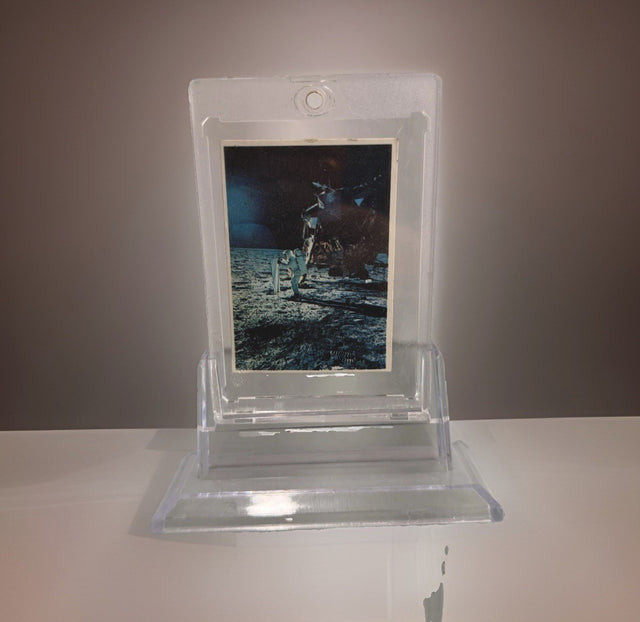
1969 Space Candy Buzz Aldrin Apollo 11 On The Moon Card #19 Taylor-Reed Display
$59.00 USD
-
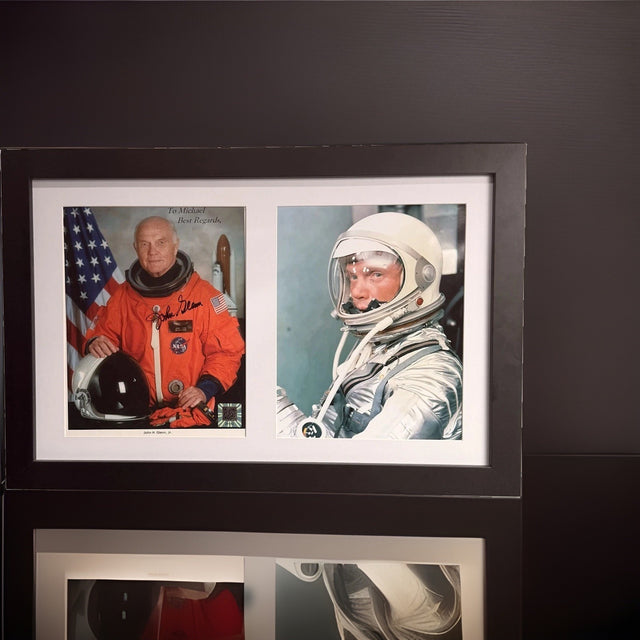
John Glenn Signed Autographed NASA Photo Display JSA Mercury Astronaut Framed
$199.00 USD
Browse the collection for current listings.