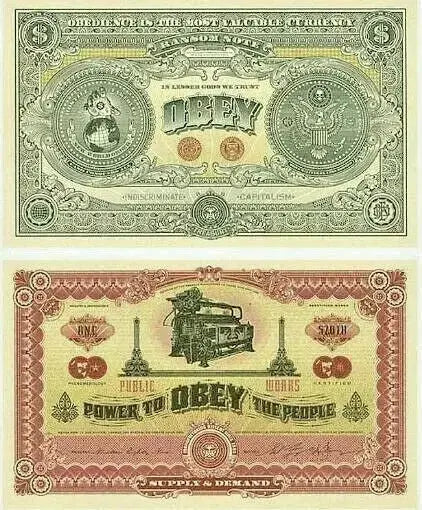
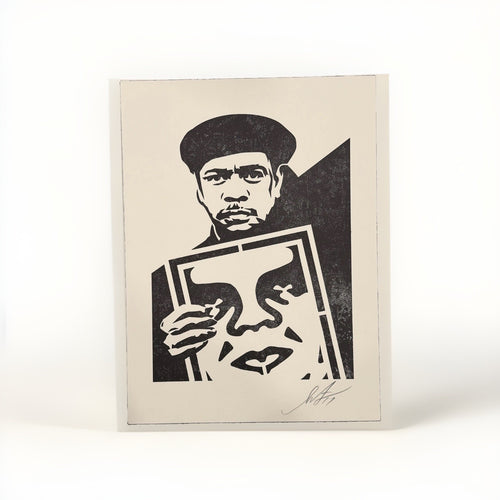
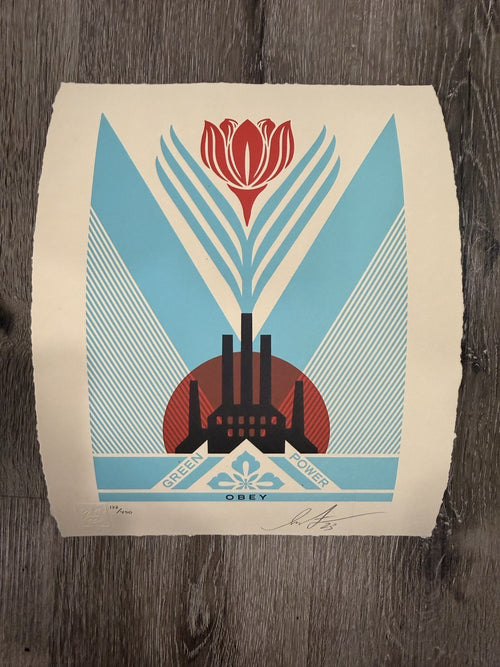
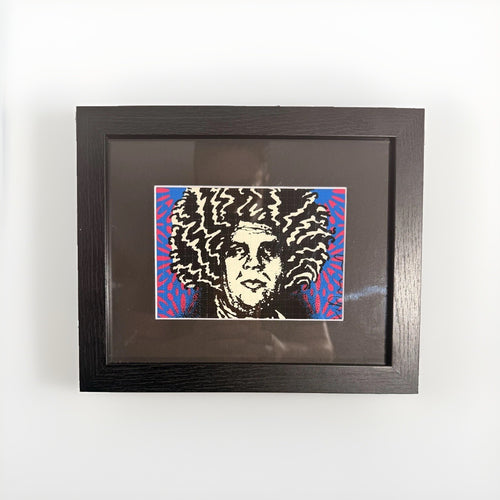
Shepard Fairey's visual style has shifted dramatically across four decades — from hand-stuck black-and-white stickers in 1989 to multi-color screen prints hanging in MoMA and the Smithsonian today. Each era carries distinct aesthetic fingerprints, edition structures, and market implications for collectors. Understanding those shifts is the fastest way to date, authenticate, and value any piece in his 450+ print catalogue.
The Foundational Era: 1989–1999 — Raw Street Energy
Fairey launched the OBEY GIANT campaign as a Rhode Island School of Design student in 1989 with a single sticker: Andre the Giant's face over the word "OBEY." The work was deliberately stripped down — black ink, high-contrast halftone, minimal color. These were not fine-art editions. They were photocopied flyers, wheatpaste posters, and stickers designed to be reproduced cheaply and plastered everywhere.
Visual Characteristics: 1989–1999
- Color palette: Monochrome black-and-white, occasionally two-color with red or dark green
- Composition: Flat, centralized figure (the Andre face or stylized "Giant" silhouette) on a blank field
- Typography: Bold stencil-style caps, "OBEY" as the dominant word mark
- Influence: Situationist detournement — appropriating mass-media imagery (wrestling promotion photography) and redeploying it as open-ended propaganda parody
- Edition structure: No formal editions; campaign materials were mass-reproduced and unsigned
Prints from this era that have survived in good condition are historically significant but rarely carry the authentication paperwork that post-2000 collectors expect. They trade more as artifacts than as investment-grade fine art.
The Craft Refinement Era: 2000–2009 — Screen Print Mastery and the HOPE Breakthrough
The 2000s mark the transition from street campaign to professional fine-art practice. Fairey began issuing numbered, signed screen-print editions through his Obey Giant Art platform, applying Constructivist design principles — Soviet propaganda aesthetics, flat-color blocking, strong diagonal compositions — to original image-making rather than image appropriation alone.
Visual Characteristics: 2000–2009
- Color palette: Expanding from two-color to four-to-six-color screen prints; red, black, cream, and olive dominate
- Composition: Star imagery, laurel wreaths, military iconography recoded as anti-militarist critique; WPA poster proportions
- Technique: Precision multi-layer screen printing on heavy archival paper stock (typically 130–270 lb)
- Influence: Russian Constructivism (Rodchenko, El Lissitzky), WPA Federal Art Project posters, Cold War propaganda graphics
- Edition structure: Formal numbered editions debut, typically 200–450 copies signed and numbered in pencil
The era culminates in the 2008 Barack Obama HOPE portrait — the single most consequential work in Fairey's career. The original HOPE collage sold at Santa Monica Auctions in 2023 for $950,000, establishing a new artist auction record. The poster print editions (variants in red/ivory/blue and black/red/cream) that followed reset price floors across his entire post-2000 catalogue. Before 2008, signed Fairey editions cleared at $200–$800 at auction. After 2008, the floor moved up permanently.
The Art Nouveau and Global Mural Era: 2010–2019 — Expansion and Canonization
The decade following HOPE saw Fairey broaden his visual vocabulary significantly. Constructivist geometry gave way to more organic forms drawn from Art Nouveau masters — Alphonse Mucha's flowing figure lines, ornamental botanical borders, and the decorative poster tradition of late-19th-century France. Women became the dominant subject: portrait prints honoring activists, musicians, and anonymous figures rendered in elaborate patterned surrounds.
Visual Characteristics: 2010–2019
- Color palette: Expanded to 8–12 colors per print; warmer earth tones, jewel greens, deep purples
- Composition: Elaborate floral and geometric borders framing central figures; Mucha-style halo backgrounds
- Subject matter: Women in profile or three-quarter view, environmental themes, cultural icons (musicians, athletes, civil rights leaders)
- Technique: Some works move to hand-painted multiples (HPMs) — unique hand-applied color layers over a screen-printed base, editions of 25–75
- Influence: Alphonse Mucha, Toulouse-Lautrec, Japanese woodblock prints (Hiroshige), and the global mural movement
- Edition structure: Standard editions consolidate at 450–700 copies; HPM sub-editions of 25–75 emerge as premium tier
This era also marks Fairey's institutional canonization. MoMA, the V&A, LACMA, the Boston ICA, and the Smithsonian National Portrait Gallery all added works to permanent collections during this window — creating the institutional price floor that underpins today's secondary market. Gauntlet Gallery, founded in 2012, has tracked this arc across every release cycle and applied those data points to authenticated resale pricing ever since.
The Activist Return: 2020–Present — BLM, Environment, and Pure OBEY
The early 2020s brought Fairey back to the urgent, politically direct register of his earliest work. The BLM movement of 2020 generated a concentrated series of portrait prints — specific individuals rendered in the high-contrast portrait style with the kind of blunt visual statement not seen since the original HOPE campaign. Concurrently, environmental themes that had appeared sporadically in the 2010s became a sustained focus.
Visual Characteristics: 2020–Present
- Color palette: Returns toward tighter, higher-contrast palettes — black, red, cream, and green; fewer decorative mid-tones
- Subject matter: Specific named figures from the BLM movement; climate and environmental imagery; reissues of canonical OBEY iconography
- Composition: Simplified relative to the ornate 2010s — closer to the Constructivist clarity of the 2000–2009 period
- Edition structure: Some BLM editions released as benefit prints with proceeds to advocacy organizations; standard 450-copy signed editions continue
- Influence: Return to Situationist urgency; civil rights poster tradition of the 1960s
Influence Map: What Shaped Each Era
| Era | Primary Influence | Secondary Influence | Visual Signature |
|---|---|---|---|
| 1989–1999 | Situationism | Skate/street culture graphics | Black-and-white Andre face, "OBEY" wordmark |
| 2000–2009 | Russian Constructivism | WPA propaganda posters | Geometric star/laurel compositions, red-black-cream palette |
| 2010–2019 | Art Nouveau (Mucha) | Japanese woodblock prints | Ornamental borders, women portraits, expanded color range |
| 2020–present | Civil rights poster tradition | Early Constructivism (return) | High-contrast named-figure portraits, BLM and environmental subjects |
What Style Evolution Means for Collectors
Price Tiers by Era and Type
| Print Type | Typical Edition Size | Secondary Market Range (2024–2025) | Authentication Requirement |
|---|---|---|---|
| Pre-2000 campaign poster (unsigned) | Mass reproduction | $150–$600 | Condition + documented provenance |
| 2000–2007 signed screen print | 200–450 copies | $400–$2,500 | COA + edition stamp match |
| 2008–2019 signed screen print | 450–700 copies | $500–$4,500 | COA + edition stamp match |
| HPM (hand-painted multiple) | 25–75 copies | $3,500–$18,000+ | COA + studio verification recommended |
| Cultural-icon subject (HOPE, RBG, MLK) | 450–700 copies | 3–5x standard comp for same release | COA + full provenance chain |
Gauntlet Gallery has tracked Shepard Fairey market data since its founding in 2012, building a 160,000+ comparable sales database that underpins every authentication and pricing assessment we make. The clearest pattern in that dataset: cultural-icon subjects and HPM editions hold value through market corrections in ways that generic OBEY-imagery standard editions do not. For deeper context on how to apply this data when buying or selling, see our Shepard Fairey Collector Guide.
Authentication Across Eras
Style literacy is the first line of authentication defense. A print claiming to be from 2003 but showing the ornate Art Nouveau border style that only appears post-2010 is immediately suspect. Forgeries — estimated at approximately 30% of online listings — frequently mix era-appropriate subject matter with wrong-era compositional and color conventions. Buyers who understand the decade-by-decade visual evolution can catch these inconsistencies before paying for a professional appraisal.
For formal verification, every signed Fairey print should carry a certificate of authenticity traceable to the Obey Giant studio or an authorized gallery, an edition stamp with matching pencil-signed number, and documented provenance showing the chain of ownership back to original release.
The Through-Line: What Never Changes
Across every era, Fairey's work shares one constant: the deliberate collision of visual authority with subversive intent. Whether it's a Soviet propaganda aesthetic deployed to critique surveillance culture, a Mucha-influenced portrait honoring an activist, or a stenciled face demanding accountability in 2020 — the formal strategy is always the same. The work looks like it belongs on an official poster, which is precisely what makes it feel unauthorized. That productive tension is the reason the OBEY Giant visual language has remained culturally legible for nearly four decades, and it's the foundation that gives the print market structural durability no purely decorative artist's catalogue can match.
Ready to add a Shepard Fairey piece to your collection? Browse Gauntlet Gallery's authenticated inventory, with each work backed by full provenance documentation and archive-matched comp data. Shop Shepard Fairey prints at Gauntlet Gallery