Store Shepard Fairey prints flat in archival folders at 65–72°F and 40–55% relative humidity, and frame them behind 99% UV-filtering acrylic — not standard glass. Those two rules alone protect the largest share of resale value. Everything below explains exactly how to execute both, and what mistakes most collectors make that silently erode what they paid.
Why Storage and Framing Matter More Than You Think
Fairey prints are paper-based screen prints or offset lithographs on stock ranging from 80 lb uncoated to 300 gsm archival cotton rag, depending on the edition tier. Paper responds directly to its environment. At Gauntlet Gallery, founded in 2012, we have tracked condition-adjusted resale data across 160,000+ comparable sales and the pattern is consistent: prints in conservation storage sell for 25–40% more at auction and on secondary markets than identical editions in poor condition. A $3,500 signed edition of Andre the Giant Have a Mercy in near-mint condition does not compete with the same print showing light fading or acidic mat burn. They are different products to a serious buyer.
Flat Storage: The Non-Negotiable Baseline
Never Store Rolled Long-Term
Fairey prints frequently arrive in mailing tubes. That is a shipping format, not a storage format. Within two weeks of receipt, unroll the print and store it flat. Extended rolling creates memory in the paper — the print will never lie completely flat again without pressure — and causes micro-stress fractures in screen-print ink layers that are invisible to the naked eye but visible under UV light and to experienced graders.
Keep the Original Tube as a Provenance Asset
Do not discard the original shipping tube. Auction houses, gallery consignment desks, and private buyers use the presence of original packaging as a provenance checkpoint. A tube with Obey Giant packing tape, return address, and the collector's original shipping label is a small but real authentication signal. Store the flattened print separately; store the tube in a closet or flat file cabinet drawer.
Archival Folders and Solander Boxes
For prints not yet framed, use either:
- Polyester archival sleeves (Mylar Type D or equivalent) for individual prints — these are inert and will not off-gas acids
- Acid-free portfolio folders with interleaving glassine sheets between prints to prevent ink transfer
- Solander boxes (clamshell archival boxes) for edition sets or multiple prints stored together
Do not use standard plastic page protectors or poly bags. Many retail plastics contain plasticizers that off-gas and deposit a residue on print surfaces over years.
Climate Control: Temperature and Humidity Targets
| Parameter | Target Range | Damage Threshold | Typical Problem Cause |
|---|---|---|---|
| Temperature | 65–72°F (18–22°C) | Below 50°F or above 80°F | Attic, garage, un-insulated storage unit |
| Relative Humidity | 40–55% RH | Below 30% or above 65% | Basement, bathroom proximity, dry heated rooms in winter |
| Light Exposure | Zero direct UV | Any unfiltered sunlight | South/west-facing rooms, uncovered windows near display wall |
| Air Quality | Low particulate, stable | Visible dust accumulation | HVAC vents, open shelving in high-traffic areas |
A $30 digital hygrometer/thermometer placed in the same room as stored prints is the cheapest insurance you can buy. Check it monthly. If readings are out of range, a small room humidifier or dehumidifier corrects most residential environments for under $80.
Framing: The $300–$700 Investment That Pays for Itself
UV-Filtering Acrylic, Not Standard Glass
This is the single most important framing decision for a Fairey print. Standard glass blocks roughly 45–50% of UV radiation. Museum-grade acrylic — Tru Vue Optium Museum Acrylic is the benchmark product — blocks 99%+ of UV and also reduces glare without the blue cast that older anti-reflective glass produces.
UV fading is not theoretical. Warm pigments — the reds and oranges that dominate Fairey's HOPE palette, his concert poster work, and the Andre the Giant colorways — degrade measurably faster than cool blues and greens. A Fairey print displayed behind standard glass in a room with three hours of indirect light exposure per day can show visible color shift within seven to ten years. Behind museum acrylic, the same print will show negligible change over decades. Sun fading can destroy 30–60% of resale value on color-critical works, and there is no reversing it.
Budget Guidance by Print Tier
| Print Tier | Typical Secondary Market Value | Recommended Framing Budget | Minimum Acceptable |
|---|---|---|---|
| Standard edition (unsigned, 450–700 prints) | $200–$600 | $150–$250 | UV acrylic + acid-free mat |
| Signed edition (450–700 prints) | $600–$1,800 | $300–$500 | Museum acrylic + archival mounting |
| Signed AP / Remarque (15–50 prints) | $1,800–$5,000 | $400–$700 | Full conservation framing, float mount |
| HPM hand-painted multiple | $5,000–$25,000+ | $600–$1,200+ | Custom conservation framing, hinge mount |
Acid-Free Matting
Standard matboard contains lignin and acids that migrate into paper over time, leaving a visible brown stain line called mat burn. This is a hard grading deduction — it reads as "damage" on any condition report. Use only 100% rag or alpha-cellulose conservation matboard with a pH of 8.0 or higher. When in doubt, ask the framer to show you the matboard packaging. Conservation-grade mat is not expensive; it adds roughly $20–$40 to the job over commodity matboard.
Archival Corner Mounting, Not Adhesive
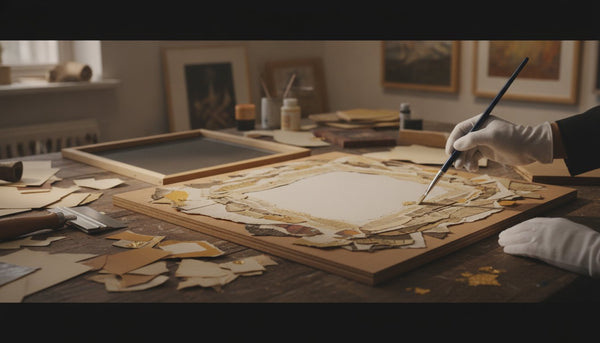
Never allow a framer to dry-mount, wet-mount, or tape-hinge a Fairey print directly to a backing board. Dry mounting bonds the print permanently to the substrate — it is irreversible and destroys resale value instantly. Tape hinges leave adhesive residue that yellows and stains the paper margin over time.
The correct methods:
- Archival corner mounts — polyester or paper pockets that hold the print by its corners with no adhesive contact with the print surface
- Conservation hinges with reversible starch paste (for larger or heavier prints where corners alone cannot support the weight)
Float Mounting to Preserve Deckle Edges
Many Fairey prints — particularly letterpress, woodblock, and higher-edition offset works — have deckle edges (the rough, untrimmed paper edge). Floating the print on a backing board, with the entire sheet visible against a complementary background color, preserves this detail and signals to buyers that the print has not been trimmed to fit a cheaper pre-cut mat. Deckle preservation is a positive condition note in grading reports. It adds no cost; it only requires that your framer uses corner mounts or hinge mounts rather than slipping the print under a window mat that covers the edges.
Light and Display Placement
Even behind 99% UV acrylic, placement matters. The acrylic handles UV; it does not eliminate cumulative photon exposure at visible wavelengths. High-intensity LED spotlights aimed directly at a print for eight or more hours daily will produce measurable fading over a decade, even without UV. Best practices:
- Hang on an interior wall, not opposite a south- or west-facing window
- Use ambient room lighting rather than direct track spotlights on the print surface
- If spotlights are used for display, keep lux levels below 150 at the print surface (a standard light meter app can check this)
The Provenance Preservation Checklist
Conservation is not just physical care — it is documentation. Every item listed below adds to a print's provenance chain and is verifiable by a buyer before purchase:
- Original certificate of authenticity (COA) from Obey Giant Art or the issuing gallery — store flat in archival sleeve, never folded
- Original shipping tube with Obey packing materials
- Original receipt or order confirmation from Obey Giant Art, Printed Editions, or the primary gallery
- Any gallery exhibition documentation or press materials associated with the edition
- Photos taken at receipt showing unrolled condition before framing
A print with complete documentation and conservation framing will consistently outperform an identical edition with degraded provenance records on any sales platform. Refer to the Shepard Fairey Collector Guide for a full breakdown of edition tiers, authentication markers, and current market comps by subject category.
What to Do When You Receive a New Print
The first 48 hours after a print arrives set the trajectory for its long-term condition. Here is the correct sequence:
- Photograph the outside of the shipping tube or package before opening
- Open carefully, document the interior packing materials
- Unroll slowly on a clean, flat surface — do not force flat; let the paper relax under light weight for 24–48 hours
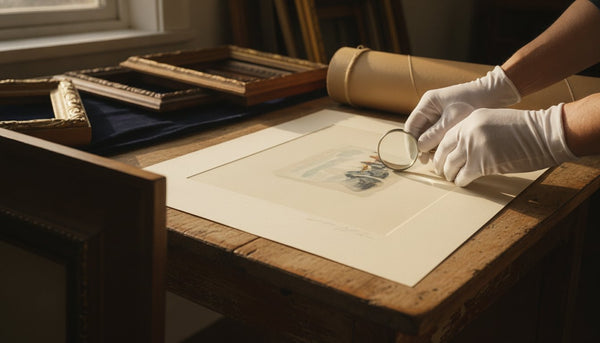
- Examine under good daylight lighting for any shipping damage — note any observations
- Photograph front and back of the print at full resolution
- Place in archival sleeve or between glassine sheets in an acid-free folder while framing is arranged
- Commission conservation framing within 90 days; do not leave valuable prints in flat storage indefinitely without UV protection
Shepard Fairey prints bought at the right tier and stored correctly hold and grow value. The conservation steps in this guide are not complicated — they are simply specific. Getting the framing wrong is the most common and most costly mistake Fairey collectors make, and it is entirely avoidable.
Browse currently available authenticated Shepard Fairey prints, including signed editions and hand-painted multiples, at Gauntlet Gallery's Shepard Fairey collection. Every piece ships with full provenance documentation and conservation framing guidance.