DEATH NYC Woman Gucci GG Logo Signed Ltd Ed Print COA Street Pop Art — Collector Guide, Value & Authentication
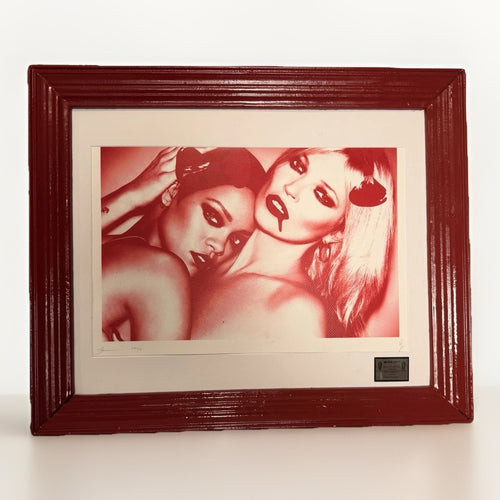
The gallery went silent when this dropped. A mysterious woman emerges from luxury's fever dream — her crimson lips blazing, scarlet flowers cascading across monochrome skin, while Gucci's sacred GG monogram bleeds across designer wallpaper like digital prayer flags. Yellow lightning strikes. Blue Om symbols whisper ancient secrets across the composition. DEATH NYC's Woman Gucci GG Logo is not just a print. It is a collision of worlds — fashion cathedral meets spiritual cosmos, desire pressed flat and signed by hand.
Founded in New York in 2013, DEATH NYC built its reputation by weaponizing the visual grammar of luxury brands and fine art icons, fusing them into limited edition prints that hang in the uneasy space between reverence and subversion. This piece is among the studio's most layered works: every square inch of the composition is working overtime, dense with meaning the way a designer runway show is dense with intention.
What This Print Depicts
At its core, this print is a meditation on the modern feminine — refracted through two entirely different spiritual and commercial lenses simultaneously. The central figure, a woman rendered in graphic monochrome, reads as both icon and cipher. Her crimson lips carry the weight of a thousand perfume campaigns; the scarlet flowers are simultaneously baroque portraiture and contemporary editorial.
The Gucci GG monogram — Alessandro Michele's resurgent symbol of neo-maximalism — tiles across the background like sacred wallpaper in a cathedral of consumption. When DEATH NYC drops a luxury logo into a composition, it is never decoration. The GG pattern here functions as environment, as atmosphere, as the air the figure breathes. Gucci's house code, born in 1921, has cycled through aristocratic restraint and flamboyant excess; DEATH NYC captures it at its most spiritually charged, the logo rendered less as branding and more as talisman.
The blue Om symbols (ॐ) pierce the composition like anchors. Om is the primordial sound of Hindu cosmology, the syllable that precedes and underlies existence. Placed against a Gucci monogram field, it creates a deliberate friction: the eternal versus the seasonal, the unbranded versus the hyphenated, the breath of the universe versus the breath of fashion week. The yellow lightning strikes complete the circuit — energy, voltage, the electric shock of want.
This is precisely the DEATH NYC formula that has attracted serious collectors since the studio's earliest runs: choose an icon from the canon of luxury (Gucci, Louis Vuitton, Chanel, Supreme), pair it with a loaded symbol from an entirely different register of human experience, and let the collision generate meaning the artist could never have scripted alone.
Authentication
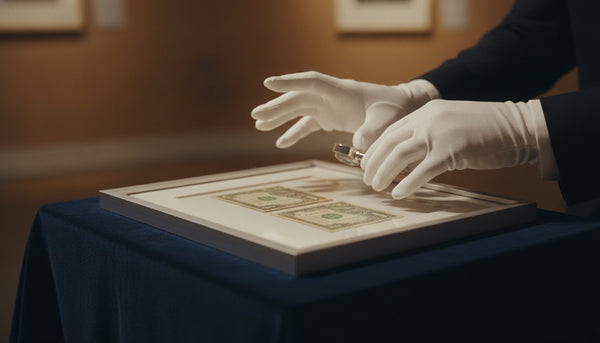
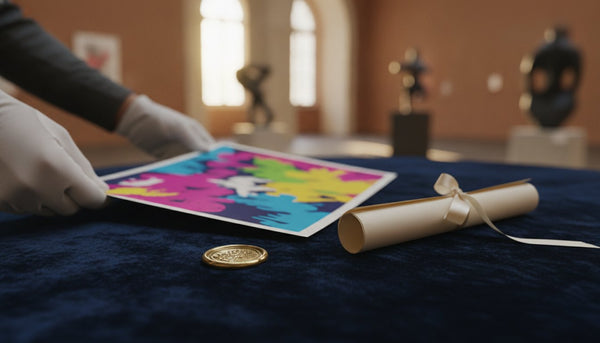
Every authentic DEATH NYC Woman Gucci GG Logo print ships with a Certificate of Authenticity (COA) that meets the studio's strict physical standards. Authentication is non-negotiable for this market — here is what to verify before any transaction:
- Gold embossed COA seal — physically raised, not flat. Run your fingertip across the seal. Authentic COAs carry a tactile emboss you can feel. Flat, printed-only seals are a primary counterfeit indicator.
- Hand-signed in ink by the artist. DEATH NYC signs in ballpoint or gel ink directly on the certificate. Examine the signature for natural ink variation and line pressure — digital reproduction signatures are uniform in a way no hand signature is.
- Edition number. DEATH NYC typically limits runs to 50–100 copies per edition. The COA will carry an edition number (e.g., 23/100). Verify the edition fraction aligns with the studio's documented run size for this motif.
- Print condition. Examine paper stock, ink density, and registration under a loupe. Authentic DEATH NYC prints use archival-grade stock with consistent color depth across the edition.
- Original retail context. This print carried a retail price at release — a hallmark of DEATH NYC's accessibility-first pricing model, which has historically amplified secondary market demand by keeping entry points democratized.
At Gauntlet Gallery, every DEATH NYC print we handle has been authenticated against these standards. We do not list unsigned works as artist-signed, and we do not list flat-seal COAs as embossed. That is a baseline, not a differentiator — but it matters.
Collector Value
DEATH NYC occupies a specific and defensible position in the street pop art market: low retail entry, strong secondary demand, and a motif library that tracks cultural relevance with unusual precision. When the studio chooses to pair a luxury brand with a fine art or spiritual reference, it is making a bet on what the culture will be processing in five years — and the track record is strong.
Popular DEATH NYC motifs — particularly those featuring Gucci, Louis Vuitton, Chanel, and Supreme in collision with high-art or spiritual imagery — have historically achieved 2–5x retail value within 12–24 months of initial release. A print purchased at retail that enters secondary market at – represents a category of return that outperforms most traditional collectibles at the same acquisition price point.
Several factors drive demand for this specific print:
- Gucci brand heat. Gucci's cultural relevance has remained exceptional across both the Alessandro Michele and Sabato De Sarno eras; the GG monogram is among the most recognized luxury symbols globally.
- Spiritual-luxury collision motif. DEATH NYC's Om + luxury brand pairings are among the studio's most discussed works in collector forums; they sit at a crossroads of audiences — luxury fashion collectors, street art collectors, and Eastern philosophy adherents — that rarely overlap.
- Woman portrait scarcity. Female figure studies with crimson lip iconography represent a smaller slice of the DEATH NYC catalog than celebrity or cartoon-based works, adding relative rarity.
Gauntlet Gallery has executed over 160,000 comparable sales across the street pop art and limited edition print market since our founding in 2012. That transaction depth gives us real signal on what moves, what holds, and what accelerates. DEATH NYC works — particularly motif-dense, luxury-collision editions with clean COA paperwork — belong in a category we track closely.
The retail price point on this print is also worth noting as a collector floor. DEATH NYC's pricing model has historically meant that even moderate secondary appreciation produces material percentage returns. A print purchased at and resold at represents a 150% gain — the same gain that would require a ,500 print to reach ,750 in a higher-priced category.
Browse the full Gauntlet Gallery collection → gauntlet.gallery/collections/all