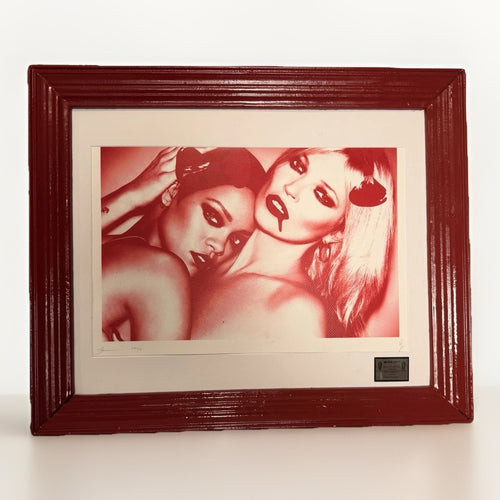
DEATH NYC Mickey Mouse x Murakami Flowers Signed Ltd Ed Print COA Pop Art — Collector Guide, Value & Authentication
Some art whispers. This one grabs you by the collar.
The moment you see it — Mickey Mouse's familiar silhouette swallowed whole by Takashi Murakami's manic, grinning flowers — something short-circuits in your brain. It is recognition and disorientation at once. You know both icons intimately, yet together they become something you have never seen before. That is the DEATH NYC effect, and it is exactly why serious collectors have been chasing these prints since the artist first emerged from the streets of New York.
I pulled this particular piece from a private stash in SoHo — still carrying that particular electricity of a collection assembled with obsession rather than calculation. Mint condition. Hand-signed. A numbered edition of 100. It is the kind of work that stops conversations cold when it goes on the wall.
What This Print Depicts
DEATH NYC is anonymous — street-born, New York-raised, deliberately ungovernable. The artist has built an entire body of work on a single, uncompromising premise: take the most saccharine, over-reproduced images in consumer culture and detonate them against each other until something true shakes loose.
Mickey Mouse is the perfect raw material. He is not just a cartoon character — he is the mascot of the entire American entertainment industrial complex, a symbol engineered by committee to be universally lovable and utterly inoffensive. DEATH NYC specializes in making Mickey offensive again. In this print, Mickey is not broken or distorted; he is simply placed inside Takashi Murakami's flower universe, grinning back at you from a sea of grinning blooms.
The Murakami connection is loaded. Murakami's smiling flowers are themselves one of the great acts of cultural arbitrage in recent art history — imagery borrowed from anime and kawaii street culture, elevated to six-figure canvases and Louis Vuitton collaborations, sold simultaneously to teenagers and hedge fund managers. By drowning Mickey in those flowers, DEATH NYC is pointing at the whole machine: Disney, Murakami, the art market, consumerism itself. The red and black palette is deliberate — it reads as warning label, as danger, as stop sign.
The result is a work that rewards sustained looking. The longer you sit with it, the more the grinning becomes unnerving, the sweetness curdles pleasantly, and you realize you are looking at one of the more precise cultural critiques of the last decade executed on a 18x18 sheet of paper.
Authentication
Authentication is where the DEATH NYC market separates collectors from marks. The prints are small-edition and hand-finished, which means fakes circulate — and the telltale signs are tactile, not visual.
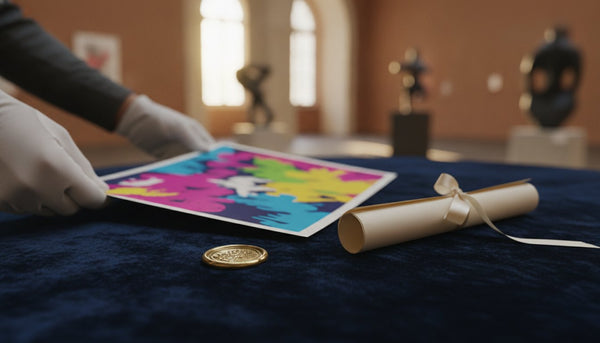
Every authentic DEATH NYC print in this edition carries a Certificate of Authenticity with a physically raised gold embossed seal. Run your finger across it. If it is flat — if it was printed rather than stamped — walk away. The embossing is not decorative; it is the authentication standard.
The artist's signature and date appear directly on the print face, applied by hand. The edition number (typically rendered as "X/100" for this series) is also hand-annotated. Standard retail pricing for this work was approximately $100 at point of issue — making it one of the most accessible entry points in the limited-edition street art market. That accessibility is precisely what drives secondary-market demand: buyers who passed on it at $100 chase it once it moves.
This piece comes with full COA documentation. Condition is mint — no foxing, no surface abrasion, no rolling damage.
Collector Value
The economics of DEATH NYC are unusually clean for a street art market that can be opaque. The editions are small (50–100 copies), the retail prices were low ($100 range), and the artist's cultural moment has been building steadily since the early 2010s. Popular motifs — and Mickey Mouse paired with Murakami flowers qualifies — have achieved 2x to 5x returns within 12 to 24 months of retail issuance on the secondary market.
That trajectory makes sense when you map the demand drivers. DEATH NYC sits at the intersection of three collector bases: street art collectors, pop art collectors, and Disney/character art collectors. Each community independently drives demand. When a single work appeals to all three simultaneously, scarcity works in a multiplied direction.
Gauntlet Gallery has operated since 2012 with over 160,000 comparable sales across the street art and pop art spectrum. The pattern we see consistently: DEATH NYC works with recognizable cultural pairings outperform single-icon pieces on the secondary market, and the Murakami collaboration is one of the artist's most sought-after series. Works in this condition — mint, with original COA, hand-signed and dated — command a meaningful premium over unsigned or undocumented examples.
If you are building an investment-grade street pop art collection, this is not a speculative bet. It is a position in a documented market with a clear track record.
Ready to add it to your collection? Browse the full Gauntlet Gallery inventory — sourced from private collections, curated for authenticity, and backed by 14 years of expertise in the street art market.