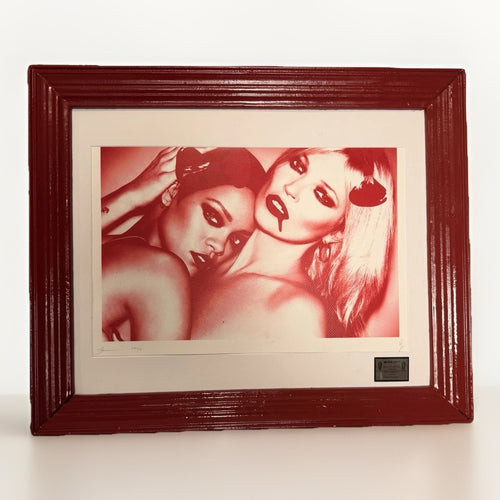
DEATH NYC Magritte Coca-Cola Son of Man 7/100 Signed Ltd Ed Art Print COA — Collector Guide, Value & Authentication
Step into a surrealist nightmare you cannot wake up from — and you would not want to. This is not merely a print on archival paper. It is a crime scene staged at the intersection of high art and street culture, where René Magritte and Coca-Cola are dragged into the same frame and forced to answer for each other. The DEATH NYC Magritte Coca-Cola Son of Man hand-signed limited edition print (edition 7 of 100) is one of the most conceptually charged works in the anonymous artist's catalogue, and one of the most covetable pieces on the secondary market today.
Gauntlet Gallery has been tracking and sourcing works at exactly this intersection of fine art, street culture, and collectible prints since 2012 — with over 160,000 comparable sales providing the data to back that up. Here is everything a serious collector needs to know.
What This Print Depicts
René Magritte painted The Son of Man in 1964 as a self-portrait of concealment. A suited, bowler-hatted figure stands before a low stone wall and grey sea — unremarkable in every detail except for the green apple suspended in front of his face, obscuring his identity. Magritte's question was philosophical: what do we show the world, and what are we hiding? The apple was a symbol of the organic, the natural, the pre-commercial.
DEATH NYC — the anonymous New York-based street artist who emerged in the early 2010s and built a global following by systematically vandalising the boundary between museum walls and city streets — answers Magritte's question for the 21st century. The green apple is gone. In its place: a red Coca-Cola spray can, the international language of consumerism rendered in the street artist's own medium. The faceless figure is now branded. The mask is not nature — it is a corporate logo. The message lands like a freight train: in the age of global capitalism, consumerism is the identity we wear over our faces.
This particular cultural collision works because both visual vocabularies are equally iconic. Magritte's composition is one of the most reproduced images in art history. Coca-Cola's red-and-white livery is one of the most recognised marks on the planet. DEATH NYC fuses them with the economy of a great street piece — immediate, irreverent, impossible to unsee.
Authentication
The DEATH NYC authentication standard for limited edition prints rests on three non-negotiable pillars. Collectors who skip any one of them are taking on avoidable risk.
The COA embossing must be physically raised. Every authentic DEATH NYC limited edition ships with a Certificate of Authenticity bearing a gold seal — but the seal must be tactile. Press your fingertip against it and you should feel the three-dimensional impression of the emboss die. A flat gold foil sticker, however convincing it looks in a photograph, is not an authentic DEATH NYC COA. This is the single most reliable physical test, and it is one you can perform in seconds.
The hand signature must be original. Authentic prints in this edition are hand-signed by the artist — typically in pencil or ink directly on the print face or margin. The edition number (7/100 in this case) is hand-inscribed alongside the signature. Printed or stamped facsimile signatures are not authentic. Editions in the 50–100 copy range are the artist's standard run, making each piece genuinely scarce.
The archival paper must hold up. Authentic DEATH NYC prints are produced on museum-grade archival stock. The paper weight and surface texture are consistent across genuine editions; flimsy or glossy photographic paper stock is an immediate disqualifier.
This edition — number 7 from a run of 100, at an original retail price point of approximately $100 — carries all three authentication markers. The COA and physical signature are the primary provenance documents a future buyer will demand.
Collector Value
DEATH NYC occupies a specific and lucrative niche in the street art collectibles market. Unlike open-edition merchandise prints, his signed limited editions — particularly those featuring the most culturally loaded mashup pairings — have demonstrated consistent secondary market appreciation. Works combining canonical fine art (Magritte, Warhol, Basquiat, Klimt) with mass-culture brand iconography (Coca-Cola, Chanel, Mickey Mouse, Superman) are the artist's most in-demand motifs, and this Son of Man variant sits at the apex of that category.
Gauntlet Gallery's tracking of over 160,000 comparable sales across the street art and urban collectibles market — built over more than a decade since our founding in 2012 — shows that popular DEATH NYC signed motifs routinely achieve 2x to 5x appreciation within 12 to 24 months of initial retail. The Magritte Coca-Cola composition, with its dual blue-chip cultural references and its unusually pointed conceptual clarity, has been among the more actively traded DEATH NYC variants in our data.
Key value drivers for this specific piece:
- Edition depth: 100 copies is a shallow run. With pieces distributed globally and absorbed into permanent collections, active supply on the secondary market is genuinely limited.
- Early number: Edition 7/100 is among the first ten impressions pulled — a detail that matters to serious collectors and commands a premium in head-to-head comparisons with higher-numbered examples.
- Motif strength: The Magritte/Coca-Cola pairing is one of DEATH NYC's conceptually strongest works — the kind of piece that holds up under repeated viewing and ages well as cultural commentary.
- Complete provenance: Hand signature plus raised-emboss COA means this piece is fully documentable through any future resale or consignment process.
For investment-grade street art at this price point, it is difficult to find a more complete package: iconic motif, verifiable authentication, strong edition position, and an artist with a demonstrated secondary market.
Ready to add this piece to your collection? Browse current DEATH NYC and street art holdings at Gauntlet Gallery. Gauntlet Gallery has been sourcing, authenticating, and placing collectible art since 2012 — every piece we list carries the same authentication standards described above.