The Number That Changes Everything

Use dated completed sales for the same artist, release, format and condition, recording the venue, currency and fees. Asking prices and broad archive totals do not establish a realized sale price or future return.
That's not a typo. That's not a marketing number somebody rounded up to sound impressive. That's the actual size of the sold-price database sitting behind the Gauntlet Gallery platform right now.
And if you collect seriously — or want to start — that number should matter to you more than almost anything else in the secondary market conversation.
Here's why.
The Problem Every Collector Ignores Until It Costs Them
The secondary market for street art, contemporary prints, and pop-culture collectibles runs on information asymmetry. Dealers know what things actually sold for. Auction houses know. The guy who's been doing this for twenty years knows.
You, buying off an Instagram post or a gallery newsletter? You're often guessing.
That asymmetry isn't an accident. It's the engine of the trade. When a seller knows the last three comps on a Shepard Fairey screen print and you don't, the spread between what you pay and what it's worth is their profit margin. Sometimes that spread is fine. Sometimes it's catastrophic.
How many times have you purchased a piece and only later — usually by accident — discovered what it actually traded for six months ago?
That's the game as it was designed to be played. The database changes the rules.
What a "Comp" Actually Means in This Market

Before we go further, let's be precise about terminology, because the word "comp" gets used loosely in ways that can mislead you.
Asking Price Is Not a Comp
A gallery listing price is not a comp. A dealer's Instagram asking price is not a comp. An unsigned edition sitting on a secondary platform at a number the seller invented is not a comp.
A comp is a verified sold transaction. Money changed hands. The piece moved. That's the only number that tells you anything real about market value.
The Comp Hierarchy
Not all sold transactions carry equal weight. Here's how to think about the stack:
-
Major auction house results (Christie's, Sotheby's, Phillips, Bonhams)
- Public record, hammer price plus buyer's premium
- Highest credibility signal
- Skews toward trophy pieces; thin data on mid-market
-
Specialist auction results (Heritage, Julien's, Propstore for entertainment)
- Better coverage for street art, collectibles, memorabilia
- Volume helps — these houses move a lot of paper
-
Verified secondary market platforms
- Useful when the platform confirms the sale and has authentication standards
- Quality varies enormously by platform
-
Private sale disclosures
- Useful but unverifiable; treat as directional, not definitive
A database that aggregates across the first two tiers at serious scale is a fundamentally different research tool than anything most collectors have ever had access to before.
Comparable-Sales Research
Scale matters in data for one simple reason: outliers stop being noise and start being signal.
With ten comps on an artist, one anomalous sale — a provenance story that drove a bidding war, a condition issue that tanked a price — can distort your read on the market badly. With hundreds of comps across years, editions, condition grades, and sale venues, the picture sharpens dramatically.
You Can Actually See the Trend
Is this artist's market accelerating? Plateauing? Quietly softening while the hype cycle keeps people buying at the top?
With thin data, you're reading tea leaves. With deep data, you're reading a chart. Those are not the same activity and they don't produce the same outcomes.
You Can Price by Edition Variant
Edition size matters. Colorway matters. Signed versus unsigned matters. Print-on-paper versus canvas matters. A database of real depth lets you filter to the actual variant you're looking at, not just the artist in aggregate.
That's the difference between knowing that KAWS original fakes sell well in general and knowing what a specific variant in its original Medicom packaging with intact hologram has actually traded for across multiple verified sales events.
You Can Identify the Arbitrage Before You Step Into It
Some of the most important things a deep comp database tells you aren't about what you're buying — they're about what you're being offered.
When you can pull fifty comps on a piece and the asking price sits thirty percent above the high end of that range, you know something the seller may be counting on you not to know. You can walk, negotiate, or buy with open eyes. That's a different position than most collectors are in.
Authentication and Comps: The Relationship Nobody Explains

Here's the thing databases reveal that surprises even experienced collectors: authentication tier affects comp value significantly, and the gap is widening.
The market is getting more sophisticated about provenance documentation. A piece that would have traded at near-parity with a fully documented example a decade ago may now carry a meaningful discount — or struggle to sell at all in certain categories.
Let's walk through what that looks like across specific segments of the market.
Street Art Prints
Banksy is the clearest example of authentication tier driving price spread. Pest Control certification is not optional in the top tier of the Banksy market — it is the market. Pieces without Pest Control documentation trade at material discounts, and the gap has been growing as institutional buyers and serious collectors have standardized their requirements. No reputable gallery, including Gauntlet, claims to provide Pest Control authentication. That lives with the artist's own office, full stop.
Shepard Fairey works differently. There is no artist-issued COA from Fairey's camp in the same structured way. Authentication for Fairey works through a chain: signature verification, correct edition numbering, cross-reference against Obey Giant drop records, and a clean provenance chain back toward original issue. Comps on properly documented Fairey pieces versus those with a murky chain reflect that difference.
Music Memorabilia
This is where authentication tier creates some of the widest price spreads in the entire collectibles market.
The FBI's Operation Bullpen — which ran through the late 1990s and resulted in multiple convictions — exposed the scale of forgery in sports and music memorabilia and permanently changed how serious buyers approach this category. The aftershocks are still being felt. Unsigned inventory from that era carries reputational risk even when it's legitimate.
The current authentication standard for music memorabilia runs through Beckett Authentication Services (BAS), JSA (James Spence Authentication), and PSA/DNA. Each has different strengths. Within BAS, the Roger Epperson REAL tier represents the specialist music authentication track — Epperson's music-specific expertise is widely regarded as the top of the field for that category.
The JSA Basic versus LOA distinction matters more than casual collectors realize. A JSA Basic sticker is a pass/fail opinion. A JSA Letter of Authenticity involves a more detailed examination and written documentation.
PSA's certification-verification warnings are not theoretical. PSA has issued public guidance about fake PSA slabs — counterfeit holders with counterfeit stickers — circulating in the market. Verification through PSA's actual database is mandatory, not optional, before relying on a PSA cert as a comp-equivalent piece.
KAWS and Designer Collectibles
The KAWS market has developed increasingly precise authentication practice. For contemporary pieces, the standard is the Medicom hologram, molded foot stamp, and documented release record. Earlier pieces carry weight through original packaging integrity, intact Medicom holograms, and verifiable Medicom release records.
Comps in this space split meaningfully between pristine-in-box examples and opened or resealed pieces. The database captures that distinction when you know how to filter it. An opened KAWS figure trading without documentation is a different market object than a sealed example with full provenance, and a robust comp set will show you exactly what that difference is worth in dollar terms.
Warhol Works
The former Warhol Authentication Board no longer exists. For a Warhol comparison, identify the exact edition and support attribution with provenance, publisher and catalogue records and qualified expertise. An item-specific TrueCOA record may organize evidence but is not the market’s universal authentication pathway.
Comps on Warhols with strong institutional provenance chains versus pieces with thinner documentation tell a story that no single authentication sticker can replace. This is a case where the database earns its keep by showing you the full distribution of outcomes rather than a single reference point.
How to Actually Use Comp Data: A Working Method
Here's a practical method for turning raw data into buying decisions.
-
Start with the specific variant, not the artist
- Filter to the exact edition, colorway, size, and medium you're considering
- Don't dilute your read with aggregate artist data unless the variant sample is too thin to be useful on its own
-
Check the date range and weight recency
- A comp from three years ago is directional but not current
- Markets move — in both directions — and old comps can be actively misleading in a shifting environment
- Prioritize the last twelve to eighteen months; use older data for trend context
-
Note the sale venue for each comp
- Major auction results and specialist auction results are not the same signal
- Private sale disclosures should be filtered or weighted differently
-
Look at the full distribution, not just the average
- Where are the outliers? What drove them?
- A wide distribution often signals condition sensitivity or authentication variance in the market for that piece
- A tight distribution signals a liquid, well-understood market — harder to find undervalued entry points, but also lower risk
-
Cross-reference against current asking prices
- Where does the piece you're being offered sit relative to the comp range?
- Above the high end: understand why before you buy
- Below the low end: understand why even more urgently before you buy
-
Factor in authentication tier explicitly
- Are the comps you're looking at for fully documented pieces or for the same item with thinner provenance?
- That distinction can account for significant price spread in many categories
The Secondary Market Behavior That Databases Expose

This is the part that makes some people in the trade uncomfortable.
When comp data is thin or inaccessible, certain pricing behaviors can persist in the market that couldn't survive in a transparent environment. Not fraud — just the natural consequence of information asymmetry.
Asking Price Anchoring
Sellers set high asking prices not because the market supports them but because the buyer has no efficient way to check. With a deep comp database, that anchoring gets tested immediately against real transaction history. The asking price either holds up or it doesn't.
Category Hype Disconnected from Transaction Reality
Certain artists or collectible categories carry significant cultural heat that hasn't yet (or may never) translate into the secondary market valuations that the hype implies. Databases show you where hype and transaction reality are aligned and where they're running in different directions.
Would you rather buy the heat or buy the transaction history?
Stale Comps Being Passed as Current
A seller who references a two-year-old auction result as justification for today's asking price is giving you outdated information. Whether they know it's outdated or not almost doesn't matter — what matters is whether you can check it. A current database lets you.
What Databases Can't Tell You
Intellectual honesty requires saying this plainly: a comp database is a tool, not an oracle.
There are things that real transaction data cannot capture on its own.
It can't tell you about condition from a photograph. A sold price for a piece in excellent condition tells you nothing useful if the piece you're being offered has undisclosed foxing, fading, or restoration. Condition due diligence is still your job.
It can't fully account for provenance premiums on specific pieces. If a work has a documented exhibition history, a famous former owner, or a direct-from-artist trail, that premium may not be fully expressed in the aggregate comp data for similar works.
It can't predict the market. The future value of any piece in any category is genuinely uncertain. Comps tell you where the market has been, which helps you understand where it is, but price appreciation or depreciation is not guaranteed by any historical pattern.
And it can't substitute for relationships. The secondary market still runs partly on information that never makes it into a database — what dealers know about supply coming to market, what auction specialists know about bidder interest in a category, what a trusted advisor knows about your specific collecting goals.
Data and expertise work best together. Neither replaces the other.
Red Flags
When you're using comp data to evaluate a purchase or verify a seller's pricing rationale, watch for these specifically.
- The seller can't name a recent comp. Anyone pricing confidently should be able to point to recent transaction data. If they can't — or won't — that tells you something.
- The comp they cite is for a different variant. A signed example comp doesn't justify an unsigned asking price at the same level. An artist proof comp doesn't translate directly to an open edition. Check that the comp is actually comparable.
- The database reference is asking prices, not sold prices. This happens more than it should. Platforms that aggregate listing prices and call it "market data" are not showing you comps. They're showing you wishful thinking at scale.
- The authentication referenced can't be verified. PSA certs should be checked against PSA's actual database. BAS certs have verification tools. JSA has a verification lookup. If the cert can't be confirmed through the issuing body's own system, treat it as unconfirmed regardless of what the holder looks like.
- The comp range is presented without distribution context. Being told "this piece sold for X" when X is the top of a wide range — and the median is materially lower — is incomplete information being used strategically. Always ask about the distribution.
- Sudden category hype with no supporting comp history. When an artist or collectible category starts appearing everywhere but the transaction data doesn't yet reflect the noise, be patient. Hype that hasn't hit comps yet may hit comps later, or it may not. Buying ahead of comps is speculation, and you should price it as such.
- Death NYC without both the signed COA and the studio gold seal. The standard for Death NYC authentication requires both elements. A piece with one and not the other is not fully documented by that standard, regardless of what else accompanies it.
Bottom Line
Information asymmetry is how the secondary market has extracted value from collectors for decades. You paid for what you didn't know.
It doesn't eliminate the need for authentication expertise, for condition judgment, for relationship-based market intelligence, or for the kind of curatorial eye that makes a collection more than a portfolio. None of that goes away.
But it does mean that the basic question — what has this actually sold for? — has a real answer you can access. And that changes the negotiation, the evaluation, and the risk profile of every single buying decision you make.
The collectors who learn to use this tool well will not be perfect. They'll still make mistakes. But they'll make fewer of the expensive, preventable kind — the kind where you bought at the top of a market you could have known was at the top, or paid a premium for a piece whose authentication tier the comps would have flagged immediately.
That's the game the database changes. Not everything — everything.
Use it.
Frequently Asked Questions
What exactly counts as a "comp" in your database, and how is it verified?
A comp in our database is a verified sold transaction — a price at which a piece actually changed hands. We pull from major and specialist auction house results where hammer prices and buyer's premiums are public record, and from verified secondary market platform sales where transaction confirmation is available. Asking prices, listing prices, and unconfirmed private sale figures are not comps. The 261,209 figure reflects actual transactions, not inventory numbers.
How often is the database updated?
Continuously. Auction results are integrated following sale completion and public record availability. The database is a live resource, not a quarterly report. That matters because markets move, and stale data in a shifting environment can be as misleading as no data at all.
Can I use comp data to authenticate a piece?
No. Comps are pricing tools, not authentication tools. They can help compare documented sales, but a sold price does not verify the object in front of you. Check evidence appropriate to the actual work: Pest Control for eligible Banksy works, the named specialist opinion for memorabilia, and provenance, publisher and catalogue research for Warhol. Any TrueCOA record is documentation for the particular item, not proof supplied by a universal Warhol authority.
What do I do if the comp range is very wide for the piece I'm researching?
A wide distribution is itself useful information. It typically means one of a few things: condition sensitivity is significant in this category; authentication tier creates meaningful price variance; or the piece has sold in different market contexts (a major-house auction versus a specialist platform, for example) that produce structurally different outcomes. When you see a wide range, your job is to figure out which of those factors is driving it and where the piece you're considering sits within them. Don't average away the distribution — investigate what's causing it.
How does edition size affect comp reliability?
Larger editions generally produce more comps, which improves statistical reliability. For very limited editions — artist proofs, variants released in single digits, one-of-a-kind works — the comp sample may be thin enough that each individual transaction carries unusual weight. In those cases, supplement the comp data with category-level context and, where possible, input from specialists with deep knowledge of that artist's market. Thin comps call for more caution in interpretation, not less.
Does comp data work the same way for space memorabilia and music memorabilia?
The same analytical framework applies, but the authentication overlay is different and matters significantly. Music memorabilia comps are heavily influenced by BAS, JSA, and PSA certification tier — with Roger Epperson REAL within BAS representing the specialist music tier. Space memorabilia carries the same three-body framework with the addition of specialist letters from people like Zarelli for certain categories. Always filter your comps with authentication tier in mind for these categories.
Can the database tell me if an artist's market is declining?
Yes, with appropriate caveats. A time-series view of comp data for a specific artist or category will show you directional trends — rising averages, falling averages, or a plateau. What it can't tell you is whether the trend will continue. It can also be lagging: a market that has started to soften in private sales may not show up in auction results for several months. Treat trend data as a strong directional signal, not a guarantee, and pair it with current market intelligence from people active in that category.
Is comp data useful for selling, or just buying?
Equally useful on both sides of a transaction, and arguably more important when you're selling. Pricing a piece to sell requires knowing where the market actually clears — not where you'd like it to clear, not where it was eighteen months ago, and not what a dealer told you at acquisition. A deep comp database lets you price competitively, defend your pricing to sophisticated buyers who've done their own research, and identify the sale venue most likely to produce the best outcome for your specific piece in the current market environment. Sellers who come to the table with real comp data close faster and at better prices than those who don't.
Available at Gauntlet Gallery
Explore current pieces available from the gallery.
-

1963 Farquhar Earth in Space Transparent Celestial Globe 16" Compass VTG
$699.00 USD
-

1967 Beatles Richard Avedon STERN Original Posters Set of 4 Linen Backed Copy
$999.00 USD
-
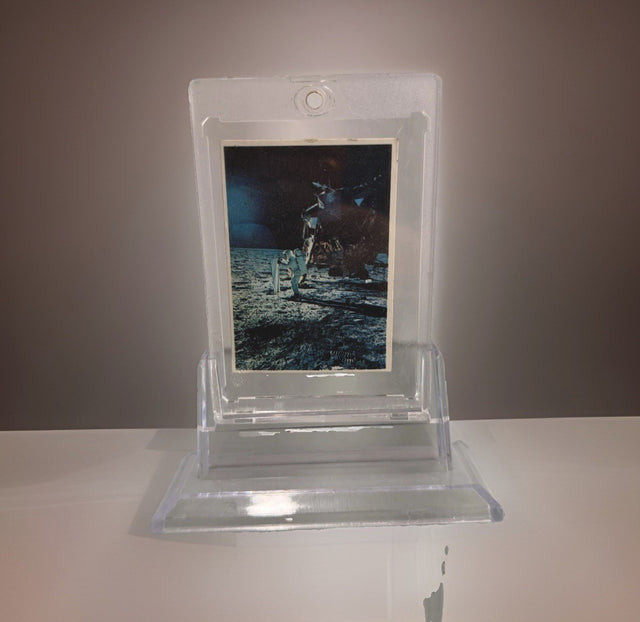
1969 Space Candy Buzz Aldrin Apollo 11 On The Moon Card #19 Taylor-Reed Display
$59.00 USD
-

1980 Polo Player Green Pink Chalk Pastel Bears Andy Warhol Signature AS-IS
$399.00 USD
-

After Andy Warhol Moon Landing Line Drawing 5/50 w/ Astronaut Autographs As-Is
$175.00 USD
-

After John Lennon "I Do" Framed Print, Marked A/P Unverified
$99.00 USD


Browse the collection for current listings.