

Gauntlet Gallery — Banksy Prints
Separation Wall - Beach
Work Summary & Collector Notes
A 2006 giclee documenting one of Banksy's 2005 interventions on the Israeli West Bank separation barrier: against the grey concrete slabs he has drawn, in white outline, a cozy domestic living room — two plump armchairs flanking a window that opens, trompe-l'oeil style, onto an idyllic alpine landscape of green meadow, mountains and blue sky. A lone figure stands at the foot of the wall for scale. It belongs to the small group of prints derived from Banksy's Palestine "wall" project, where he used illusionistic holes and vistas to imagine the barrier away.
Collector notes: Edition; saved release record states an edition size of 56. Edition-specific signature, numbering, and stamp details were not stated in the saved release record. Verify signing and numbering against a documented example of this edition.
Why It Matters
This image distills Banksy's central trick on the West Bank wall: painting an illusory escape onto an instrument of confinement. By framing a holiday-postcard mountain view inside a homely sitting room, he turns nine metres of militarised concrete into a domestic window, making the wall's brutality legible to a Western audience through the language of comfort and tourism. It is one of the most politically pointed bodies of work in Banksy's career — art made on the actual barrier rather than a gallery wall — and helped move the Israeli-Palestinian separation barrier into mainstream art-world and pop-culture conversation. The contrast between the inviting interior and the bleak reality it covers is the whole argument.
Collector Perspective
A genuinely scarce piece: the edition is just 56, far smaller than Banksy's mass-market POW screenprints that ran into the hundreds. It is a giclee rather than a screenprint, which some Banksy buyers weight slightly differently, but the tiny run and the strong, recognisable Palestine subject support demand. With only 56 in existence the work surfaces infrequently, so pricing is set as much by what is available at the moment as by any standing comp.
Historical Context
The work derives from Banksy's December 2005 trip to the Israeli West Bank barrier, where he painted a series of images — children digging through, a ladder, a girl with balloons, and these illusory "windows" and holes opening onto idealised landscapes — directly onto the Palestinian side of the concrete. Produced as a giclee in 2006, during what is described here as Banksy's Stencil Boom Era, it sits alongside the artist's other Palestine & The Wall pieces and prefigures his later, more elaborate 2017 Walled Off Hotel project in Bethlehem, which overlooks the same barrier. The motif of a sitting-room window onto mountains is a direct comment on the wall as a domestic-scale obstruction to an ordinary life and view.
Documented Release Details
- Object type
- Editioned print
- Release date
- 2006
- Release-date note
- Catalog-listed release year from the saved secondary record; primary release-page confirmation remains pending.
- Medium and materials
- Giclee.
- Edition details
- Edition; saved release record states an edition size of 56.
- Signature and marks
- Edition-specific signature, numbering, and stamp details were not stated in the saved release record. Verify signing and numbering against a documented example of this edition.
Documented History and Meaning
History note: This page treats Banksy's broader career as background context, not proof that this specific edition belongs to any single exhibition or event. Release-level facts here come from a saved secondary catalog record.
Meaning / interpretation: Read as documented context rather than stated intent: The work derives from Banksy's December 2005 trip to the Israeli West Bank barrier, where he painted a series of images — children digging through, a ladder, a girl with balloons, and these illusory "windows" and holes opening onto idealised landscapes — directly onto the Palestinian side of the concrete. This is an interpretive reading of the release context, not a statement of the artist's intent for this specific work. This interpretive note follows the cited artist or publisher context.
Release context: The saved catalog lists 2006.
Authentication, Presentation and Provenance
- Original presentation
- Original packaging or presentation was not documented in the release sources reviewed.
- Authentication note
- Compare the support, dimensions, edition number, and signature against a documented example of this edition. Gauntlet Gallery does not authenticate works purchased from third parties.
- Provenance note
- Edition origin is attributed in the saved record to the release source named in the saved record. That does not establish the ownership history of an individual copy: retain the original invoice, reseller or gallery paperwork, labels, correspondence, and condition photographs.
Sources and Verification
Verification status: Secondary catalog snapshot; artist-level context added
- Banksy — Wikipedia · reference encyclopedia · Accessed 2026-07-13 · General artist-level biographical and career reference.
- Banksy (Q133600) — Wikidata · reference knowledge base · Accessed 2026-07-13 · Structured identifier used for the artist across catalog metadata.
FAQ
What does this print depict?
Banksy's white line-drawing of a living room — two armchairs flanking a window — painted onto the grey concrete of the Israeli West Bank separation barrier, with the window opening trompe-l'oeil onto an idyllic alpine mountain landscape. A figure stands at the base for scale.
What is the edition size?
The edition is 56.
What medium is it?
It is a giclee print, produced in 2006 after Banksy's 2005 intervention on the West Bank wall.
Is it signed?
The title does not specify signed or unsigned; both signed and unsigned examples typically exist for Banksy editions, with signed copies commanding a premium.
Who is Banksy?
Banksy is the anonymous England-based street artist who emerged from Bristol in the early 1990s, known for fast stencil work, dark humour, and anti-war, anti-establishment imagery, including a celebrated series of works painted directly on the West Bank barrier in Palestine.
Related Banksy Works


Shop Banksy at Gauntlet Gallery
Live listings with authentication, provenance and documentation.
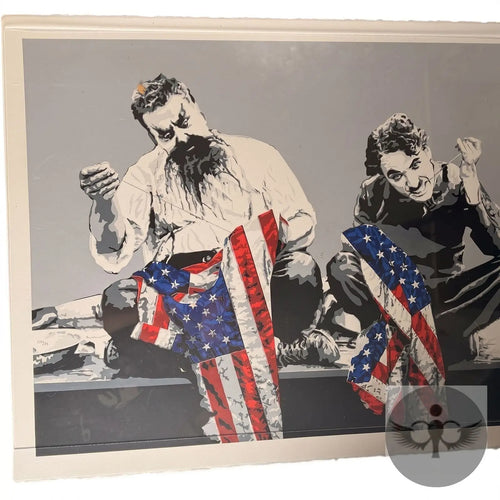
Mr. Brainwash 2018 "Recovery Plan" Signed Screenprint of Chaplin with USA Flag
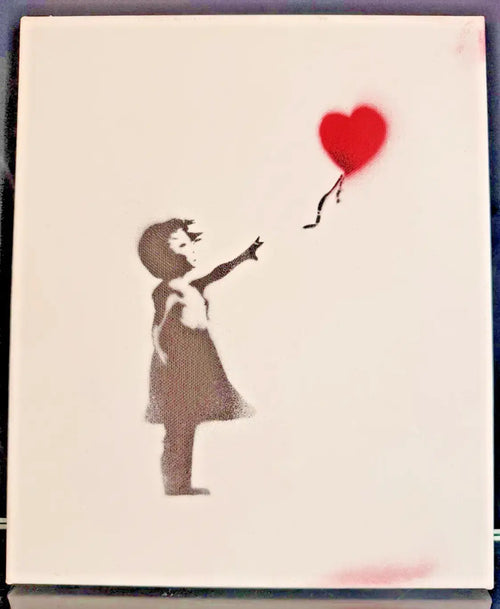
Banksy Girl with Balloon Dismaland 2/12 Signed Stencil Canvas 2015 Ticket
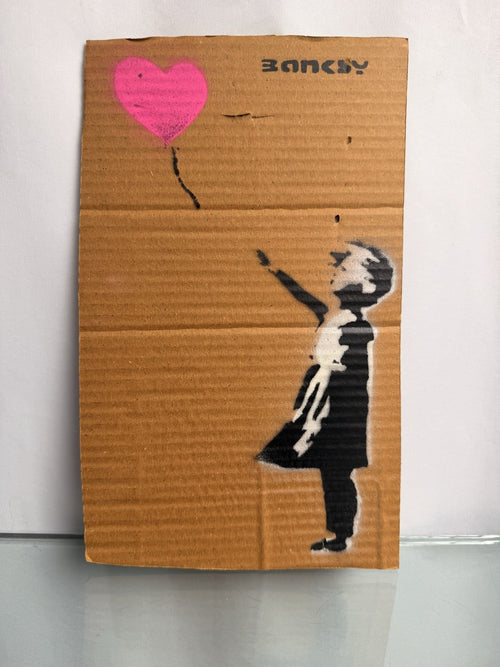
WMMS Signed Original Stencil Spray Art on Cardboard Banksy Dismaland Style 3/3
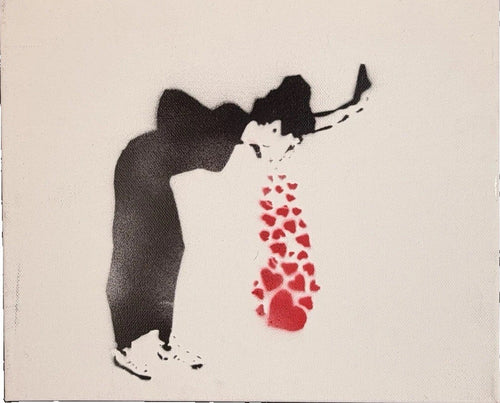
Banksy Dismaland Achieve Greatness 1/10 Signed Stencil Canvas 2015 Ticket
Be first when new Banksy pieces drop
You're on the list ✓ — first look at every new Banksy arrival.
Shop Banksy & Dismaland
Explore current pieces available from the gallery.

Browse the collection for current listings.