

Gauntlet Gallery — Banksy Prints
Flower Thrower
Work Summary & Collector Notes
A masked protester is caught mid-throw in Banksy's signature black-and-white spray stencil, but instead of a Molotov cocktail his raised arm hurls a bouquet of flowers. In this variant the gesture's arc is traced by a circle of red stars rather than the usual single-color leaves, framing the figure's pitch and turning the act of rioting into an act of giving. It is one of the most recognized images in Banksy's entire output, first stencilled in Jerusalem and later editioned through Pictures on Walls.
Collector notes: Edition; saved release record states an edition size of 20. Edition-specific signature, numbering, and stamp details were not stated in the saved release record. Verify signing and numbering against a documented example of this edition.
Why It Matters
Flower Thrower is Banksy's clearest statement of nonviolent resistance: a balaclava-clad rioter in the classic throwing stance, but the weapon swapped for a bunch of flowers. The substitution converts an image of street conflict into a plea for peace, which is exactly why it has become shorthand for protest itself, reproduced on walls, placards and merchandise worldwide. Originating from the West Bank wall context, it carries a specific anti-war charge while remaining universal enough to read anywhere. The red-star arc in this version pushes the political reading further, evoking flags and revolutionary iconography while keeping the central message that love and gesture, not force, are the real weapons.
Collector Perspective
This is an exceptionally small run of just 20, which puts it far below the scale of Banksy's better-known POW screen-print editions (typically 150 signed / 500-750 unsigned) and into genuine rarity territory. At that edition size individual examples surface only rarely, so price discovery leans heavily on comparable signed Banksy works and the strength of provenance rather than frequent auction repeats. Given the iconic image and the tiny count, demand is durable, but the thin trade history means a wider bid-ask spread than the mass-market prints.
Historical Context
The image dates to 2003, squarely in Banksy's Stencil Boom era, when the artist's fast multi-layer stencils were spreading from Bristol and London onto walls internationally. The motif is rooted in his work around the Israeli West Bank barrier and the broader anti-war mood of the early 2000s Iraq War period, when imagery of rioters and Molotov cocktails was everywhere in news coverage. By replacing the firebomb with flowers, Banksy inverted that visual language at the exact moment it was most loaded. The work has since been retitled and reproduced endlessly (often as "Love Is in the Air"), cementing it as one of the defining images of the decade's protest art.
Documented Release Details
- Object type
- Editioned print or object
- Release date
- 2003
- Release-date note
- Catalog-listed release year from the saved secondary record; primary release-page confirmation remains pending.
- Medium and materials
- Medium and materials were not documented in the saved record.
- Edition details
- Edition; saved release record states an edition size of 20.
- Signature and marks
- Edition-specific signature, numbering, and stamp details were not stated in the saved release record. Verify signing and numbering against a documented example of this edition.
Documented History and Meaning
History note: This page treats Banksy's broader career as background context, not proof that this specific edition belongs to any single exhibition or event. Release-level facts here come from a saved secondary catalog record.
Meaning / interpretation: Read as documented context rather than stated intent: The image dates to 2003, squarely in Banksy's Stencil Boom era, when the artist's fast multi-layer stencils were spreading from Bristol and London onto walls internationally. This is an interpretive reading of the release context, not a statement of the artist's intent for this specific work. This interpretive note follows the cited artist or publisher context.
Release context: The saved catalog lists 2003.
Authentication, Presentation and Provenance
- Original presentation
- Original packaging or presentation was not documented in the release sources reviewed.
- Authentication note
- Compare the support, dimensions, edition number, and signature against a documented example of this edition. Gauntlet Gallery does not authenticate works purchased from third parties.
- Provenance note
- Edition origin is attributed in the saved record to the release source named in the saved record. That does not establish the ownership history of an individual copy: retain the original invoice, reseller or gallery paperwork, labels, correspondence, and condition photographs.
Sources and Verification
Verification status: Secondary catalog snapshot; artist-level context added
- Banksy — Wikipedia · reference encyclopedia · Accessed 2026-07-13 · General artist-level biographical and career reference.
- Banksy (Q133600) — Wikidata · reference knowledge base · Accessed 2026-07-13 · Structured identifier used for the artist across catalog metadata.
FAQ
What does Flower Thrower depict?
A masked man in a baseball cap and bandana is shown in a classic rioter's throwing pose, arm cocked back, but the object in his hand is a bouquet of flowers rather than a Molotov cocktail. In this variant the throw's trajectory is traced by an arc of red stars.
How large is the edition?
This is a very small edition of 20, making it considerably rarer than Banksy's standard Pictures on Walls print runs.
Is it signed or unsigned?
The title does not specify, so verify each example individually.
What medium is it?
The medium is not documented for this specific example. The underlying image is a spray-paint stencil; Banksy's editioned versions of it are typically screen prints, so confirm the exact process for the piece in question.
Who is Banksy?
Banksy is an anonymous England-based street artist who emerged from Bristol in the early 1990s, known for fast stencil work, dark humor, and anti-war, anti-establishment messages, with recurring motifs including rats, riot police, and children with balloons.
Related Banksy Works


Shop Banksy at Gauntlet Gallery
Live listings with authentication, provenance and documentation.
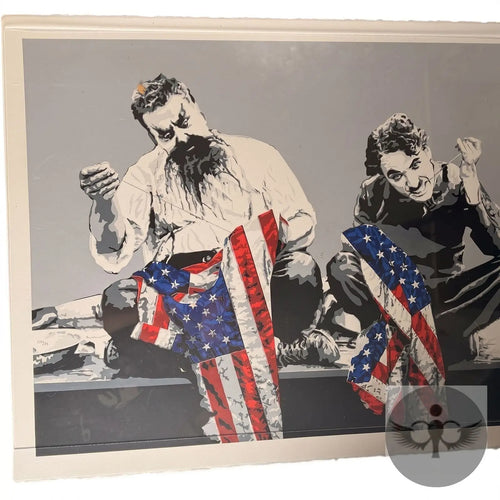
Mr. Brainwash 2018 "Recovery Plan" Signed Screenprint of Chaplin with USA Flag
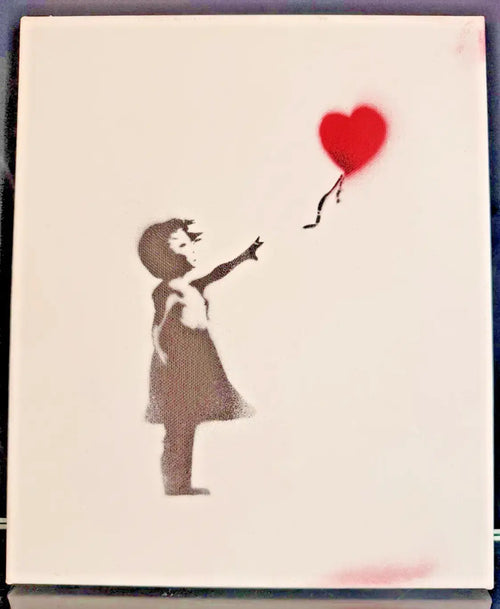
Banksy Girl with Balloon Dismaland 2/12 Signed Stencil Canvas 2015 Ticket
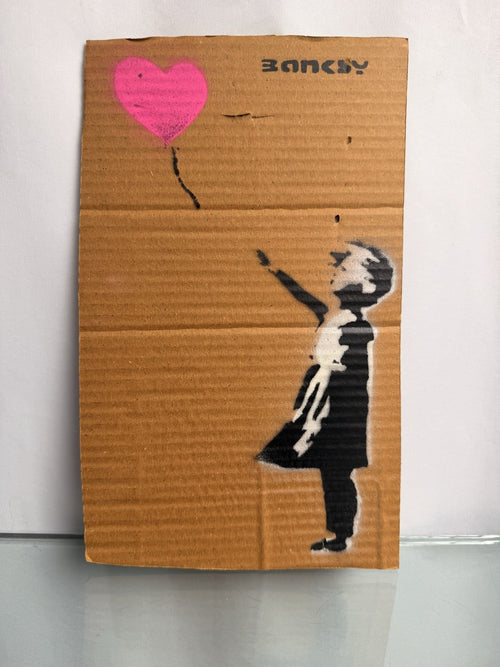
WMMS Signed Original Stencil Spray Art on Cardboard Banksy Dismaland Style 3/3
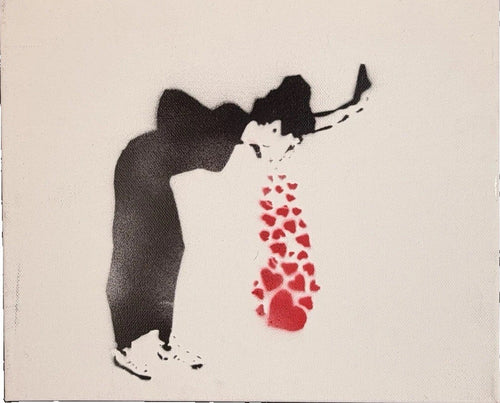
Banksy Dismaland Achieve Greatness 1/10 Signed Stencil Canvas 2015 Ticket
Be first when new Banksy pieces drop
You're on the list ✓ — first look at every new Banksy arrival.
Shop Banksy & Dismaland
Explore current pieces available from the gallery.

Browse the collection for current listings.