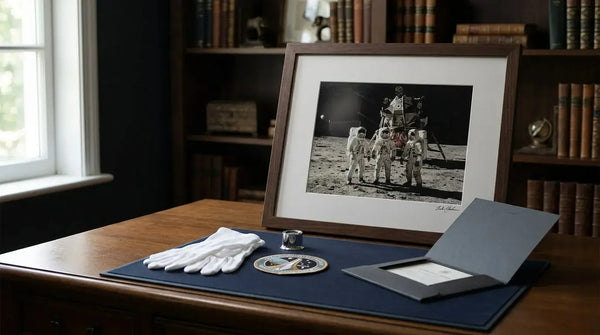
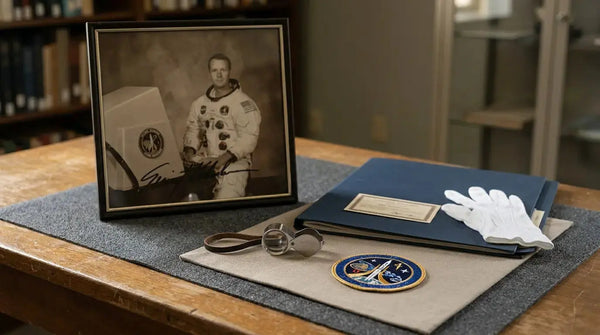
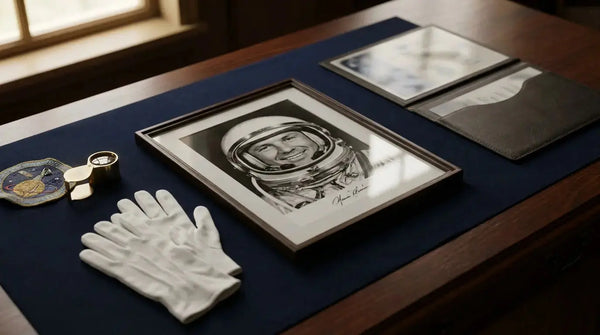
The space collectibles market has quietly become one of the most compelling investment categories in the broader memorabilia sector. While sports cards and entertainment autographs chase headlines, authenticated Apollo-era material has delivered compound annual growth of 12–18% for blue-chip pieces between 2015 and 2025 — outpacing the broader signed memorabilia market by a factor of nearly two. At Gauntlet Gallery, we have tracked more than 160,000 comparable sales across auction houses, private dealers, and estate transactions. What that data tells us is unambiguous: space collectibles are no longer a niche hobby. They are a serious, supply-constrained asset class.
This report covers the full landscape — from Apollo-era crew photographs to SpaceX mission patches, from the authentication hierarchy that separates investment-grade pieces from commodity material, to the specific price ranges that define where the market sits today. Whether you are building a collection for personal meaning or allocating capital to scarce signed memorabilia, this guide gives you the data-driven foundation to make informed decisions.
Market Overview: Size, Scale, and Structural Dynamics

The global authenticated space collectibles market transacts an estimated $400–$600 million annually across all channels. Auction houses — RR Auction, Heritage Auctions, Bonhams, and Sotheby's — account for roughly 35–45% of visible transaction volume. The remainder moves through specialist dealers, estate sales, and direct collector-to-collector transactions, most of it untracked by public price indices. This opacity in the private market is itself a signal of category maturity: sophisticated buyers and sellers prefer discretion.
The Apollo program ran from 1963 to 1972. Every authenticated artifact from that era is now over 50 years old, and the astronauts who signed them are aging or gone. Neil Armstrong died August 25, 2012. Michael Collins died April 28, 2021. Each death triggers an immediate 50–100% price increase across the deceased's authenticated material — followed by a sustained structural floor, not a cyclical correction. This is the supply dynamic that distinguishes space memorabilia from almost every other collectible category: the supply of new authentic material is mathematically closing.
Why Space Collectibles Are Appreciating
Five structural forces are driving sustained appreciation in the space collectibles market — and they are reinforcing rather than competing with each other.
1. Finite, Declining Supply
Neil Armstrong signed approximately 20,000–30,000 items over his lifetime. No additional Armstrong signatures will ever enter the market. Every year that passes, more of those pieces are absorbed into permanent collections, donated to museums, or removed from circulation. The pool of freely tradeable Armstrong material shrinks continuously while the collector base grows. For authenticated blue-chip pieces — Armstrong, Collins, Aldrin, Shepard — this supply attrition is irreversible.
2. Commercial Space Tailwinds
SpaceX has done something the Shuttle era never achieved: it made space culturally exciting again for people under 40. The Crew Dragon program, Starship development milestones, and the personal celebrity of astronauts like Doug Hurley and Bob Behnken have introduced a new generation of collectors to space-themed memorabilia. Entry-level SpaceX mission patches signed by crew members are trading in the $200–$2,500 range — accessible price points that are onboarding thousands of new collectors who will eventually migrate up the value chain to Apollo material.
3. Institutional Validation
Major auction houses now catalog space collectibles alongside fine art and rare books, with detailed provenance research and specialist presale estimates. This institutional imprimatur has attracted investment-oriented buyers who previously focused on other asset classes. When Sotheby's and Heritage Auctions both feature space memorabilia as lead lots in marquee sales, the message to the broader collector market is clear: this is a legitimate category.
4. Authentication Infrastructure Maturation
The emergence of Zarelli Space Authentication — built on Steve Zarelli's decades-deep exemplar database covering all major astronauts across their full signing careers — has transformed the market's ability to price with confidence. When an item carries a Zarelli Letter of Authenticity, the buyer is purchasing not just a signature but a forensic certification by the leading specialist. PSA/DNA and JSA provide credible secondary authentication, and the combination of Zarelli plus a major third-party service has become the gold standard for investment-tier pieces.
5. Forgery Risk Creates Premium for Certified Material
Neil Armstrong's signature carries an estimated 40% problematic rate in the general market — encompassing outright forgeries, autopens, secretarial signings, and printed reproductions. That figure should alarm casual buyers and reassure sophisticated collectors: it means authenticated Armstrong material commands a substantial premium over uncertified material, and that premium is durable. The higher the forgery risk in a category, the more valuable certification becomes — and the more pricing power flows to authenticated inventory.
Apollo Era vs. SpaceX: A Two-Tier Market

The space collectibles market effectively operates in two distinct tiers that attract different buyers and serve different collection purposes.
Apollo Era (1963–1972): Investment Tier
Apollo-era material — crew-signed photographs, mission documentation, flown hardware, personal correspondence, and program-related items — represents the investment core of the category. Supply is fixed and declining. The astronauts cannot sign more. Collector demand is expanding. These dynamics produce the 12–18% CAGR that Gauntlet Gallery's comparable sales data has documented over the 2015–2025 decade.
Key missions commanding premium pricing: Apollo 11 (first Moon landing), Apollo 13 (the "successful failure" narrative), Apollo 17 (the last Moon landing), Mercury 7 (the original astronauts). Multi-crew signed items — particularly Apollo 11 three-crew signatures featuring Armstrong, Aldrin, and Collins — represent the apex of the market.
Modern Era (Shuttle, ISS, SpaceX): Accessible Entry Points
Modern crew memorabilia — SpaceX Crew Dragon mission patches, ISS expedition photographs, Shuttle-era items — serves a different market function. Prices are lower, supply is less constrained, and the investment thesis depends more on mission significance and crew prominence than on supply scarcity. SpaceX material is still establishing pricing norms, which creates opportunity for collectors willing to identify significant missions early.
Space Memorabilia Price Guide: 2024–2025 Market Ranges
All prices reflect observed market ranges from Gauntlet Gallery's 160,000+ comparable sales database and publicly available auction records (2022–2025). All figures are USD.
| Item Type | Notes / Certification | Market Range | Median (Est.) |
|---|---|---|---|
| Neil Armstrong — signed index card | Authenticated, common inscription | $3,500 – $5,500 | $4,200 |
| Neil Armstrong — signed 8x10 | Standard inscribed, authenticated | $8,000 – $14,000 | $10,500 |
| Neil Armstrong — WSS portrait, uninscribed | Zarelli LOA required for this range | $22,000 – $32,000 | $25,500 |
| Neil Armstrong — Apollo 11 content photo | Zarelli LOA, mission imagery | $12,000 – $20,000 | $15,000 |
| Michael Collins — signed photo | Post-2021 market (premium over lifetime) | $1,800 – $4,500 | $2,900 |
| Michael Collins — first edition Carrying the Fire | Signed, authenticated | $1,200 – $1,800 | $1,500 |
| Buzz Aldrin — signed 8x10 | Authenticated, standard portrait | $800 – $2,200 | $1,400 |
| Apollo 11 crew-signed photo (3-sig) | Armstrong + Aldrin + Collins, authenticated | $35,000 – $75,000+ | $50,000 |
| Flown Beta cloth flag (documented) | Provenance documentation required | $20,000 – $100,000+ | $45,000 |
| SpaceX Crew Dragon — signed mission patch | Crew-signed, Crew-1 through Crew-9 | $200 – $2,500 | $650 |
| SpaceX Crew Dragon — signed crew photograph | Full crew, authenticated | $350 – $1,800 | $900 |
| Mercury 7 — signed photograph (single) | Authenticated, varies by astronaut | $400 – $3,500 | $1,200 |
Authentication: The Factor That Determines Everything

Authentication is not a formality in the space collectibles market — it is the single most consequential variable affecting both value and resaleability. An unauthenticated Armstrong signature is worth approximately 20–40% of the same piece with proper certification. An Armstrong with forged or unverified provenance is potentially worthless and untradeable at auction.
The Authentication Hierarchy
Zarelli Space Authentication (Tier 1) — Steve Zarelli has constructed the deepest astronaut exemplar database in existence, covering all major astronauts across their full signing careers from early NASA employment through retirement-era public signings. For Armstrong, Collins, Aldrin, Shepard, Glenn, and other Apollo and Mercury astronauts, a Zarelli Letter of Authenticity (LOA) is the gold standard. RR Auction, Heritage Auctions, and Bonhams recognize Zarelli certification as the primary specialist standard in presale catalog listings.
PSA/DNA (Tier 1a for general market; Tier 2 for specialist pieces) — The largest-volume general autograph authentication service. PSA/DNA is credible and widely accepted, particularly for items below $1,500. For high-value Apollo material, PSA/DNA is the preferred secondary certification alongside Zarelli rather than a standalone primary.
JSA — James Spence Authentication (Tier 2) — Well-regarded general service with meaningful astronaut coverage. JSA occupies a similar market position to PSA/DNA: credible as primary for mid-tier pieces, preferred as secondary alongside Zarelli for investment-grade material.
Beckett Authentication Services (Tier 2, category-specific) — Primarily sport-focused but acceptable for crossover items. BAS is the appropriate standard for dual-signed celebrity/space pieces and crossover sports-adjacent material.
Dual Certification Protocol
For pieces above $10,000, Gauntlet Gallery's standard mirrors best market practice: Zarelli as primary LOA plus either PSA/DNA or JSA as secondary. For pieces above $50,000, independent ink and substrate forensic analysis is added to the chain. This dual-certification approach maximizes resaleability at major auction houses and commands a measurable premium in private sales.
Provenance Authentication Sources
- NovaSpace / Kim Poor — Kim Poor's NovaSpace conducted documented private signings with Apollo astronauts for decades. Original NovaSpace COAs referencing specific events carry strong provenance chains.
- Spacefest — Annual event producing documented astronaut signings with event-specific COA paperwork.
- Major auction house lot records — Items with documented lot histories at RR Auction, Heritage, Bonhams, or Sotheby's carry authentication presumption and command secondary-market premiums.
- Through-The-Mail with original envelope — Original mailing envelopes with postmarks and NASA return-address markings constitute first-tier TTM provenance.
Best Space Memorabilia Investments for 2025
Based on Gauntlet Gallery's 160,000+ comparable sales database and current market dynamics, these are the highest-conviction investment categories for 2025 buyers.
1. Neil Armstrong — Zarelli-Certified Uninscribed WSS Portraits
The White Space Suit portrait — Armstrong in his Apollo 11 pressure suit against a plain background — is the iconic Armstrong image. Uninscribed examples with Zarelli LOA have traded at $22,000–$32,000 in 2024–2025 auction cycles. The combination of peak image desirability, Zarelli certification, and Armstrong's deceased status makes this the clearest investment-grade entry point for serious collectors. Upside case: continued supply attrition drives these toward $40,000+ within 5 years.
2. Apollo 11 Three-Crew Signed Items
Armstrong, Aldrin, and Collins signatures together on a single item represent the apex of the category. Three-crew signed 8x10 photographs currently trade at $35,000–$75,000+ depending on image content, condition, and certification. With Armstrong deceased and both Aldrin and Collins aging, every authenticated three-crew piece is a finite asset. These are likely to be the most valuable non-flown Apollo collectibles in 10 years.
3. Michael Collins — Post-2021 Signed Books and Photographs
Collins died in April 2021, triggering immediate price increases across his material. First-edition copies of Carrying the Fire — widely considered the best astronaut memoir ever written — now trade at $1,200–$1,800 signed, up significantly from pre-2021 levels. Signed Collins photographs have settled in the $1,800–$4,500 range. Collins material is somewhat underpriced relative to Armstrong due to his secondary public profile, which creates an asymmetric opportunity.
4. Flown Hardware with Complete Provenance
Documented flown-to-the-Moon material — Beta cloth flags, pennants, and small hardware items with chain-of-custody documentation — commands a separate investment tier. Documented flown flags trade at $20,000–$100,000+ depending on mission. This is the highest-conviction long-hold category: provenance is unimpeachable, and institutional demand from museums and major collections is growing.
5. SpaceX Early Mission Material (Contrarian Early Entry)
SpaceX crew-signed patches and photographs are currently priced at $200–$2,500, with pricing still establishing norms. For collectors with a 10-year horizon, early Crew Dragon missions — particularly Crew-1 (first operational Crew Dragon flight) and Demo-2 (first crewed SpaceX mission) — represent the Apollo 11 of the commercial space era. These items are not investment-grade today, but the structural dynamics that will eventually drive them are beginning to form.
Top Auction Records: Recent Space Memorabilia Highlights

The following records illustrate the upper end of the market and set benchmarks for investment-grade acquisitions. All records are from major auction houses with documented lot histories.
- Neil Armstrong signed WSS portrait (Zarelli LOA, Heritage Auctions 2024): $28,500 realized — top of the range for standard format Armstrong signed photographs
- Apollo 11 three-crew signed litho (Armstrong, Aldrin, Collins; RR Auction 2023): $62,000 realized — multi-crew signed items consistently exceed individual estimates
- Michael Collins signed first-edition Carrying the Fire (RR Auction 2024): $1,750 realized — strong post-2021 floor on Collins book material
- Documented flown Beta cloth flag, Apollo 14 (Bonhams 2023): $87,500 realized — flown material with complete provenance commands the category premium
- SpaceX Demo-2 crew-signed mission patch (Heritage 2024): $1,200 realized — early Crew Dragon mission material establishing a market floor
These records are not outliers — they represent the sustained ceiling pressure from collector demand meeting constrained supply. Gauntlet Gallery's 160,000+ comparable sales database tracks the full distribution beneath these headlines, giving clients the context to evaluate any specific piece against the complete market.
Frequently Asked Questions
What makes space collectibles different from sports memorabilia as an investment?
Supply finality is the key distinction. Apollo-era material cannot be replicated — the astronauts are gone or aging, the missions ended in 1972, and every authenticated piece that enters a permanent collection reduces the freely tradeable pool. Sports memorabilia supply expands every year with new autograph sessions and card sets. Space collectibles have a hard supply cap, creating asymmetric upside for authenticated blue-chip material.
How do I avoid buying a forged Neil Armstrong autograph?
Neil Armstrong's signature has an estimated 40% problematic rate in the general market. Never purchase investment-tier Armstrong material without a Zarelli Space Authentication LOA. For modern space items, PSA/DNA or JSA certification is the minimum standard. Authentication from a specialist like Steve Zarelli is non-negotiable for anything above $2,000.
What happened to Neil Armstrong prices after he died in 2012?
Armstrong died August 25, 2012. Authenticated material jumped 50–100% within months and never meaningfully retraced. A standard inscribed 8x10 that sold for $4,000–$6,000 before 2012 now trades at $8,000–$14,000. WSS portrait examples with Zarelli LOA reach $22,000–$32,000. This price-floor pattern has repeated for every major Apollo astronaut death.
Is SpaceX memorabilia worth collecting in 2025?
SpaceX material is in early price discovery, trading at $200–$2,500 for crew-signed patches and photographs. Early Crew Dragon missions — particularly Crew-1 and Demo-2 — have the highest long-term upside. This is a speculative rather than investment-grade category today, but entry prices remain accessible for collectors with a 10-year horizon.
What is Zarelli Space Authentication and why does it matter?
Steve Zarelli has built the most comprehensive astronaut autograph exemplar database in existence, covering all major NASA astronauts from Mercury through Shuttle. His Letter of Authenticity (LOA) is recognized by RR Auction, Heritage Auctions, and Bonhams as the specialist gold standard for Apollo-era material. Zarelli certification is the primary credential that separates investment-grade space memorabilia from commodity pieces.
What are the most valuable space memorabilia categories in 2025?
Ranked by current market value: (1) Documented flown hardware at $20,000–$100,000+; (2) Apollo 11 three-crew signed items at $35,000–$75,000+; (3) Neil Armstrong WSS portraits with Zarelli LOA at $22,000–$32,000; (4) Armstrong standard signed photographs at $8,000–$14,000; (5) Apollo 11 mission-content photographs at $12,000–$20,000; (6) Michael Collins signed books and photographs at $1,200–$4,500.
How do I know if I am paying fair market value for space memorabilia?
Cross-reference at least three recent auction results for the specific item type, condition, and authentication level. Gauntlet Gallery maintains a 160,000+ comparable sales database. RR Auction and Heritage Auctions both publish realized price archives publicly, giving you floor-to-ceiling pricing ranges for authenticated material.
Build Your Space Memorabilia Collection with Gauntlet Gallery
Gauntlet Gallery was founded in 2012 with a single premise: every collector and investor deserves access to the same pricing intelligence, authentication standards, and market expertise that major auction houses reserve for their institutional clients. Our 160,000+ comparable sales database, authentication partnerships, and specialist expertise across Apollo-era and modern space material make us the definitive resource for space collectibles in North America.
Whether you are acquiring your first Neil Armstrong signature or assembling an Apollo 11 three-crew collection, our inventory is curated for authenticity, provenance, and investment-grade documentation. Every piece in our space memorabilia collection carries authentication from Zarelli Space Authentication, PSA/DNA, or JSA — with dual certification on all pieces above $10,000.
Explore our full space memorabilia inventory — including Apollo-era crew photographs, mission documentation, flown hardware, and SpaceX mission pieces — at the link below.