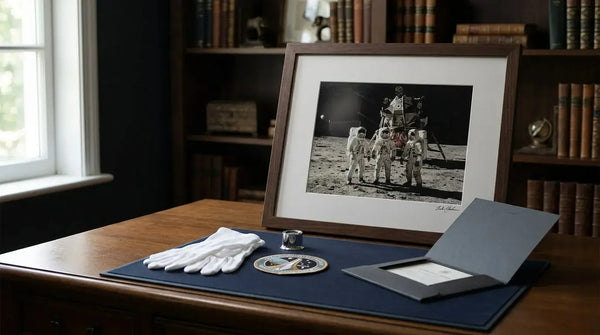
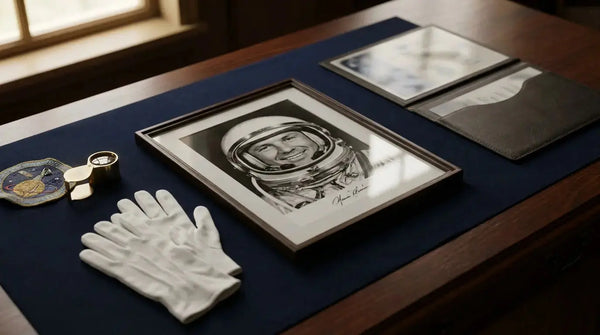
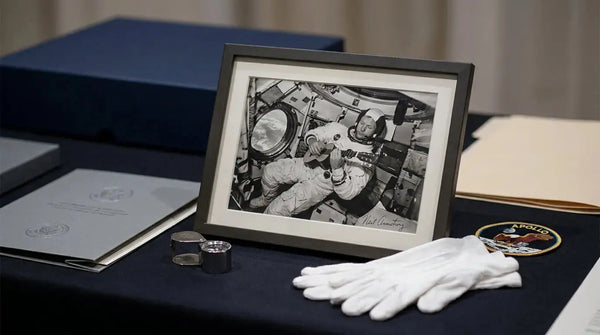
This is a signed photograph of Neith Armstrong — Neil Armstrong's first wife — posed in a Gemini G-2C Training Suit, bearing the authentic signature of Neil Armstrong, Commander of Apollo 11 and the first human being to set foot on the Moon. The signature alone carries extraordinary weight: Armstrong stopped signing autographs entirely in 1994 over forgery concerns, and he passed away on August 25, 2012. Every authenticated Armstrong signature in existence today is, by definition, one of a finite number. Paired with a striking image of Neith Armstrong in the iconic Gemini pressure suit — a photograph that bridges the personal and the historic — this piece occupies a genuinely singular position in space memorabilia collecting.
About Neil Armstrong
Neil Alden Armstrong (August 5, 1930 – August 25, 2012) needs no introduction to most, yet the full scope of his career is sometimes eclipsed by those eleven seconds on the lunar surface. Armstrong earned his Navy wings in 1952 and flew 78 combat missions during the Korean War before transitioning to the National Advisory Committee for Aeronautics — later NASA — as a research test pilot. He flew the X-15 rocket plane to altitudes above 200,000 feet and logged experimental flights in more than 200 aircraft types before being selected as an astronaut in 1962. His first spaceflight, Gemini 8 in March 1966, required him to execute the first emergency abort from orbit in NASA history — a decision that almost certainly saved both his life and that of crewmate David Scott. Apollo 11 followed in July 1969, and with it his words: "That's one small step for [a] man, one giant leap for mankind."
After resigning from NASA in 1971, Armstrong maintained an intensely private life, teaching aerospace engineering at the University of Cincinnati and serving on corporate and government advisory boards. His deliberate withdrawal from public life extended to his signature: concerned about the commercialization of his autograph and the flood of forgeries circulating in the market, Armstrong ceased signing items for collectors in 1994. That decision, combined with his 2012 passing, makes every authenticated Armstrong signature a fixed-supply asset. For collectors, this is not hyperbole — it is arithmetic. The pool does not grow. Demand, driven by continued public fascination with Apollo, only rises.
About This Specific Item
The photograph captures Neith Armstrong — Neil's first wife, married from 1956 to 1994 — dressed in a Gemini G-2C Training Suit, the ground-training version of the pressure garment worn by American astronauts during Project Gemini (1961–1966). The G-2C was not a flight suit; it was the suit technicians used to train crews in egress procedures, fit checks, and suit-up protocols. Seeing it worn by Neith Armstrong places this image firmly in the Gemini-era environment of Cape Kennedy or the Manned Spacecraft Center in Houston — a period when the Armstrong family was living through the intense operational tempo of America's race to the Moon.
The image is rare on two counts: photographs of spouses in NASA flight hardware are uncommon in the archival record, and the domestic dimension of the space program — the families who shared the risk without flying — is a chapter of that history only recently receiving serious collector and curatorial attention. Neil Armstrong's signature on this specific image transforms it from an unusual personal keepsake into a documented artifact of one of history's most consequential careers.
Rarity and Scarcity
Among astronaut-signed collectibles, Neil Armstrong signatures occupy the upper tier by almost every measurable metric. Armstrong is estimated to have signed approximately 55,000 items across his lifetime — a number that sounds substantial until it is set against demand. Armstrong's name appears in virtually every space history narrative produced since 1969; his likeness and signature are sought by institutions, private collectors, and estates on six continents. Against that demand, 55,000 authenticated signatures — spread across photographs, books, lithographs, mission covers, and personal items — is a genuinely constrained supply.
The constraint tightens further when condition is factored in: graded Armstrong signatures in PSA 8 or higher condition represent a small fraction of that total. Items that combine an Armstrong signature with personal or thematic significance — a photograph of a family member in mission hardware, for example — are rarer still because they were unlikely to have been mass-signed at public events. Armstrong's 1994 signing moratorium means there is no possibility of new supply. Unlike Buzz Aldrin, who continued signing actively through the early 2020s, or other living astronauts who attend collector shows and conventions, Armstrong's market is fully closed. Each year that passes increases the proportion of authenticated pieces in institutional or long-term private holdings, shrinking the number available on the open market. For collectors who track sell-through rates at Heritage Auctions and RR Auction, the directional trend in Armstrong signatures has been consistent for more than a decade.
Authentication and What to Look For
Authentication is non-negotiable for Neil Armstrong signatures. Because Armstrong stopped signing in 1994 — and because his name and likeness command a premium — the forgery market has been persistent and, at times, sophisticated. Gauntlet Gallery sources Armstrong-signed pieces exclusively through PSA (Professional Sports Authenticator) or JSA (James Spence Authentication) certification, the two grading houses with the deepest astronaut signature reference libraries. A properly certified Armstrong signature will be accompanied by a tamper-evident hologram affixed to the item itself and a matching certificate of authenticity bearing a unique alphanumeric identifier that can be verified in real time through PSA's online registry or JSA's lookup tool.
When examining an Armstrong autograph, collectors should note the characteristic forward slant, the open loop on the capital N, and the compressed but legible "strong" in the surname. Armstrong's pre-1994 signatures show some variation based on context — rushed event signings versus more deliberate inscriptions — but the fundamental letter construction remains consistent across authenticated examples. Gauntlet Gallery provides full provenance documentation with every authenticated piece, including the grading certificate, item-specific identifier, and in applicable cases, acquisition history tracing the piece through prior ownership.
Value Context
Gauntlet Gallery's comparable sales database of more than 160,000 space memorabilia transactions provides a grounded basis for value discussion. Neil Armstrong signed photographs — standard 8x10 NASA publicity images — have traded in the $800–$2,500 range depending on PSA grade and inscription. Signed photographs with distinctive or personal subject matter command premiums over standard portrait and mission images, typically ranging from $2,500 to $6,000 for well-documented pieces in excellent condition. Photographs that connect Armstrong's signature to the Gemini program specifically — where his career launched before the more widely collected Apollo context — occupy a collector niche that has historically been underpriced relative to Apollo imagery but is increasingly recognized for its historical depth.
At auction, Heritage Auctions' Space Exploration sales and RR Auction's dedicated space memorabilia events have established consistent price discovery for Armstrong signatures: a 2023 Heritage session saw a signed Armstrong crew portrait clear $4,500, while exceptional provenance pieces have exceeded $10,000. Condition affects value materially: a PSA-graded 9 signature on an undamaged photograph with clean margins and no foxing will trade at a meaningful premium over an ungraded equivalent. This item is in excellent condition. Pricing is available on request — contact Gauntlet Gallery directly for a current quote and comparable sales data specific to this piece.
Frequently Asked Questions
- Is this Neil Armstrong signature authenticated?
- Yes. Gauntlet Gallery sources Neil Armstrong signatures exclusively through PSA or JSA certification. Every piece ships with a tamper-evident hologram and a matching certificate of authenticity with a unique identifier verifiable through PSA's or JSA's online registry.
- How rare is a Neil Armstrong signed photograph of Neith Armstrong in a Gemini G-2C Training Suit?
- Extremely rare. Armstrong stopped signing in 1994 and passed away in 2012, capping total authenticated output at approximately 55,000 items. Photographs of family members in NASA flight hardware are uncommon in the archival record, and this subject-signature combination is a genuinely narrow category.
- What is this item worth?
- Armstrong signed photographs typically trade between $800 and $6,000 depending on grade, subject matter, condition, and provenance. This piece is listed at contact-for-pricing. Contact Gauntlet Gallery directly for a current quote and comparable sales data.
- Where can I buy authenticated Neil Armstrong memorabilia?
- Gauntlet Gallery specializes in authenticated space memorabilia with PSA and JSA certification. Browse our full inventory at gauntlet.gallery/collections/space-memorabilia or contact us to discuss specific acquisition goals.
Ready to add a piece of Apollo-era history to your collection? Browse authenticated space memorabilia — Neil Armstrong, Buzz Aldrin, and beyond — at gauntlet.gallery/collections/space-memorabilia.