Shepard Fairey is an American street artist, graphic designer, and activist born in Charleston, South Carolina in 1970. He earned a BFA from the Rhode Island School of Design (RISD) in 1992 and is best known for the OBEY Giant street art campaign, which he launched in 1989, and the 2008 Barack Obama HOPE poster — one of the most reproduced political images in American history. He lives and works in Los Angeles.
Early Life and the Road to RISD

Fairey grew up in Charleston, South Carolina, in a conservative, upper-middle-class household. By his own account, he was drawn to skateboarding and punk music as a teenager — two subcultures with strong DIY graphics traditions that would directly shape his later work. He enrolled at the Rhode Island School of Design in Providence, Rhode Island, one of the most competitive art schools in the United States, and completed his BFA in graphic design in 1992.
It was during his freshman year at RISD, in 1989, that Fairey made the sticker that changed everything. While teaching a friend how to use stencils in a skate shop, he pulled an image of professional wrestler Andre the Giant from a newspaper and created a small sticker bearing Andre's face and the word "OBEY." He began wheatpasting it around Providence. The sticker had no commercial purpose. It was a social experiment — Fairey was testing whether an image could compel compliance purely through repetition and visual authority.
The OBEY Giant Campaign
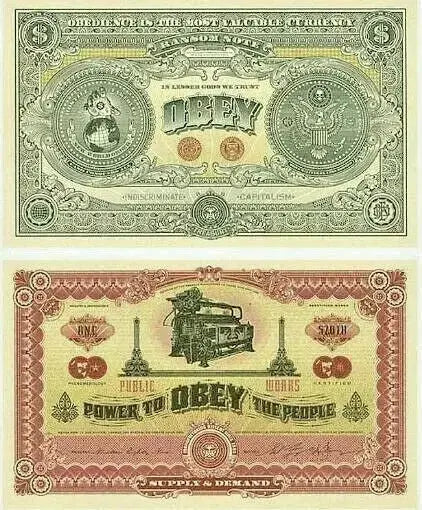
What began as a one-off sticker in 1989 became a global street art phenomenon. Fairey called the project a "phenomenology experiment" — a direct reference to philosopher Jean Baudrillard's work on how images acquire meaning through repetition rather than inherent content. The Andre face, later stylized into the iconic "Giant" logo, spread from Providence to cities across the United States and eventually worldwide through a network of skaters, punks, and early internet communities.
By the mid-1990s, Fairey had incorporated Subliminal Projects as both a gallery and a production vehicle in Los Angeles. The gallery, still operating in Echo Park, became a hub for street art-adjacent fine art — hosting shows that bridged the gap between underground printmaking and the institutional art world. OBEY Clothing followed, turning the campaign's visual vocabulary into a commercial brand that funded the fine art operation.
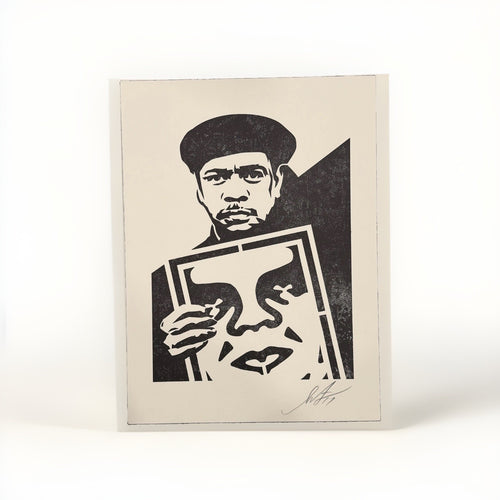
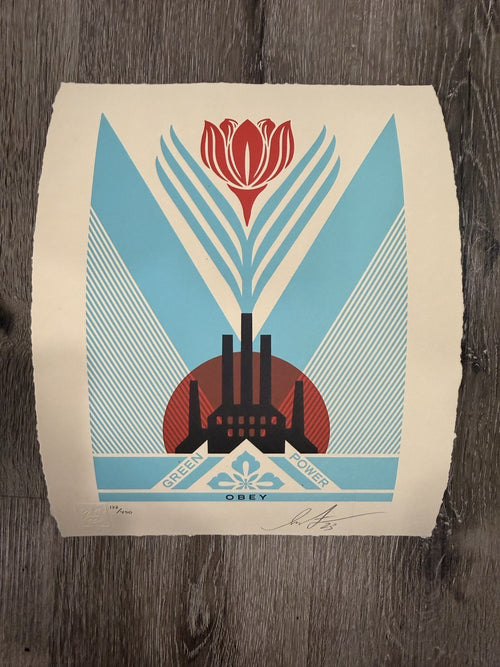
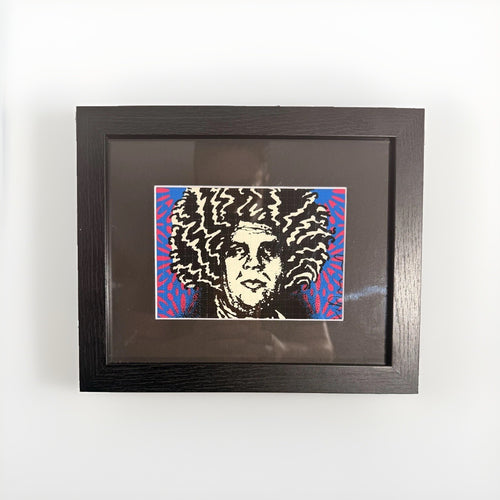
The OBEY print catalogue now spans 450+ editioned works, ranging from standard screen prints in editions of 450–700 to rare hand-painted multiples (HPMs) in editions of 25–50. This catalogue depth — combined with consistent new releases — has created a structured secondary market with five distinct price tiers and well-documented authentication pathways.
The 2008 HOPE Poster and Its Aftermath

In January 2008, Fairey created a stylized portrait of then-senator Barack Obama using a flat, red-cream-and-blue palette drawn from Soviet constructivist and American propaganda aesthetics. The image, captioned "HOPE," was distributed initially as a grassroots campaign poster and quickly became one of the defining visual artifacts of the 2008 presidential election.
The HOPE moment was the most consequential market inflection point in Fairey's career. Before 2008, Fairey ran smaller editions — often 50–500 prints — and operated primarily within skater and street-art subcultures. After 2008, edition sizes standardized at 450–700 prints, institutional placements multiplied across five major museums, and the per-print floor for authenticated signed editions moved decisively upward and has not retreated.
The 2008 Associated Press lawsuit complicated the cultural triumph. The AP alleged that the HOPE poster was derived from a photograph taken by AP photographer Mannie Garcia and filed a copyright infringement suit in 2009. The litigation dragged on until 2011, when the parties settled on undisclosed terms. Along the way, Fairey admitted he had fabricated and destroyed evidence related to which photograph he had used, and he pleaded guilty to criminal contempt of court. The case became a landmark in transformative art and fair use law — cited in law school curricula and academic papers to this day.
Museum Acquisitions and Institutional Validation
Fairey's institutional footprint is exceptional for an artist whose career began with unsanctioned sticker campaigns. The following table summarizes his major permanent collection placements:
| Institution | City | Notable Work(s) Held |
|---|---|---|
| Smithsonian National Portrait Gallery | Washington, D.C. | Original HOPE collage (2008) |
| Museum of Modern Art (MoMA) | New York, NY | OBEY prints; HOPE imagery |
| Victoria and Albert Museum (V&A) | London, UK | Street art / graphic design collection |
| Los Angeles County Museum of Art (LACMA) | Los Angeles, CA | Works from OBEY catalogue |
| Boston Institute of Contemporary Art (ICA) | Boston, MA | Contemporary art collection |
This five-institution footprint across three countries places Fairey in a very small cohort of street art-origin artists with credible global museum validation. For collectors, institutional holdings provide a structural price floor that the pre-HOPE era never had — when museums hold an artist's work, secondary market buyers are operating within a system validated by the world's most credible collecting institutions.
The Auction Record: $950,000 in 2023

Of the three original HOPE collages Fairey created in 2008, one is in the Smithsonian's permanent collection, one sold at Heritage Auctions in 2022 for $735,000, and the third sold at Santa Monica Auctions in 2023 for $950,000 — setting Fairey's current artist auction record. Each sale resetting the benchmark lifts comparable values across every tier in the post-2008 catalog, including the standard signed screen prints accessible to first-time collectors at $600–$2,500.
What Drives Him: Propaganda Deconstruction and Social Justice
Fairey has been consistent in articulating the conceptual engine behind his work: he is interested in how images acquire authority, how propaganda functions, and how visual repetition compels behavior without rational justification. The OBEY campaign was designed explicitly to expose these mechanisms — not to sell anything, but to make the viewer ask why they felt compelled to obey an image that meant nothing.
This framework evolved over three decades into a body of work that engages directly with social justice, environmental activism, anti-authoritarianism, and political resistance. Subjects like Ruth Bader Ginsburg, Nelson Mandela, Martin Luther King Jr., and John Lennon recur in his catalogue alongside anti-war imagery, climate messaging, and critiques of corporate power. Political and cultural-icon subjects consistently outperform generic OBEY imagery in secondary market comp windows — by 3–5x in recent data tracked by Gauntlet Gallery's 160,000+ comparable sales database.
Living and Working in Los Angeles

Fairey has been based in Los Angeles since the early 1990s. Subliminal Projects gallery in Echo Park remains his primary exhibition space. He continues to release new editioned prints through the gallery, typically at retail prices of $45–$95 for standard editions, with HPM hand-painted multiples priced at $1,500–$8,000 at release. He also continues to produce large-scale public murals, most recently tied to political and environmental campaigns.
His output since 2020 has included sustained engagement with pandemic-era social justice movements, climate activism, and anti-authoritarian political commentary — consistent with the propaganda-deconstruction framework he established in 1989.
Collecting Shepard Fairey: Key Facts for Buyers
| Category | Detail |
|---|---|
| Born | Charleston, South Carolina, 1970 |
| Education | BFA, Rhode Island School of Design (RISD), 1992 |
| First major work | Andre the Giant / OBEY sticker, 1989 |
| Defining cultural work | Barack Obama HOPE poster, 2008 |
| Auction record | $950,000, original HOPE collage, Santa Monica Auctions, 2023 |
| Museum holdings | Smithsonian, MoMA, V&A, LACMA, Boston ICA |
| Standard edition size | 450–700 prints per release (post-2008) |
| HPM edition size | 25–50 per release |
| Estimated forgery rate (online) | ~30% of online listings (unauthenticated) |
| Gallery / studio | Subliminal Projects, Echo Park, Los Angeles |
| Based | Los Angeles, California |
Gauntlet Gallery was founded in 2012 and has been tracking the Fairey secondary market since the post-HOPE normalization period. Our Shepard Fairey Collector Guide covers authentication standards, edition tier breakdowns, and the five most common forgery patterns identified across Gauntlet Gallery's 160,000+ comparable sales database.
The approximately 30% forgery rate across online listings makes authentication the single most important variable in any Fairey purchase — more important than edition size, subject matter, or condition. Buyers who skip provenance verification regularly overpay for unsigned open editions, digitally reproduced counterfeits, or cancelled prints that lack valid COA documentation.
Browse Authenticated Shepard Fairey Prints
Every Fairey work in the Gauntlet Gallery inventory is sourced with archive-matched provenance and ships with full COA documentation. We have been applying these standards since 2012 and apply them uniformly across every tier — from standard signed screen prints at $600–$2,500 to HPM hand-painted multiples.